Introduction
AI Last-Mile Delivery Optimization platforms use artificial intelligence, machine learning, route optimization, predictive analytics, real-time operational data, and business rules to improve the final stage of delivering products from a warehouse, store, distribution center, or fulfillment location to the customer.
Last-mile delivery is often one of the most operationally challenging parts of logistics. A delivery operation may need to coordinate hundreds or thousands of orders, multiple vehicles, driver availability, delivery time windows, traffic conditions, vehicle capacity, customer preferences, and unexpected events. AI-powered optimization helps businesses make these decisions faster and with greater consistency.
Best for: E-commerce companies, retailers, grocery businesses, courier services, distributors, manufacturers, third-party logistics providers, restaurants, field-service organizations, and enterprises operating multi-vehicle delivery networks.
Not ideal for: Individuals, very small businesses with only occasional deliveries, or companies handling a small number of predictable shipments. Basic navigation or manual route planning may be sufficient when delivery complexity is low.
What’s Changed in AI Last-Mile Delivery Optimization
- Dynamic routing is becoming standard: Delivery plans can be adjusted as traffic, order volumes, cancellations, and driver availability change.
- AI is being combined with optimization algorithms: Machine learning can predict delivery conditions while mathematical optimization determines feasible vehicle and stop assignments.
- Predictive ETAs are increasingly important: Customers expect accurate arrival windows rather than broad delivery estimates.
- Real-time dispatch is becoming more intelligent: Systems can identify exceptions and recommend route changes without requiring every decision to be made manually.
- AI agents are emerging in logistics workflows: Agentic systems can potentially monitor deliveries, identify exceptions, summarize operational problems, and trigger approved workflows.
- Delivery-slot optimization is gaining importance: Platforms can help businesses balance customer convenience with fleet capacity.
- Failed-delivery prediction is becoming a useful optimization layer: Historical delivery outcomes can help identify addresses or situations likely to create problems.
- Electric vehicles require new optimization constraints: Battery range, charging time, charging locations, payload, and route length can affect delivery planning.
- Multimodal operational data is expanding: Order systems, GPS, telematics, maps, traffic, customer data, weather, and warehouse information can feed optimization workflows.
- Human oversight remains important: Dispatchers should be able to review and override automated decisions.
- Operational observability is becoming essential: Teams need visibility into route changes, ETA changes, delivery exceptions, and system performance.
- Privacy and governance matter more: Customer addresses, driver locations, vehicle information, and delivery history can represent sensitive operational data.
Quick Buyer Checklist
When evaluating AI last-mile delivery optimization platforms, look for:
- Multi-vehicle optimization.
- Multi-stop route planning.
- Dynamic route replanning.
- Real-time traffic integration.
- Predictive ETAs.
- Delivery time windows.
- Delivery-slot optimization.
- Vehicle-capacity constraints.
- Driver availability.
- Driver working-hour constraints.
- Pickup and delivery support.
- Priority-order handling.
- Same-day delivery support.
- Failed-delivery management.
- Customer notifications.
- Proof-of-delivery workflows.
- Real-time GPS tracking.
- Fleet utilization analytics.
- Driver workload balancing.
- Exception management.
- API access.
- SDK support.
- ERP integration.
- TMS integration.
- WMS integration.
- E-commerce integrations.
- Telematics integrations.
- Mobile driver applications.
- Data privacy controls.
- Role-based access.
- Auditability.
- Cost monitoring.
- Usage controls.
- EV routing support.
- Charging constraints.
- Vendor lock-in considerations.
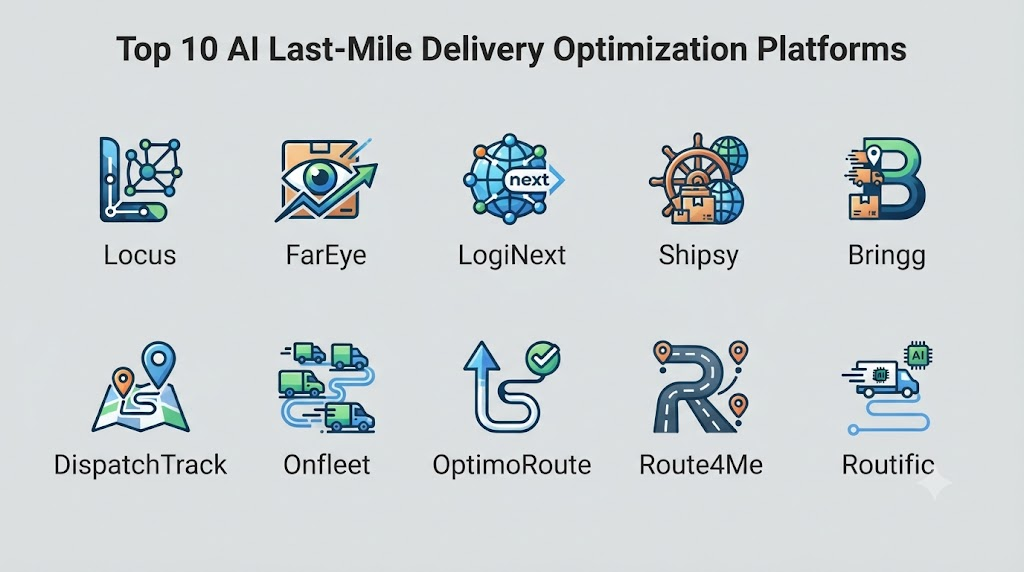
Top 10 AI Last-Mile Delivery Optimization Platforms
1. Google Maps Platform Route Optimization API
One-line verdict: Best for developers building customized last-mile delivery, dispatch, routing, and logistics applications.
Short description:
Google Maps Platform provides routing and route-optimization capabilities that developers can incorporate into custom delivery applications. It is particularly relevant when organizations want to build their own delivery experience while using established mapping and routing infrastructure.
Standout Capabilities
- Multi-vehicle route optimization.
- Multi-stop routing.
- Delivery and shipment constraints.
- Route planning.
- Travel-time information.
- Geographic routing.
- Developer APIs.
- Custom logistics applications.
AI-Specific Depth
- Model support: Google-managed routing and optimization technologies; specific underlying models are not publicly stated.
- RAG / knowledge integration: N/A for core routing.
- Evaluation: Organizations should evaluate route quality using historical delivery data and operational KPIs.
- Guardrails: API authentication, permissions, quotas, and application-level controls.
- Observability: API and application monitoring can be implemented; internal optimization tracing varies.
Pros
- Strong developer ecosystem.
- Suitable for custom delivery applications.
- Useful for complex routing requirements.
Cons
- Requires development expertise.
- Usage costs can increase with volume.
- Surrounding dispatch and delivery workflows may need to be built separately.
Security & Compliance
Security capabilities depend on the services and cloud architecture being used. Specific compliance requirements should be verified for the intended deployment.
Deployment & Platforms
- Cloud.
- APIs.
- Web applications.
- Mobile applications through integration.
- Backend logistics systems.
Integrations & Ecosystem
Google Maps Platform can be integrated into custom logistics applications.
- E-commerce systems.
- ERP.
- TMS.
- WMS.
- Fleet platforms.
- Mobile applications.
- Custom APIs.
Pricing Model
Usage-based pricing; exact costs depend on the services and consumption volume.
Best-Fit Scenarios
- Custom delivery platforms.
- Large-scale e-commerce routing.
- Developer-built dispatch systems.
2. Onfleet
One-line verdict: Best for businesses that need last-mile delivery management combined with dispatch, tracking, driver workflows, and optimization.
Short description:
Onfleet provides technology for managing last-mile delivery operations. Its platform combines dispatch, driver management, tracking, delivery communication, and operational visibility.
Standout Capabilities
- Delivery management.
- Dispatch.
- Route planning.
- Driver tracking.
- Delivery notifications.
- Proof of delivery.
- Customer communication.
- Delivery analytics.
AI-Specific Depth
- Model support: Proprietary optimization and automation capabilities; exact underlying AI architecture is not publicly stated.
- RAG / knowledge integration: N/A for core delivery optimization.
- Evaluation: Delivery and route performance can be evaluated against operational KPIs.
- Guardrails: Workflow permissions and operational controls vary.
- Observability: Delivery tracking and operational analytics.
Pros
- Strong last-mile focus.
- Good combination of routing and delivery management.
- Useful customer communication capabilities.
Cons
- More delivery-focused than broad transportation optimization.
- Complex enterprise routing may require additional systems.
- Advanced capabilities vary by configuration.
Security & Compliance
Security capabilities vary by service and plan. Specific certifications should be verified directly when required.
Deployment & Platforms
- Cloud.
- Web.
- Mobile driver applications.
- APIs.
Integrations & Ecosystem
- E-commerce.
- CRM.
- ERP.
- Customer communication.
- Delivery systems.
- APIs.
Pricing Model
Subscription and usage structures vary.
Best-Fit Scenarios
- E-commerce delivery.
- Local delivery operations.
- Last-mile fleet management.
3. OptimoRoute
One-line verdict: Best for delivery and field-service companies looking for practical route optimization and scheduling.
Short description:
OptimoRoute focuses on route planning and scheduling for delivery and field-service operations. It can help organizations coordinate vehicles, stops, schedules, and delivery requirements.
Standout Capabilities
- Route optimization.
- Multi-stop delivery planning.
- Driver scheduling.
- Delivery time windows.
- Workload balancing.
- Route visualization.
- Real-time updates.
- Delivery tracking.
AI-Specific Depth
- Model support: Proprietary optimization technology; exact model architecture is not publicly stated.
- RAG / knowledge integration: N/A.
- Evaluation: Route efficiency and delivery performance can be measured using operational KPIs.
- Guardrails: Business rules and routing constraints.
- Observability: Route and delivery monitoring.
Pros
- Practical delivery workflows.
- Suitable for field-service operations.
- Supports multiple routing constraints.
Cons
- May not cover highly specialized enterprise transportation requirements.
- Advanced customization varies.
- Integration requirements should be evaluated before deployment.
Security & Compliance
Security capabilities vary by deployment. Specific certifications should be verified where required.
Deployment & Platforms
- Cloud.
- Web.
- Mobile driver workflows.
- Enterprise integrations.
Integrations & Ecosystem
- ERP.
- CRM.
- Delivery systems.
- Fleet systems.
- Telematics.
- APIs.
Pricing Model
Subscription-style pricing varies by plan and configuration.
Best-Fit Scenarios
- Local delivery.
- Field service.
- Small and mid-sized delivery fleets.
4. Routific
One-line verdict: Best for small and mid-sized delivery operations seeking straightforward route optimization and driver management.
Short description:
Routific provides route planning and optimization for delivery businesses. Its focus is on helping teams create efficient routes while coordinating multiple drivers and stops.
Standout Capabilities
- Multi-stop routing.
- Route optimization.
- Driver management.
- Delivery scheduling.
- Route visualization.
- Delivery tracking.
- Customer notifications.
- Operational reporting.
AI-Specific Depth
- Model support: Proprietary optimization technology; exact AI architecture is not publicly stated.
- RAG / knowledge integration: N/A.
- Evaluation: Route performance can be evaluated using delivery and operational KPIs.
- Guardrails: Routing constraints and business rules.
- Observability: Route and delivery tracking.
Pros
- Accessible for smaller operations.
- Straightforward workflow.
- Useful for multi-stop delivery.
Cons
- May not satisfy highly complex enterprise routing requirements.
- Advanced customization varies.
- Enterprise governance should be evaluated separately.
Security & Compliance
Security controls vary by service. Specific certifications should be independently verified.
Deployment & Platforms
- Cloud.
- Web.
- Mobile driver workflows.
- API integrations may vary.
Integrations & Ecosystem
- E-commerce.
- ERP.
- Delivery management.
- Customer communication.
- Fleet systems.
- APIs.
Pricing Model
Subscription pricing varies according to plan and usage.
Best-Fit Scenarios
- Local delivery companies.
- SMB fleets.
- Retail delivery.
5. HERE Routing
One-line verdict: Best for businesses requiring advanced mapping, traffic information, location intelligence, and routing capabilities.
Short description:
HERE provides mapping and location technologies that can support delivery and transportation applications. Its routing capabilities can serve as a foundation for custom last-mile delivery systems.
Standout Capabilities
- Routing.
- Traffic information.
- Location intelligence.
- Fleet optimization.
- Geographic data.
- Developer APIs.
- Logistics applications.
- Enterprise location services.
AI-Specific Depth
- Model support: Proprietary routing and location technologies; exact models are not publicly stated.
- RAG / knowledge integration: N/A for traditional routing.
- Evaluation: Customers can benchmark routes against operational data.
- Guardrails: API and enterprise controls vary.
- Observability: Application-level monitoring can be implemented.
Pros
- Strong mapping ecosystem.
- Useful for custom applications.
- Suitable for location-intensive logistics.
Cons
- Development work may be required.
- Complete delivery workflows may need additional systems.
- Pricing varies by service.
Security & Compliance
Security and compliance capabilities vary by product and deployment.
Deployment & Platforms
- Cloud.
- APIs.
- Web.
- Mobile integrations.
- Enterprise applications.
Integrations & Ecosystem
- TMS.
- ERP.
- WMS.
- Fleet systems.
- Telematics.
- Mobile applications.
- APIs.
Pricing Model
Usage-based and enterprise pricing varies.
Best-Fit Scenarios
- Global delivery platforms.
- Custom logistics applications.
- Enterprise routing systems.
6. Descartes Route Planner
One-line verdict: Best for delivery organizations wanting routing integrated into broader transportation and logistics management.
Short description:
Descartes provides logistics technology covering transportation planning, delivery operations, route planning, and fleet-related workflows. Its broader ecosystem can be useful for businesses connecting last-mile optimization with supply-chain processes.
Standout Capabilities
- Route planning.
- Delivery scheduling.
- Fleet optimization.
- Dispatch.
- Delivery management.
- Transportation integration.
- Logistics analytics.
- Operational workflows.
AI-Specific Depth
- Model support: Proprietary optimization and analytics; exact model architecture varies.
- RAG / knowledge integration: N/A for core route optimization.
- Evaluation: Planned routes can be compared with actual delivery results.
- Guardrails: Operational rules and permissions vary.
- Observability: Route and delivery monitoring varies by configuration.
Pros
- Broad logistics ecosystem.
- Strong enterprise orientation.
- Useful for connecting routing to transportation processes.
Cons
- Larger platform scope can increase implementation complexity.
- May be more than smaller delivery operations require.
- Exact functionality varies by solution.
Security & Compliance
Security capabilities vary by product and deployment.
Deployment & Platforms
- Cloud.
- Enterprise.
- Web.
- Mobile delivery workflows depending on solution.
Integrations & Ecosystem
- ERP.
- TMS.
- WMS.
- Fleet management.
- Telematics.
- Delivery platforms.
- APIs.
Pricing Model
Enterprise/custom pricing varies.
Best-Fit Scenarios
- Enterprise delivery operations.
- Transportation companies.
- Multi-location logistics.
7. PTV Route Optimiser
One-line verdict: Best for complex delivery networks requiring advanced transportation planning, routing, scheduling, and constraint management.
Short description:
PTV provides transportation and route optimization technologies designed for organizations managing complex vehicle-routing and scheduling requirements.
Standout Capabilities
- Vehicle-route optimization.
- Multi-stop planning.
- Scheduling.
- Fleet planning.
- Delivery optimization.
- Constraint management.
- Scenario analysis.
- Transportation analytics.
AI-Specific Depth
- Model support: Optimization and analytics technologies; exact model architecture varies.
- RAG / knowledge integration: N/A.
- Evaluation: Route quality can be measured against business objectives.
- Guardrails: Business constraints provide operational controls.
- Observability: Route and transportation analytics vary by deployment.
Pros
- Strong transportation-planning capabilities.
- Suitable for complex routing.
- Supports scenario-based planning.
Cons
- Can require specialist implementation.
- May be excessive for simple delivery fleets.
- Exact capabilities depend on configuration.
Security & Compliance
Security and enterprise controls vary by deployment.
Deployment & Platforms
- Cloud.
- Enterprise.
- Integration/API options vary.
Integrations & Ecosystem
- TMS.
- ERP.
- Fleet systems.
- Telematics.
- Logistics platforms.
- APIs.
Pricing Model
Enterprise/custom pricing; exact pricing is Not publicly stated.
Best-Fit Scenarios
- Large delivery networks.
- Complex transportation planning.
- Multi-depot logistics.
8. Samsara
One-line verdict: Best for delivery fleets combining route intelligence with real-time vehicle telematics and operational visibility.
Short description:
Samsara provides connected-operations technology covering vehicle telematics, GPS tracking, fleet management, driver information, and operational analytics. Its value in last-mile delivery comes from combining vehicle data with broader fleet workflows.
Standout Capabilities
- GPS vehicle tracking.
- Fleet telematics.
- Driver information.
- Vehicle monitoring.
- Fleet analytics.
- Asset tracking.
- Operational dashboards.
- Real-time visibility.
AI-Specific Depth
- Model support: AI and machine-learning capabilities vary across the platform.
- RAG / knowledge integration: N/A for traditional routing.
- Evaluation: Fleet KPIs can be measured before and after implementation.
- Guardrails: Administrative and role-based controls vary.
- Observability: Strong operational telemetry and fleet monitoring.
Pros
- Strong vehicle-data ecosystem.
- Useful telematics integration.
- Excellent operational visibility.
Cons
- Not exclusively a last-mile route optimization platform.
- Hardware considerations may apply.
- Advanced routing may require complementary technology.
Security & Compliance
Security capabilities vary by service and deployment. Specific certifications should be independently verified.
Deployment & Platforms
- Cloud.
- Web.
- Mobile.
- Connected vehicle hardware.
Integrations & Ecosystem
- Telematics.
- Fleet systems.
- TMS.
- ERP.
- APIs.
- Vehicle data.
Pricing Model
Subscription and hardware/service pricing varies.
Best-Fit Scenarios
- Delivery fleets.
- Telematics-driven operations.
- Fleet visibility.
9. ArcGIS Network Analyst
One-line verdict: Best for organizations where last-mile delivery optimization depends heavily on geographic and spatial intelligence.
Short description:
ArcGIS Network Analyst provides network analysis and vehicle-routing capabilities within a broader GIS environment. It is particularly useful when delivery planning must be combined with geographic analysis.
Standout Capabilities
- Vehicle routing.
- Network analysis.
- Service-area analysis.
- Spatial optimization.
- Geographic visualization.
- Location analysis.
- GIS integration.
- Enterprise mapping.
AI-Specific Depth
- Model support: Primarily optimization and GIS analytics; AI functionality varies across the wider ArcGIS ecosystem.
- RAG / knowledge integration: N/A for core routing.
- Evaluation: Route models can be benchmarked using real operational data.
- Guardrails: GIS permissions and enterprise controls vary.
- Observability: GIS and operational analytics vary.
Pros
- Powerful geographic capabilities.
- Strong for spatially complex operations.
- Integrates with enterprise GIS environments.
Cons
- Requires GIS expertise for advanced use.
- Can be more complex than delivery-specific platforms.
- Implementation may require specialized resources.
Security & Compliance
Enterprise GIS security capabilities vary by deployment and applicable products.
Deployment & Platforms
- Cloud.
- Enterprise.
- Desktop GIS.
- Web.
- APIs.
Integrations & Ecosystem
- GIS.
- ERP.
- TMS.
- WMS.
- Spatial databases.
- Asset-management systems.
- APIs.
Pricing Model
License/subscription and enterprise pricing varies.
Best-Fit Scenarios
- GIS-heavy delivery operations.
- Public-sector logistics.
- Geographic network planning.
10. OR-Tools
One-line verdict: Best for developers building highly customized last-mile delivery optimization engines with direct control over routing logic.
Short description:
OR-Tools is an open-source optimization suite that supports vehicle-routing, scheduling, assignment, and constraint-optimization problems. It is particularly useful when an organization wants to build its own last-mile optimization system.
Standout Capabilities
- Vehicle-routing problems.
- Capacity constraints.
- Time windows.
- Scheduling.
- Assignment optimization.
- Custom objectives.
- Constraint programming.
- Developer integration.
AI-Specific Depth
- Model support: Optimization-focused rather than an AI model platform.
- RAG / knowledge integration: N/A.
- Evaluation: Developers can create custom benchmarks using historical delivery data.
- Guardrails: Explicit optimization constraints can enforce operational rules.
- Observability: Application-level logging and optimization metrics can be built.
Pros
- Open-source.
- Highly customizable.
- Strong for engineering teams.
Cons
- Requires development expertise.
- Surrounding delivery workflows must be built.
- Maintenance becomes the organization’s responsibility.
Security & Compliance
Security depends largely on the organization’s implementation, infrastructure, and operational controls.
Deployment & Platforms
- Self-hosted.
- Cloud.
- Windows.
- macOS.
- Linux.
- Custom applications.
Integrations & Ecosystem
- Python.
- C++.
- Java.
- .NET.
- Databases.
- APIs.
- Custom logistics platforms.
Pricing Model
Open-source; infrastructure, engineering, maintenance, and support costs may still apply.
Best-Fit Scenarios
- Custom delivery optimization.
- Proprietary logistics platforms.
- Advanced engineering teams.
Comparison Table
| Tool Name | Best For | Deployment | Model Flexibility | Strength | Watch-Out | Public Rating |
|---|---|---|---|---|---|---|
| Google Maps Platform Route Optimization API | Custom delivery applications | Cloud | Hosted / API | Developer ecosystem | Requires engineering | N/A |
| Onfleet | Last-mile delivery management | Cloud | Hosted / Varies | Delivery workflows | Complex networks may need more | N/A |
| OptimoRoute | Delivery and field service | Cloud | Hosted / Varies | Practical optimization | Advanced customization varies | N/A |
| Routific | SMB delivery | Cloud | Hosted / Varies | Ease of use | Enterprise depth | N/A |
| HERE Routing | Custom logistics systems | Cloud | Hosted / API | Mapping + routing | Development required | N/A |
| Descartes Route Planner | Enterprise delivery | Cloud / Enterprise | Hosted / Varies | Logistics ecosystem | Implementation complexity | N/A |
| PTV Route Optimiser | Complex transportation | Cloud / Enterprise | Hosted / Varies | Advanced optimization | Specialist implementation | N/A |
| Samsara | Fleet-driven delivery | Cloud | Hosted / Varies | Telematics | Not purely routing | N/A |
| ArcGIS Network Analyst | GIS-heavy delivery | Cloud / Enterprise / Desktop | Algorithmic / Varies | Spatial intelligence | GIS expertise | N/A |
| OR-Tools | Developers | Self-hosted / Cloud | Open-source | Customization | Requires engineering | N/A |
Scoring & Evaluation
The following scoring is a comparative editorial framework rather than an official vendor ranking. Scores should be validated with a pilot using the organization’s own delivery data.
The weighting prioritizes core optimization, integration, operational reliability, cost, and security.
- Core features – 20%
- AI reliability & evaluation – 15%
- Guardrails & safety – 10%
- Integrations & ecosystem – 15%
- Ease of use – 10%
- Performance & cost controls – 15%
- Security & admin – 10%
- Support & community – 5%
| Tool | Core | Reliability/Eval | Guardrails | Integrations | Ease | Perf/Cost | Security/Admin | Support | Weighted Total |
|---|---|---|---|---|---|---|---|---|---|
| Google Maps Platform Route Optimization API | 10 | 9 | 9 | 10 | 7 | 9 | 9 | 10 | 9.15 |
| Onfleet | 8 | 8 | 8 | 9 | 9 | 8 | 8 | 9 | 8.40 |
| OptimoRoute | 9 | 8 | 8 | 9 | 9 | 9 | 8 | 8 | 8.60 |
| Routific | 8 | 8 | 8 | 8 | 9 | 9 | 8 | 8 | 8.25 |
| HERE Routing | 10 | 9 | 9 | 10 | 7 | 9 | 9 | 9 | 9.00 |
| Descartes Route Planner | 9 | 9 | 9 | 10 | 8 | 8 | 9 | 9 | 8.95 |
| PTV Route Optimiser | 10 | 9 | 9 | 9 | 7 | 9 | 9 | 9 | 8.90 |
| Samsara | 9 | 9 | 9 | 10 | 8 | 8 | 9 | 10 | 9.00 |
| ArcGIS Network Analyst | 10 | 9 | 9 | 10 | 6 | 8 | 10 | 10 | 9.00 |
| OR-Tools | 10 | 9 | 8 | 9 | 5 | 10 | 7 | 10 | 8.65 |
Top 3 for Enterprise
- Google Maps Platform Route Optimization API — Strong for custom, large-scale delivery applications.
- HERE Routing — Well suited to location-intensive logistics architectures.
- Descartes Route Planner — Strong consideration for broader transportation and delivery operations.
Top 3 for SMB
- OptimoRoute — Practical for delivery and field-service operations.
- Routific — Suitable for smaller delivery fleets.
- Onfleet — Strong for last-mile delivery management.
Top 3 for Developers
- Google Maps Platform Route Optimization API — Strong API-oriented architecture.
- OR-Tools — Maximum customization and optimization control.
- HERE Routing — Useful for custom location-aware applications.
Which AI Last-Mile Delivery Optimization Platform Is Right for You?
Solo / Freelancer
Most individuals do not need specialized last-mile optimization software.
Basic navigation is generally enough when:
- There are very few deliveries.
- There is one driver.
- Delivery schedules are flexible.
- Routes can be planned manually.
- There are no significant capacity constraints.
Developers creating delivery applications may instead benefit from APIs or open-source optimization libraries.
SMB
SMBs should prioritize simplicity.
Look for:
- Multi-stop routing.
- Driver management.
- Customer notifications.
- Delivery windows.
- Route tracking.
- Mobile workflows.
- Simple integrations.
- Predictable costs.
A lightweight platform can deliver more value than a complex enterprise transportation suite.
Mid-Market
Mid-market organizations should focus on operational integration.
Evaluate:
- Order volumes.
- Number of vehicles.
- Delivery zones.
- Driver availability.
- Customer time windows.
- Vehicle capacity.
- Traffic.
- Failed deliveries.
- ERP integration.
- WMS integration.
- TMS integration.
At this stage, route optimization should connect directly to order and dispatch workflows.
Enterprise
Enterprise buyers should consider:
- Multi-depot optimization.
- Large-scale route calculations.
- Real-time replanning.
- Dynamic dispatch.
- TMS integration.
- ERP integration.
- WMS integration.
- Telematics.
- Predictive ETAs.
- Delivery-slot optimization.
- Fleet utilization.
- Governance.
- Role-based access.
- Auditability.
- Data residency.
- API scalability.
Large organizations should test the platform against real peak-period delivery volumes.
Regulated Industries
Organizations handling sensitive deliveries should evaluate:
- Customer location privacy.
- Driver-location privacy.
- Data residency.
- Data retention.
- Encryption.
- Access management.
- Audit logs.
- API authentication.
- Vendor risk.
- Incident response.
Healthcare, pharmaceutical, public-sector, and other regulated logistics environments may require additional governance.
Budget vs Premium
A budget-oriented system may be appropriate when:
- Fleet size is small.
- Routes are predictable.
- Delivery volumes are moderate.
- Customer requirements are simple.
Premium solutions become more valuable when:
- Delivery volumes are high.
- Customer time windows are strict.
- Vehicles operate across multiple regions.
- Traffic changes frequently.
- Driver utilization matters.
- Failed deliveries are expensive.
- Multiple systems must be integrated.
Build vs Buy
Build when:
- Last-mile optimization is strategically important.
- Routing logic is unique.
- You have a strong engineering team.
- You require deep integration with proprietary systems.
- You need complete control over optimization objectives.
Buy when:
- You need faster implementation.
- Routing is not a competitive differentiator.
- You need established mapping and traffic infrastructure.
- You want ready-made driver workflows.
- You prefer managed infrastructure.
A hybrid approach can also work well: use a routing API or optimization engine while maintaining your own order, customer, business-rule, analytics, and governance layers.
Implementation Playbook: 30 / 60 / 90 Days
First 30 Days: Pilot + Success Metrics
Select one delivery region or fleet.
Collect:
- Historical orders.
- Customer addresses.
- Delivery windows.
- Vehicle information.
- Driver schedules.
- Service times.
- GPS data.
- Traffic information.
- Actual arrival times.
- Failed-delivery records.
Create baseline measurements for:
- Delivery kilometers.
- Driving time.
- On-time delivery.
- Fuel consumption.
- Vehicle utilization.
- Driver overtime.
- Failed deliveries.
- Average delivery duration.
- Customer complaints.
Run historical routes through the shortlisted platform and compare the results with actual operations.
Days 31–60: Security + Evaluation + Rollout
Create an evaluation framework.
Measure:
- Route distance.
- Route duration.
- Delivery-window compliance.
- Vehicle capacity.
- Driver workload.
- ETA accuracy.
- Replanning performance.
- Failed-delivery rate.
Test unusual situations:
- Traffic disruptions.
- Road closures.
- Driver absence.
- Vehicle breakdown.
- Order cancellation.
- New urgent order.
- Incorrect address.
- Delivery-window conflict.
- Vehicle capacity changes.
For AI-enabled workflows, test:
- Incorrect recommendations.
- Unsupported explanations.
- Prompt injection.
- Unauthorized data access.
- Incorrect tool calls.
- Hallucinated delivery information.
Maintain version control for:
- Optimization rules.
- AI prompts.
- Model versions.
- Route policies.
- Business constraints.
Days 61–90: Cost, Latency + Governance
Integrate the optimization system with:
- ERP.
- WMS.
- TMS.
- E-commerce platform.
- Order-management system.
- Fleet platform.
- Telematics.
- Driver applications.
Then optimize:
- Route recalculation frequency.
- API usage.
- Data refresh intervals.
- Compute consumption.
- Replanning thresholds.
- Notification frequency.
Establish governance around:
- Automated dispatch.
- Manual overrides.
- Route changes.
- Customer data.
- Driver location.
- AI recommendations.
- Incident management.
- Model changes.
- Business-rule changes.
Common Mistakes & How to Avoid Them
- Optimizing only for distance: The shortest route may not provide the lowest total operating cost.
- Ignoring delivery windows: Customer promises should be part of route optimization.
- Ignoring service time: The time required at each stop can significantly affect route quality.
- Using poor address data: Incorrect or incomplete addresses can undermine even sophisticated optimization.
- Ignoring vehicle capacity: Route plans must reflect actual vehicle limitations.
- Ignoring driver availability: Driver schedules should be incorporated into planning.
- Treating static routes as permanent: Real-world delivery conditions change throughout the day.
- No ETA evaluation: Measure predicted arrival times against actual arrival times.
- Over-automating dispatch: Human dispatchers should have appropriate override capabilities.
- No historical benchmark: Always compare optimized routes with real historical performance.
- Ignoring failed deliveries: A route is not successful if customers repeatedly miss deliveries.
- Ignoring customer experience: Delivery optimization should balance operational efficiency with customer satisfaction.
- No cost monitoring: API calls, route calculations, and data processing can create unexpected costs.
- Ignoring privacy: Customer and driver location information should be protected.
- Creating vendor lock-in: Maintain control over important operational data and business rules.
FAQs
1. What is AI Last-Mile Delivery Optimization?
AI Last-Mile Delivery Optimization uses AI, machine learning, optimization algorithms, maps, traffic information, and operational data to improve the final stage of product delivery.
2. Why is last-mile delivery optimization important?
The last mile can involve large numbers of stops, strict delivery windows, traffic, driver constraints, and customer expectations. Optimization helps coordinate these variables more efficiently.
3. Can AI optimize multiple delivery vehicles?
Yes. Multi-vehicle routing is a fundamental capability of many delivery optimization systems.
4. Can AI optimize same-day delivery?
Yes. Same-day delivery can be optimized by considering available vehicles, order priorities, delivery windows, driver schedules, and travel times.
5. Can AI change routes during the day?
Many platforms support dynamic or real-time replanning when conditions change.
6. Can AI improve delivery ETAs?
Yes. Predictive ETA systems can use route information, traffic, historical travel times, stop duration, and other data to estimate arrival times.
7. Can last-mile optimization reduce delivery costs?
It can potentially reduce mileage, driving time, overtime, fuel consumption, and inefficient vehicle utilization. Actual savings depend on the operation.
8. Can AI optimize delivery slots?
Some systems can help coordinate delivery windows and fleet capacity. Exact functionality varies by platform.
9. Can these platforms support electric delivery vehicles?
Some platforms support EV-related routing considerations such as range and charging. The depth of EV functionality varies.
10. Can last-mile optimization integrate with an e-commerce platform?
Yes. APIs and connectors can connect route optimization with order-management and e-commerce systems.
11. Can AI replace delivery dispatchers?
Usually, no. AI can automate route planning and recommendations, but human dispatchers remain valuable for exceptions and operational judgment.
12. Can route optimization work with a warehouse management system?
Yes. WMS integration can provide shipment and order information that can be used for delivery planning.
13. What data does an AI delivery optimization platform need?
Typical data includes delivery addresses, orders, time windows, vehicle capacity, driver availability, service times, traffic information, and historical delivery data.
14. Is customer delivery data secure?
Security depends on the platform and implementation. Buyers should evaluate encryption, access control, retention, data residency, and vendor security practices.
15. Can companies use their own AI models?
Some platforms support APIs or custom architectures, but traditional routing platforms generally manage their own optimization technologies. BYO-model capabilities vary.
16. Can businesses self-host last-mile optimization software?
Some open-source and developer-oriented technologies can be self-hosted. Many commercial platforms are cloud-based.
17. What KPIs should companies track?
Important metrics include cost per delivery, kilometers per delivery, on-time delivery, failed deliveries, vehicle utilization, driver overtime, ETA accuracy, and customer satisfaction.
18. What is the difference between route optimization and delivery optimization?
Route optimization focuses primarily on vehicle and stop sequencing. Delivery optimization can be broader, including scheduling, dispatch, customer communication, driver workflows, and delivery outcomes.
19. Is open-source route optimization suitable for businesses?
It can be suitable for organizations with strong engineering teams that need highly customized optimization and are willing to maintain the software.
20. Should an SMB buy an AI last-mile delivery platform?
An SMB should consider one when manual planning becomes time-consuming, delivery volumes increase, or inefficient routing begins to affect customer service and operating costs.
Conclusion
AI Last-Mile Delivery Optimization is evolving from simple route planning into a broader operational intelligence capability.Modern platforms can help businesses coordinate orders, vehicles, drivers, delivery windows, traffic, customer expectations, ETAs, capacity, and real-time exceptions within a single optimization workflow.For custom applications, Google Maps Platform Route Optimization API and HERE Routing are strong technologies to evaluate. Onfleet, OptimoRoute, and Routific are relevant for delivery-focused businesses. Descartes and PTV are worth considering for larger transportation operations, while Samsara provides valuable fleet and telematics context. ArcGIS Network Analyst is particularly useful when geographic intelligence is central to the operation, and OR-Tools gives developers significant control over custom optimization.The best platform depends on your delivery volume, fleet complexity, geography, integrations, technical resources, budget, and governance requir