Introduction
AI Supplier Risk Prediction platforms help procurement, supply-chain, and risk teams identify suppliers that may create operational, financial, compliance, quality, cybersecurity, or delivery problems. Instead of relying only on periodic supplier reviews, these systems combine supplier data, transaction history, external signals, operational metrics, and artificial intelligence to detect patterns that may indicate emerging risk.
The goal is not simply to assign suppliers a risk score. A useful platform should help teams understand why a supplier is considered risky, what signals are changing, how serious the exposure may be, and what action should be taken.
Best for: Procurement teams, supply-chain organizations, manufacturers, retailers, healthcare companies, financial institutions, technology businesses, and enterprises with large or globally distributed supplier networks.
Not ideal for: Small organizations with only a handful of suppliers, limited transaction history, or very simple purchasing processes. In those environments, manual supplier reviews and basic risk dashboards may be sufficient.
What’s Changed in AI Supplier Risk Prediction
- Continuous monitoring is replacing periodic supplier reviews: Organizations increasingly want risk signals throughout the supplier lifecycle rather than relying only on annual assessments.
- Predictive analytics is becoming more actionable: Systems increasingly focus on forecasting potential disruption instead of merely describing historical supplier performance.
- External intelligence is becoming important: Supplier risk can be influenced by financial, geopolitical, regulatory, environmental, and operational developments outside the procurement system.
- AI can correlate multiple risk signals: A supplier with worsening delivery performance, financial deterioration, quality problems, and increasing geographic exposure may require greater attention than any single indicator suggests.
- Natural-language risk summaries are becoming more useful: Procurement professionals can receive explanations of supplier-risk changes instead of reviewing dozens of dashboards.
- AI agents are emerging: Agents can potentially investigate risk signals, summarize affected suppliers, compare alternatives, and prepare recommended actions.
- Human oversight remains important: Supplier-risk predictions can influence sourcing and business-continuity decisions, so organizations need review workflows.
- Explainability is becoming a buyer requirement: Teams increasingly need to understand what caused a risk score to change.
- False positives matter: Too many unnecessary alerts can overwhelm procurement teams and reduce confidence in the system.
- Data quality remains critical: Incomplete supplier records, outdated financial information, duplicate supplier identities, and missing performance history can undermine predictions.
- Privacy and governance requirements are increasing: Supplier intelligence may contain confidential business information and commercially sensitive data.
- Scenario analysis is becoming more valuable: Teams increasingly want to ask what happens if a supplier fails, a region becomes unavailable, or a critical supplier’s delivery performance deteriorates.
Quick Buyer Checklist
When evaluating AI supplier risk prediction platforms, look for:
- Supplier-risk scoring.
- Predictive risk models.
- Early-warning alerts.
- Financial-risk monitoring.
- Delivery-risk prediction.
- Quality-risk monitoring.
- Supplier concentration analysis.
- Geographic-risk analysis.
- Compliance monitoring.
- Cybersecurity-risk information.
- External supplier intelligence.
- Supplier normalization.
- Supplier relationship mapping.
- Risk trend analysis.
- Explainable risk scores.
- Natural-language risk summaries.
- AI-generated recommendations.
- Human review workflows.
- Scenario analysis.
- Alternative supplier discovery.
- Data-quality monitoring.
- Model evaluation.
- False-positive monitoring.
- Model/version tracking.
- Data privacy controls.
- Data-retention controls.
- RBAC.
- SSO.
- Audit logs.
- Data residency.
- API access.
- ERP integration.
- Procurement-system integration.
- Supply-chain integrations.
- Data warehouse connectivity.
- Vendor portability.
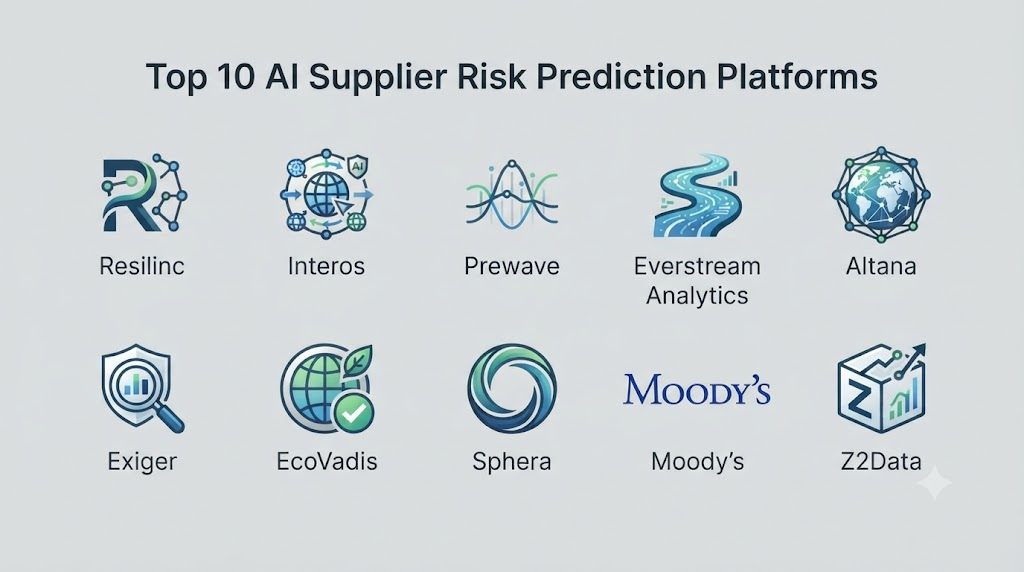
Top 10 AI Supplier Risk Prediction Platforms
1. Everstream Analytics
One-line verdict: Best for organizations seeking predictive supply-chain risk intelligence and early-warning signals across complex global supplier networks.
Short description:
Everstream Analytics focuses on supply-chain risk intelligence and predictive analytics. It can help organizations identify potential disruptions involving suppliers, logistics, geography, and other external risk factors.
Standout Capabilities
- Supply-chain risk monitoring.
- Predictive disruption intelligence.
- Supplier risk visibility.
- Event monitoring.
- Geographic risk analysis.
- Supply-chain mapping.
- Early-warning signals.
- Risk analytics.
AI-Specific Depth
- Model support: Proprietary predictive analytics and AI capabilities; exact model architecture is not publicly stated.
- RAG / knowledge integration: External and enterprise supply-chain data integration varies.
- Evaluation: Predictive risk performance can be evaluated against historical events; detailed evaluation methodology varies.
- Guardrails: Enterprise access and workflow controls vary.
- Observability: Risk monitoring and alerting are available; detailed AI observability varies.
Pros
- Strong focus on predictive supply-chain risk.
- Useful for global supplier networks.
- Helps teams identify emerging disruptions.
Cons
- More specialized than a complete procurement suite.
- External-risk intelligence may require integration with internal supplier data.
- Risk predictions should still be reviewed by supply-chain professionals.
Security & Compliance
Enterprise security and governance capabilities vary by service and deployment. Specific certifications should be independently verified for the applicable environment.
Deployment & Platforms
- Cloud.
- Web.
- Enterprise integrations.
Integrations & Ecosystem
Everstream can be incorporated into broader supply-chain and procurement workflows.
- ERP systems.
- Procurement systems.
- Supply-chain platforms.
- Supplier data.
- APIs.
- Enterprise data environments.
Pricing Model
Enterprise/custom pricing; exact pricing is Not publicly stated.
Best-Fit Scenarios
- Global supply-chain risk monitoring.
- Supplier disruption prediction.
- Business-continuity planning.
2. Prewave
One-line verdict: Best for companies needing continuous supplier monitoring across operational, sustainability, geopolitical, and compliance-related risks.
Short description:
Prewave provides supply-chain risk intelligence and supplier monitoring designed to identify potentially relevant risk events. It is particularly useful for organizations managing complex supplier ecosystems and regulatory obligations.
Standout Capabilities
- Supplier monitoring.
- Risk intelligence.
- Supply-chain visibility.
- Sustainability monitoring.
- Regulatory-risk monitoring.
- Early-warning alerts.
- Risk classification.
- Supplier intelligence.
AI-Specific Depth
- Model support: AI-driven risk intelligence; exact model architecture is not publicly stated.
- RAG / knowledge integration: External and supplier data integration varies.
- Evaluation: Risk detection can be evaluated against historical events; detailed methodology varies.
- Guardrails: Enterprise controls vary.
- Observability: Risk alerts and monitoring are supported; detailed AI observability varies.
Pros
- Broad supplier-risk coverage.
- Useful for continuous monitoring.
- Strong relevance to sustainability and regulatory risk.
Cons
- Risk intelligence requires careful configuration.
- Alert volume needs management.
- Exact capabilities vary by implementation.
Security & Compliance
Security and governance capabilities vary by deployment. Specific certifications should be verified for the applicable service.
Deployment & Platforms
- Cloud.
- Web.
- Enterprise integrations.
Integrations & Ecosystem
- ERP.
- Procurement platforms.
- Supplier-management systems.
- Risk platforms.
- APIs.
- Enterprise data systems.
Pricing Model
Enterprise/custom pricing varies.
Best-Fit Scenarios
- Continuous supplier monitoring.
- Regulatory-risk management.
- Sustainability-related supplier risk.
3. Interos
One-line verdict: Best for enterprises seeking AI-assisted multi-tier supplier mapping, third-party risk intelligence, and supply-chain resilience.
Short description:
Interos focuses on mapping and monitoring business relationships across supply chains. Its platform is designed to provide visibility beyond direct suppliers and help organizations identify potential risks across interconnected business networks.
Standout Capabilities
- Multi-tier supply-chain mapping.
- Supplier intelligence.
- Third-party risk monitoring.
- Relationship mapping.
- Risk alerts.
- Supply-chain visibility.
- Risk scoring.
- Resilience analysis.
AI-Specific Depth
- Model support: Proprietary AI and analytics; exact model architecture is not publicly stated.
- RAG / knowledge integration: Large-scale external data integration is central to the platform.
- Evaluation: Risk-detection performance varies by use case.
- Guardrails: Enterprise governance controls vary.
- Observability: Risk monitoring and alerts are available; detailed AI tracing varies.
Pros
- Strong network-level visibility.
- Useful for multi-tier supplier analysis.
- Helps identify hidden dependencies.
Cons
- Network mapping can be complex.
- Requires internal supplier data for stronger context.
- Enterprise-oriented implementation.
Security & Compliance
Security and governance capabilities vary by deployment. Specific certifications should be verified.
Deployment & Platforms
- Cloud.
- Web.
- Enterprise integrations.
Integrations & Ecosystem
- ERP.
- Procurement.
- Supplier-management systems.
- Risk systems.
- APIs.
- Data platforms.
Pricing Model
Enterprise/custom pricing; exact pricing is Not publicly stated.
Best-Fit Scenarios
- Multi-tier supplier mapping.
- Third-party risk.
- Supply-chain resilience.
4. Resilinc
One-line verdict: Best for organizations needing supplier monitoring, disruption intelligence, business continuity, and supply-chain resilience workflows.
Short description:
Resilinc provides supply-chain resilience and supplier-risk management capabilities. It helps organizations monitor potential disruptions and coordinate responses across supplier networks.
Standout Capabilities
- Supplier risk monitoring.
- Disruption intelligence.
- Supply-chain mapping.
- Business continuity.
- Supplier assessments.
- Event monitoring.
- Risk alerts.
- Resilience planning.
AI-Specific Depth
- Model support: AI and analytics capabilities vary.
- RAG / knowledge integration: Enterprise and external data integration varies.
- Evaluation: Risk-detection effectiveness should be validated using historical events.
- Guardrails: Workflow and access controls vary.
- Observability: Event monitoring and alerts are available; detailed model observability varies.
Pros
- Strong resilience focus.
- Useful for disruption response.
- Supplier-focused risk workflows.
Cons
- Broader risk programs may require additional tools.
- Requires supplier data quality.
- Implementation can involve multiple stakeholders.
Security & Compliance
Security and governance capabilities vary. Specific certifications should be verified before procurement.
Deployment & Platforms
- Cloud.
- Web.
- Enterprise integrations.
Integrations & Ecosystem
- ERP.
- Procurement.
- Supplier management.
- Business-continuity systems.
- APIs.
- Enterprise data platforms.
Pricing Model
Enterprise/custom pricing varies.
Best-Fit Scenarios
- Supply disruption monitoring.
- Business continuity.
- Supplier resilience.
5. Craft.co
One-line verdict: Best for teams seeking supplier intelligence, company research, relationship discovery, and third-party risk visibility.
Short description:
Craft.co provides company and supplier intelligence designed to help organizations research businesses, understand relationships, and monitor third-party information.
Standout Capabilities
- Company intelligence.
- Supplier research.
- Third-party intelligence.
- Supplier discovery.
- Relationship analysis.
- Risk monitoring.
- Company profiles.
- Procurement intelligence.
AI-Specific Depth
- Model support: AI capabilities vary; exact models are not publicly stated.
- RAG / knowledge integration: Data aggregation and enterprise integration vary.
- Evaluation: Data-quality validation is important; detailed AI evaluation methodology varies.
- Guardrails: Enterprise controls vary.
- Observability: Monitoring capabilities vary.
Pros
- Useful company intelligence.
- Supports supplier research.
- Can complement procurement workflows.
Cons
- Not a complete procurement platform.
- Internal supplier data may need to be combined with external intelligence.
- Risk predictions require contextual interpretation.
Security & Compliance
Security capabilities vary by deployment. Specific certifications should be verified.
Deployment & Platforms
- Cloud.
- Web.
- Enterprise integrations.
Integrations & Ecosystem
- Procurement platforms.
- Supplier systems.
- CRM.
- Risk-management tools.
- APIs.
- Enterprise applications.
Pricing Model
Pricing varies by plan and enterprise requirements; exact pricing is Not publicly stated.
Best-Fit Scenarios
- Supplier research.
- Third-party intelligence.
- Supplier discovery.
6. EcoVadis
One-line verdict: Best for organizations incorporating sustainability, supplier assessments, and responsible-procurement risk into supplier management.
Short description:
EcoVadis focuses on sustainability ratings and assessments across business supply chains. It is particularly relevant when supplier environmental, social, ethical, and sustainability performance forms part of procurement risk management.
Standout Capabilities
- Supplier sustainability assessments.
- Sustainability ratings.
- Supplier benchmarking.
- Responsible procurement.
- Sustainability monitoring.
- Corrective-action support.
- Supplier engagement.
- Risk-oriented sustainability insights.
AI-Specific Depth
- Model support: AI and analytics capabilities vary.
- RAG / knowledge integration: Supplier and assessment data integration varies.
- Evaluation: Assessment methodologies are structured; specific AI evaluation details are not publicly stated.
- Guardrails: Enterprise access and workflow controls vary.
- Observability: Assessment and monitoring capabilities vary.
Pros
- Strong sustainability specialization.
- Useful for responsible sourcing.
- Helps integrate sustainability into supplier decisions.
Cons
- Not a complete supplier-risk platform.
- Focus is strongly sustainability-oriented.
- Sustainability ratings should not be treated as a substitute for all other supplier-risk dimensions.
Security & Compliance
Security and privacy capabilities vary by applicable service. Specific certifications should be verified.
Deployment & Platforms
- Cloud.
- Web.
- Enterprise integrations.
Integrations & Ecosystem
- Procurement systems.
- Supplier-management platforms.
- Sustainability systems.
- APIs.
- Enterprise data environments.
Pricing Model
Enterprise/custom pricing varies.
Best-Fit Scenarios
- Sustainable procurement.
- ESG supplier assessment.
- Responsible sourcing.
7. SAP Ariba Supplier Management
One-line verdict: Best for SAP-centric enterprises combining supplier management, procurement workflows, supplier information, and risk processes.
Short description:
SAP Ariba Supplier Management provides supplier-related capabilities within the broader SAP procurement ecosystem. Organizations can use supplier information and procurement workflows to support supplier evaluation and management.
Standout Capabilities
- Supplier lifecycle management.
- Supplier information.
- Supplier qualification.
- Supplier segmentation.
- Procurement integration.
- Supplier performance processes.
- SAP ecosystem connectivity.
- Enterprise workflows.
AI-Specific Depth
- Model support: SAP AI capabilities vary by product and use case.
- RAG / knowledge integration: Enterprise data integration varies.
- Evaluation: Varies by AI capability.
- Guardrails: Enterprise workflow and access controls vary.
- Observability: Application analytics and monitoring vary.
Pros
- Strong SAP ecosystem integration.
- Useful supplier lifecycle management.
- Connects supplier information with procurement processes.
Cons
- Particularly attractive to SAP-oriented organizations.
- Implementation can be complex.
- Predictive-risk functionality varies by configuration.
Security & Compliance
SAP provides enterprise security and governance capabilities across its services. Specific certifications depend on the relevant product and deployment.
Deployment & Platforms
- Cloud.
- Enterprise.
- Hybrid integrations.
Integrations & Ecosystem
- SAP ERP.
- Procurement.
- Supplier management.
- Finance.
- Sourcing.
- APIs.
Pricing Model
Enterprise/custom pricing varies.
Best-Fit Scenarios
- SAP environments.
- Supplier lifecycle management.
- Enterprise procurement.
8. Coupa Supplier Risk & Management
One-line verdict: Best for organizations wanting supplier risk capabilities connected directly to broader business-spend and procurement management.
Short description:
Coupa provides supplier-related risk and management capabilities within its broader business-spend environment. This can help organizations connect supplier information and risk considerations with procurement and spend decisions.
Standout Capabilities
- Supplier management.
- Supplier risk.
- Procurement integration.
- Spend visibility.
- Supplier information.
- Supplier performance.
- Procurement workflows.
- Business-spend context.
AI-Specific Depth
- Model support: AI capabilities vary by application.
- RAG / knowledge integration: Enterprise data integration varies.
- Evaluation: Varies by AI functionality.
- Guardrails: Enterprise access and workflow controls vary.
- Observability: Analytics and monitoring vary.
Pros
- Connects supplier risk with spend.
- Broad procurement ecosystem.
- Useful for enterprise procurement teams.
Cons
- Full platform can be extensive.
- Implementation may require significant configuration.
- Advanced AI functionality varies.
Security & Compliance
Enterprise security, access control, and governance capabilities vary by deployment. Specific certifications should be verified.
Deployment & Platforms
- Cloud.
- Web.
- Enterprise integrations.
Integrations & Ecosystem
- ERP.
- Procurement.
- Supplier systems.
- Finance.
- Sourcing.
- APIs.
Pricing Model
Enterprise/custom pricing; exact pricing is Not publicly stated.
Best-Fit Scenarios
- Enterprise procurement.
- Supplier risk + spend analysis.
- Source-to-pay environments.
9. Prevalent
One-line verdict: Best for organizations managing third-party risk assessments, supplier questionnaires, and ongoing vendor-risk processes.
Short description:
Prevalent focuses on third-party risk management and supplier assessment workflows. It can help organizations standardize vendor assessments and manage third-party risk information.
Standout Capabilities
- Third-party risk management.
- Supplier assessments.
- Vendor questionnaires.
- Risk scoring.
- Third-party monitoring.
- Risk workflows.
- Assessment automation.
- Vendor intelligence.
AI-Specific Depth
- Model support: AI capabilities vary.
- RAG / knowledge integration: External and enterprise data integration varies.
- Evaluation: Assessment accuracy and risk scoring should be validated against organizational requirements.
- Guardrails: Access and workflow controls vary.
- Observability: Risk workflows and monitoring vary.
Pros
- Strong third-party risk focus.
- Structured assessment workflows.
- Useful for supplier-risk programs.
Cons
- More third-party-risk focused than supply-chain optimization.
- Questionnaire-based processes still require supplier participation.
- Predictive capabilities vary by implementation.
Security & Compliance
Security controls vary by deployment. Specific certifications should be verified directly.
Deployment & Platforms
- Cloud.
- Web.
- Enterprise integrations.
Integrations & Ecosystem
- GRC systems.
- Procurement systems.
- Supplier platforms.
- Security tools.
- APIs.
- Enterprise data platforms.
Pricing Model
Enterprise/custom pricing varies.
Best-Fit Scenarios
- Third-party risk.
- Vendor assessments.
- Supplier governance.
10. BitSight
One-line verdict: Best for organizations emphasizing cybersecurity risk when evaluating suppliers and third-party business relationships.
Short description:
BitSight specializes in cybersecurity ratings and third-party cyber-risk intelligence. It is especially useful when supplier cybersecurity exposure is a major component of the organization’s overall supplier-risk framework.
Standout Capabilities
- Cybersecurity ratings.
- Third-party risk monitoring.
- Security performance analysis.
- Supplier cyber-risk assessment.
- External security intelligence.
- Risk prioritization.
- Portfolio monitoring.
- Security benchmarking.
AI-Specific Depth
- Model support: Analytics and machine-learning capabilities vary.
- RAG / knowledge integration: External security data is central; enterprise integration varies.
- Evaluation: Cyber-risk methodologies can be evaluated against known security indicators; exact AI evaluation methodology varies.
- Guardrails: Enterprise controls vary.
- Observability: Security monitoring and risk analytics are available; detailed model tracing varies.
Pros
- Strong cybersecurity specialization.
- Useful for third-party cyber-risk programs.
- External risk intelligence can complement procurement data.
Cons
- Cybersecurity-focused rather than comprehensive supplier risk.
- Should be combined with operational and financial risk analysis.
- Risk ratings should not be interpreted as guarantees of supplier security.
Security & Compliance
Security capabilities and certifications vary by service. Organizations should verify applicable controls during procurement.
Deployment & Platforms
- Cloud.
- Web.
- Enterprise integrations.
Integrations & Ecosystem
- GRC platforms.
- Security systems.
- Procurement platforms.
- Third-party-risk systems.
- APIs.
- Enterprise data environments.
Pricing Model
Enterprise/custom pricing; exact pricing is Not publicly stated.
Best-Fit Scenarios
- Supplier cybersecurity risk.
- Third-party cyber monitoring.
- Security-focused vendor assessment.
Comparison Table
| Tool Name | Best For | Deployment | Model Flexibility | Strength | Watch-Out | Public Rating |
|---|---|---|---|---|---|---|
| Everstream Analytics | Predictive supply-chain risk | Cloud | Proprietary / Varies | Disruption prediction | Requires contextual validation | N/A |
| Prewave | Continuous supplier monitoring | Cloud | Proprietary / Varies | Broad risk intelligence | Alert management | N/A |
| Interos | Multi-tier supplier visibility | Cloud | Proprietary / Varies | Network mapping | Complex supplier networks | N/A |
| Resilinc | Supply-chain resilience | Cloud | Proprietary / Varies | Disruption response | Implementation complexity | N/A |
| Craft.co | Supplier intelligence | Cloud | Varies | Company intelligence | Not a complete S2P suite | N/A |
| EcoVadis | Sustainability supplier risk | Cloud | Varies | Sustainability assessments | Narrower risk focus | N/A |
| SAP Ariba Supplier Management | SAP-centric supplier management | Cloud / Hybrid | Multi-model / Varies | SAP integration | SAP ecosystem dependency | N/A |
| Coupa Supplier Risk & Management | Procurement-linked supplier risk | Cloud | Multi-model / Varies | Spend + supplier context | Platform breadth | N/A |
| Prevalent | Third-party risk | Cloud | Varies | Vendor assessments | More TPRM-focused | N/A |
| BitSight | Cybersecurity supplier risk | Cloud | Proprietary / Varies | Cyber-risk intelligence | Cyber-focused | N/A |
Scoring & Evaluation
The scores below are comparative editorial assessments rather than official vendor scores. A supplier-risk platform should be judged according to the organization’s supplier landscape, risk priorities, data quality, and required response workflows.
The weighted formula uses:
- Core features – 20%
- AI reliability & evaluation – 15%
- Guardrails & safety – 10%
- Integrations & ecosystem – 15%
- Ease of use – 10%
- Performance & cost controls – 15%
- Security & admin – 10%
- Support & community – 5%
| Tool | Core | Reliability/Eval | Guardrails | Integrations | Ease | Perf/Cost | Security/Admin | Support | Weighted Total |
|---|---|---|---|---|---|---|---|---|---|
| Everstream Analytics | 10 | 9 | 9 | 9 | 8 | 8 | 9 | 9 | 8.95 |
| Prewave | 10 | 9 | 9 | 9 | 8 | 8 | 9 | 9 | 8.90 |
| Interos | 10 | 9 | 9 | 9 | 7 | 8 | 9 | 9 | 8.80 |
| Resilinc | 9 | 9 | 9 | 9 | 8 | 8 | 9 | 9 | 8.80 |
| Craft.co | 8 | 8 | 8 | 9 | 9 | 9 | 8 | 8 | 8.45 |
| EcoVadis | 9 | 8 | 9 | 9 | 9 | 8 | 9 | 9 | 8.75 |
| SAP Ariba | 10 | 9 | 10 | 10 | 7 | 8 | 10 | 10 | 9.20 |
| Coupa | 10 | 9 | 9 | 10 | 8 | 8 | 10 | 9 | 9.20 |
| Prevalent | 9 | 8 | 9 | 9 | 8 | 8 | 9 | 9 | 8.70 |
| BitSight | 9 | 9 | 9 | 9 | 9 | 9 | 10 | 9 | 9.10 |
Top 3 for Enterprise
- SAP Ariba Supplier Management — Strong option for large SAP-centered procurement organizations.
- Coupa Supplier Risk & Management — Strong choice when supplier risk must be connected with business spend.
- Interos — Particularly useful for multi-tier supply-chain visibility.
Top 3 for SMB
- Craft.co — Useful for supplier research and intelligence.
- BitSight — Strong option when cybersecurity is a primary supplier-risk concern.
- Prevalent — Useful for organizations establishing structured third-party-risk processes.
Top 3 for Developers
- Interos — Useful for organizations building supplier-network intelligence into broader data workflows.
- Everstream Analytics — Strong for supply-chain risk intelligence integrations.
- BitSight — Useful when cyber-risk signals need to be integrated into supplier-risk workflows.
Which AI Supplier Risk Prediction Platform Is Right for You?
Solo / Freelancer
A dedicated supplier-risk platform is rarely necessary for freelancers or very small businesses.
Instead, use:
- Supplier spreadsheets.
- Accounting software.
- Basic vendor reviews.
- Manual financial checks.
- Simple delivery-performance tracking.
A specialized platform becomes more appropriate as supplier dependency and business impact increase.
SMB
SMBs should prioritize simplicity.
Look for:
- Supplier risk scoring.
- Basic financial monitoring.
- Supplier performance tracking.
- Cybersecurity risk information.
- Alerts.
- Simple integrations.
- Easy supplier onboarding.
- Transparent reporting.
Avoid highly complex multi-tier supply-chain platforms unless the organization genuinely has global supplier exposure.
Mid-Market
Mid-market organizations should consider:
- Automated supplier scoring.
- Continuous monitoring.
- Financial risk.
- Operational risk.
- Quality risk.
- Supplier concentration.
- Geographic risk.
- Cybersecurity risk.
- Supplier performance.
- Early-warning alerts.
The ability to combine internal supplier performance with external risk signals becomes particularly valuable.
Enterprise
Enterprises should prioritize:
- Multi-tier supply-chain visibility.
- Supplier mapping.
- Continuous monitoring.
- Predictive analytics.
- Financial-risk signals.
- Geopolitical intelligence.
- Cybersecurity intelligence.
- Regulatory monitoring.
- Sustainability risk.
- Supplier concentration.
- Scenario modeling.
- Alternative supplier identification.
- API integration.
- Enterprise identity controls.
- Auditability.
- Explainability.
- Data governance.
Large enterprises should also assess whether the platform can scale across multiple countries, business units, currencies, procurement systems, and supplier categories.
Regulated Industries
Financial services, healthcare, pharmaceuticals, aerospace, defense, and public-sector organizations should pay particular attention to:
- Supplier-data confidentiality.
- Access controls.
- SSO.
- RBAC.
- Audit trails.
- Encryption.
- Data retention.
- Data residency.
- Data lineage.
- Model governance.
- Human review.
- Risk-score explainability.
- Regulatory reporting.
AI-generated risk scores should support professional judgment rather than automatically determining supplier eligibility.
Budget vs Premium
A basic supplier-risk solution may be sufficient when:
- The supplier base is small.
- Most suppliers are domestic.
- Supply chains are straightforward.
- Risk monitoring is mostly manual.
- Supplier dependencies are limited.
Premium platforms become more valuable when:
- The supplier network is global.
- There are multiple tiers of suppliers.
- Critical components have few alternatives.
- Disruptions can materially affect operations.
- Supplier financial health is difficult to monitor.
- External risk events matter.
- Procurement teams need continuous alerts.
Build vs Buy
Build when:
- You already have strong internal supplier data.
- Your risk models are highly specialized.
- You have experienced data scientists.
- Your organization needs custom risk calculations.
- You can maintain models and data pipelines.
Buy when:
- You need external supplier intelligence.
- You require continuous monitoring.
- You need ready-made risk signals.
- Supplier mapping is difficult to build internally.
- You want faster implementation.
A hybrid approach can work particularly well: combine a supplier-risk intelligence platform with an internal data warehouse and organization-specific risk models.
Implementation Playbook: 30 / 60 / 90 Days
First 30 Days: Pilot + Success Metrics
Select a limited group of critical suppliers.
Collect:
- Supplier master data.
- Purchase history.
- Delivery performance.
- Quality metrics.
- Contract information.
- Financial information where available.
- Geographic information.
- Supplier dependency data.
- Cybersecurity information where relevant.
Define baseline measurements:
- Number of critical suppliers.
- Supplier concentration.
- Late-delivery rate.
- Quality failure rate.
- Single-source exposure.
- Geographic concentration.
- Supplier-risk score distribution.
- Number of unresolved supplier-risk issues.
Create an initial supplier-risk taxonomy.
Days 31–60: Security + Evaluation + Rollout
Create an evaluation framework for:
- Risk prediction accuracy.
- False positives.
- False negatives.
- Alert relevance.
- Supplier identity matching.
- Risk-score consistency.
- Explanation quality.
- Event-detection accuracy.
Test AI systems against historical supplier disruptions.
Run red-team tests against AI assistants for:
- Prompt injection.
- Unauthorized supplier-data access.
- Incorrect risk conclusions.
- Fabricated supplier information.
- Unsupported financial claims.
- Misleading confidence levels.
Introduce:
- Human review.
- Risk-score overrides.
- Prompt/version control.
- Audit logging.
- RBAC.
- Data-quality monitoring.
Days 61–90: Cost, Latency + Governance
Expand monitoring to additional suppliers.
Connect:
- ERP.
- Procurement.
- Supplier management.
- Quality management.
- Logistics.
- Finance.
- Cybersecurity.
- External intelligence sources.
Optimize:
- Alert frequency.
- Model usage.
- Data-refresh schedules.
- Risk thresholds.
- Dashboard performance.
- AI query costs.
Establish governance for:
- Risk-score changes.
- AI-generated recommendations.
- Supplier escalation.
- Human overrides.
- Model changes.
- Incident management.
- Data retention.
- Supplier communication.
Common Mistakes & How to Avoid Them
- Treating risk scores as absolute truth: A risk score is an indicator, not a guarantee.
- Using outdated supplier data: Old information can produce misleading predictions.
- Ignoring supplier identity problems: Duplicate supplier records can distort risk calculations.
- Relying on a single risk signal: Financial, operational, geographic, cyber, and quality indicators should be considered together.
- Generating too many alerts: Excessive alerts create notification fatigue.
- No evaluation framework: Historical supplier events should be used to test prediction quality.
- Ignoring false negatives: Missing a genuinely high-risk supplier can be more damaging than generating an extra alert.
- No explainability: Procurement teams need to understand why supplier risk increased.
- Over-automating decisions: High-impact supplier decisions should have human oversight.
- Ignoring multi-tier dependencies: A direct supplier may depend on another company that creates significant hidden exposure.
- No data-retention controls: Supplier and risk data can be commercially sensitive.
- Ignoring cybersecurity risk: Supplier cyber exposure can create operational and reputational consequences.
- No model/version control: Changes to models and risk methodologies should be traceable.
- Vendor lock-in: Maintain access to core supplier data and risk history.
- Ignoring business context: A moderate-risk supplier may be strategically critical if there is no viable alternative.
FAQs
1. What is AI Supplier Risk Prediction?
AI Supplier Risk Prediction uses machine learning, analytics, external intelligence, and supplier data to identify patterns that may indicate future supplier problems.
2. What types of supplier risk can AI predict?
Depending on the platform, AI can help analyze financial, operational, delivery, quality, cybersecurity, geopolitical, regulatory, sustainability, and concentration risks.
3. Can AI predict supplier failure?
AI can identify indicators associated with potential supplier problems, but no system can guarantee that a supplier will fail or remain operational.
4. How does AI identify supplier risk?
Systems can combine historical supplier performance, transaction information, external events, financial indicators, geographic information, and other signals to generate risk insights.
5. Can AI monitor suppliers continuously?
Yes. Continuous monitoring is a major use case for modern supplier-risk platforms. The frequency and scope of monitoring depend on the product and data sources.
6. Can supplier-risk platforms monitor financial health?
Some platforms incorporate financial-risk intelligence or integrate with financial-risk data sources. Exact coverage varies.
7. Can AI predict delivery delays?
Some systems can analyze historical delivery performance and other operational signals to identify potential delivery risk.
8. Can AI identify single-source supplier risk?
Yes. Spend and supplier-network analytics can identify situations where important products, materials, or services depend heavily on one supplier.
9. Can these platforms detect geopolitical risk?
Some supplier-risk platforms incorporate geopolitical and external-event intelligence. Coverage varies by geography and data source.
10. Can AI assess supplier cybersecurity risk?
Yes. Specialized cybersecurity-risk platforms can provide third-party cyber-risk intelligence, while broader supplier-risk platforms may integrate cybersecurity information.
11. Can companies use their own AI models?
This depends on the platform. Some environments support integrations or configurable analytics, while others primarily use vendor-provided models and intelligence.
12. Can supplier-risk platforms be self-hosted?
Deployment options vary. Many enterprise supplier-risk products are cloud-based, while organizations can sometimes maintain internal data and analytics layers alongside the platform.
13. How should supplier-risk AI be evaluated?
Use historical supplier events and measure false positives, false negatives, detection speed, risk-score consistency, and explanation quality.
14. What are AI guardrails in supplier-risk systems?
Guardrails restrict AI behavior and data access. They can help prevent unauthorized supplier information retrieval, unsupported conclusions, and inappropriate automated actions.
15. How important is explainability?
Very important. Procurement teams should understand which signals caused a risk score to change and what evidence supports an alert.
16. How much do supplier-risk platforms cost?
Pricing varies significantly according to supplier count, monitored data sources, users, modules, integrations, and enterprise requirements. Exact pricing is generally vendor-specific.
17. Can AI replace supplier-risk managers?
No. AI can automate monitoring and analysis, but supplier-risk professionals remain important for validating predictions, understanding business context, communicating with suppliers, and making high-impact decisions.
18. What is the difference between supplier risk and third-party risk?
Supplier risk usually focuses on suppliers and procurement dependencies. Third-party risk can encompass a broader range of external organizations, including vendors, service providers, partners, and other business relationships.
19. Should SMBs use supplier-risk AI?
SMBs should consider it when supplier disruption could materially affect the business. For a small and simple supplier base, manual monitoring may be more economical.
20. Should companies build or buy supplier-risk prediction systems?
Buying is generally preferable when organizations need external intelligence, continuous monitoring, supplier mapping, and established risk workflows. Building may make sense when the company has highly specialized requirements and strong internal data-science capabilities.
Conclusion
AI Supplier Risk Prediction is becoming an important component of modern procurement and supply-chain management.The value is not simply in assigning every supplier a number. The real objective is to identify which suppliers require attention, why their risk is changing, what the likely business impact could be, and what procurement or supply-chain teams should investigate next.Everstream Analytics, Prewave, Interos, Resilinc, Craft.co, EcoVadis, SAP Ariba Supplier Management, Coupa Supplier Risk & Management, Prevalent, and BitSight approach supplier risk from different perspectives.Some focus heavily on supply-chain disruption. Others specialize in supplier intelligence, sustainability, cybersecurity, procurement, or third-party risk.The best platform therefore depends on your organization’s specific risk profile, supplier network, existing technology stack, data quality, and desired level of automa