Introduction
AI Shipment Exception Detection Tools use artificial intelligence, machine learning, predictive analytics, rules, and real-time logistics data to identify shipments that may not arrive as expected. Instead of waiting for a customer to report a late delivery or for a logistics team to discover a missed milestone manually, these platforms can monitor shipment events and highlight potential exceptions before they become larger operational problems.
AI-based exception detection is particularly useful for companies managing large shipment volumes across multiple carriers, modes, regions, warehouses, suppliers, and transportation networks.
Best for: Manufacturers, retailers, distributors, e-commerce businesses, 3PLs, freight forwarders, logistics teams, supply-chain control towers, customer-service organizations, and enterprises managing high shipment volumes.
Not ideal for: Small businesses with only a handful of shipments, simple local delivery operations, or organizations without reliable shipment-event data. A basic TMS dashboard or carrier tracking system may be sufficient for simpler operations.
What’s Changed in AI Shipment Exception Detection
- Predictive exceptions are replacing purely reactive alerts: Systems increasingly attempt to identify shipments likely to fail before a formal exception occurs.
- Real-time visibility is becoming more important: Exception detection depends on combining carrier events, GPS information, estimated arrival times, warehouse events, and other operational signals.
- AI can prioritize exceptions: Instead of producing hundreds of alerts, intelligent systems can help identify which shipments are most likely to affect customers, revenue, or production.
- ETA and exception prediction are becoming connected: A change in predicted arrival time can automatically trigger an exception workflow.
- Multimodal logistics data is expanding: Shipment records may be combined with text, documents, sensor information, images, location data, and event streams.
- AI agents can support exception management: Agents can summarize what happened, investigate potential causes, identify relevant shipments, and prepare recommended actions.
- Human-in-the-loop workflows remain important: High-impact decisions should generally be reviewed by logistics professionals.
- Data-quality monitoring is critical: Missing carrier events or inaccurate tracking information can create false alerts.
- Cost-aware AI is increasingly important: Companies need to balance real-time processing with infrastructure and model costs.
- Privacy and governance are receiving greater attention: Shipment data can contain customer, supplier, commercial, and location information.
- Exception management is moving toward closed-loop workflows: Detection can increasingly be connected to escalation, communication, rebooking, and corrective-action processes.
- Explainability matters: Logistics teams need to understand why the system considers a shipment at risk.
Quick Buyer Checklist
When evaluating AI Shipment Exception Detection Tools, look for:
- Real-time shipment monitoring.
- Predictive delay detection.
- ETA prediction.
- Missed-milestone detection.
- Route-deviation detection.
- Carrier-event monitoring.
- Shipment-risk scoring.
- Exception prioritization.
- Alert customization.
- Root-cause analysis.
- Automated escalation.
- Customer-notification workflows.
- Carrier integrations.
- TMS integration.
- ERP integration.
- WMS integration.
- API access.
- EDI support.
- Event-stream processing.
- GPS/location integration.
- IoT or sensor integration where relevant.
- AI model flexibility.
- Machine-learning capabilities.
- Explainable predictions.
- Human review workflows.
- Evaluation and model monitoring.
- False-positive management.
- Guardrails.
- Auditability.
- Role-based access.
- Data retention controls.
- Data privacy.
- Data residency.
- Encryption.
- Cost monitoring.
- Latency controls.
- Vendor lock-in considerations.
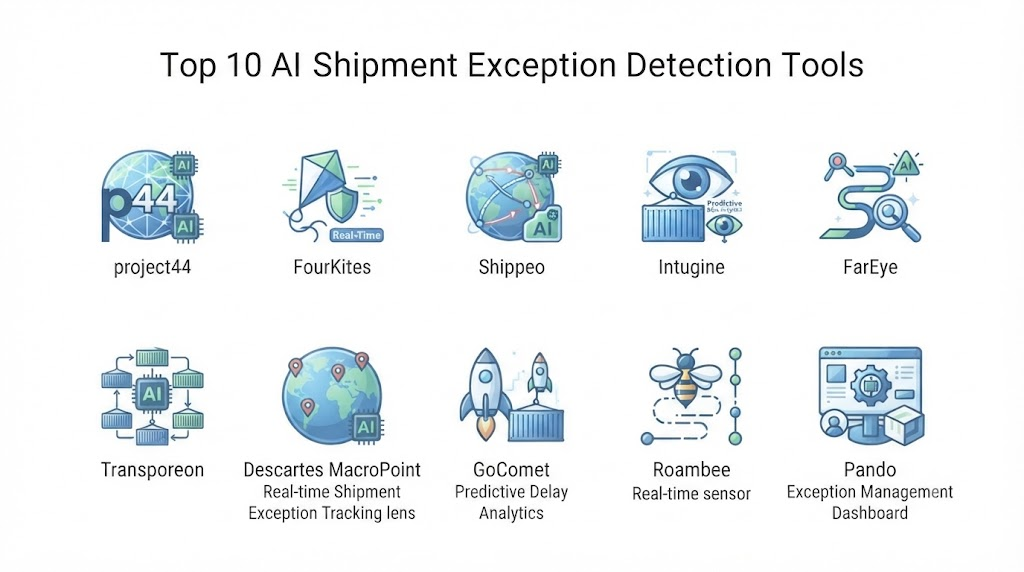
Top 10 AI Shipment Exception Detection Tools
1. project44
One-line verdict: Best for enterprises needing broad multimodal shipment visibility, predictive insights, and proactive exception management.
Short description:
project44 provides supply-chain visibility technology designed to track shipments across transportation modes and provide predictive logistics insights. Its platform is particularly relevant to organizations looking to identify shipment risks before they become customer-facing problems.
Standout Capabilities
- Multimodal shipment visibility.
- Predictive ETA capabilities.
- Shipment tracking.
- Exception identification.
- Transportation-event monitoring.
- Carrier connectivity.
- Supply-chain visibility.
- Customer-facing shipment insights.
AI-Specific Depth
- Model support: AI and machine-learning capabilities are integrated into the platform; specific model flexibility varies.
- RAG / knowledge integration: Not primarily a RAG platform.
- Evaluation: Specific internal model-evaluation methodology is not publicly stated.
- Guardrails: Enterprise workflow and access controls vary by implementation.
- Observability: Shipment events, predictive ETAs, and transportation status provide operational visibility.
Pros
- Broad transportation visibility.
- Strong fit for large shipment networks.
- Useful for proactive shipment management.
Cons
- Enterprise implementations can require significant integration work.
- Value depends heavily on shipment-data coverage.
- Pricing is not publicly stated.
Security & Compliance
Security, access controls, encryption, retention, and compliance capabilities vary by service and agreement. Specific certifications should be verified directly during procurement.
Deployment & Platforms
- Cloud.
- Web-based enterprise platform.
- APIs.
- Enterprise integrations.
Integrations & Ecosystem
project44 is designed to connect transportation data from multiple logistics participants.
- Carriers.
- TMS platforms.
- ERP systems.
- E-commerce systems.
- Transportation networks.
- APIs.
- Shipment-event feeds.
Pricing Model
Enterprise pricing varies by scope, shipment volume, integrations, and functionality. Exact pricing is not publicly stated.
Best-Fit Scenarios
- Global shipment monitoring.
- Proactive exception management.
- Multimodal transportation visibility.
2. FourKites
One-line verdict: Best for enterprises seeking predictive supply-chain visibility and proactive shipment-risk management.
Short description:
FourKites provides real-time supply-chain visibility and predictive transportation insights. Its technology is designed to help logistics teams understand shipment status, anticipate problems, and coordinate responses across complex transportation networks.
Standout Capabilities
- Real-time shipment visibility.
- Predictive ETA.
- Shipment-risk monitoring.
- Exception management.
- Carrier visibility.
- Multimodal tracking.
- Supply-chain analytics.
- Proactive notifications.
AI-Specific Depth
- Model support: AI and predictive analytics capabilities are integrated; specific model architecture varies.
- RAG / knowledge integration: Not primarily a RAG system.
- Evaluation: Detailed AI evaluation methodology is not publicly stated.
- Guardrails: Enterprise governance and workflow controls vary.
- Observability: Shipment status and predictive analytics provide visibility into transportation performance.
Pros
- Strong predictive-visibility orientation.
- Supports complex transportation networks.
- Can help teams move from reactive to proactive management.
Cons
- Requires substantial shipment-data integration.
- Enterprise-focused implementation may be complex.
- Exact pricing is not publicly stated.
Security & Compliance
Security and compliance capabilities vary by product and agreement. Verify specific certifications and controls before procurement.
Deployment & Platforms
- Cloud.
- Web.
- APIs.
- Enterprise integrations.
Integrations & Ecosystem
- Carrier networks.
- TMS.
- ERP.
- WMS.
- Logistics platforms.
- APIs.
- Data integrations.
Pricing Model
Enterprise pricing varies. Exact pricing is not publicly stated.
Best-Fit Scenarios
- Predictive shipment monitoring.
- Control-tower operations.
- Enterprise transportation visibility.
3. project44 Movement
One-line verdict: Best for organizations requiring transportation visibility and predictive shipment monitoring across complex logistics networks.
Short description:
project44’s transportation visibility capabilities provide shipment tracking and predictive logistics information. Organizations can use transportation-event data to identify shipments that may require attention.
Standout Capabilities
- Shipment tracking.
- ETA prediction.
- Transportation visibility.
- Exception monitoring.
- Carrier connectivity.
- Multimodal visibility.
- Analytics.
- Shipment-status intelligence.
AI-Specific Depth
- Model support: Integrated predictive models; exact model choices are not publicly stated.
- RAG / knowledge integration: N/A as a primary function.
- Evaluation: Specific evaluation processes are not publicly stated.
- Guardrails: Enterprise controls vary.
- Observability: Shipment events and prediction outputs provide operational visibility.
Pros
- Strong transportation-data ecosystem.
- Useful for high shipment volumes.
- Supports proactive logistics operations.
Cons
- Requires data integration.
- Best suited to organizations with substantial transportation complexity.
- Specific capabilities vary by product configuration.
Security & Compliance
Security, data handling, access controls, and compliance vary by service and customer configuration.
Deployment & Platforms
- Cloud.
- Web.
- APIs.
- Enterprise integrations.
Integrations & Ecosystem
- Carriers.
- TMS.
- ERP.
- WMS.
- Logistics systems.
- APIs.
Pricing Model
Enterprise pricing varies. Exact pricing is not publicly stated.
Best-Fit Scenarios
- Shipment visibility.
- Predictive ETA.
- Exception prioritization.
4. Shippeo
One-line verdict: Best for companies looking for real-time transportation visibility, predictive ETA, and proactive exception management.
Short description:
Shippeo provides real-time transportation visibility and predictive logistics capabilities. It is designed to help supply-chain teams understand shipment progress and identify potential disruptions earlier.
Standout Capabilities
- Real-time transportation visibility.
- Predictive ETA.
- Shipment monitoring.
- Exception management.
- Carrier connectivity.
- Multimodal visibility.
- Analytics.
- Customer-facing visibility.
AI-Specific Depth
- Model support: Predictive AI and machine-learning capabilities vary.
- RAG / knowledge integration: Not primarily a RAG platform.
- Evaluation: Specific AI evaluation methodology is not publicly stated.
- Guardrails: Enterprise governance controls vary.
- Observability: Shipment events, ETA predictions, and transportation analytics support monitoring.
Pros
- Strong real-time visibility focus.
- Useful for proactive exception detection.
- Designed for complex transportation networks.
Cons
- Requires carrier and logistics data integration.
- Enterprise deployments can require planning.
- Exact pricing is not publicly stated.
Security & Compliance
Specific security controls and certifications should be verified for the selected deployment.
Deployment & Platforms
- Cloud.
- Web.
- APIs.
- Enterprise integrations.
Integrations & Ecosystem
- Carriers.
- TMS.
- ERP.
- Logistics platforms.
- APIs.
- Transportation data feeds.
Pricing Model
Enterprise pricing varies. Exact pricing is not publicly stated.
Best-Fit Scenarios
- Real-time shipment monitoring.
- Predictive transportation operations.
- Customer delivery visibility.
5. Descartes MacroPoint
One-line verdict: Best for transportation organizations needing shipment tracking, carrier connectivity, and operational exception visibility.
Short description:
Descartes MacroPoint provides transportation visibility and shipment tracking capabilities within the broader Descartes logistics ecosystem. It is useful for organizations managing large numbers of shipments and carriers.
Standout Capabilities
- Shipment tracking.
- Carrier connectivity.
- Transportation visibility.
- Location tracking.
- ETA information.
- Exception monitoring.
- Freight visibility.
- Logistics integration.
AI-Specific Depth
- Model support: AI and predictive capabilities vary by product.
- RAG / knowledge integration: N/A as a primary capability.
- Evaluation: Specific AI evaluation methodology is not publicly stated.
- Guardrails: Enterprise workflow and access controls vary.
- Observability: Shipment events and tracking information provide operational visibility.
Pros
- Broad logistics ecosystem.
- Strong carrier connectivity.
- Useful for transportation operations.
Cons
- Broader platform may be more than some companies need.
- AI-specific functionality varies.
- Pricing is not publicly stated.
Security & Compliance
Security, access control, data handling, and compliance capabilities vary by product and deployment.
Deployment & Platforms
- Cloud.
- Web.
- APIs.
- Enterprise integrations.
Integrations & Ecosystem
- Carriers.
- TMS.
- ERP.
- Transportation systems.
- Logistics platforms.
- APIs.
Pricing Model
Enterprise pricing varies. Exact pricing is not publicly stated.
Best-Fit Scenarios
- Freight tracking.
- Carrier monitoring.
- Shipment exception management.
6. project44 Intelligent Roadside Assistance and Visibility
One-line verdict: Best for transportation teams requiring detailed road-shipment visibility and predictive risk information.
Short description:
Road transportation visibility technologies can combine carrier events, location information, estimated arrival data, and transportation signals to identify potential problems.
Standout Capabilities
- Road-shipment visibility.
- Location monitoring.
- ETA prediction.
- Event monitoring.
- Shipment risk identification.
- Transportation analytics.
- Carrier connectivity.
- Exception alerts.
AI-Specific Depth
- Model support: Predictive analytics and machine learning vary by solution.
- RAG / knowledge integration: N/A.
- Evaluation: Not publicly stated.
- Guardrails: Varies.
- Observability: Transportation-event and location data provide visibility.
Pros
- Useful for road transportation.
- Supports proactive monitoring.
- Can help identify operational delays.
Cons
- More focused on transportation visibility than strategic network design.
- Data coverage can vary.
- Specific capabilities depend on implementation.
Security & Compliance
Security and compliance details vary and should be verified for the applicable service.
Deployment & Platforms
- Cloud.
- Web.
- APIs.
Integrations & Ecosystem
- Carriers.
- TMS.
- ERP.
- Transportation systems.
- APIs.
Pricing Model
Not publicly stated.
Best-Fit Scenarios
- Road freight monitoring.
- Predictive delay detection.
- Carrier operations.
7. Transporeon
One-line verdict: Best for organizations combining transportation execution, visibility, carrier collaboration, and logistics data.
Short description:
Transporeon provides transportation-management and logistics collaboration capabilities. Its ecosystem can support shipment monitoring, carrier coordination, transportation execution, and visibility.
Standout Capabilities
- Transportation visibility.
- Carrier collaboration.
- Freight management.
- Transportation execution.
- ETA-related capabilities.
- Logistics analytics.
- Network connectivity.
- Exception monitoring.
AI-Specific Depth
- Model support: AI and analytics capabilities vary.
- RAG / knowledge integration: Not primarily a RAG platform.
- Evaluation: Specific AI evaluation methodology is not publicly stated.
- Guardrails: Enterprise controls vary.
- Observability: Transportation events and analytics provide operational visibility.
Pros
- Strong transportation ecosystem.
- Useful for carrier collaboration.
- Supports broader transportation workflows.
Cons
- Exception detection is part of a wider transportation platform.
- Implementation complexity can vary.
- Exact AI functionality depends on the product.
Security & Compliance
Security and compliance details vary by service and configuration.
Deployment & Platforms
- Cloud.
- Web.
- APIs.
- Enterprise integrations.
Integrations & Ecosystem
- Carriers.
- TMS.
- ERP.
- Transportation networks.
- Procurement systems.
- APIs.
Pricing Model
Enterprise pricing varies. Exact pricing is not publicly stated.
Best-Fit Scenarios
- Carrier collaboration.
- Transportation visibility.
- Freight operations.
8. Oracle Transportation Management
One-line verdict: Best for Oracle-centric enterprises connecting transportation execution with shipment monitoring and exception workflows.
Short description:
Oracle Transportation Management supports transportation planning, execution, monitoring, and logistics operations. Organizations can use transportation-event information and operational workflows to identify and manage shipment exceptions.
Standout Capabilities
- Transportation planning.
- Shipment execution.
- Carrier management.
- Freight management.
- Transportation monitoring.
- Logistics analytics.
- Exception workflows.
- Enterprise integration.
AI-Specific Depth
- Model support: AI and machine-learning capabilities vary across Oracle products.
- RAG / knowledge integration: Not primarily a RAG platform.
- Evaluation: Specific AI evaluation methodology is not publicly stated.
- Guardrails: Enterprise access and workflow controls vary.
- Observability: Transportation monitoring and analytics support operational visibility.
Pros
- Strong enterprise transportation platform.
- Useful for Oracle environments.
- Connects planning and execution.
Cons
- Implementation can be complex.
- May require broader Oracle ecosystem investment.
- AI-specific exception capabilities vary.
Security & Compliance
Security, access controls, encryption, retention, and compliance capabilities vary by service and configuration.
Deployment & Platforms
- Cloud.
- Web.
- Enterprise.
- APIs.
Integrations & Ecosystem
- Oracle ERP.
- Supply-chain systems.
- Carriers.
- Warehouse systems.
- Analytics.
- APIs.
Pricing Model
Enterprise pricing varies. Exact pricing is not publicly stated.
Best-Fit Scenarios
- Oracle-centric logistics.
- Transportation execution.
- Enterprise shipment monitoring.
9. SAP Transportation Management
One-line verdict: Best for SAP-centric enterprises integrating transportation planning, execution, monitoring, and broader supply-chain processes.
Short description:
SAP Transportation Management provides transportation planning and execution capabilities within the SAP supply-chain ecosystem. It can support shipment monitoring and operational workflows where transportation data is integrated with enterprise processes.
Standout Capabilities
- Transportation planning.
- Shipment execution.
- Freight management.
- Carrier collaboration.
- Transportation monitoring.
- Supply-chain integration.
- Analytics.
- Exception management.
AI-Specific Depth
- Model support: AI capabilities vary across SAP offerings.
- RAG / knowledge integration: Enterprise data integration is more central than RAG.
- Evaluation: Specific AI evaluation methodology is not publicly stated.
- Guardrails: Enterprise controls vary.
- Observability: Transportation analytics and monitoring provide visibility.
Pros
- Strong SAP ecosystem integration.
- Suitable for complex enterprises.
- Connects transportation with business processes.
Cons
- Most attractive to SAP-oriented organizations.
- Implementation can be extensive.
- AI functionality varies across products.
Security & Compliance
Security and compliance capabilities vary by SAP deployment and configuration.
Deployment & Platforms
- Cloud.
- Enterprise.
- SAP ecosystem.
- APIs.
Integrations & Ecosystem
- SAP ERP.
- Warehousing.
- Procurement.
- Supply-chain planning.
- Carriers.
- APIs.
Pricing Model
Enterprise pricing varies. Exact pricing is not publicly stated.
Best-Fit Scenarios
- SAP-centric transportation operations.
- Enterprise logistics.
- Integrated shipment monitoring.
10. FourKites Dynamic ETA and Exception Management
One-line verdict: Best for logistics teams wanting predictive ETAs and prioritized intervention across high-volume shipment networks.
Short description:
Predictive ETA and shipment-risk capabilities can help transportation teams identify shipments that are likely to miss expected delivery windows and prioritize interventions.
Standout Capabilities
- Predictive ETA.
- Shipment-risk scoring.
- Delay detection.
- Exception prioritization.
- Transportation visibility.
- Carrier monitoring.
- Shipment analytics.
- Proactive alerts.
AI-Specific Depth
- Model support: Machine-learning and predictive models are integrated; exact model choices are not publicly stated.
- RAG / knowledge integration: N/A as a primary function.
- Evaluation: Specific evaluation methodology is not publicly stated.
- Guardrails: Enterprise governance controls vary.
- Observability: Shipment-event and prediction monitoring provide operational visibility.
Pros
- Strong predictive orientation.
- Helps prioritize high-risk shipments.
- Useful for large transportation operations.
Cons
- Requires reliable transportation data.
- Enterprise-focused.
- Exact pricing is not publicly stated.
Security & Compliance
Specific security and compliance controls should be verified with the vendor for the selected configuration.
Deployment & Platforms
- Cloud.
- Web.
- APIs.
- Enterprise integrations.
Integrations & Ecosystem
- Carrier networks.
- TMS.
- ERP.
- WMS.
- Transportation platforms.
- APIs.
Pricing Model
Enterprise pricing varies. Exact pricing is not publicly stated.
Best-Fit Scenarios
- Predictive ETA monitoring.
- High-volume freight operations.
- Exception prioritization.
Comparison Table
| Tool Name | Best For | Deployment | Model Flexibility | Strength | Watch-Out | Public Rating |
|---|---|---|---|---|---|---|
| project44 | Enterprise shipment visibility | Cloud | Hosted/Integrated | Multimodal visibility | Integration complexity | N/A |
| FourKites | Predictive visibility | Cloud | Hosted/Integrated | Shipment-risk prediction | Data dependency | N/A |
| project44 Movement | Transportation monitoring | Cloud | Hosted/Integrated | ETA and visibility | Enterprise focus | N/A |
| Shippeo | Real-time visibility | Cloud | Hosted/Integrated | Predictive ETA | Integration requirements | N/A |
| Descartes MacroPoint | Freight tracking | Cloud | Hosted/Integrated | Carrier connectivity | Broad portfolio | N/A |
| project44 Road Visibility | Road freight | Cloud | Hosted/Integrated | Road shipment intelligence | Road-focused | N/A |
| Transporeon | Carrier collaboration | Cloud | Hosted/Integrated | Transportation ecosystem | Platform breadth | N/A |
| Oracle Transportation Management | Oracle enterprises | Cloud | Hosted/Integrated | Transportation management | Implementation complexity | N/A |
| SAP Transportation Management | SAP enterprises | Cloud/Enterprise | Hosted/Integrated | ERP integration | SAP ecosystem dependency | N/A |
| FourKites Dynamic ETA | Predictive intervention | Cloud | Hosted/Integrated | Risk prioritization | Requires quality data | N/A |
Scoring & Evaluation
The following scoring framework is comparative rather than an official vendor rating. Actual performance can vary significantly depending on shipment volume, carrier coverage, data quality, geographic scope, integrations, and configuration.
| Tool | Core | Reliability/Eval | Guardrails | Integrations | Ease | Perf/Cost | Security/Admin | Support | Weighted Total |
|---|---|---|---|---|---|---|---|---|---|
| project44 | 10 | 9 | 9 | 10 | 8 | 8 | 9 | 9 | 9.00 |
| FourKites | 10 | 9 | 9 | 10 | 8 | 8 | 9 | 9 | 9.00 |
| project44 Movement | 10 | 9 | 9 | 10 | 8 | 8 | 9 | 9 | 9.00 |
| Shippeo | 9 | 9 | 9 | 9 | 8 | 8 | 9 | 9 | 8.85 |
| Descartes MacroPoint | 9 | 8 | 9 | 10 | 8 | 8 | 9 | 9 | 8.80 |
| project44 Road Visibility | 9 | 9 | 9 | 10 | 8 | 8 | 9 | 9 | 8.90 |
| Transporeon | 9 | 8 | 9 | 10 | 8 | 8 | 9 | 9 | 8.80 |
| Oracle Transportation Management | 9 | 8 | 9 | 10 | 7 | 8 | 10 | 10 | 8.85 |
| SAP Transportation Management | 9 | 8 | 9 | 10 | 7 | 8 | 10 | 10 | 8.85 |
| FourKites Dynamic ETA | 9 | 9 | 9 | 10 | 8 | 8 | 9 | 9 | 8.90 |
Top 3 for Enterprise
- project44 — Strong choice for organizations requiring broad multimodal visibility and predictive shipment intelligence.
- FourKites — Well suited to large enterprises seeking predictive transportation visibility.
- Oracle Transportation Management — Particularly relevant for organizations already operating within an Oracle environment.
Top 3 for SMB
- Descartes MacroPoint — Practical for organizations needing shipment tracking and carrier connectivity.
- Shippeo — Suitable for organizations looking to improve transportation visibility.
- Transporeon — Relevant for businesses needing stronger carrier collaboration and transportation connectivity.
Top 3 for Developers
- project44 — Strong API and transportation-data orientation.
- FourKites — Useful for integrating predictive logistics data into applications and workflows.
- Descartes MacroPoint — Relevant for shipment-tracking and transportation integrations.
Which AI Shipment Exception Detection Tool Is Right for You?
Solo / Freelancer
A solo logistics consultant or small operation may not need an enterprise visibility platform.
Consider simpler solutions that provide:
- Carrier tracking.
- Basic ETA monitoring.
- Shipment dashboards.
- Email alerts.
- Spreadsheet exports.
- Simple API access.
The objective should be to reduce manual monitoring rather than introduce a complex control tower.
SMB
SMBs should focus on high-value exceptions.
Instead of monitoring every possible event, prioritize:
- Late shipments.
- Missed delivery windows.
- Critical customer orders.
- Production-critical inbound shipments.
- High-value freight.
- Carrier delays.
A simple risk score can often be more useful than hundreds of low-priority alerts.
Mid-Market
Mid-market organizations should connect shipment exception detection with operational workflows.
Prioritize:
- TMS integration.
- ERP integration.
- Carrier connectivity.
- Automated escalation.
- Customer-service notifications.
- Exception dashboards.
- Predictive ETA.
- Root-cause analysis.
Enterprise
Enterprises should consider a complete exception-management architecture.
Important capabilities include:
- Multimodal visibility.
- Predictive ETA.
- Risk scoring.
- Carrier performance analysis.
- Control-tower workflows.
- Automated escalation.
- Customer notifications.
- AI-assisted investigation.
- Data governance.
- Auditability.
- API access.
- Global carrier coverage.
Regulated Industries
Companies handling sensitive or regulated logistics data should evaluate:
- Data residency.
- Encryption.
- Access controls.
- Retention policies.
- Audit logs.
- Identity management.
- Vendor security.
- Human approval workflows.
- Data-sharing controls.
Budget vs Premium
Budget deployments can focus on:
- Shipment tracking.
- Delay alerts.
- Basic ETA prediction.
- Carrier monitoring.
Premium deployments can add:
- Predictive exception scoring.
- AI-assisted investigation.
- Automated root-cause analysis.
- Control towers.
- Customer communication.
- Multimodal visibility.
- Advanced analytics.
- Automated workflows.
Build vs Buy
Build when:
- You have highly specialized exception logic.
- Your organization has strong data-science capabilities.
- You already have reliable transportation-event infrastructure.
- Your workflows are unique.
- You need complete control over models.
Buy when:
- You need broad carrier connectivity.
- You require transportation visibility quickly.
- You lack specialized ML infrastructure.
- You want maintained predictive models.
- You need enterprise support and integrations.
A hybrid approach is often practical: purchase visibility and transportation-data infrastructure while developing proprietary risk models and business rules.
Implementation Playbook: 30 / 60 / 90 Days
First 30 Days: Pilot + Success Metrics
Start with one shipment category, region, carrier group, or transportation mode.
Collect:
- Shipment IDs.
- Origin.
- Destination.
- Carrier.
- Transportation mode.
- Planned pickup.
- Actual pickup.
- Planned delivery.
- Actual delivery.
- Tracking events.
- ETA history.
- Exception history.
- Customer priority.
- Shipment value.
Define success metrics:
- Late-shipment detection rate.
- False-positive rate.
- Prediction lead time.
- Number of prevented exceptions.
- Customer-impact reduction.
- Manual monitoring hours saved.
- Alert response time.
Days 31–60: Security + Evaluation + Rollout
Create an AI evaluation framework.
Test:
- Late-delivery prediction.
- Missed-milestone prediction.
- ETA changes.
- Route deviations.
- Missing tracking events.
- False-positive exceptions.
- False negatives.
Establish an evaluation dataset containing historical shipments with known outcomes.
For AI-generated explanations, evaluate:
- Accuracy.
- Consistency.
- Unsupported claims.
- Incorrect root causes.
- Missing context.
Also perform security testing for:
- Unauthorized data access.
- Prompt injection.
- Data leakage.
- Improper API permissions.
- Excessive automated actions.
Days 61–90: Optimization + Governance
Connect exception detection to operational workflows.
For example:
Shipment risk detected → Risk score calculated → Priority determined → Logistics employee notified → Root cause investigated → Action selected → Customer/carrier notified → Outcome recorded
Establish:
- Model monitoring.
- Data-quality monitoring.
- Exception-performance dashboards.
- Escalation policies.
- Human approval.
- Audit logging.
- Incident response.
- Prompt/version control for AI agents.
- Cost monitoring.
- Model-performance review.
Common Mistakes & How to Avoid Them
- Too many alerts: Prioritize exceptions by business impact.
- No false-positive measurement: Track whether alerts actually represent meaningful risks.
- Ignoring false negatives: A system that misses critical delays can be more dangerous than one that generates extra alerts.
- Poor tracking data: Missing carrier events can create misleading predictions.
- No historical evaluation: Test the system against shipments with known outcomes.
- Over-automation: Keep humans involved in high-impact operational decisions.
- Ignoring customer priority: A small delay on a low-priority shipment may matter less than a short delay on a critical order.
- No root-cause analysis: Detection alone is less useful if teams cannot understand what caused the exception.
- Ignoring carrier differences: Different carriers may have different event patterns and data quality.
- No data-retention policy: Define how long shipment and customer information should be stored.
- Poor integration: Alerts need to reach the systems where logistics teams actually work.
- No escalation logic: Define who receives an alert and when.
- Ignoring cost: Real-time AI processing across millions of shipments can create infrastructure costs.
- No model monitoring: Prediction quality can change as transportation patterns change.
- Vendor lock-in: Maintain access to core shipment data and important prediction outputs.
- No auditability: Critical exception decisions should be traceable.
- Treating every exception equally: Use risk scores and business priorities.
- Letting AI invent causes: AI-generated explanations should be grounded in actual shipment events.
FAQs
1. What Is AI Shipment Exception Detection?
AI Shipment Exception Detection uses machine learning, predictive analytics, transportation events, and business rules to identify shipments that may experience problems.
2. What Shipment Exceptions Can AI Detect?
Common examples include delays, missed milestones, route deviations, unexpected ETA changes, missing events, and potentially other transportation risks.
3. How Is AI Different From Traditional Shipment Alerts?
Traditional alerts often trigger after a predefined event occurs. AI can potentially predict that an exception is likely before the event officially happens.
4. Can AI Predict Late Deliveries?
Yes. Predictive models can use shipment history, transportation events, location information, carrier behavior, and other signals to estimate delay risk.
5. Can AI Detect Exceptions Before They Happen?
That is one of the main advantages of predictive exception detection. The system can identify patterns associated with future delays or missed delivery expectations.
6. What Data Does an AI Exception Detection System Need?
Typical data includes shipment events, carrier information, planned and actual milestones, locations, ETA history, transportation mode, and delivery requirements.
7. Can These Tools Work With a TMS?
Many enterprise transportation-visibility platforms can integrate with TMS environments through APIs, data feeds, or other integration mechanisms.
8. Can AI Monitor Multiple Carriers?
Yes. Multi-carrier monitoring is a common requirement for transportation visibility platforms.
9. Can AI Monitor Ocean, Air, Rail, and Road Shipments?
Many visibility platforms support multiple transportation modes, but coverage varies by provider and geography.
10. Can AI Detect Customs Delays?
Some logistics platforms can monitor customs-related events or integrate trade data, but the exact capabilities vary by platform.
11. Can AI Detect Route Deviations?
Where suitable location or tracking data is available, systems can identify deviations from expected transportation patterns.
12. Does AI Shipment Exception Detection Replace Logistics Teams?
No. AI should primarily help teams identify, prioritize, investigate, and respond to exceptions more efficiently.
13. What Is Exception Prioritization?
Exception prioritization ranks shipment problems according to factors such as customer impact, shipment value, delivery urgency, production importance, and probability of delay.
14. How Do You Measure AI Exception Detection Accuracy?
Use historical shipments with known outcomes and measure metrics such as precision, recall, false-positive rate, false-negative rate, and prediction lead time.
15. What Is Predictive ETA?
Predictive ETA estimates when a shipment is likely to arrive based on current and historical transportation information.
16. Can AI Explain Why a Shipment Is at Risk?
Some platforms can provide explanations or contributing factors. These explanations should be validated against actual shipment data.
17. What Is the Biggest Risk of AI Shipment Exception Detection?
Poor data quality can cause inaccurate predictions and unnecessary alerts. Automated decisions based on incorrect data can create operational problems.
18. Can AI Reduce Customer Complaints?
It can help logistics teams identify delivery problems earlier and communicate proactively, potentially reducing unexpected customer-impacting delays.
19. Can AI Automatically Notify Customers?
Some logistics workflows can support automated notifications, although companies should establish appropriate approval and communication policies.
20. Should Small Businesses Use AI Shipment Exception Detection?
Small businesses should use it when shipment volume or complexity makes manual monitoring inefficient. Otherwise, simpler tracking tools may be sufficient.
21. Can Companies Build Their Own Exception Detection System?
Yes. Companies with strong data-science and engineering teams can build proprietary prediction models, particularly when they have unique logistics data.
22. Is Self-Hosting Necessary?
Not necessarily. Cloud platforms can be appropriate for many organizations, while self-hosting or hybrid architectures may be preferred when data-control requirements are particularly strict.
23. Can These Systems Use Open-Source AI Models?
Some architectures can incorporate open-source models, particularly when organizations build their own exception-analysis layer. Vendor-specific model flexibility varies.
24. What Are AI Guardrails in Exception Management?
Guardrails can prevent an AI system from making unsupported claims, accessing unauthorized information, or taking operational actions beyond its permitted scope.
25. How Important Is Human Review?
Human review is particularly important when exceptions could affect critical customers, production schedules, regulatory requirements, expensive freight, or contractual commitments.
26. Can AI Identify the Root Cause of a Shipment Delay?
AI can analyze shipment events and related data to identify likely contributing factors, but the result should be treated as an analytical recommendation rather than automatically assumed to be correct.
27. How Can Companies Avoid Alert Fatigue?
Use severity levels, risk scores, business priorities, escalation rules, and suppression logic to ensure teams receive only actionable alerts.
28. What Is the Difference Between Shipment Visibility and Exception Detection?
Visibility tells you where a shipment is and what is happening. Exception detection focuses on identifying shipments that require attention or may deviate from expectations.
29. How Much Does AI Shipment Exception Detection Cost?
Pricing varies significantly by provider, shipment volume, integrations, modules, and implementation scope. Exact pricing is often not publicly stated.
30. What Is the Best AI Shipment Exception Detection Tool?
There is no universal winner. The right platform depends on shipment volume, transportation modes, carrier coverage, data quality, existing systems, geography, and operational requirements.
Conclusion
AI Shipment Exception Detection Tools can help logistics teams move from reactive shipment monitoring to proactive exception management.Instead of waiting for a missed delivery milestone, logistics teams can use predictive signals to identify shipments that are likely to become problematic and prioritize the ones that require immediate intervention.Platforms such as project44, FourKites, Shippeo, Descartes MacroPoint, Transporeon, Oracle Transportation Management, and SAP Transportation Management can be relevant depending on the organization’s transportation environment and existing technology stack.However, AI alone does not guarantee better exception management. The quality of carrier data, historical shipment information, business rules, integrations, evaluation processes, and operational workflows often determines whether an AI solution produces useful results.