Introduction
AI Demand Forecasting Platforms use artificial intelligence, machine learning, statistical forecasting, and business data to predict future demand for products, materials, services, or capacity. Instead of relying only on historical averages or manually adjusted spreadsheets, these platforms can analyze multiple demand signals and generate forecasts that help organizations make better planning decisions.
For manufacturers, retailers, distributors, and supply-chain organizations, demand forecasting is closely connected to inventory, procurement, production, workforce planning, transportation, and financial decisions. A better forecast can help reduce excess inventory while also lowering the risk of stockouts and production disruptions.
Best for: Manufacturers, retailers, distributors, consumer-goods companies, e-commerce businesses, logistics organizations, supply-chain teams, procurement departments, and enterprises managing large numbers of products or locations.
Not ideal for: Very small businesses with limited SKUs, highly predictable demand, or little historical data. In those cases, basic statistical forecasting or ERP planning functionality may provide enough value without a specialized AI platform.
What’s Changed in AI Demand Forecasting Platforms
- Forecasting is becoming more granular: Organizations increasingly forecast at SKU, location, customer, channel, and time-period levels.
- AI can combine more demand signals: Modern forecasting workflows can incorporate historical sales alongside promotions, seasonality, pricing, holidays, product attributes, and operational information.
- Probabilistic forecasting is becoming more important: Instead of producing only one number, advanced systems can estimate ranges and uncertainty.
- External signals can influence forecasts: Weather, market conditions, events, and other external variables can be incorporated where appropriate and available.
- AI is moving beyond simple prediction: Platforms increasingly connect forecasts with replenishment, inventory optimization, scenario analysis, and planning workflows.
- Generative AI is improving planner interaction: Natural-language interfaces can help planners investigate forecast changes and exceptions.
- AI agents can assist forecasting workflows: Agentic systems can investigate unusual demand patterns, summarize forecast exceptions, and prepare recommended adjustments.
- Forecast explainability matters more: Planners need to understand why the system changed a forecast rather than simply receiving a new number.
- Human overrides remain important: Experienced planners often have information that is not captured in historical data.
- Model selection can become automated: Modern forecasting systems may use ensembles or select different methods for different demand patterns.
- Evaluation is becoming continuous: Forecast performance should be measured across products, locations, time horizons, and demand conditions.
- Cost and latency are increasingly relevant: Organizations need to balance forecast frequency, model complexity, data-processing costs, and business value.
Quick Buyer Checklist
Before selecting an AI demand forecasting platform, evaluate:
- SKU-level forecasting.
- Location-level forecasting.
- Multi-horizon forecasting.
- Seasonal forecasting.
- Intermittent-demand forecasting.
- New-product forecasting.
- Promotion forecasting.
- External-variable support.
- Probabilistic forecasting.
- Scenario planning.
- Forecast explainability.
- Planner overrides.
- Forecast accuracy measurement.
- Forecast bias monitoring.
- Model-drift detection.
- Automated model selection.
- Machine-learning support.
- Hosted-model support.
- BYO-model capabilities.
- Multi-model support.
- RAG and knowledge integration.
- AI evaluation.
- Guardrails.
- Prompt-injection protection for AI assistants.
- Human-in-the-loop workflows.
- ERP integration.
- MRP integration.
- MES integration.
- WMS integration.
- CRM integration.
- APIs and SDKs.
- Data-import flexibility.
- Dashboard and reporting capabilities.
- Cost controls.
- Latency.
- Security.
- RBAC.
- SSO.
- Auditability.
- Data retention.
- Data residency.
- Data-export capabilities.
- Vendor lock-in risk.
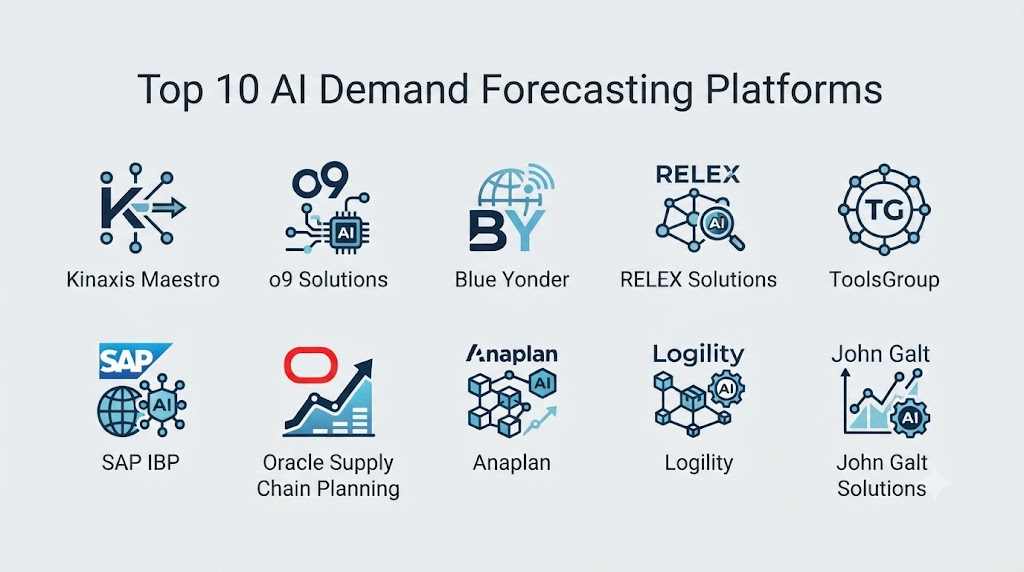
Top 10 AI Demand Forecasting Platforms
1. o9 Solutions
One-line verdict: Best for enterprises seeking AI-powered demand forecasting connected to broader supply-chain planning and scenario management.
Short description:
o9 Solutions provides an integrated planning platform that connects demand, supply, inventory, and other business planning processes. Its demand-planning capabilities are designed for complex enterprise environments where forecasting needs to connect with downstream supply-chain decisions.
Standout Capabilities
- Demand forecasting.
- Supply planning.
- Inventory planning.
- Scenario analysis.
- Digital supply-chain modeling.
- AI-assisted planning.
- Collaborative planning.
- Exception management.
AI-Specific Depth
- Model support: AI and machine-learning capabilities vary by application and configuration.
- RAG / knowledge integration: Enterprise data integration varies.
- Evaluation: Forecast evaluation and planning analytics are available, with exact capabilities depending on implementation.
- Guardrails: Enterprise workflow and access controls vary.
- Observability: Supply-chain analytics and planning monitoring capabilities are available.
Pros
- Strong enterprise planning capabilities.
- Connects demand with supply and inventory.
- Useful for complex scenario analysis.
Cons
- Implementation can be substantial.
- May be more platform than a simple forecasting tool.
- Enterprise pricing can be difficult to compare.
Security & Compliance
Enterprise security, identity, access, and governance capabilities vary by deployment and contract. Specific certifications should be verified for the applicable environment.
Deployment & Platforms
- Cloud.
- Enterprise environments.
- Hybrid integrations.
Integrations & Ecosystem
o9 can connect demand forecasting with broader enterprise planning systems.
- ERP.
- Supply-chain systems.
- Inventory systems.
- Procurement.
- Manufacturing.
- APIs.
- Enterprise data platforms.
Pricing Model
Enterprise/custom pricing; exact pricing is Not publicly stated.
Best-Fit Scenarios
- Global demand planning.
- Complex manufacturing networks.
- Integrated demand and supply planning.
2. Kinaxis Maestro
One-line verdict: Best for organizations needing responsive demand planning connected with concurrent supply-chain planning and decision-making.
Short description:
Kinaxis provides supply-chain planning and orchestration capabilities for organizations managing complex demand, supply, inventory, and operational networks. Its platform supports demand planning while connecting forecasts to broader supply-chain decisions.
Standout Capabilities
- Demand planning.
- Supply planning.
- Inventory planning.
- Scenario analysis.
- Supply-chain orchestration.
- Exception management.
- AI-assisted planning.
- Concurrent planning.
AI-Specific Depth
- Model support: AI/ML capabilities vary by application.
- RAG / knowledge integration: Enterprise knowledge integration varies.
- Evaluation: Forecast and planning evaluation capabilities vary.
- Guardrails: Workflow and enterprise controls vary.
- Observability: Supply-chain monitoring and analytics capabilities.
Pros
- Strong supply-chain integration.
- Good scenario-planning capabilities.
- Suitable for complex demand environments.
Cons
- Enterprise implementation can be complex.
- May be excessive for smaller organizations.
- Exact AI capabilities depend on the selected modules.
Security & Compliance
Enterprise security and governance capabilities vary by service and deployment. Specific certifications should be verified.
Deployment & Platforms
- Cloud.
- Enterprise.
- Hybrid integrations.
Integrations & Ecosystem
- ERP.
- MES.
- Inventory.
- Procurement.
- Supply-chain systems.
- APIs.
- Enterprise data platforms.
Pricing Model
Enterprise/custom pricing; exact pricing is Not publicly stated.
Best-Fit Scenarios
- Global supply chains.
- High-demand variability.
- Complex supply-and-demand planning.
3. Blue Yonder
One-line verdict: Best for manufacturers, retailers, and distributors combining AI forecasting with inventory and supply-chain planning.
Short description:
Blue Yonder offers supply-chain planning and execution capabilities covering demand planning, supply planning, inventory, replenishment, warehouse operations, and fulfillment. Its demand-planning capabilities are particularly relevant to organizations managing large product and location portfolios.
Standout Capabilities
- Demand forecasting.
- Inventory planning.
- Replenishment.
- Supply planning.
- Demand sensing.
- Scenario planning.
- Supply-chain analytics.
- AI-enabled planning.
AI-Specific Depth
- Model support: AI and machine-learning capabilities vary by product.
- RAG / knowledge integration: Varies / N/A.
- Evaluation: Forecast-performance measurement varies by solution.
- Guardrails: Enterprise controls vary.
- Observability: Supply-chain analytics and monitoring are available.
Pros
- Broad supply-chain functionality.
- Strong fit for large product portfolios.
- Demand planning connects with inventory and supply.
Cons
- Large platform footprint.
- Implementation can require significant resources.
- Organizations may not need every component.
Security & Compliance
Security and administrative capabilities vary by deployment. Specific certifications should be verified for the selected service.
Deployment & Platforms
- Cloud.
- Enterprise.
- Hybrid integrations.
Integrations & Ecosystem
- ERP.
- WMS.
- TMS.
- Inventory.
- Procurement.
- Manufacturing.
- APIs.
Pricing Model
Enterprise/custom pricing varies.
Best-Fit Scenarios
- Retail demand forecasting.
- Manufacturing demand planning.
- Large-scale replenishment.
4. SAP Integrated Business Planning
One-line verdict: Best for SAP-centric organizations requiring enterprise demand forecasting integrated with supply and inventory planning.
Short description:
SAP Integrated Business Planning provides demand planning and forecasting alongside supply and inventory planning capabilities. It is particularly suitable for organizations already invested in SAP enterprise applications.
Standout Capabilities
- Demand forecasting.
- Statistical forecasting.
- Demand planning.
- Supply planning.
- Inventory planning.
- Scenario analysis.
- Collaboration.
- Enterprise integration.
AI-Specific Depth
- Model support: SAP AI and machine-learning capabilities vary by application.
- RAG / knowledge integration: Enterprise data integration varies.
- Evaluation: Forecast accuracy and planning analytics capabilities vary.
- Guardrails: Enterprise governance and access controls vary.
- Observability: Planning analytics and monitoring capabilities.
Pros
- Strong SAP ecosystem integration.
- Broad supply-chain planning.
- Suitable for large enterprises.
Cons
- Best fit for SAP-oriented organizations.
- Implementation can be complex.
- Requires planning expertise.
Security & Compliance
SAP provides enterprise security and governance capabilities. Exact certifications and controls depend on the relevant service and deployment.
Deployment & Platforms
- Cloud.
- Enterprise.
- Hybrid integrations.
Integrations & Ecosystem
- SAP ERP.
- Manufacturing.
- Inventory.
- Procurement.
- Supplier systems.
- APIs.
- Enterprise analytics.
Pricing Model
Enterprise subscription/custom pricing varies.
Best-Fit Scenarios
- SAP-based manufacturers.
- Global demand planning.
- Integrated supply-chain planning.
5. Oracle Fusion Cloud Supply Chain & Manufacturing
One-line verdict: Best for Oracle customers wanting AI-assisted demand forecasting connected with enterprise supply-chain and manufacturing processes.
Short description:
Oracle Fusion Cloud Supply Chain & Manufacturing provides demand-management, supply-planning, inventory, procurement, and manufacturing capabilities. Its broader Oracle AI ecosystem can support intelligent planning and analytics.
Standout Capabilities
- Demand management.
- Demand forecasting.
- Supply planning.
- Inventory planning.
- Manufacturing.
- Procurement.
- Scenario planning.
- Analytics.
AI-Specific Depth
- Model support: Oracle AI capabilities vary by service.
- RAG / knowledge integration: Available through applicable Oracle data and AI services.
- Evaluation: Varies by AI application.
- Guardrails: Enterprise AI and security controls vary.
- Observability: Cloud and application monitoring capabilities.
Pros
- Strong Oracle ecosystem.
- Broad enterprise supply-chain functionality.
- Useful integration with procurement and manufacturing.
Cons
- Enterprise implementation complexity.
- Advanced functionality may require specialist expertise.
- Less suitable for simple forecasting needs.
Security & Compliance
Oracle provides enterprise security and governance capabilities. Specific certifications should be confirmed for the relevant services and regions.
Deployment & Platforms
- Cloud.
- Hybrid integrations.
- Enterprise environments.
Integrations & Ecosystem
- Oracle ERP.
- Inventory.
- Manufacturing.
- Procurement.
- WMS.
- APIs.
- Analytics.
Pricing Model
Enterprise subscription/custom pricing varies.
Best-Fit Scenarios
- Oracle-based organizations.
- Enterprise demand planning.
- Integrated manufacturing planning.
6. Microsoft Dynamics 365 Supply Chain Management
One-line verdict: Best for Microsoft-oriented businesses seeking demand forecasting connected with ERP, inventory, procurement, and planning.
Short description:
Dynamics 365 Supply Chain Management provides capabilities for demand forecasting, master planning, inventory, procurement, manufacturing, and warehouse management. Its Microsoft ecosystem also provides opportunities to connect forecasting workflows with broader analytics and AI services.
Standout Capabilities
- Demand forecasting.
- Master planning.
- Inventory management.
- Procurement.
- Manufacturing.
- Warehouse management.
- Business analytics.
- AI-assisted workflows.
AI-Specific Depth
- Model support: Microsoft AI capabilities vary by service and configuration.
- RAG / knowledge integration: Available through applicable Microsoft data and AI services.
- Evaluation: Depends on the AI functionality used.
- Guardrails: Enterprise security and AI controls vary.
- Observability: Microsoft cloud and application monitoring capabilities.
Pros
- Strong Microsoft ecosystem.
- Broad ERP and supply-chain integration.
- Useful for organizations already using Dynamics.
Cons
- Advanced forecasting may require configuration.
- AI capabilities can span multiple Microsoft services.
- Full implementation can be complex.
Security & Compliance
Microsoft provides extensive enterprise security, identity, and compliance capabilities. Exact certification applicability depends on the selected service and deployment.
Deployment & Platforms
- Cloud.
- Hybrid.
- Web-based enterprise applications.
Integrations & Ecosystem
- Power Platform.
- Azure.
- ERP.
- MES.
- WMS.
- Procurement.
- APIs.
Pricing Model
Subscription and enterprise licensing vary by configuration.
Best-Fit Scenarios
- Microsoft-based businesses.
- Mid-market manufacturers.
- Integrated demand and inventory planning.
7. ToolsGroup
One-line verdict: Best for organizations prioritizing machine-learning demand forecasting, inventory optimization, and service-level improvement.
Short description:
ToolsGroup focuses on supply-chain planning and inventory optimization. Its capabilities include demand forecasting, replenishment, inventory optimization, and related planning workflows.
Standout Capabilities
- Demand forecasting.
- Demand sensing.
- Inventory optimization.
- Replenishment.
- Service-level optimization.
- Forecast analytics.
- Scenario planning.
- Inventory segmentation.
AI-Specific Depth
- Model support: Proprietary forecasting and optimization approaches; exact model options vary.
- RAG / knowledge integration: Varies / N/A.
- Evaluation: Forecast-performance measurement and planning analytics.
- Guardrails: Workflow controls vary.
- Observability: Forecast and inventory analytics.
Pros
- Strong demand and inventory focus.
- Useful for complex demand patterns.
- More specialized than broad ERP platforms.
Cons
- Integration work may be required.
- Exact functionality varies by implementation.
- Supply-chain expertise may still be required.
Security & Compliance
Security and compliance capabilities vary by deployment. Specific certifications should be verified.
Deployment & Platforms
- Cloud.
- Enterprise environments.
Integrations & Ecosystem
- ERP.
- WMS.
- Supply-chain systems.
- Inventory systems.
- Demand data.
- APIs.
Pricing Model
Enterprise/custom pricing; exact pricing is Not publicly stated.
Best-Fit Scenarios
- Large SKU portfolios.
- Demand variability.
- Inventory-focused forecasting.
8. Anaplan
One-line verdict: Best for organizations wanting flexible connected planning, forecasting, scenario modeling, and cross-functional decision support.
Short description:
Anaplan is a connected planning platform that can be used for demand, supply, inventory, financial, workforce, and operational planning. Its flexible modeling architecture is useful when forecasting must connect multiple business functions.
Standout Capabilities
- Demand planning.
- Scenario modeling.
- Connected planning.
- Forecasting.
- Supply planning.
- Collaboration.
- Business analytics.
- Workflow management.
AI-Specific Depth
- Model support: AI capabilities vary by platform and application.
- RAG / knowledge integration: Varies / N/A.
- Evaluation: Forecast and planning evaluation varies.
- Guardrails: Enterprise administration and workflow controls.
- Observability: Planning analytics and monitoring.
Pros
- Flexible planning architecture.
- Strong scenario modeling.
- Cross-functional planning support.
Cons
- Requires model design and implementation.
- Not solely a demand-forecasting product.
- Complexity can increase with custom models.
Security & Compliance
Enterprise security and administrative capabilities vary by service and deployment.
Deployment & Platforms
- Cloud.
- Web.
- Enterprise integrations.
Integrations & Ecosystem
- ERP.
- CRM.
- Supply-chain systems.
- Data warehouses.
- APIs.
- Enterprise databases.
Pricing Model
Enterprise subscription/custom pricing; exact pricing is Not publicly stated.
Best-Fit Scenarios
- Connected demand planning.
- Scenario analysis.
- Cross-functional forecasting.
9. SAS Viya
One-line verdict: Best for organizations wanting advanced statistical modeling, machine learning, forecasting, and enterprise analytics.
Short description:
SAS Viya provides an enterprise analytics and AI platform supporting statistical analysis, machine learning, forecasting, and model management. It can be used to build sophisticated demand forecasting workflows where organizations need deeper analytical control.
Standout Capabilities
- Statistical forecasting.
- Machine learning.
- Predictive analytics.
- Model management.
- Scenario analysis.
- Data preparation.
- Advanced analytics.
- Enterprise AI workflows.
AI-Specific Depth
- Model support: Supports a broad range of analytics and machine-learning approaches.
- RAG / knowledge integration: Available capabilities vary by SAS and deployed services.
- Evaluation: Strong model evaluation and validation capabilities.
- Guardrails: Enterprise governance and model-management capabilities.
- Observability: Model monitoring and analytics capabilities vary by deployment.
Pros
- Strong analytical capabilities.
- Suitable for sophisticated forecasting models.
- Good model-management foundation.
Cons
- Requires analytics expertise.
- Can be more complex than specialized forecasting SaaS.
- Implementation may require data-science resources.
Security & Compliance
Enterprise security, governance, access control, and auditing capabilities are available; specific certifications depend on deployment.
Deployment & Platforms
- Cloud.
- Hybrid.
- Enterprise environments.
Integrations & Ecosystem
- Databases.
- Data warehouses.
- APIs.
- Enterprise applications.
- Analytics environments.
- Machine-learning workflows.
Pricing Model
Enterprise/custom pricing; exact pricing is Not publicly stated.
Best-Fit Scenarios
- Advanced demand modeling.
- Data-science-led organizations.
- Enterprise forecasting teams.
10. FICO Platform
One-line verdict: Best for organizations combining predictive analytics, optimization, decision intelligence, and complex business planning.
Short description:
FICO provides analytics, decisioning, optimization, and AI technologies that can be applied to complex business planning problems. Its optimization capabilities can be particularly relevant when demand forecasting needs to connect with inventory and operational decisions.
Standout Capabilities
- Predictive analytics.
- Machine learning.
- Optimization.
- Decision intelligence.
- Scenario analysis.
- Model management.
- Enterprise analytics.
- Business decision workflows.
AI-Specific Depth
- Model support: Multiple analytics and machine-learning approaches.
- RAG / knowledge integration: Varies / N/A.
- Evaluation: Model evaluation and analytical validation capabilities vary.
- Guardrails: Decision governance and enterprise controls vary.
- Observability: Model and decision monitoring capabilities vary.
Pros
- Strong optimization capabilities.
- Suitable for sophisticated decision-making.
- Useful beyond simple forecasting.
Cons
- May require specialist analytical expertise.
- Not primarily a plug-and-play demand forecasting application.
- Enterprise implementation can be complex.
Security & Compliance
Enterprise security and governance capabilities vary by product and deployment. Specific certifications should be independently verified.
Deployment & Platforms
- Cloud.
- Enterprise.
- Hybrid architectures.
Integrations & Ecosystem
- ERP.
- Data warehouses.
- APIs.
- Enterprise analytics.
- Decision systems.
- Business applications.
Pricing Model
Enterprise/custom pricing; exact pricing is Not publicly stated.
Best-Fit Scenarios
- Complex demand optimization.
- Enterprise decision intelligence.
- Forecasting combined with optimization.
Comparison Table
| Tool | Best For | Deployment | Model Flexibility | Strength | Watch-Out | Public Rating |
|---|---|---|---|---|---|---|
| o9 Solutions | Enterprise demand planning | Cloud / Hybrid | Multi-model / Varies | Integrated planning | Implementation complexity | N/A |
| Kinaxis Maestro | Responsive supply chains | Cloud / Hybrid | Multi-model / Varies | Concurrent planning | Enterprise complexity | N/A |
| Blue Yonder | Retail + manufacturing | Cloud / Hybrid | Multi-model / Varies | Demand and supply integration | Large platform footprint | N/A |
| SAP IBP | SAP-centric enterprises | Cloud / Hybrid | Multi-model / Varies | Enterprise integration | SAP ecosystem complexity | N/A |
| Oracle Fusion SCM | Oracle enterprises | Cloud / Hybrid | Multi-model / Varies | Integrated SCM | Implementation effort | N/A |
| Microsoft Dynamics 365 SCM | Microsoft-oriented organizations | Cloud / Hybrid | Multi-model / Varies | ERP integration | Configuration effort | N/A |
| ToolsGroup | Inventory-focused forecasting | Cloud | Varies | Forecast + inventory optimization | Integration requirements | N/A |
| Anaplan | Connected planning | Cloud | Multi-model / Varies | Scenario modeling | Requires model design | N/A |
| SAS Viya | Advanced analytics | Cloud / Hybrid | Multi-model / Open analytics | Statistical + ML depth | Requires expertise | N/A |
| FICO Platform | Optimization + decision intelligence | Cloud / Hybrid | Multi-model / Varies | Optimization | Specialist implementation | N/A |
Scoring & Evaluation
The following scores are comparative assessments for demand-forecasting use cases and are not official vendor ratings.
The weighting is:
- Core features – 20%
- AI reliability & evaluation – 15%
- Guardrails & safety – 10%
- Integrations & ecosystem – 15%
- Ease of use – 10%
- Performance & cost controls – 15%
- Security & admin – 10%
- Support & community – 5%
| Tool | Core | Reliability/Eval | Guardrails | Integrations | Ease | Perf/Cost | Security/Admin | Support | Weighted Total |
|---|---|---|---|---|---|---|---|---|---|
| o9 Solutions | 10 | 9 | 9 | 10 | 7 | 8 | 10 | 9 | 9.00 |
| Kinaxis Maestro | 10 | 9 | 9 | 10 | 7 | 9 | 10 | 9 | 9.15 |
| Blue Yonder | 10 | 9 | 9 | 10 | 8 | 8 | 10 | 9 | 9.10 |
| SAP IBP | 10 | 9 | 10 | 10 | 7 | 8 | 10 | 10 | 9.20 |
| Oracle Fusion SCM | 10 | 9 | 10 | 10 | 7 | 8 | 10 | 10 | 9.20 |
| Microsoft Dynamics 365 SCM | 9 | 8 | 9 | 10 | 8 | 9 | 10 | 10 | 9.00 |
| ToolsGroup | 9 | 9 | 8 | 9 | 8 | 9 | 9 | 9 | 8.80 |
| Anaplan | 8 | 8 | 9 | 9 | 8 | 8 | 9 | 9 | 8.55 |
| SAS Viya | 9 | 10 | 9 | 9 | 6 | 8 | 10 | 10 | 8.90 |
| FICO Platform | 9 | 9 | 9 | 9 | 6 | 8 | 10 | 9 | 8.70 |
Top 3 for Enterprise
- SAP Integrated Business Planning — Strong choice for organizations operating extensively within the SAP ecosystem.
- Oracle Fusion Cloud Supply Chain & Manufacturing — Strong enterprise supply-chain integration.
- Kinaxis Maestro — Particularly useful for complex and rapidly changing supply networks.
Top 3 for SMB
- Microsoft Dynamics 365 Supply Chain Management — Attractive for organizations already using the Microsoft ecosystem.
- ToolsGroup — Stronger focus on demand and inventory optimization.
- Anaplan — Useful where flexible planning and scenario modeling matter.
Top 3 for Developers
- SAS Viya — Strong analytical and machine-learning capabilities.
- FICO Platform — Useful for advanced optimization and decisioning.
- Anaplan — Flexible connected-planning architecture and integrations.
Which AI Demand Forecasting Platform Is Right for You?
Solo / Freelancer
For small businesses, a dedicated enterprise forecasting platform may be unnecessary.
Focus on:
- Clean historical demand data.
- Simple forecasting.
- Seasonality.
- Basic scenario analysis.
- Easy exports.
- Spreadsheet integration.
- Transparent forecast metrics.
The most important thing is to avoid overengineering the forecasting process.
SMB
SMBs should prioritize:
- Ease of deployment.
- ERP integration.
- SKU-level forecasts.
- Forecast accuracy.
- Automated model selection.
- Simple dashboards.
- Planner overrides.
- Affordable scaling.
A specialized forecasting platform can be valuable when demand variability is causing significant inventory or fulfillment problems.
Mid-Market
Mid-market organizations should connect demand forecasting to:
Sales → Demand Forecast → Inventory → Procurement → Production → Fulfillment
Important capabilities include:
- Multi-location forecasting.
- Promotion modeling.
- Demand sensing.
- Scenario planning.
- Forecast-bias monitoring.
- Inventory integration.
- Supplier planning.
Enterprise
Enterprise organizations should evaluate:
- Multi-country forecasting.
- Multi-channel demand.
- Thousands of SKUs.
- Product hierarchies.
- Probabilistic forecasting.
- External signals.
- Scenario planning.
- Demand sensing.
- AI governance.
- Model monitoring.
- Data residency.
- ERP/MES/WMS integration.
- Human planning workflows.
SAP, Oracle, Kinaxis, o9 Solutions, and Blue Yonder are particularly relevant when demand forecasting must operate as part of a broader enterprise planning architecture.
Regulated Industries
Organizations in regulated environments should examine:
- Data residency.
- Data retention.
- Access control.
- Audit logs.
- Encryption.
- Model governance.
- Human approval.
- Explainability.
- Data lineage.
- AI decision records.
Forecasting data may include sensitive commercial information, so security should be evaluated alongside accuracy.
Budget vs Premium
A simpler solution may be sufficient when:
- Product portfolios are small.
- Demand is predictable.
- There are few locations.
- Forecast horizons are short.
- Inventory costs are low.
Premium platforms become more attractive when:
- Thousands of SKUs exist.
- Demand is volatile.
- Multiple locations are involved.
- Promotions significantly influence sales.
- Forecast errors create large inventory costs.
- Supply chains are global.
Build vs Buy
Build when:
- You have a strong data-science team.
- Forecasting logic is highly specialized.
- You need proprietary models.
- Data is already centralized.
- Your organization can maintain models long term.
Buy when:
- You need rapid deployment.
- Forecasting must integrate with ERP and supply-chain workflows.
- You need mature planning capabilities.
- Internal AI expertise is limited.
A hybrid strategy can also work: use a commercial platform for planning workflows while developing specialized models for particular products or markets.
Implementation Playbook: 30 / 60 / 90 Days
First 30 Days: Pilot + Success Metrics
Choose one product family or business unit.
Collect:
- Historical sales.
- SKU information.
- Location.
- Pricing.
- Promotions.
- Seasonality.
- Stockouts.
- Product launches.
- Returns.
- Orders.
- Lead times.
Establish baseline metrics:
- Forecast accuracy.
- Forecast bias.
- Stockout rate.
- Excess inventory.
- Inventory turnover.
- Service level.
- Planning effort.
Compare the AI forecast against the current forecasting process.
Days 31–60: Harden Security + Evaluation + Rollout
Create an evaluation dataset containing different demand conditions.
Test:
- Normal demand.
- Seasonal demand.
- Demand spikes.
- Demand declines.
- Intermittent demand.
- Promotions.
- New products.
- Stockout periods.
Evaluate:
- Forecast accuracy.
- Bias.
- Stability.
- Confidence intervals.
- Planner overrides.
- Model failures.
For AI assistants, test:
- Hallucinations.
- Incorrect forecast explanations.
- Prompt injection.
- Unauthorized data access.
- Retrieval errors.
- Incorrect business recommendations.
Implement:
- Model version control.
- Forecast versioning.
- Data lineage.
- Access control.
- Audit logging.
- Human approval.
- Incident handling.
Days 61–90: Optimize Cost, Latency + Governance + Scale
Once the pilot demonstrates value:
- Automate forecast generation.
- Tune model frequency.
- Optimize data pipelines.
- Reduce unnecessary model processing.
- Establish forecast thresholds.
- Introduce automated exception detection.
- Expand to additional product families.
Create governance around:
- Forecast overrides.
- Model changes.
- New product forecasts.
- External signals.
- AI-generated explanations.
- Model drift.
- Forecast anomalies.
Common Mistakes & How to Avoid Them
- Poor historical data: Inaccurate sales data creates unreliable forecasts.
- Ignoring stockouts: Historical sales may understate true demand when products were unavailable.
- Ignoring promotions: Promotional demand can distort standard forecasting models.
- No forecast-bias monitoring: A model can appear accurate while systematically over- or under-forecasting.
- Using only one model: Different demand patterns may require different forecasting approaches.
- Ignoring intermittent demand: Spare parts and slow-moving products require specialized techniques.
- Overusing external signals: More data does not automatically mean better forecasts.
- No evaluation framework: Forecasting performance must be measured continuously.
- Ignoring planner expertise: Human knowledge can provide important information that historical data cannot capture.
- No model-drift monitoring: Customer behavior and market conditions change.
- Ignoring uncertainty: A single forecast number can hide significant risk.
- No scenario planning: Organizations need to understand how forecasts behave under alternative conditions.
- Excessive automation: AI forecasts should not automatically drive major purchasing decisions without appropriate controls.
- Ignoring data privacy: Commercial demand data can be highly sensitive.
- Creating too many alerts: Forecasting teams can become overwhelmed by unnecessary exceptions.
- Vendor lock-in: Maintain data portability and integration flexibility from the beginning.
FAQs
1. What is an AI demand forecasting platform?
An AI demand forecasting platform uses machine learning, statistical methods, historical demand, and additional business signals to estimate future demand for products, services, materials, or locations.
2. How is AI demand forecasting different from traditional forecasting?
Traditional forecasting often relies on statistical techniques and manual adjustments. AI forecasting can analyze larger sets of variables and select or combine models based on demand patterns.
3. Can AI forecast demand at the SKU level?
Yes. Many demand-planning systems support SKU-level forecasting, often combined with product, location, channel, and time hierarchies.
4. Can AI forecast demand for new products?
Yes, but new-product forecasting is more challenging because historical demand may not exist. Systems may use product attributes, comparable products, market information, or planner assumptions.
5. Can AI account for promotions?
Many forecasting platforms can incorporate promotional information. The quality of promotional forecasting depends on the availability and accuracy of promotion data.
6. Can AI demand forecasting reduce inventory?
Better forecasts can help organizations align inventory with expected demand. However, inventory reduction should not be the only objective because service levels and stockout risks must also be considered.
7. Can AI predict sudden demand spikes?
AI can identify changing patterns and incorporate certain external or operational signals, but extreme events remain difficult to predict reliably.
8. What data is required for AI demand forecasting?
Common inputs include historical sales, orders, SKU information, locations, prices, promotions, seasonality, stockouts, product launches, and other relevant business signals.
9. Can AI demand forecasting work with ERP systems?
Yes. ERP integration is commonly used to obtain sales, inventory, procurement, product, and order information.
10. Can AI demand forecasting work with MES?
Yes. For manufacturers, MES data can provide production information that helps connect demand forecasts with manufacturing capacity and planning.
11. Can these platforms use external data?
Some platforms can incorporate external variables such as weather, events, market information, or economic indicators. Exact capabilities vary.
12. What is probabilistic demand forecasting?
Probabilistic forecasting provides a range of possible future demand outcomes rather than relying exclusively on one forecast number. This can help planners understand uncertainty.
13. Can AI explain why a forecast changed?
Some platforms provide forecast drivers, explanations, or analytics. The depth of explainability varies significantly between products.
14. Can AI automatically override human forecasts?
Some systems support automated workflows, but organizations should establish governance rules before allowing AI to override human planning decisions.
15. Can AI agents help demand planners?
Yes. AI agents can potentially investigate forecast exceptions, summarize demand changes, compare scenarios, retrieve planning information, and prepare recommendations.
16. How should an AI forecasting system be evaluated?
Use metrics such as forecast accuracy, bias, service level, stockout reduction, inventory impact, forecast stability, and business value.
17. What is forecast bias?
Forecast bias measures whether forecasts consistently overestimate or underestimate actual demand. Persistent bias can create excess inventory or stockout risk.
18. Does AI forecasting require a large amount of historical data?
Not necessarily, but sufficient high-quality data generally improves forecasting reliability. New products and intermittent-demand items require additional techniques.
19. Can AI forecasting be self-hosted?
Deployment options vary. Many enterprise platforms are cloud-based, while some organizations can support hybrid architectures or specialized analytics environments.
20. Can companies use their own AI models?
Some platforms support external models or customized analytics, while others rely primarily on their own forecasting technology. BYO-model support should be verified during technical evaluation.
21. How can companies protect demand data?
Use encryption, least-privilege access, RBAC, SSO where appropriate, audit logging, data-retention controls, secure APIs, and appropriate data-residency policies.
22. What is the biggest challenge in AI demand forecasting?
Data quality is one of the biggest challenges. Incorrect sales records, stockouts, missing promotions, inconsistent product hierarchies, and incomplete historical information can significantly reduce forecast quality.
Conclusion
AI Demand Forecasting Platforms can help organizations make better decisions about future demand, inventory, production, procurement, staffing, and fulfillment. Their value increases when forecasting is connected to the broader planning process rather than treated as an isolated prediction exercise.Platforms such as o9 Solutions, Kinaxis Maestro, Blue Yonder, SAP Integrated Business Planning, Oracle Fusion Cloud Supply Chain & Manufacturing, and Microsoft Dynamics 365 Supply Chain Management are particularly relevant for organizations that want forecasting integrated with enterprise planning.ToolsGroup offers a more specialized supply-chain and inventory-oriented approach, while SAS Viya and FICO can be attractive for organizations with sophisticated analytics and optimization requirements. Anaplan is useful when demand forecasting needs to participate in broader connected planning and scenario modeling.