Introduction
AI API Documentation Generators are software development tools that use artificial intelligence to automatically create, update, and maintain API documentation from source code, API specifications, and development workflows.
API documentation is essential for helping developers understand how to use, integrate, and maintain software interfaces. However, manually writing and updating documentation can be time-consuming, especially when APIs change frequently.
AI API Documentation Generators help development teams create accurate and developer-friendly documentation by analyzing:
- API endpoints
- Source code
- API schemas
- Request and response structures
- Authentication methods
- Code examples
- Developer workflows
These tools provide capabilities such as:
- Automated API documentation creation
- Endpoint description generation
- Example code generation
- API schema analysis
- Documentation updates
- Natural language explanations
- Developer portal support
AI API Documentation Generators are used by:
- Software developers
- API engineers
- DevOps teams
- Developer advocates
- Platform engineering teams
- Enterprise software organizations
They integrate with:
- API gateways
- Git repositories
- IDEs
- CI/CD pipelines
- Developer portals
The goal of AI API Documentation Generators is to reduce documentation effort, improve API usability, and ensure developers always have updated technical information.
Why AI API Documentation Generators Matter
Modern applications depend on:
- Internal APIs
- Public APIs
- Microservices
- Third-party integrations
Poor documentation can create:
- Integration delays
- Developer confusion
- Increased support requests
- API adoption problems
AI documentation tools help organizations:
- Maintain accurate API references
- Improve developer experience
- Reduce documentation workload
- Accelerate integrations
- Support API-first development
How AI API Documentation Generators Work
Step 1: Analyze API Sources
Tools collect information from:
- Source code
- OpenAPI specifications
- API schemas
- Repository files
Step 2: Understand API Behavior
AI identifies:
- Endpoints
- Parameters
- Responses
- Authentication flows
Step 3: Generate Documentation
The system creates:
- Endpoint descriptions
- Usage guides
- Examples
- Explanations
Step 4: Validate Documentation
Tools check:
- Accuracy
- Completeness
- API consistency
Step 5: Maintain Updates
Documentation stays synchronized with:
- Code changes
- API versions
- New releases
Key Features of AI API Documentation Generators
Automatic Documentation Creation
Generates:
- API references
- Endpoint details
- Technical explanations
Code Example Generation
Creates examples for:
- Python
- JavaScript
- Java
- Other languages
OpenAPI Support
Works with:
- Swagger
- OpenAPI specifications
Natural Language Explanations
Converts technical details into:
- Developer-friendly descriptions
Documentation Synchronization
Updates documentation when:
- APIs change
Developer Portal Integration
Supports:
- API catalogs
- Documentation websites
Common Use Cases
API Development Teams
Creating:
- Internal API references
- Developer guides
Enterprise Platforms
Managing:
- Large API ecosystems
SaaS Products
Improving:
- Customer integrations
Microservices Architecture
Documenting:
- Service interfaces
Open Source Projects
Maintaining:
- Public API documentation
Developer Experience Teams
Improving:
- API adoption
Benefits of AI API Documentation Generators
Faster Documentation Creation
Reduces manual writing effort.
Better Documentation Accuracy
Keeps information aligned with APIs.
Improved Developer Experience
Makes APIs easier to understand.
Reduced Maintenance Work
Automates updates.
Faster API Adoption
Helps developers integrate quickly.
Challenges of AI API Documentation Generators
Incorrect Descriptions
AI output requires review.
Missing Business Context
AI may not understand API purpose.
Security Concerns
Sensitive API information must be protected.
Documentation Quality
Generated content may need editing.
Complex API Systems
Large architectures require configuration.
Evaluation Criteria
Documentation Accuracy
Evaluate:
- Correct endpoint information
- Completeness
API Understanding
Consider:
- Schema analysis
- Code understanding
Automation
Evaluate:
- Generation workflows
- Update capabilities
Integration
Check:
- API tools
- Git platforms
- CI/CD systems
Developer Experience
Consider:
- Readability
- Usability
Enterprise Support
Evaluate:
- Security
- Governance
Key Trends
AI-Powered Developer Experience
Organizations are using AI to improve API usability.
Automated API Portals
AI is helping maintain:
- Dynamic documentation platforms
Code-to-Documentation Workflows
Development teams are moving toward:
- Automatic documentation generation
Conversational API Documentation
Future systems will allow developers to:
- Ask questions about APIs directly
Continuous API Intelligence
AI will monitor:
- API changes
- Documentation accuracy
Methodology
The following AI API Documentation Generators were evaluated based on:
- Documentation generation quality
- API understanding
- Automation
- Integration
- Developer experience
- Scalability
- Enterprise readiness
- Accuracy
- Customization
- Value
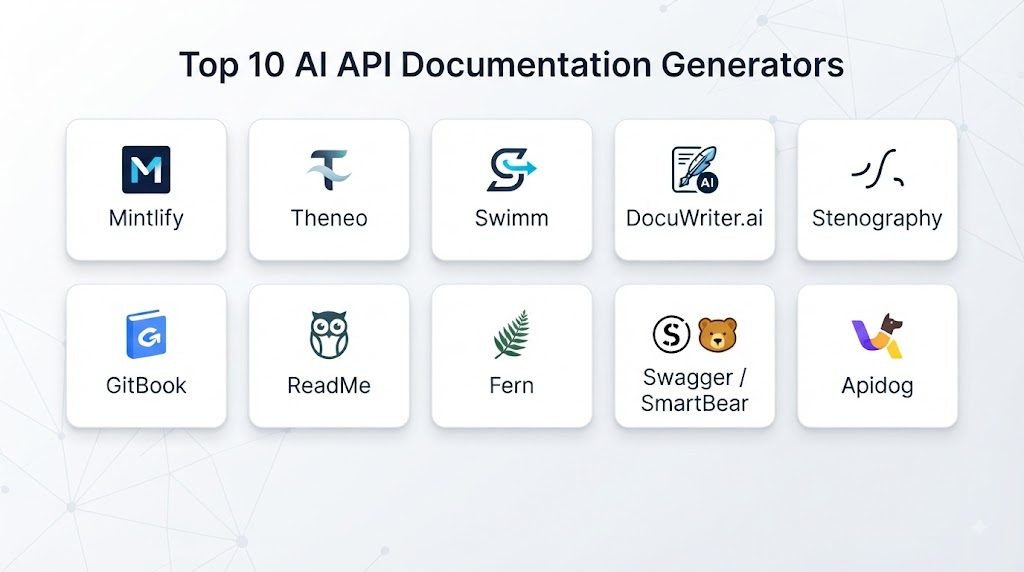
Top 10 AI API Documentation Generators
1. Mintlify
Mintlify provides AI-powered documentation generation for developer-focused products.
Key Features
- AI documentation writing
- Code-based documentation
- API reference generation
- Developer portal support
- Documentation updates
Pros
- Modern developer experience
- Strong AI documentation workflow
Cons
- Best suited for developer products
2. Swimm
Swimm provides AI-assisted documentation for software teams.
Key Features
- Code documentation
- Knowledge sharing
- Documentation synchronization
- Developer onboarding
Pros
- Strong engineering documentation
- Code context awareness
Cons
- More focused on internal documentation
3. GitBook AI
GitBook provides AI-powered technical documentation capabilities.
Key Features
- Documentation generation
- Knowledge management
- Collaboration
- Developer guides
Pros
- Easy collaboration
- Strong documentation platform
Cons
- Requires content management setup
4. ReadMe AI
ReadMe provides API documentation and developer portal solutions.
Key Features
- API reference pages
- Developer portals
- API analytics
- Documentation assistance
Pros
- Strong API documentation features
- Developer-focused
Cons
- Advanced features require configuration
5. Postman Documentation AI
Postman provides API development and documentation capabilities.
Key Features
- API documentation generation
- Collections
- Examples
- API collaboration
Pros
- Popular API platform
- Strong API workflow integration
Cons
- Best for Postman users
6. Stoplight Studio AI
Stoplight provides API design and documentation tools.
Key Features
- OpenAPI documentation
- API design
- Schema management
- Documentation generation
Pros
- Strong API governance
- Good design workflow
Cons
- Requires API design knowledge
7. SwaggerHub AI
SwaggerHub provides API lifecycle management.
Key Features
- OpenAPI documentation
- API design
- Collaboration
- API governance
Pros
- Industry-standard API format
- Enterprise support
Cons
- Enterprise-focused
8. Document360 AI
Document360 provides AI-powered knowledge base documentation.
Key Features
- Documentation generation
- Knowledge management
- Search capabilities
- Content organization
Pros
- Strong knowledge management
- Easy organization
Cons
- Not only API-focused
9. Docusaurus AI Documentation Workflow
Docusaurus supports documentation websites with AI-assisted workflows.
Key Features
- Documentation sites
- Markdown support
- Developer documentation
- Customization
Pros
- Open source
- Flexible
Cons
- Requires technical setup
10. Scribe AI
Scribe provides AI-powered documentation creation.
Key Features
- Automated guides
- Step-by-step documentation
- Workflow capture
- Content generation
Pros
- Easy documentation creation
- Good automation
Cons
- More workflow-focused
Comparison Table: Top 10 AI API Documentation Generators
| No. | Tool Name | Best For | Platform(s) Supported | Deployment | Standout Feature | Public Rating |
|---|---|---|---|---|---|---|
| 1 | Mintlify | Developer documentation | Cloud | Managed | AI docs generation | 4.7/5 |
| 2 | Swimm | Engineering docs | Cloud | Managed | Code context docs | 4.6/5 |
| 3 | GitBook AI | Technical documentation | Cloud | Managed | Collaboration | 4.6/5 |
| 4 | ReadMe | API portals | Cloud | Managed | API experience | 4.7/5 |
| 5 | Postman Docs AI | API workflows | Cloud | Managed | API integration | 4.7/5 |
| 6 | Stoplight Studio | API design | Cloud/Desktop | Managed | OpenAPI support | 4.6/5 |
| 7 | SwaggerHub | API governance | Cloud | Enterprise | API lifecycle | 4.6/5 |
| 8 | Document360 | Knowledge bases | Cloud | Managed | Documentation management | 4.5/5 |
| 9 | Docusaurus | Developer sites | Open Source | Self-hosted | Custom docs sites | 4.5/5 |
| 10 | Scribe AI | Process documentation | Cloud | Managed | Automated guides | 4.5/5 |
Weighted Evaluation Table
| No. | Tool Name | Documentation Quality 25% | Ease of Use 15% | API Support 15% | Automation 10% | Integration 10% | Scalability 10% | Value 15% | Total Score |
|---|---|---|---|---|---|---|---|---|---|
| 1 | Mintlify | 25 | 15 | 15 | 10 | 10 | 10 | 14 | 99 |
| 2 | Swimm | 24 | 14 | 14 | 10 | 10 | 10 | 14 | 96 |
| 3 | GitBook AI | 24 | 15 | 14 | 10 | 10 | 10 | 14 | 97 |
| 4 | ReadMe | 25 | 14 | 15 | 10 | 10 | 10 | 13 | 97 |
| 5 | Postman Docs AI | 24 | 15 | 15 | 10 | 10 | 10 | 14 | 98 |
| 6 | Stoplight Studio | 24 | 13 | 15 | 10 | 10 | 10 | 13 | 95 |
| 7 | SwaggerHub | 24 | 13 | 15 | 10 | 10 | 10 | 13 | 95 |
| 8 | Document360 | 23 | 15 | 13 | 10 | 10 | 10 | 13 | 94 |
| 9 | Docusaurus | 23 | 12 | 14 | 10 | 10 | 10 | 14 | 93 |
| 10 | Scribe AI | 23 | 15 | 12 | 10 | 10 | 10 | 14 | 94 |
Which AI API Documentation Generator Is Right for You?
Choose Mintlify for modern developer documentation.
Choose Swimm for engineering knowledge sharing.
Choose GitBook AI for collaborative documentation.
Choose ReadMe for API developer portals.
Choose Postman Documentation AI for API workflows.
Choose Stoplight Studio for API design and governance.
Choose SwaggerHub for enterprise API lifecycle management.
Choose Document360 for knowledge bases.
Choose Docusaurus for customizable documentation websites.
Choose Scribe AI for automated process documentation.
Implementation Playbook
Phase 1: Analyze API Documentation Needs
- Identify API consumers
- Define documentation goals
- Select formats
Phase 2: Connect API Sources
- Import schemas
- Connect repositories
- Configure workflows
Phase 3: Generate Documentation
- Create API references
- Add examples
- Review content
Phase 4: Publish Documentation
- Deploy developer portals
- Share documentation
- Collect feedback
Phase 5: Maintain Documentation
- Monitor API changes
- Update content
- Improve developer experience
Common Mistakes
- Publishing AI-generated docs without review
- Ignoring API changes
- Missing examples
- Poor documentation structure
- Exposing sensitive information
- Not involving developers
FAQs
1. What are AI API Documentation Generators?
They are tools that automatically create and maintain API documentation using artificial intelligence.
2. Why use AI for API documentation?
AI reduces manual writing effort and keeps documentation updated.
3. Can AI generate API examples?
Yes, many tools create code examples and usage scenarios.
4. Do AI documentation tools understand APIs?
They can analyze schemas, code, and API structures.
5. Can these tools support OpenAPI?
Yes, many support OpenAPI and Swagger formats.
6. Do AI API documentation tools replace technical writers?
No, they assist writers and developers.
7. Can documentation update automatically after code changes?
Many tools support synchronization workflows.
8. Are AI documentation tools useful for enterprises?
Yes, they support large API ecosystems.
9. Can AI explain complex APIs?
Yes, AI can convert technical details into readable explanations.
10. What is the future of API documentation?
AI will create more interactive, conversational, and automatically maintained API documentation.
Conclusion
AI API Documentation Generators are transforming how organizations create and maintain technical documentation by automating content generation, improving accuracy, and enhancing developer experience.Platforms such as Mintlify, GitBook AI, ReadMe, Postman Documentation AI, Stoplight, SwaggerHub, and Swimm help teams build clearer and more accessible API documentation.As API-driven software development continues growing, AI-powered documentation tools will become an essential part of modern developer workflows, helping teams deliver better integrations and faster developer onboarding.