Introduction
Agent Planning & Reasoning Modules are AI components that help autonomous agents understand goals, analyze situations, make decisions, create plans, and execute complex tasks step by step.
Traditional AI systems mainly respond to direct inputs, while modern AI agents need advanced reasoning capabilities to solve multi-step problems. Agent Planning and Reasoning Modules provide the intelligence layer that allows agents to decide what actions to take, which tools to use, and how to achieve desired outcomes.
As organizations adopt agentic AI systems, planning and reasoning capabilities have become essential for building reliable autonomous applications.
These modules help AI agents:
- Understand complex objectives
- Break large tasks into smaller steps
- Select appropriate actions
- Evaluate possible outcomes
- Adapt plans based on new information
- Coordinate with other agents
- Improve decision-making
Agent Planning & Reasoning Modules are used by:
- AI engineers
- Machine learning researchers
- Enterprise automation teams
- Software developers
- Robotics teams
- Data scientists
- AI product teams
Modern reasoning modules provide capabilities such as:
- Task decomposition
- Goal planning
- Logical reasoning
- Decision-making
- Self-reflection
- Tool selection
- Memory integration
- Workflow optimization
- Multi-agent coordination
The goal of Agent Planning & Reasoning Modules is to enable AI agents to think, plan, and act effectively in complex environments.
What Is Agent Planning?
Agent planning is the process where an AI agent determines the steps required to achieve a specific goal.
For example:
Goal:
“Create a business report.”
Planning steps:
- Collect relevant data
- Analyze information
- Identify insights
- Generate report
- Review final output
Planning allows agents to move from simple responses to autonomous task execution.
What Is AI Reasoning?
AI reasoning is the ability of an AI system to analyze information, understand relationships, evaluate options, and make decisions.
Reasoning helps agents:
- Solve problems
- Understand context
- Make predictions
- Choose actions
- Handle uncertainty
How Agent Planning & Reasoning Modules Work
Goal Understanding
The agent receives a target objective.
Example:
“Optimize customer support workflow.”
Situation Analysis
The system analyzes:
- Available information
- Constraints
- Required resources
Task Decomposition
The goal is divided into smaller actions.
Example:
- Analyze support tickets
- Identify common issues
- Recommend improvements
Plan Generation
The module creates an execution strategy.
Action Selection
The agent chooses:
- Tools
- APIs
- Data sources
- Next steps
Plan Execution
The agent performs tasks and adjusts based on results.
Types of AI Planning Approaches
Rule-Based Planning
Uses predefined rules and workflows.
Benefits:
- Predictable behavior
- Easy control
Goal-Based Planning
The agent creates actions to achieve specific objectives.
Benefits:
- Flexible execution
- Better automation
Hierarchical Planning
Large goals are divided into smaller tasks.
Benefits:
- Handles complex problems
- Improves organization
Reactive Planning
Agents respond dynamically to changes.
Benefits:
- Faster adaptation
- Real-time decisions
Reasoning-Based Planning
Uses AI models to analyze situations and create strategies.
Benefits:
- Better problem solving
- Complex decision support
Key Capabilities of Planning & Reasoning Modules
Task Decomposition
Breaks complex goals into manageable tasks.
Benefits:
- Better execution
- Improved accuracy
Decision Making
Helps agents select the best actions.
Benefits:
- Smarter automation
- Reduced errors
Chain-of-Thought Reasoning
Allows models to process complex problems step by step.
Benefits:
- Better reasoning performance
- Improved problem solving
Planning Optimization
Improves execution strategies.
Benefits:
- Efficient workflows
- Resource optimization
Self-Reflection
Allows agents to evaluate their own outputs.
Benefits:
- Error correction
- Better results
Tool Selection
Helps agents decide which tools to use.
Benefits:
- Better automation
- More accurate actions
Common Use Cases
Autonomous AI Assistants
Agents use reasoning for:
- Personal tasks
- Scheduling
- Research
Software Development Agents
Planning modules help with:
- Code generation
- Debugging
- Testing
- Deployment
Business Automation
AI agents manage:
- Workflows
- Reports
- Decisions
Robotics
Reasoning modules support:
- Navigation
- Planning
- Object interaction
Research Agents
Agents perform:
- Information gathering
- Analysis
- Experiment planning
Enterprise Decision Support
AI helps with:
- Strategy analysis
- Forecasting
- Recommendations
Why Agent Planning & Reasoning Modules Matter
Better Autonomous Systems
Agents can complete tasks independently.
Complex Problem Solving
AI can handle multi-step challenges.
Improved Accuracy
Planning reduces random actions.
Adaptive Intelligence
Agents adjust strategies based on new information.
Enterprise AI Adoption
Reasoning makes AI systems more useful in business environments.
Evaluation Criteria for Buyers
Reasoning Capability
Evaluate:
- Decision quality
- Planning accuracy
- Problem-solving ability
Integration Support
Important compatibility:
- LLMs
- Agent frameworks
- APIs
- Enterprise systems
Planning Flexibility
Look for:
- Custom workflows
- Dynamic planning
- Task management
Memory Integration
Support for:
- Long-term memory
- Context retrieval
- Knowledge systems
Monitoring
Important features:
- Reasoning traces
- Execution logs
- Performance tracking
Security and Governance
Evaluate:
- Control mechanisms
- Human approval
- Safe execution
Key Trends
Advanced Agentic AI
AI systems are becoming more autonomous.
Reasoning-Focused Models
New AI models focus on deeper problem solving.
Self-Improving Agents
Agents are becoming capable of evaluating and improving their own workflows.
Multi-Agent Planning
Multiple agents collaborate on complex problems.
AI Safety and Control
Organizations are improving monitoring and governance.
Enterprise Reasoning Systems
Businesses are adopting AI decision-support platforms.
Methodology
The following Agent Planning & Reasoning Modules were evaluated based on:
- Planning capabilities
- Reasoning quality
- Agent integration
- Workflow support
- Scalability
- Developer experience
- Enterprise readiness
- Flexibility
- Monitoring
- Value
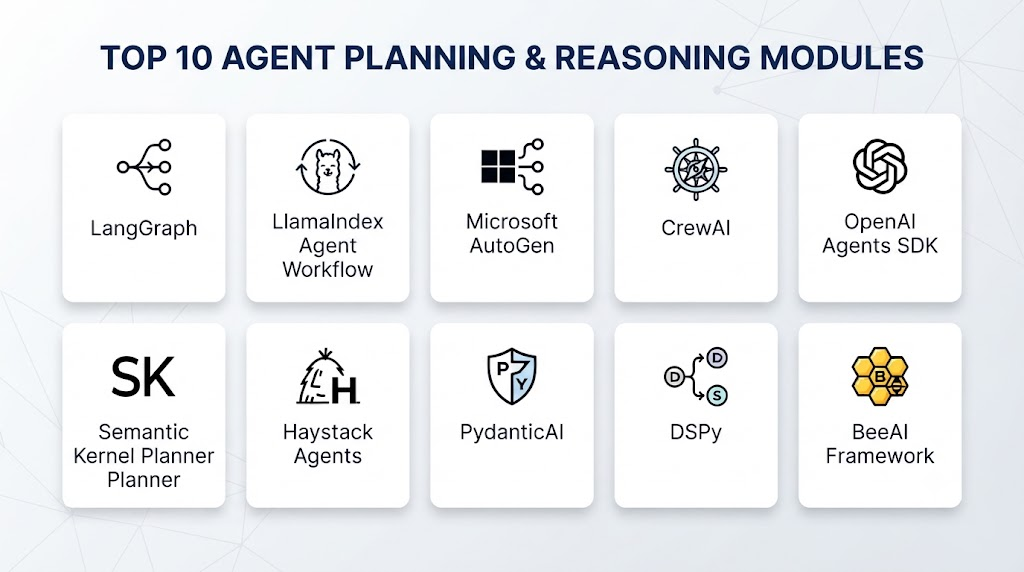
Top 10 Agent Planning & Reasoning Modules
1. LangGraph Planning
LangGraph provides structured planning and reasoning workflows for stateful AI agents.
Key Features
- Graph-based planning
- Agent workflows
- State management
- Task decomposition
- Memory integration
- Human approval workflows
- Tool usage
- Multi-agent support
- Workflow control
- Debugging
Pros
- Excellent workflow control
- Flexible architecture
- Production-ready
- Strong agent support
- Developer-friendly
Cons
- Requires programming knowledge
- Learning curve
- Technical setup required
Platforms
Cloud and local environments.
Deployment or Support
Production AI applications.
Security & Compliance
Depends on implementation.
Integrations & Ecosystem
LLMs, APIs, databases, and AI frameworks.
Support & Community
Large developer community.
2. Microsoft AutoGen Reasoning
Microsoft AutoGen enables AI agents to reason and collaborate through structured conversations.
Key Features
- Agent reasoning
- Task planning
- Multi-agent collaboration
- Human feedback
- Tool integration
- Workflow execution
- Custom agents
- LLM support
- Agent communication
- Research workflows
Pros
- Strong multi-agent reasoning
- Flexible architecture
- Open-source
- Research-backed
- Enterprise potential
Cons
- Requires technical skills
- Still evolving
- Production setup needed
Platforms
Cloud and local environments.
Deployment or Support
Research and enterprise deployment.
Security & Compliance
Depends on implementation.
Integrations & Ecosystem
Microsoft ecosystem and AI tools.
Support & Community
Developer community.
3. OpenAI Reasoning Models
OpenAI reasoning models provide advanced problem-solving capabilities for AI applications.
Key Features
- Complex reasoning
- Planning assistance
- Decision support
- Mathematical reasoning
- Coding assistance
- Tool usage
- Structured outputs
- Agent integration
- Problem solving
- AI workflows
Pros
- Strong reasoning ability
- Broad capabilities
- Developer ecosystem
- High-quality outputs
- Flexible applications
Cons
- API dependency
- Usage costs
- Requires careful prompting
Platforms
Cloud environments.
Deployment or Support
AI application development.
Security & Compliance
Depends on implementation.
Integrations & Ecosystem
OpenAI APIs and applications.
Support & Community
Developer community.
4. Anthropic Claude Reasoning
Claude provides advanced reasoning capabilities for AI assistants and agent applications.
Key Features
- Long context reasoning
- Planning
- Analysis
- Document understanding
- Agent workflows
- Tool usage
- Enterprise applications
- Safety controls
- API access
- AI assistance
Pros
- Strong reasoning
- Large context handling
- Good safety approach
- Enterprise-friendly
- High-quality analysis
Cons
- API dependency
- Pricing considerations
- Requires integration work
Platforms
Cloud environments.
Deployment or Support
Enterprise AI applications.
Security & Compliance
Enterprise security options.
Integrations & Ecosystem
AI applications and APIs.
Support & Community
Developer community.
5. Google Gemini Reasoning
Gemini provides AI reasoning capabilities for complex tasks and agent applications.
Key Features
- Multimodal reasoning
- Planning
- Long context support
- Tool integration
- Data analysis
- AI workflows
- Enterprise integration
- Code reasoning
- Agent support
- Cloud deployment
Pros
- Multimodal capability
- Strong ecosystem
- Enterprise integration
- Large context support
- Flexible
Cons
- Google ecosystem dependency
- Requires cloud knowledge
- Integration complexity
Platforms
Google Cloud environments.
Deployment or Support
Enterprise deployment.
Security & Compliance
Google Cloud security.
Integrations & Ecosystem
Google AI services.
Support & Community
Developer support.
6. Semantic Kernel Planner
Semantic Kernel provides planning capabilities for enterprise AI applications.
Key Features
- AI planning
- Plugin usage
- Task execution
- Memory support
- Workflow automation
- Enterprise integration
- Multiple language support
- Agent orchestration
- Developer SDKs
- LLM connectivity
Pros
- Enterprise-focused
- Strong integrations
- Flexible
- Good governance
- Microsoft support
Cons
- Requires development skills
- Learning curve
- Microsoft ecosystem focus
Platforms
Cloud and enterprise environments.
Deployment or Support
Enterprise deployment.
Security & Compliance
Enterprise security support.
Integrations & Ecosystem
Microsoft services and APIs.
Support & Community
Enterprise support.
7. LlamaIndex Agent Planning
LlamaIndex provides planning capabilities for AI agents connected with data.
Key Features
- Data-aware planning
- Agent workflows
- Retrieval integration
- Tool usage
- Knowledge access
- Task execution
- RAG workflows
- Memory integration
- LLM support
- Enterprise search
Pros
- Strong data integration
- Excellent RAG capabilities
- Flexible
- AI-focused
- Developer-friendly
Cons
- Requires AI expertise
- Data preparation needed
- Complex workflows
Platforms
Cloud and local environments.
Deployment or Support
Enterprise AI applications.
Security & Compliance
Depends on implementation.
Integrations & Ecosystem
Databases, documents, APIs, and AI models.
Support & Community
Developer community.
8. ReAct Framework
ReAct combines reasoning and action execution for AI agents.
Key Features
- Reasoning-action loops
- Tool usage
- Decision making
- Task planning
- Agent workflows
- LLM integration
- Problem solving
- Research support
- Developer framework
- Custom agents
Pros
- Simple concept
- Effective agent pattern
- Flexible
- Widely adopted
- Research-backed
Cons
- Requires implementation
- Not a complete platform
- Needs engineering effort
Platforms
Cloud and local environments.
Deployment or Support
AI application development.
Security & Compliance
Depends on implementation.
Integrations & Ecosystem
LLMs and agent frameworks.
Support & Community
Research and developer community.
9. BabyAGI
BabyAGI is an experimental autonomous agent framework.
Key Features
- Task planning
- Goal management
- Autonomous execution
- Memory integration
- Task prioritization
- AI workflows
- Tool usage
- Agent experiments
- LLM integration
- Automation
Pros
- Popular autonomous agent concept
- Easy experimentation
- Learning resource
- Open-source
- Flexible
Cons
- Limited production features
- Requires monitoring
- Experimental nature
Platforms
Cloud and local environments.
Deployment or Support
Prototype deployment.
Security & Compliance
Requires additional controls.
Integrations & Ecosystem
LLMs and AI tools.
Support & Community
Developer community.
10. DSPy
DSPy is a framework for programming and optimizing language model applications.
Key Features
- AI pipeline optimization
- Prompt optimization
- Reasoning workflows
- Modular AI programs
- Evaluation systems
- LLM integration
- Developer tools
- AI optimization
- Research support
- Custom workflows
Pros
- Research-oriented
- Improves AI pipelines
- Flexible
- Powerful optimization
- Open-source
Cons
- Requires expertise
- Learning curve
- Research-focused
Platforms
Cloud and local environments.
Deployment or Support
AI development.
Security & Compliance
Depends on implementation.
Integrations & Ecosystem
LLMs and AI frameworks.
Support & Community
Research community.
Comparison Table
| Tool Name | Best For | Platform(s) Supported | Deployment | Standout Feature | Public Rating |
|---|---|---|---|---|---|
| LangGraph | Agent workflows | Cloud/Local | Production | Stateful planning | |
| AutoGen | Multi-agent reasoning | Cloud/Local | Flexible | Agent collaboration | |
| OpenAI Reasoning Models | AI reasoning | Cloud | Managed | Advanced reasoning | |
| Claude Reasoning | Analysis tasks | Cloud | Managed | Long context | |
| Gemini Reasoning | Multimodal AI | Cloud | Enterprise | Multimodal reasoning | |
| Semantic Kernel Planner | Enterprise AI | Cloud | Enterprise | AI planning | |
| LlamaIndex Planning | Data agents | Cloud/Local | Enterprise | Knowledge planning | |
| ReAct | Agent patterns | Cloud/Local | Flexible | Reasoning-action loop | |
| BabyAGI | Experiments | Cloud/Local | Prototype | Autonomous planning | |
| DSPy | AI optimization | Cloud/Local | Development | Program optimization |
Weighted Evaluation
| Tool Name | Core Features 25% | Ease of Use 15% | Integrations & Ecosystem 15% | Security & Compliance 10% | Performance & Reliability 10% | Support & Community 10% | Price/Value 15% | Total |
|---|---|---|---|---|---|---|---|---|
| LangGraph | 25 | 13 | 15 | 10 | 10 | 10 | 14 | 97 |
| AutoGen | 25 | 13 | 15 | 10 | 10 | 10 | 14 | 97 |
| OpenAI Reasoning | 25 | 15 | 15 | 10 | 10 | 10 | 13 | 98 |
| Claude Reasoning | 25 | 15 | 14 | 10 | 10 | 10 | 13 | 97 |
| Gemini Reasoning | 24 | 14 | 15 | 10 | 10 | 10 | 13 | 96 |
| Semantic Kernel | 24 | 12 | 15 | 10 | 10 | 10 | 13 | 94 |
| LlamaIndex | 24 | 14 | 15 | 10 | 10 | 10 | 14 | 97 |
| ReAct | 23 | 13 | 14 | 10 | 10 | 10 | 15 | 95 |
| BabyAGI | 21 | 14 | 13 | 10 | 10 | 10 | 15 | 93 |
| DSPy | 23 | 12 | 14 | 10 | 10 | 10 | 14 | 93 |
Which Agent Planning & Reasoning Module Is Right for You?
Choose LangGraph for production agent workflows.
Choose Microsoft AutoGen for multi-agent reasoning.
Choose OpenAI Reasoning Models for advanced AI problem solving.
Choose Claude Reasoning for analysis-heavy applications.
Choose Gemini Reasoning for multimodal AI systems.
Choose Semantic Kernel Planner for enterprise applications.
Choose LlamaIndex Planning for data-connected agents.
Choose ReAct for implementing reasoning-action patterns.
Choose BabyAGI for autonomous AI experiments.
Choose DSPy for optimizing AI pipelines.
Implementation Playbook
Phase 1: Define Reasoning Requirements
- Identify business goals
- Select AI tasks
- Define decision requirements
- Determine automation level
Phase 2: Design Planning Architecture
- Create workflows
- Define agent roles
- Select reasoning approach
- Configure memory
Phase 3: Build and Test
- Integrate models
- Add tools
- Test planning quality
- Evaluate outputs
Phase 4: Deploy
- Monitor decisions
- Add human review
- Track performance
- Improve workflows
Phase 5: Optimize
- Improve prompts
- Update workflows
- Enhance reasoning
- Reduce errors
Common Mistakes
- Expecting perfect autonomous decisions
- Poor goal definition
- Lack of human oversight
- Ignoring security
- Poor memory management
- Not testing edge cases
- Overcomplicating workflows
- Using unsuitable reasoning methods
FAQs
1. What are Agent Planning & Reasoning Modules?
They are AI components that help agents plan tasks, make decisions, and solve complex problems.
2. Why do AI agents need reasoning?
Reasoning helps agents understand goals and choose better actions.
3. What is AI planning?
AI planning is the process of creating steps required to achieve an objective.
4. Who uses reasoning modules?
Developers, enterprises, researchers, and automation teams use them.
5. Can reasoning modules work with multiple agents?
Yes. They support multi-agent planning and collaboration.
6. Are AI reasoning systems fully autonomous?
Many require human supervision for important decisions.
7. How do reasoning modules improve AI?
They improve task understanding, planning, and decision quality.
8. Can businesses customize reasoning workflows?
Yes. Most frameworks allow custom planning logic.
9. What industries use AI reasoning?
Healthcare, finance, software, research, and automation industries use them.
10. What is the future of AI reasoning?
Advanced reasoning will become a key capability for autonomous AI agents.
Conclusion
Agent Planning & Reasoning Modules are becoming a fundamental technology for building intelligent autonomous AI systems. They enable agents to understand goals, create plans, make decisions, and execute complex tasks.Frameworks and technologies such as LangGraph, AutoGen, OpenAI Reasoning Models, Claude, Gemini, Semantic Kernel, and LlamaIndex are helping organizations build more capable AI agents.As agentic AI continues evolving, planning and reasoning capabilities will become essential for creating reliable, adaptive, and intelligent AI systems.