Introduction
Model Incident Management Tools are AI operations platforms designed to detect, manage, investigate, and resolve issues that affect machine learning models running in production environments.
As organizations deploy more AI systems, maintaining reliable model performance becomes increasingly important. Machine learning models can experience incidents caused by data drift, model degradation, infrastructure failures, incorrect predictions, security issues, or unexpected user behavior.
Model incident management platforms help organizations:
- Detect AI model failures
- Investigate production issues
- Track incidents
- Coordinate response teams
- Improve model reliability
- Maintain business continuity
These platforms are used by:
- MLOps engineers
- Machine learning engineers
- AI operations teams
- Data scientists
- DevOps teams
- Enterprise AI teams
Modern model incident management solutions provide capabilities such as:
- Model monitoring
- Automated alerts
- Incident tracking
- Root cause analysis
- Performance analysis
- Drift detection
- Audit history
- Collaboration workflows
- Automated remediation
- Integration with MLOps systems
The goal of Model Incident Management Tools is to ensure AI systems remain reliable, available, and trustworthy throughout their production lifecycle.
What Are Model Incident Management Tools?
Model Incident Management Tools are systems that help teams identify and resolve problems affecting machine learning models after deployment.
Unlike traditional application incidents, AI model incidents may involve:
- Prediction quality problems
- Data quality issues
- Model drift
- Bias changes
- Feature failures
- Unexpected outputs
Example:
A banking fraud detection model suddenly starts missing suspicious transactions.
A model incident management system can:
- Detect unusual performance changes
- Alert the AI operations team
- Identify possible causes
- Compare model versions
- Trigger rollback or remediation
Why Organizations Need Model Incident Management Tools
Production AI systems are continuously affected by changing environments.
Common challenges include:
- Changing data patterns
- Model accuracy degradation
- Increasing inference failures
- Infrastructure issues
- Security concerns
Without proper incident management, organizations may face:
- Business losses
- Incorrect AI decisions
- Customer dissatisfaction
- Compliance problems
Model incident management tools help organizations:
- Respond faster
- Reduce downtime
- Improve AI reliability
- Maintain production quality
How Model Incident Management Works
Continuous Monitoring
The system observes:
- Model performance
- Data quality
- Predictions
- Infrastructure metrics
Incident Detection
The platform identifies:
- Performance drops
- Data changes
- Model failures
Alert Generation
Teams receive alerts about:
- Critical issues
- Model degradation
- Production problems
Investigation
Teams analyze:
- Model versions
- Data changes
- Feature behavior
- Recent deployments
Resolution
Actions include:
- Model rollback
- Retraining
- Configuration updates
- Data corrections
Post-Incident Analysis
Teams document:
- Root causes
- Solutions
- Prevention strategies
Key Components of Model Incident Management Platforms
Model Monitoring Engine
Tracks:
- Accuracy
- Latency
- Prediction quality
- Data changes
Alert Management System
Handles:
- Notifications
- Severity levels
- Escalations
Incident Tracking
Manages:
- Incident records
- Ownership
- Status updates
Root Cause Analysis
Helps identify:
- Data problems
- Model issues
- Infrastructure failures
Collaboration Workflows
Supports:
- Team communication
- Issue resolution
Reporting System
Provides:
- Incident history
- Performance trends
- Reliability reports
Types of Model Incident Management Tools
AI Model Monitoring Platforms
Focused on:
- Model performance tracking
Examples:
- Arize AI
- Fiddler AI
- WhyLabs
MLOps Platforms
Focused on:
- Complete ML lifecycle management
Examples:
- MLflow
- Databricks
- Kubeflow
Cloud AI Monitoring Platforms
Focused on:
- Managed AI operations
Examples:
- Amazon SageMaker Model Monitor
- Vertex AI Model Monitoring
- Azure ML Monitoring
IT Incident Platforms with AI Support
Focused on:
- Incident workflows
Examples:
- PagerDuty
- ServiceNow
Key Features of Model Incident Management Tools
Real-Time Monitoring
Tracks:
- Model behavior
- System performance
- User impact
Automated Alerts
Detects:
- Abnormal patterns
- Failures
- Quality issues
Root Cause Analysis
Analyzes:
- Data changes
- Model versions
- Pipeline failures
Incident Workflows
Provides:
- Assignment
- Escalation
- Resolution tracking
Model Health Reports
Shows:
- Performance trends
- Reliability metrics
Integration Support
Connects with:
- MLOps tools
- Cloud platforms
- DevOps systems
Common Use Cases
Financial AI Systems
Managing:
- Fraud detection incidents
- Risk model failures
Healthcare AI
Monitoring:
- Clinical prediction models
- Medical AI reliability
Recommendation Systems
Handling:
- Ranking failures
- Personalization issues
Customer Service AI
Managing:
- Chatbot failures
- Response quality problems
Generative AI Applications
Monitoring:
- LLM output problems
- Prompt failures
- Hallucination issues
Enterprise AI Platforms
Supporting:
- Large-scale AI operations
Why Model Incident Management Tools Matter
Faster Issue Detection
Problems are identified earlier.
Reduced AI Downtime
Teams resolve failures quickly.
Better Model Reliability
Models remain accurate and stable.
Improved Collaboration
Teams coordinate effectively.
Stronger AI Governance
Organizations maintain better control.
Evaluation Criteria for Buyers
Monitoring Capabilities
Evaluate:
- Model metrics
- Data monitoring
- Drift detection
Incident Workflow
Consider:
- Alerts
- Escalation
- Collaboration
Root Cause Analysis
Evaluate:
- Investigation tools
- Diagnostic capabilities
Integration Support
Look for:
- MLOps tools
- Cloud platforms
- DevOps systems
Scalability
Consider:
- Number of models
- Enterprise workloads
Security
Evaluate:
- Access management
- Data protection
Key Trends
AI Operations Automation
Incident response is becoming automated.
LLM Reliability Monitoring
Organizations are focusing on:
- AI output quality
- Hallucination detection
Predictive Incident Management
AI is being used to predict failures before they occur.
MLOps and IT Operations Integration
AI incident workflows are connecting with DevOps platforms.
Automated Remediation
Systems are beginning to fix issues automatically.
Responsible AI Operations
Organizations are improving AI reliability and accountability.
Methodology
The following Model Incident Management Tools were evaluated based on:
- Monitoring capabilities
- Incident response workflows
- AI observability
- Integration ecosystem
- Scalability
- Security
- Automation
- Enterprise readiness
- Developer experience
- Value
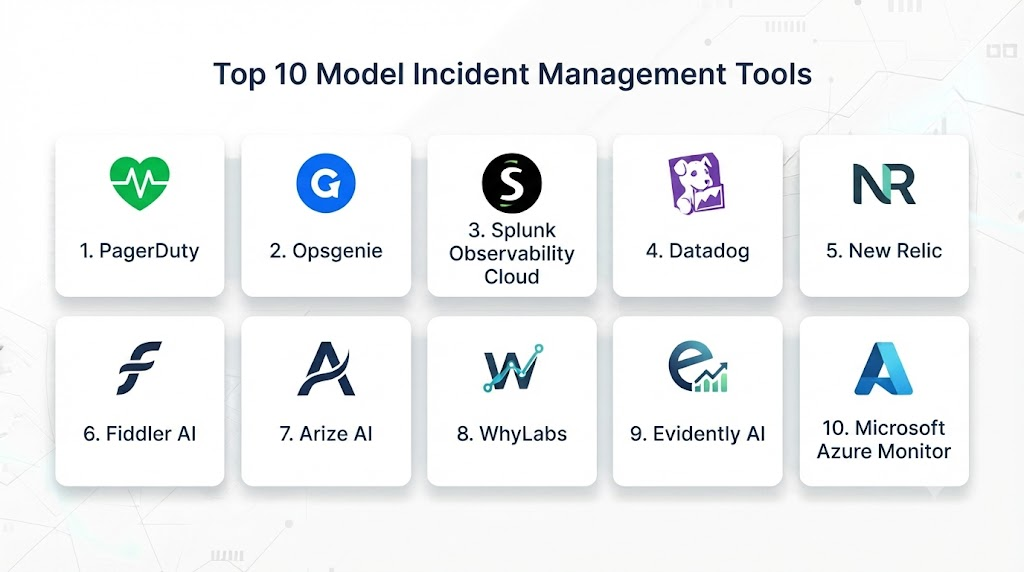
Top 10 Model Incident Management Tools
1. Arize AI
Arize AI provides machine learning observability and model incident monitoring.
Key Features
- Model performance monitoring
- Data drift detection
- Prediction monitoring
- Root cause analysis
- Embedding monitoring
- LLM observability
- Alerts
- Model comparison
- Performance analytics
- Incident investigation
Pros
- AI-focused monitoring
- Strong observability
- LLM support
- Good debugging capabilities
- Enterprise ready
Cons
- Premium pricing
- Requires setup
- Enterprise focused
Platforms
Cloud environments.
Deployment or Support
Enterprise AI teams.
Security & Compliance
Enterprise controls.
Integrations & Ecosystem
MLOps platforms.
Support & Community
Enterprise support.
2. Fiddler AI
Fiddler AI provides explainable AI monitoring and governance.
Key Features
- Model monitoring
- Explainability
- Drift detection
- Bias monitoring
- Alerts
- Incident investigation
- LLM monitoring
- Reporting
- Governance support
- Performance tracking
Pros
- Strong explainability
- AI governance support
- Enterprise ready
- Good monitoring
- Responsible AI features
Cons
- Commercial platform
- Higher cost
- Complex workflows
Platforms
Cloud environments.
Deployment or Support
Enterprise organizations.
Security & Compliance
Enterprise controls.
Integrations & Ecosystem
AI platforms.
Support & Community
Enterprise support.
3. WhyLabs
WhyLabs provides AI observability and monitoring solutions.
Key Features
- Data quality monitoring
- Model monitoring
- Drift detection
- Alerts
- AI reliability tracking
- LLM monitoring
- Dashboard analytics
- Data profiling
- Incident detection
- Reporting
Pros
- Strong AI observability
- Developer friendly
- Good monitoring
- Open-source support
- LLM capabilities
Cons
- Requires configuration
- Limited incident workflow
- Additional tools may be needed
Platforms
Cloud environments.
Deployment or Support
AI engineering teams.
Security & Compliance
Enterprise controls.
Integrations & Ecosystem
MLOps tools.
Support & Community
Developer community.
4. Datadog ML Monitoring
Datadog provides infrastructure and AI monitoring capabilities.
Key Features
- Monitoring dashboards
- Alerts
- Performance tracking
- Infrastructure visibility
- Logs
- Metrics
- Incident management
- Cloud integrations
- AI workload monitoring
- Collaboration
Pros
- Strong monitoring ecosystem
- Enterprise adoption
- Excellent alerts
- Infrastructure integration
- Reliable
Cons
- Not AI-specific
- Requires configuration
- Expensive at scale
Platforms
Cloud environments.
Deployment or Support
Enterprise operations teams.
Security & Compliance
Enterprise controls.
Integrations & Ecosystem
DevOps ecosystem.
Support & Community
Enterprise support.
5. Amazon SageMaker Model Monitor
Amazon SageMaker Model Monitor provides AWS-based model monitoring.
Key Features
- Model quality monitoring
- Data drift detection
- Bias monitoring
- Alerts
- Endpoint monitoring
- Model performance tracking
- AWS integration
- Reporting
- Security controls
- MLOps workflows
Pros
- AWS integration
- Managed service
- Enterprise security
- Scalable
- Production ready
Cons
- AWS dependency
- Cost complexity
- Requires AWS expertise
Platforms
AWS Cloud.
Deployment or Support
Enterprise AI teams.
Security & Compliance
AWS security framework.
Integrations & Ecosystem
AWS services.
Support & Community
Enterprise support.
6. Google Vertex AI Model Monitoring
Vertex AI provides managed AI monitoring capabilities.
Key Features
- Model monitoring
- Data drift detection
- Prediction analysis
- Performance tracking
- Alerts
- Metadata integration
- Security
- Model lifecycle support
- Cloud integration
- Reporting
Pros
- Managed platform
- Google AI ecosystem
- Scalable
- Enterprise ready
- Strong integration
Cons
- Google Cloud dependency
- Pricing complexity
- Learning curve
Platforms
Google Cloud.
Deployment or Support
Enterprise AI teams.
Security & Compliance
Google Cloud security.
Integrations & Ecosystem
Google AI services.
Support & Community
Enterprise support.
7. Azure Machine Learning Monitoring
Azure ML provides monitoring for deployed machine learning models.
Key Features
- Model monitoring
- Data drift detection
- Performance tracking
- Alerts
- Security controls
- Deployment monitoring
- Responsible AI integration
- Model management
- Governance support
- Reporting
Pros
- Microsoft ecosystem
- Enterprise governance
- Strong security
- Scalable
- Managed service
Cons
- Azure dependency
- Configuration complexity
- Learning curve
Platforms
Microsoft Azure.
Deployment or Support
Enterprise AI teams.
Security & Compliance
Microsoft security framework.
Integrations & Ecosystem
Azure services.
Support & Community
Enterprise support.
8. Evidently AI
Evidently AI provides open-source ML monitoring.
Key Features
- Data drift detection
- Model performance analysis
- Data quality checks
- Reports
- Metrics tracking
- Dashboard support
- Testing workflows
- ML monitoring
- Open-source tools
- Integration support
Pros
- Open source
- Easy adoption
- Developer friendly
- Good reports
- Flexible
Cons
- Limited enterprise workflows
- Requires integration
- Manual setup
Platforms
Cloud and local environments.
Deployment or Support
ML engineering teams.
Security & Compliance
Implementation dependent.
Integrations & Ecosystem
ML tools.
Support & Community
Open-source community.
9. PagerDuty
PagerDuty provides incident response management.
Key Features
- Incident alerts
- Escalation workflows
- On-call management
- Automation
- Collaboration
- Notifications
- Incident tracking
- Reporting
- Integrations
- Reliability workflows
Pros
- Strong incident management
- Enterprise adoption
- Excellent alerts
- Automation support
- Reliable
Cons
- Not AI-specific
- Requires integrations
- Additional monitoring needed
Platforms
Cloud environments.
Deployment or Support
Operations teams.
Security & Compliance
Enterprise controls.
Integrations & Ecosystem
DevOps platforms.
Support & Community
Enterprise support.
10. ServiceNow AI Operations
ServiceNow provides enterprise IT and AI operations workflows.
Key Features
- Incident management
- Workflow automation
- AI operations
- Root cause analysis
- Service management
- Alerts
- Collaboration
- Reporting
- Governance
- Enterprise integration
Pros
- Enterprise workflows
- Strong automation
- IT integration
- Governance support
- Scalable
Cons
- Expensive
- Complex implementation
- Not ML-specific
Platforms
Cloud environments.
Deployment or Support
Large enterprises.
Security & Compliance
Enterprise controls.
Integrations & Ecosystem
Enterprise IT systems.
Support & Community
Enterprise support.
Comparison Table
| Tool Name | Best For | Platform(s) Supported | Deployment | Standout Feature | Public Rating |
|---|---|---|---|---|---|
| Arize AI | ML observability | Cloud | Enterprise | AI debugging | |
| Fiddler AI | Responsible AI monitoring | Cloud | Enterprise | Explainability | |
| WhyLabs | AI monitoring | Cloud | Flexible | Drift detection | |
| Datadog | Enterprise monitoring | Cloud | Enterprise | Infrastructure visibility | |
| SageMaker Monitor | AWS AI | AWS | Enterprise | Managed monitoring | |
| Vertex AI Monitor | Google AI | GCP | Enterprise | Cloud monitoring | |
| Azure ML Monitor | Microsoft AI | Azure | Enterprise | Governance | |
| Evidently AI | Open-source monitoring | Cloud/Local | Flexible | Data testing | |
| PagerDuty | Incident response | Cloud | Enterprise | Alerts | |
| ServiceNow AIOps | Enterprise operations | Cloud | Enterprise | Workflow automation |
Weighted Evaluation
| Tool Name | Core Features 25% | Ease of Use 15% | Integrations & Ecosystem 15% | Security & Compliance 10% | Performance & Reliability 10% | Support & Community 10% | Price/Value 15% | Total |
|---|---|---|---|---|---|---|---|---|
| Arize AI | 25 | 14 | 15 | 10 | 10 | 10 | 13 | 97 |
| Fiddler AI | 24 | 13 | 14 | 10 | 10 | 10 | 12 | 93 |
| WhyLabs | 24 | 14 | 14 | 10 | 10 | 10 | 15 | 97 |
| Datadog | 24 | 14 | 15 | 10 | 10 | 10 | 12 | 95 |
| SageMaker Monitor | 24 | 13 | 15 | 10 | 10 | 10 | 12 | 94 |
| Vertex AI Monitor | 24 | 13 | 15 | 10 | 10 | 10 | 12 | 94 |
| Azure ML Monitor | 24 | 13 | 15 | 10 | 10 | 10 | 13 | 95 |
| Evidently AI | 23 | 15 | 14 | 10 | 10 | 10 | 15 | 97 |
| PagerDuty | 23 | 14 | 15 | 10 | 10 | 10 | 13 | 95 |
| ServiceNow AIOps | 25 | 12 | 14 | 10 | 10 | 10 | 12 | 93 |
Which Model Incident Management Tool Is Right for You?
Choose Arize AI for AI model observability.
Choose Fiddler AI for explainable AI monitoring.
Choose WhyLabs for AI reliability monitoring.
Choose Datadog for enterprise monitoring integration.
Choose Amazon SageMaker Model Monitor for AWS AI systems.
Choose Vertex AI Model Monitoring for Google Cloud.
Choose Azure ML Monitoring for Microsoft environments.
Choose Evidently AI for open-source monitoring.
Choose PagerDuty for incident response workflows.
Choose ServiceNow AI Operations for enterprise IT operations.
Implementation Playbook
Phase 1: Define Model Health Metrics
- Identify important metrics
- Define incident thresholds
- Set monitoring goals
Phase 2: Connect Monitoring Systems
- Integrate models
- Collect performance data
- Enable alerts
Phase 3: Build Incident Workflows
- Assign ownership
- Create escalation paths
- Define response actions
Phase 4: Investigate Issues
- Analyze model behavior
- Identify root causes
- Apply fixes
Phase 5: Improve Reliability
- Review incidents
- Update processes
- Automate remediation
Common Mistakes
- No model monitoring
- Missing alert rules
- Poor incident ownership
- Ignoring model drift
- No rollback process
- Manual troubleshooting
- Lack of documentation
FAQs
1. What are Model Incident Management Tools?
They are platforms that help detect and resolve problems affecting AI models in production.
2. Why is model incident management important?
It helps maintain reliable AI performance and reduce production failures.
3. What types of AI issues can these tools detect?
They can detect drift, performance drops, data issues, and prediction problems.
4. Who uses model incident management platforms?
MLOps teams, AI engineers, and enterprise operations teams use them.
5. Can these tools monitor LLM applications?
Yes, many support LLM observability and AI output monitoring.
6. How do these platforms improve AI reliability?
They provide alerts, analysis, and resolution workflows.
7. Are open-source options available?
Yes, tools like Evidently AI provide open-source monitoring capabilities.
8. Do these tools integrate with MLOps platforms?
Yes, most integrate with modern AI infrastructure.
9. What is AI incident response?
It is the process of identifying, analyzing, and resolving AI system failures.
10. What is the future of model incident management?
AI operations will become more automated with predictive detection and self-healing systems.
Conclusion
Model Incident Management Tools are becoming essential for organizations operating AI systems in production. They help teams detect problems, investigate failures, and maintain reliable machine learning applications.Platforms such as Arize AI, Fiddler AI, WhyLabs, Evidently AI, cloud AI monitoring solutions, and enterprise incident management platforms provide powerful capabilities for modern AI operations.As AI adoption continues to expand, effective model incident management will become a critical part of MLOps, AI governance, and reliable enterprise AI deployment.