Introduction
Responsible AI Tooling Platforms are solutions that help organizations design, develop, deploy, and manage artificial intelligence systems in a safe, ethical, transparent, and trustworthy way.
As AI adoption grows across industries, organizations need tools that ensure AI systems are not only powerful but also fair, secure, explainable, and aligned with business and regulatory requirements.
Responsible AI tools help address major AI challenges such as:
- Algorithmic bias
- Lack of transparency
- Privacy risks
- Security concerns
- Unfair decision-making
- Model reliability issues
- Compliance requirements
These platforms help AI teams evaluate and improve models before and after deployment.
Responsible AI Tooling is used by:
- AI engineers
- Data scientists
- MLOps teams
- Security teams
- Compliance professionals
- Enterprise AI leaders
- Research teams
Modern Responsible AI platforms provide capabilities such as:
- Explainable AI (XAI)
- Bias detection
- Fairness testing
- Model transparency
- AI risk assessment
- Privacy protection
- Model monitoring
- Governance workflows
- Audit reporting
Why Responsible AI Matters
AI systems can create risks such as:
- Biased predictions
- Incorrect decisions
- Privacy violations
- Lack of explanation
- Security vulnerabilities
Responsible AI tooling helps organizations:
- Detect problems early
- Improve model fairness
- Increase user trust
- Meet regulations
- Build safer AI applications
Key Principles of Responsible AI
Fairness
AI systems should avoid unfair treatment of individuals or groups.
Transparency
Users should understand how AI systems make decisions.
Accountability
Organizations should define responsibility for AI outcomes.
Privacy
AI systems should protect sensitive information.
Security
AI models should resist misuse and attacks.
Reliability
AI systems should perform consistently.
How Responsible AI Tools Work
Step 1: Data Assessment
Tools analyze:
- Training data
- Data quality
- Potential bias
Step 2: Model Evaluation
Systems test:
- Accuracy
- Fairness
- Explainability
Step 3: Risk Identification
Platforms detect:
- Bias issues
- Security problems
- Compliance gaps
Step 4: Model Improvement
Teams improve:
- Data
- Algorithms
- Policies
Step 5: Continuous Monitoring
Organizations track:
- Model behavior
- Performance
- Risks
Key Components of Responsible AI Platforms
Explainable AI Engine
Provides:
- Model explanations
- Feature importance
- Decision insights
Bias Detection System
Identifies:
- Unfair outcomes
- Data imbalance
Fairness Assessment
Measures:
- Equal treatment
- Model impact
Privacy Protection
Supports:
- Data protection
- Privacy controls
Risk Management
Tracks:
- AI risks
- Compliance requirements
Monitoring Dashboard
Shows:
- Model health
- Fairness metrics
- Performance changes
Types of Responsible AI Tools
Explainable AI Platforms
Used for:
- Understanding AI decisions
AI Fairness Tools
Used for:
- Bias testing
- Fairness measurement
AI Governance Platforms
Used for:
- Policy management
- Compliance
AI Security Tools
Used for:
- Protecting models
Model Monitoring Platforms
Used for:
- Continuous AI evaluation
Key Features of Responsible AI Tooling
Explainability
Helps users understand:
- Why a model made a decision
- Which factors influenced predictions
Bias Detection
Identifies:
- Unfair patterns
- Dataset problems
Fairness Metrics
Measures:
- Equal opportunity
- Statistical fairness
Model Documentation
Maintains:
- Model cards
- Audit records
Privacy Controls
Protects:
- Sensitive data
- User information
Compliance Reporting
Creates:
- Governance reports
- Risk documentation
Common Use Cases
Financial Services
Managing:
- Credit decisions
- Fraud detection models
Healthcare AI
Ensuring:
- Fair medical predictions
- Patient privacy
Hiring AI
Monitoring:
- Recruitment fairness
- Bias reduction
Generative AI
Evaluating:
- LLM responses
- AI safety
Autonomous Systems
Improving:
- Reliability
- Safety
Government AI
Supporting:
- Transparent decision-making
Benefits of Responsible AI Tools
Improved Trust
Users gain confidence in AI systems.
Reduced Bias
Organizations identify unfair outcomes.
Better Compliance
Supports AI regulations and standards.
Safer AI Deployment
Reduces operational risks.
Better Decision Making
Provides transparency into AI behavior.
Evaluation Criteria
Fairness Capabilities
Evaluate:
- Bias detection
- Fairness metrics
Explainability
Consider:
- Model interpretation
- Transparency
Governance Support
Evaluate:
- Policy management
- Documentation
Security
Check:
- Privacy
- Risk controls
Integration
Consider:
- ML frameworks
- Cloud platforms
Scalability
Evaluate:
- Enterprise adoption
Key Trends
Responsible Generative AI
Organizations are focusing on:
- Safe LLM usage
- AI output evaluation
AI Regulation Compliance
Companies are preparing for:
- AI governance requirements
- Industry standards
Automated AI Risk Detection
AI systems are helping identify AI risks automatically.
Human Oversight
Organizations are combining:
- AI automation
- Human review
Responsible AI for AI Agents
New tools are emerging for:
- Agent safety
- Permission control
- Autonomous AI monitoring
Methodology
The following Responsible AI Tooling Platforms were evaluated based on:
- Fairness capabilities
- Explainability
- AI safety features
- Governance support
- Monitoring
- Integration
- Security
- Scalability
- Enterprise readiness
- Value
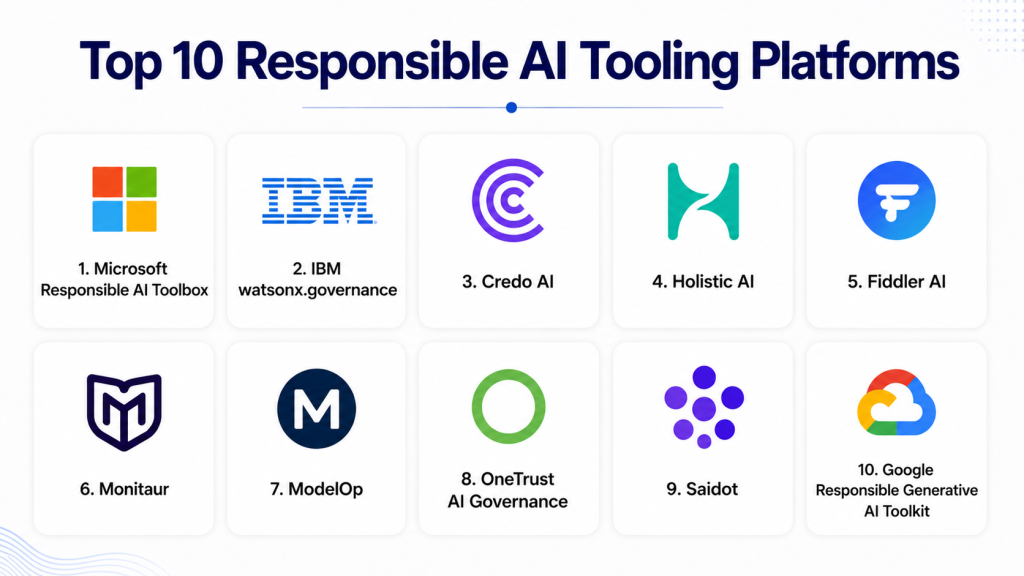
Top 10 Responsible AI Tooling Platforms
- IBM AI Fairness 360
- Microsoft Responsible AI Dashboard
- Google What-If Tool
- IBM watsonx.governance
- Fiddler AI
- Arize AI
- WhyLabs
- Arthur AI
- Holistic AI
- TensorFlow Responsible AI Tools
1. IBM AI Fairness 360
IBM AI Fairness 360 is an open-source toolkit for detecting and reducing bias in AI models.
Key Features
- Bias detection
- Fairness metrics
- Bias mitigation algorithms
- Dataset analysis
- Model evaluation
- Machine learning integration
- Research support
- Explainability workflows
Pros
- Open source
- Strong fairness capabilities
- Research-backed
Cons
- Requires technical expertise
- Focused mainly on fairness
2. Microsoft Responsible AI Dashboard
Microsoft Responsible AI Dashboard provides tools for analyzing ML models.
Key Features
- Error analysis
- Explainability
- Fairness evaluation
- Data analysis
- Model debugging
- Responsible AI reporting
Pros
- Strong visualization
- Developer friendly
- Microsoft ecosystem support
Cons
- Best with Azure environments
3. Google What-If Tool
Google What-If Tool helps users analyze machine learning models interactively.
Key Features
- Model analysis
- Feature comparison
- Fairness investigation
- Visualization
- Performance analysis
- Interactive exploration
Pros
- Easy visualization
- Open source
- Educational value
Cons
- Limited enterprise governance features
4. IBM watsonx.governance
IBM watsonx.governance provides enterprise AI governance and responsible AI management.
Key Features
- AI risk management
- Model governance
- Compliance workflows
- Explainability
- Monitoring
- Documentation
- Policy management
Pros
- Enterprise ready
- Strong governance
- Compliance support
Cons
- Complex implementation
5. Fiddler AI
Fiddler AI provides AI monitoring and explainability solutions.
Key Features
- Model explainability
- Bias detection
- Performance monitoring
- Drift detection
- AI observability
- Risk analysis
Pros
- Strong monitoring
- Good explanations
- Enterprise features
Cons
- Premium pricing
6. Arize AI
Arize AI provides ML observability and AI evaluation tools.
Key Features
- Model monitoring
- LLM evaluation
- Drift detection
- Explainability
- Performance tracking
- AI quality monitoring
Pros
- Strong ML observability
- Developer focused
Cons
- More monitoring focused
7. WhyLabs
WhyLabs provides AI observability and monitoring solutions.
Key Features
- Data monitoring
- Model monitoring
- Bias tracking
- Drift detection
- AI quality metrics
- Alerts
Pros
- Strong monitoring
- Good analytics
Cons
- Requires technical setup
8. Arthur AI
Arthur AI provides AI monitoring and governance capabilities.
Key Features
- Model monitoring
- Bias detection
- Explainability
- Model performance tracking
- AI risk analysis
- Governance support
Pros
- Strong AI monitoring
- Enterprise support
Cons
- Higher pricing
9. Holistic AI
Holistic AI focuses on AI risk management and responsible AI.
Key Features
- AI auditing
- Risk assessment
- Bias evaluation
- Compliance support
- Governance workflows
- Reporting
Pros
- Responsible AI focused
- Strong risk assessment
Cons
- Specialized platform
10. TensorFlow Responsible AI Tools
TensorFlow provides responsible AI resources and tools.
Key Features
- Fairness analysis
- Model interpretation
- Visualization
- ML evaluation
- Developer tools
- Open-source support
Pros
- Free
- Large community
- Strong ML ecosystem
Cons
- Requires technical expertise
Comparison Table: Top 10 Responsible AI Tooling Platforms
| No. | Tool Name | Best For | Platform(s) Supported | Deployment | Standout Feature | Public Rating |
|---|---|---|---|---|---|---|
| 1 | IBM AI Fairness 360 | Bias detection | Local / Cloud | Open Source | Fairness algorithms | 4.8/5 |
| 2 | Microsoft Responsible AI Dashboard | Model analysis | Azure | Managed | Responsible AI reports | 4.7/5 |
| 3 | Google What-If Tool | Model exploration | Cloud / Local | Open Source | Interactive analysis | 4.6/5 |
| 4 | IBM watsonx.governance | Enterprise AI governance | Cloud | Managed | Risk management | 4.8/5 |
| 5 | Fiddler AI | AI monitoring | Cloud | Managed | Explainability | 4.6/5 |
| 6 | Arize AI | ML observability | Cloud | Managed | AI evaluation | 4.6/5 |
| 7 | WhyLabs | AI monitoring | Cloud | Managed | Data intelligence | 4.5/5 |
| 8 | Arthur AI | Model governance | Cloud | Managed | Bias monitoring | 4.5/5 |
| 9 | Holistic AI | AI auditing | Cloud | Managed | Risk assessment | 4.4/5 |
| 10 | TensorFlow Responsible AI | Developers | Local / Cloud | Open Source | ML ecosystem | 4.5/5 |
Weighted Evaluation Table
| No. | Tool Name | Fairness 25% | Ease of Use 15% | AI Integration 15% | Security 10% | Scalability 10% | Governance 10% | Value 15% | Total Score |
|---|---|---|---|---|---|---|---|---|---|
| 1 | IBM AI Fairness 360 | 25 | 13 | 15 | 9 | 10 | 10 | 15 | 97 |
| 2 | Microsoft Responsible AI Dashboard | 24 | 15 | 15 | 10 | 10 | 10 | 13 | 97 |
| 3 | Google What-If Tool | 23 | 15 | 14 | 9 | 9 | 9 | 15 | 94 |
| 4 | IBM watsonx.governance | 25 | 14 | 15 | 10 | 10 | 10 | 14 | 98 |
| 5 | Fiddler AI | 24 | 14 | 15 | 10 | 10 | 10 | 13 | 96 |
| 6 | Arize AI | 23 | 15 | 15 | 10 | 10 | 9 | 13 | 95 |
| 7 | WhyLabs | 23 | 14 | 14 | 10 | 10 | 9 | 13 | 93 |
| 8 | Arthur AI | 23 | 14 | 15 | 9 | 10 | 10 | 13 | 94 |
| 9 | Holistic AI | 24 | 13 | 14 | 10 | 10 | 10 | 13 | 94 |
| 10 | TensorFlow Responsible AI | 22 | 14 | 15 | 9 | 10 | 9 | 15 | 94 |
Which Responsible AI Tool Is Right for You?
Choose IBM AI Fairness 360 for fairness testing.
Choose Microsoft Responsible AI Dashboard for Azure ML workflows.
Choose Google What-If Tool for model analysis.
Choose IBM watsonx.governance for enterprise AI governance.
Choose Fiddler AI for explainability and monitoring.
Choose Arize AI for ML observability.
Choose WhyLabs for AI monitoring.
Choose Arthur AI for model governance.
Choose Holistic AI for AI auditing.
Choose TensorFlow Responsible AI Tools for developer workflows.
Implementation Playbook
Phase 1: Define Responsible AI Goals
- Identify risks
- Define fairness requirements
- Establish governance standards
Phase 2: Analyze Data
- Check bias
- Review data quality
- Identify risks
Phase 3: Evaluate Models
- Test fairness
- Analyze explanations
- Measure performance
Phase 4: Deploy Safely
- Apply controls
- Monitor AI behavior
- Maintain documentation
Phase 5: Continuous Improvement
- Review outcomes
- Update policies
- Improve models
Common Mistakes
- Ignoring AI fairness
- Deploying models without evaluation
- Poor documentation
- No monitoring
- Lack of human oversight
- Ignoring privacy concerns
FAQs
1. What is Responsible AI Tooling?
Responsible AI tools help organizations build safe, fair, and transparent AI systems.
2. Why is Responsible AI important?
It reduces risks and improves trust in AI applications.
3. What problems do Responsible AI tools solve?
They address bias, transparency, privacy, and security issues.
4. Can Responsible AI tools evaluate LLMs?
Yes, many support generative AI evaluation and governance.
5. Who uses Responsible AI platforms?
AI engineers, researchers, compliance teams, and enterprises.
6. What is AI fairness testing?
It measures whether AI systems treat different groups fairly.
7. How does explainable AI help?
It shows why AI systems make specific decisions.
8. Are Responsible AI tools part of AI governance?
Yes, they are an important component of AI governance frameworks.
9. Can Responsible AI tools improve model quality?
Yes, they help identify and fix AI problems.
10. What is the future of Responsible AI?
Responsible AI will become essential as AI systems become more widely adopted.
Conclusion
Responsible AI Tooling Platforms are becoming essential for organizations that want to build trustworthy and ethical AI systems. These tools help detect bias, improve transparency, manage risks, and ensure AI applications operate responsibly.Platforms such as IBM AI Fairness 360, Microsoft Responsible AI Dashboard, IBM watsonx.governance, Fiddler AI, Arize AI, and Holistic AI provide valuable capabilities for responsible AI development.As artificial intelligence continues transforming industries, responsible AI practices will become a core requirement for building secure, fair, and reliable AI solutions.