Introduction
Bias & Fairness Testing Suites are AI evaluation tools that help organizations identify, measure, and reduce unfair behavior in machine learning models and artificial intelligence systems.
As AI models are increasingly used in areas such as hiring, healthcare, finance, education, insurance, and customer services, ensuring fair and unbiased decisions has become a critical requirement.
AI models can unintentionally learn biases from:
- Training datasets
- Historical decisions
- Data imbalance
- Human labeling processes
- Feature selection
- Model design
Bias & Fairness Testing Suites help organizations analyze AI systems and determine whether their models provide fair outcomes across different groups.
These platforms support:
- Bias detection
- Fairness measurement
- Model evaluation
- Data analysis
- Explainability
- Risk assessment
- Responsible AI workflows
Bias and fairness tools are used by:
- Data scientists
- Machine learning engineers
- AI researchers
- MLOps teams
- Compliance teams
- Responsible AI specialists
- Enterprise AI leaders
Modern fairness testing platforms provide capabilities such as:
- Fairness metrics
- Bias identification
- Group comparison analysis
- Model explanations
- Bias mitigation recommendations
- Reporting dashboards
- Compliance documentation
The goal of Bias & Fairness Testing Suites is to help organizations create AI systems that are accurate, transparent, and fair.
What Is AI Bias?
AI bias occurs when an artificial intelligence system produces unfair or unequal outcomes for certain groups of people.
Bias can happen because of:
- Biased training data
- Historical inequalities
- Limited datasets
- Incorrect assumptions
- Poor model design
Example:
An AI hiring model trained on biased historical hiring data may unfairly favor one group over another.
What Is Fairness Testing?
Fairness testing evaluates whether an AI model treats different groups equally.
It measures:
- Prediction differences
- Error rates
- Decision outcomes
- Model impact
Example:
A loan approval model can be tested to check whether approval rates differ unfairly between demographic groups.
Why Bias & Fairness Testing Matters
AI systems influence important decisions.
Without fairness testing, organizations may face:
- Discrimination risks
- Regulatory issues
- Loss of user trust
- Unethical AI outcomes
Fairness testing helps organizations:
- Detect hidden bias
- Improve model reliability
- Build responsible AI systems
- Increase transparency
How Bias & Fairness Testing Works
Step 1: Data Analysis
The system analyzes:
- Training datasets
- Demographic information
- Data distribution
Step 2: Model Evaluation
The platform tests:
- Predictions
- Accuracy
- Outcomes
Step 3: Fairness Measurement
Tools calculate:
- Fairness metrics
- Group differences
- Bias indicators
Step 4: Bias Identification
The system detects:
- Unfair patterns
- Data imbalance
- Model issues
Step 5: Improvement
Teams apply:
- Data changes
- Model adjustments
- Fairness techniques
Common Fairness Metrics
Demographic Parity
Measures whether different groups receive similar outcomes.
Equal Opportunity
Checks whether qualified individuals receive equal chances.
Equalized Odds
Measures prediction fairness across groups.
Disparate Impact
Identifies whether decisions negatively affect specific groups.
Statistical Parity Difference
Compares outcome differences between groups.
Key Components of Fairness Testing Platforms
Bias Detection Engine
Identifies:
- Unfair patterns
- Group differences
Fairness Metrics Library
Provides:
- Statistical measurements
- Evaluation methods
Explainability Module
Shows:
- Model decisions
- Feature importance
Visualization Dashboard
Displays:
- Bias reports
- Fairness scores
Mitigation Tools
Helps teams:
- Reduce bias
- Improve models
Reporting System
Creates:
- Audit reports
- Compliance documentation
Types of Bias Testing Tools
Open-Source Fairness Libraries
Examples:
- AI Fairness 360
- Fairlearn
Used by researchers and developers.
Enterprise AI Governance Platforms
Examples:
- IBM watsonx.governance
- Fiddler AI
Used for enterprise AI management.
ML Monitoring Platforms
Examples:
- Arize AI
- WhyLabs
Used for continuous fairness monitoring.
Key Features of Bias & Fairness Testing Suites
Fairness Evaluation
Measures:
- Model fairness
- Group performance
Bias Detection
Identifies:
- Unfair predictions
- Data problems
Explainable AI
Provides:
- Decision explanations
- Model transparency
Automated Reports
Generates:
- Fairness reports
- Compliance documentation
Model Comparison
Allows teams to compare:
- Different models
- Different versions
Continuous Monitoring
Tracks:
- Fairness changes
- Model behavior
Common Use Cases
Financial Services
Testing:
- Credit scoring models
- Loan approval systems
Healthcare AI
Evaluating:
- Medical prediction models
- Patient risk systems
Recruitment AI
Checking:
- Hiring algorithms
- Candidate ranking models
Insurance
Analyzing:
- Pricing models
- Risk predictions
Government AI
Ensuring:
- Fair public services
- Transparent decisions
Generative AI
Evaluating:
- LLM outputs
- AI-generated responses
Benefits of Bias & Fairness Testing Tools
Reduced AI Bias
Helps identify unfair patterns.
Improved Trust
Users gain confidence in AI decisions.
Better Compliance
Supports responsible AI requirements.
Improved Model Quality
Helps create more reliable models.
Better Transparency
Organizations understand AI behavior.
Evaluation Criteria
Fairness Metrics
Evaluate:
- Available measurements
- Accuracy of analysis
Explainability
Consider:
- Model interpretation
- Transparency
Integration
Check support for:
- ML frameworks
- AI pipelines
Automation
Evaluate:
- Automated testing
- Reporting
Scalability
Consider:
- Enterprise workloads
- Large datasets
Governance Support
Check:
- Documentation
- Compliance reporting
Key Trends
Fairness Testing for Generative AI
Organizations are evaluating:
- LLM bias
- Toxic outputs
- Unequal responses
Automated Responsible AI Testing
AI systems are helping identify fairness issues automatically.
Continuous Fairness Monitoring
Companies are monitoring models after deployment.
AI Regulation Compliance
Organizations are preparing for:
- AI governance requirements
- Responsible AI standards
Human Oversight
Human review remains important for high-impact AI decisions.
Methodology
The following Bias & Fairness Testing Suites were evaluated based on:
- Fairness capabilities
- Bias detection
- Explainability
- Integration
- Reporting
- Monitoring
- Scalability
- Enterprise readiness
- Security
- Value
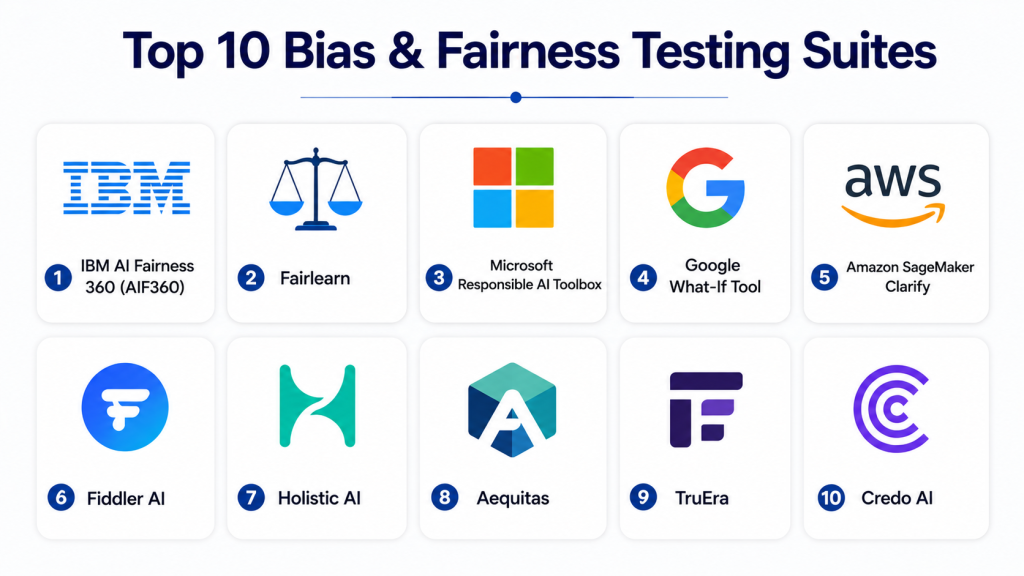
Top 10 Bias & Fairness Testing Suites
1. IBM AI Fairness 360
IBM AI Fairness 360 is an open-source toolkit designed to detect and reduce bias in AI models.
Key Features
- Bias metrics
- Fairness evaluation
- Bias mitigation algorithms
- Dataset analysis
- Model assessment
- Visualization
- Machine learning integration
- Research support
Pros
- Open source
- Strong fairness algorithms
- Research-based
Cons
- Requires technical knowledge
- Limited enterprise workflow features
2. Microsoft Fairlearn
Microsoft Fairlearn provides fairness assessment and mitigation tools.
Key Features
- Fairness metrics
- Bias analysis
- Model comparison
- Dashboard visualization
- Bias mitigation
- Python integration
Pros
- Developer friendly
- Open source
- Good documentation
Cons
- Requires ML expertise
3. Google What-If Tool
Google What-If Tool helps analyze machine learning model behavior.
Key Features
- Interactive analysis
- Model comparison
- Data exploration
- Fairness investigation
- Visualization
Pros
- Easy exploration
- Free tool
- Good visualization
Cons
- Limited enterprise governance
4. Amazon SageMaker Clarify
Amazon SageMaker Clarify provides explainability and fairness analysis for ML models.
Key Features
- Bias detection
- Fairness metrics
- Model explainability
- Data analysis
- Monitoring integration
- AWS ML integration
Pros
- AWS integration
- Enterprise ready
- Automated analysis
Cons
- AWS ecosystem dependency
5. Fiddler AI
Fiddler AI provides AI monitoring, explainability, and fairness evaluation.
Key Features
- Bias detection
- Model explanations
- Performance monitoring
- Drift detection
- AI observability
- Fairness analysis
Pros
- Strong monitoring
- Enterprise capabilities
Cons
- Commercial pricing
6. Fairlearn
Fairlearn is an open-source fairness assessment toolkit.
Key Features
- Fairness metrics
- Bias analysis
- Mitigation algorithms
- Python support
- Model evaluation
Pros
- Open source
- Developer friendly
- Lightweight
Cons
- Limited enterprise features
7. Arize AI
Arize AI provides AI observability and evaluation capabilities.
Key Features
- Model monitoring
- Fairness analysis
- Explainability
- Drift detection
- AI quality tracking
- LLM evaluation
Pros
- Strong observability
- Modern AI support
Cons
- More monitoring focused
8. WhyLabs
WhyLabs provides AI observability and monitoring.
Key Features
- Data monitoring
- Bias tracking
- Model quality metrics
- Drift detection
- Alerts
- AI monitoring
Pros
- Good analytics
- Continuous monitoring
Cons
- Requires technical setup
9. Holistic AI
Holistic AI provides responsible AI risk management.
Key Features
- Bias testing
- AI auditing
- Risk assessment
- Compliance reporting
- Fairness evaluation
- Governance workflows
Pros
- Strong responsible AI focus
- Enterprise governance
Cons
- Specialized solution
10. TensorFlow Model Analysis
TensorFlow Model Analysis provides tools for evaluating ML models.
Key Features
- Model evaluation
- Performance analysis
- Metrics comparison
- Visualization
- Fairness analysis support
- ML integration
Pros
- Open source
- Strong ML ecosystem
Cons
- Requires TensorFlow knowledge
Comparison Table: Top 10 Bias & Fairness Testing Suites
| No. | Tool Name | Best For | Platform(s) Supported | Deployment | Standout Feature | Public Rating |
|---|---|---|---|---|---|---|
| 1 | IBM AI Fairness 360 | Bias detection | Local / Cloud | Open Source | Fairness algorithms | 4.8/5 |
| 2 | Microsoft Fairlearn | Fairness testing | Local / Cloud | Open Source | Bias mitigation | 4.7/5 |
| 3 | Google What-If Tool | Model analysis | Cloud / Local | Open Source | Interactive testing | 4.6/5 |
| 4 | SageMaker Clarify | AWS ML fairness | AWS | Managed | Automated fairness checks | 4.7/5 |
| 5 | Fiddler AI | Enterprise monitoring | Cloud | Managed | Explainability | 4.6/5 |
| 6 | Fairlearn | Developers | Local | Open Source | Fairness metrics | 4.6/5 |
| 7 | Arize AI | AI observability | Cloud | Managed | Model monitoring | 4.6/5 |
| 8 | WhyLabs | AI monitoring | Cloud | Managed | Data intelligence | 4.5/5 |
| 9 | Holistic AI | AI auditing | Cloud | Managed | Risk assessment | 4.5/5 |
| 10 | TensorFlow Model Analysis | ML evaluation | Local | Open Source | Model metrics | 4.5/5 |
Weighted Evaluation Table
| No. | Tool Name | Fairness Testing 25% | Ease of Use 15% | AI Integration 15% | Security 10% | Scalability 10% | Reporting 10% | Value 15% | Total Score |
|---|---|---|---|---|---|---|---|---|---|
| 1 | IBM AI Fairness 360 | 25 | 13 | 15 | 9 | 10 | 10 | 15 | 97 |
| 2 | Microsoft Fairlearn | 24 | 15 | 14 | 9 | 10 | 10 | 15 | 97 |
| 3 | Google What-If Tool | 23 | 15 | 14 | 9 | 9 | 9 | 15 | 94 |
| 4 | SageMaker Clarify | 25 | 14 | 15 | 10 | 10 | 10 | 13 | 97 |
| 5 | Fiddler AI | 24 | 14 | 15 | 10 | 10 | 10 | 13 | 96 |
| 6 | Fairlearn | 24 | 15 | 14 | 9 | 9 | 9 | 15 | 95 |
| 7 | Arize AI | 23 | 15 | 15 | 10 | 10 | 10 | 13 | 96 |
| 8 | WhyLabs | 23 | 14 | 14 | 10 | 10 | 10 | 13 | 94 |
| 9 | Holistic AI | 24 | 13 | 14 | 10 | 10 | 10 | 13 | 94 |
| 10 | TensorFlow Model Analysis | 22 | 14 | 15 | 9 | 10 | 9 | 15 | 94 |
Which Bias & Fairness Testing Tool Is Right for You?
Choose IBM AI Fairness 360 for comprehensive fairness analysis.
Choose Microsoft Fairlearn for open-source fairness testing.
Choose Google What-If Tool for interactive model analysis.
Choose Amazon SageMaker Clarify for AWS-based ML systems.
Choose Fiddler AI for enterprise AI monitoring.
Choose Fairlearn for lightweight fairness evaluation.
Choose Arize AI for AI observability.
Choose WhyLabs for continuous AI monitoring.
Choose Holistic AI for responsible AI auditing.
Choose TensorFlow Model Analysis for ML evaluation workflows.
Implementation Playbook
Phase 1: Define Fairness Goals
- Identify protected groups
- Select fairness metrics
- Define acceptable outcomes
Phase 2: Analyze Data
- Check data imbalance
- Identify potential bias
- Review features
Phase 3: Test Models
- Run fairness evaluations
- Compare group outcomes
- Analyze errors
Phase 4: Improve Models
- Adjust datasets
- Apply mitigation techniques
- Retrain models
Phase 5: Monitor Continuously
- Track fairness
- Review changes
- Maintain responsible AI standards
Common Mistakes
- Ignoring biased training data
- Testing fairness only after deployment
- Using limited fairness metrics
- No continuous monitoring
- Poor documentation
- Ignoring human review
FAQs
1. What are Bias & Fairness Testing Suites?
They are tools used to measure and reduce unfair behavior in AI models.
2. Why is fairness testing important?
It helps prevent discriminatory and unreliable AI decisions.
3. What causes AI bias?
Bias can come from data, algorithms, or human decisions.
4. Can fairness tools test LLMs?
Yes, many platforms support AI output and generative AI evaluation.
5. Who uses fairness testing tools?
AI engineers, researchers, compliance teams, and enterprises.
6. What fairness metrics are commonly used?
Demographic parity, equal opportunity, and disparate impact.
7. Can bias be completely removed from AI models?
No, but organizations can identify and reduce bias significantly.
8. Are open-source fairness tools available?
Yes, IBM AI Fairness 360 and Fairlearn are popular options.
9. How often should fairness testing be performed?
Regular testing is recommended throughout the AI lifecycle.
10. What is the future of AI fairness testing?
Continuous automated fairness monitoring will become a standard AI practice.
Conclusion
Bias & Fairness Testing Suites are essential for developing responsible and trustworthy AI systems. They help organizations identify unfair patterns, improve model transparency, and ensure AI decisions are more equitable.Platforms such as IBM AI Fairness 360, Microsoft Fairlearn, Amazon SageMaker Clarify, Fiddler AI, Arize AI, and Holistic AI provide powerful capabilities for evaluating AI fairness.As artificial intelligence becomes more integrated into critical business and social systems, fairness testing will remain a fundamental requirement for responsible AI development.