Introduction
Prompt Security & Injection Defense Tools are AI security solutions designed to protect large language models (LLMs), AI applications, and agent-based systems from malicious prompts, prompt injection attacks, data leakage, and unsafe AI behavior.
As organizations increasingly deploy generative AI applications such as chatbots, AI assistants, enterprise copilots, and autonomous AI agents, protecting these systems from manipulation has become a major security requirement.
Prompt injection attacks occur when attackers create specially designed inputs that attempt to:
- Override AI instructions
- Bypass security controls
- Extract confidential information
- Manipulate AI responses
- Access restricted data
- Change AI agent behavior
Prompt Security & Injection Defense Tools help organizations secure AI applications by providing:
- Prompt monitoring
- Attack detection
- Input filtering
- Output validation
- Data protection
- AI security testing
- Threat analysis
- Policy enforcement
These platforms are used by:
- AI engineers
- Security teams
- MLOps engineers
- Application developers
- Enterprise AI architects
- Responsible AI teams
Modern Prompt Security platforms provide capabilities such as:
- Prompt injection detection
- Jailbreak prevention
- Sensitive data protection
- AI firewall controls
- LLM security testing
- Runtime monitoring
- Threat intelligence
- Security analytics
The goal of Prompt Security & Injection Defense Tools is to help organizations build secure, reliable, and trustworthy AI applications.
Why Prompt Security Matters
Generative AI applications often connect with:
- Business documents
- Databases
- APIs
- Internal systems
- Customer information
Without proper protection, AI applications may experience:
- Data leakage
- Unauthorized access
- Harmful outputs
- Business risks
- Security incidents
Prompt Security Tools help organizations:
- Protect AI applications
- Secure sensitive information
- Prevent manipulation
- Improve AI reliability
Types of Prompt Security Threats
Direct Prompt Injection
Attackers directly manipulate AI instructions.
Example:
- User enters malicious commands
Indirect Prompt Injection
Malicious instructions are hidden inside:
- Documents
- Websites
- Emails
- External data sources
Jailbreak Attacks
Attempts to bypass:
- Safety rules
- Content restrictions
Data Extraction Attacks
Attempts to reveal:
- Private information
- System prompts
- Training data
AI Agent Manipulation
Targets:
- Autonomous AI agents
- Tool usage
- Decision-making workflows
How Prompt Security Tools Work
Step 1: Analyze Input Prompts
Systems inspect:
- User instructions
- Context
- External content
Step 2: Detect Threat Patterns
Platforms identify:
- Injection attempts
- Jailbreak techniques
- Malicious behavior
Step 3: Apply Security Policies
Tools enforce:
- Blocking rules
- Access controls
- Safety policies
Step 4: Validate AI Output
Systems check:
- Sensitive information
- Unsafe responses
- Policy violations
Step 5: Monitor AI Activity
Platforms track:
- Security events
- Attack patterns
- User behavior
Key Components of Prompt Security Platforms
Prompt Firewall
Controls:
- Incoming prompts
- Malicious instructions
Injection Detection Engine
Identifies:
- Attack patterns
- Suspicious requests
Output Protection Layer
Checks:
- AI responses
- Data leakage risks
Security Monitoring Dashboard
Tracks:
- Threats
- Incidents
- Usage patterns
Policy Enforcement System
Manages:
- AI security rules
- Access permissions
Testing Framework
Supports:
- Security testing
- Red-team exercises
Key Features of Prompt Security & Injection Defense Tools
Prompt Injection Detection
Detects:
- Malicious prompts
- Instruction manipulation
Jailbreak Prevention
Blocks:
- Unsafe AI requests
- Policy bypass attempts
Data Loss Prevention
Protects:
- Confidential information
- Sensitive data
Prompt Monitoring
Tracks:
- User interactions
- AI behavior
AI Security Testing
Evaluates:
- Application vulnerabilities
- Model weaknesses
Real-Time Protection
Provides:
- Runtime security
- Immediate threat response
Common Use Cases
Enterprise AI Assistants
Protecting:
- Internal copilots
- Employee AI tools
Customer Service Chatbots
Preventing:
- Unsafe responses
- Data exposure
Retrieval-Augmented Generation (RAG)
Securing:
- Document-based AI systems
- Knowledge assistants
AI Agents
Protecting:
- Autonomous workflows
- Tool access
Healthcare AI
Securing:
- Patient information
- Medical assistants
Financial AI
Protecting:
- Sensitive financial data
- Automated decisions
Benefits of Prompt Security Tools
Improved AI Safety
Reduces harmful AI behavior.
Better Data Protection
Prevents sensitive information leakage.
Stronger Enterprise Security
Protects business AI applications.
Better Compliance
Supports AI security requirements.
Increased Trust
Creates safer AI experiences.
Evaluation Criteria
Threat Detection
Evaluate:
- Injection detection accuracy
- Attack coverage
AI Security Features
Consider:
- Jailbreak prevention
- Data protection
Integration
Check:
- LLM platforms
- AI applications
Runtime Protection
Evaluate:
- Real-time monitoring
- Blocking capabilities
Reporting
Consider:
- Security dashboards
- Incident reports
Scalability
Evaluate:
- Enterprise deployment
Key Trends
AI Firewall Development
Organizations are adopting security layers between users and AI models.
LLM Security Testing
Security teams are performing:
- AI red teaming
- Vulnerability testing
AI Agent Security
New tools focus on:
- Agent permissions
- Autonomous action protection
Runtime AI Protection
Organizations need continuous AI security monitoring.
Secure RAG Systems
Companies are protecting AI systems connected with enterprise data.
Methodology
The following Prompt Security & Injection Defense Tools were evaluated based on:
- Prompt protection
- Injection detection
- AI security testing
- Runtime monitoring
- Data protection
- Integration
- Scalability
- Enterprise readiness
- Reporting
- Value
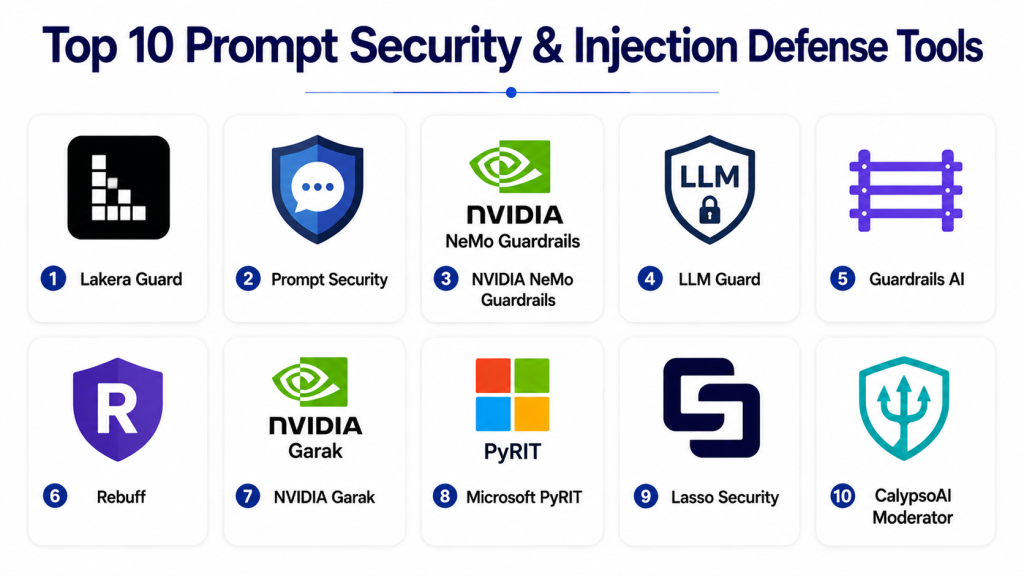
Top 10 Prompt Security & Injection Defense Tools
1. Lakera Guard
Lakera Guard provides AI security protection for LLM applications.
Key Features
- Prompt injection detection
- Jailbreak detection
- Sensitive data protection
- Real-time monitoring
- AI threat intelligence
- API integration
- Content filtering
Pros
- Specialized LLM security
- Real-time protection
- Developer friendly
Cons
- Focused mainly on generative AI security
2. Protect AI
Protect AI provides security solutions for machine learning and AI systems.
Key Features
- AI vulnerability detection
- Model security
- Risk monitoring
- AI supply chain protection
- Security assessments
Pros
- Broad AI security coverage
- Enterprise focused
Cons
- Requires security expertise
3. Rebuff
Rebuff provides open-source prompt injection detection.
Key Features
- Prompt attack detection
- LLM security checks
- Vector-based detection
- Heuristic analysis
- API support
Pros
- Open source
- Lightweight
- Easy integration
Cons
- Limited enterprise features
4. NVIDIA NeMo Guardrails
NVIDIA NeMo Guardrails provides programmable safety controls for LLM applications.
Key Features
- Input guardrails
- Output filtering
- Conversation control
- Policy enforcement
- LLM application security
Pros
- Strong AI ecosystem
- Developer flexibility
Cons
- Requires technical expertise
5. Microsoft Azure AI Content Safety
Microsoft Azure AI Content Safety provides AI safety controls.
Key Features
- Content filtering
- Risk detection
- Prompt safety
- AI application protection
- Azure integration
Pros
- Enterprise ready
- Strong cloud integration
Cons
- Best with Azure services
6. AWS Bedrock Guardrails
AWS Bedrock Guardrails provides safety controls for generative AI applications.
Key Features
- Content filtering
- Prompt controls
- Sensitive data protection
- AI safety policies
- AWS integration
Pros
- Strong AWS ecosystem
- Enterprise scalability
Cons
- AWS dependency
7. Guardrails AI
Guardrails AI provides validation and safety controls for LLM applications.
Key Features
- Output validation
- Input checks
- AI reliability controls
- Custom validators
- Developer tools
Pros
- Flexible
- Open source
Cons
- Requires customization
8. Lasso Security
Lasso Security provides AI security testing and protection.
Key Features
- Prompt injection testing
- AI vulnerability assessment
- Security monitoring
- Risk analysis
Pros
- Security focused
- Enterprise capabilities
Cons
- Specialized platform
9. Prompt Security
Prompt Security provides protection against AI attacks.
Key Features
- Prompt attack detection
- Data leakage prevention
- AI security monitoring
- Threat analysis
- Policy controls
Pros
- Focused AI security solution
- Enterprise protection
Cons
- Newer market category
10. Robust Intelligence AI Security Platform
Robust Intelligence provides AI security testing and protection.
Key Features
- AI risk assessment
- Model security testing
- Vulnerability detection
- Monitoring
- Governance support
Pros
- Enterprise AI security
- Comprehensive testing
Cons
- Enterprise pricing
Comparison Table: Top 10 Prompt Security & Injection Defense Tools
| No. | Tool Name | Best For | Platform(s) Supported | Deployment | Standout Feature | Public Rating |
|---|---|---|---|---|---|---|
| 1 | Lakera Guard | LLM security | Cloud | Managed | Prompt injection defense | 4.8/5 |
| 2 | Protect AI | AI security | Cloud | Enterprise | AI vulnerability protection | 4.7/5 |
| 3 | Rebuff | Developers | Local / Cloud | Open Source | Injection detection | 4.5/5 |
| 4 | NVIDIA NeMo Guardrails | LLM applications | Cloud / Local | Open Source | Programmable guardrails | 4.7/5 |
| 5 | Azure AI Content Safety | Enterprise AI | Azure | Managed | Content protection | 4.6/5 |
| 6 | AWS Bedrock Guardrails | AWS AI apps | AWS | Managed | AI safety controls | 4.7/5 |
| 7 | Guardrails AI | LLM validation | Cloud / Local | Open Source | Custom validators | 4.6/5 |
| 8 | Lasso Security | AI testing | Cloud | Managed | Security assessment | 4.5/5 |
| 9 | Prompt Security | AI protection | Cloud | Managed | Threat detection | 4.5/5 |
| 10 | Robust Intelligence | Enterprise AI security | Cloud | Enterprise | AI testing | 4.6/5 |
Weighted Evaluation Table
| No. | Tool Name | Security 25% | Ease of Use 15% | AI Integration 15% | Detection 10% | Scalability 10% | Monitoring 10% | Value 15% | Total Score |
|---|---|---|---|---|---|---|---|---|---|
| 1 | Lakera Guard | 25 | 15 | 15 | 10 | 10 | 10 | 14 | 99 |
| 2 | Protect AI | 25 | 13 | 15 | 10 | 10 | 10 | 13 | 96 |
| 3 | Rebuff | 22 | 15 | 14 | 9 | 9 | 9 | 15 | 93 |
| 4 | NVIDIA NeMo Guardrails | 24 | 14 | 15 | 10 | 10 | 10 | 14 | 97 |
| 5 | Azure AI Content Safety | 24 | 15 | 15 | 10 | 10 | 10 | 13 | 97 |
| 6 | AWS Bedrock Guardrails | 24 | 15 | 15 | 10 | 10 | 10 | 13 | 97 |
| 7 | Guardrails AI | 23 | 14 | 15 | 9 | 10 | 10 | 14 | 95 |
| 8 | Lasso Security | 23 | 13 | 14 | 10 | 10 | 10 | 13 | 93 |
| 9 | Prompt Security | 23 | 14 | 14 | 10 | 10 | 10 | 13 | 94 |
| 10 | Robust Intelligence | 24 | 13 | 15 | 10 | 10 | 10 | 13 | 95 |
Which Prompt Security Tool Is Right for You?
Choose Lakera Guard for specialized LLM security.
Choose Protect AI for complete AI security.
Choose Rebuff for open-source prompt injection defense.
Choose NVIDIA NeMo Guardrails for customizable LLM controls.
Choose Azure AI Content Safety for Microsoft environments.
Choose AWS Bedrock Guardrails for AWS AI applications.
Choose Guardrails AI for flexible validation.
Choose Lasso Security for AI security testing.
Choose Prompt Security for AI attack protection.
Choose Robust Intelligence for enterprise AI security.
Implementation Playbook
Phase 1: Identify AI Security Risks
- Map AI applications
- Identify sensitive data
- Define attack scenarios
Phase 2: Add Security Controls
- Configure guardrails
- Enable monitoring
- Apply policies
Phase 3: Test AI Applications
- Perform attack testing
- Validate defenses
- Improve protections
Phase 4: Monitor Production Systems
- Track threats
- Review incidents
- Update policies
Phase 5: Continuous AI Security
- Improve detection
- Update defenses
- Maintain compliance
Common Mistakes
- Deploying LLM apps without security controls
- Ignoring prompt injection risks
- No output validation
- Poor access management
- No AI security testing
- Exposing sensitive information
FAQs
1. What are Prompt Security & Injection Defense Tools?
They are security solutions that protect AI applications from malicious prompts and attacks.
2. What is prompt injection?
Prompt injection is an attack where users manipulate AI instructions to change system behavior.
3. Why is prompt security important?
It protects AI applications from data leakage and unauthorized actions.
4. Can prompt security tools protect AI agents?
Yes, many support AI agent security and permission controls.
5. Do these tools work with LLM applications?
Yes, they are designed for generative AI and LLM systems.
6. What attacks can these tools detect?
They detect prompt injection, jailbreaks, and unsafe requests.
7. Are open-source prompt security tools available?
Yes, tools such as Rebuff and Guardrails AI provide open-source options.
8. Can prompt security prevent all AI attacks?
No, but it significantly reduces security risks.
9. How do organizations test AI security?
They use AI red teaming, vulnerability testing, and security monitoring.
10. What is the future of prompt security?
AI security layers will become essential for enterprise AI applications.
Conclusion
Prompt Security & Injection Defense Tools are becoming critical for organizations deploying generative AI applications. They protect AI systems from prompt manipulation, data leakage, jailbreak attacks, and unsafe behavior.Platforms such as Lakera Guard, Protect AI, NVIDIA NeMo Guardrails, AWS Bedrock Guardrails, Azure AI Content Safety, and Guardrails AI provide powerful security capabilities for modern AI applications.As AI assistants, RAG systems, and autonomous AI agents continue expanding, prompt security will become a fundamental requirement for building safe, reliable, and enterprise-ready AI solutions.