Introduction
AI Audit Readiness Platforms are solutions designed to help organizations prepare, manage, and maintain documentation required for auditing artificial intelligence systems.
As businesses adopt AI across critical operations, regulators, customers, and internal governance teams increasingly require evidence that AI systems are safe, transparent, compliant, and responsibly managed.
AI audits evaluate areas such as:
- AI governance processes
- Model documentation
- Data usage
- Risk management
- Security controls
- Fairness evaluation
- Compliance requirements
- Operational monitoring
AI Audit Readiness Platforms help organizations collect, organize, and maintain audit-related information throughout the AI lifecycle.
These platforms support organizations by providing:
- Audit preparation workflows
- Compliance documentation
- Model inventories
- Risk assessments
- Evidence collection
- Policy tracking
- Governance reporting
AI Audit Readiness Platforms are used by:
- AI governance teams
- Compliance officers
- Risk managers
- Data scientists
- MLOps engineers
- Security teams
- Enterprise AI leaders
Modern AI audit platforms provide capabilities such as:
- Automated evidence collection
- AI system documentation
- Regulatory mapping
- Risk tracking
- Audit trails
- Policy management
- Governance dashboards
The goal of AI Audit Readiness Platforms is to help organizations demonstrate that their AI systems are secure, explainable, compliant, and responsibly managed.
Why AI Audit Readiness Matters
AI systems are becoming part of important business decisions.
Organizations need to prove:
- How AI models work
- What data was used
- Who approved deployment
- How risks are managed
- How performance is monitored
Without audit readiness, organizations may face:
- Compliance failures
- Regulatory penalties
- Security concerns
- Lack of stakeholder trust
- Difficulty managing AI risks
AI Audit Readiness Platforms help organizations:
- Prepare for audits
- Maintain AI documentation
- Improve governance
- Reduce compliance effort
Areas Covered by AI Audits
Model Governance
Audits review:
- Model ownership
- Model lifecycle
- Version history
- Approval records
Data Governance
Audits evaluate:
- Data sources
- Data quality
- Data permissions
- Privacy controls
Responsible AI
Reviews include:
- Bias testing
- Fairness evaluation
- Explainability
Security Management
Checks include:
- Access controls
- Vulnerability management
- AI security practices
Compliance Management
Includes:
- Regulatory requirements
- Internal policies
- Industry standards
How AI Audit Readiness Platforms Work
Step 1: AI System Discovery
Platforms identify:
- AI models
- Applications
- Data sources
- Owners
Step 2: Evidence Collection
Systems collect:
- Documentation
- Reports
- Model information
Step 3: Compliance Mapping
Platforms connect AI systems with:
- Regulations
- Standards
- Internal policies
Step 4: Risk Evaluation
Tools analyze:
- AI risks
- Compliance gaps
- Governance issues
Step 5: Audit Reporting
Organizations generate:
- Audit reports
- Evidence packages
- Compliance documentation
Key Components of AI Audit Readiness Platforms
AI Inventory Management
Tracks:
- Models
- Applications
- Owners
- Deployment status
Evidence Management
Stores:
- Reports
- Documentation
- Approval records
Compliance Mapping
Connects AI practices with:
- Regulations
- Frameworks
Risk Assessment Module
Identifies:
- AI risks
- Governance gaps
Policy Management
Controls:
- AI standards
- Usage rules
Audit Dashboard
Provides:
- Compliance status
- Risk visibility
Common AI Audit Frameworks
NIST AI Risk Management Framework
Helps organizations:
- Identify AI risks
- Manage trustworthy AI practices
ISO AI Management Standards
Provides:
- AI governance guidance
- Management controls
EU AI Act Compliance
Supports:
- AI risk classification
- Documentation requirements
Responsible AI Frameworks
Focus on:
- Fairness
- Transparency
- Accountability
Key Features of AI Audit Readiness Platforms
Automated Evidence Collection
Collects:
- Model records
- Performance data
- Governance information
Audit Trail Management
Tracks:
- Changes
- Approvals
- Activities
AI Documentation Management
Maintains:
- Model cards
- Reports
- Policies
Compliance Reporting
Creates:
- Audit summaries
- Compliance reports
Risk Monitoring
Tracks:
- AI risks
- Control effectiveness
Workflow Automation
Manages:
- Reviews
- Approvals
- Governance tasks
Common Use Cases
Financial Services
Auditing:
- Credit scoring models
- Fraud detection AI
Healthcare
Reviewing:
- Medical AI systems
- Patient data usage
Enterprise AI
Managing:
- Internal AI applications
- Generative AI systems
Government AI
Supporting:
- Public AI accountability
Insurance
Auditing:
- Risk prediction models
- Automated decisions
AI Agent Governance
Monitoring:
- Autonomous AI actions
- Agent permissions
Benefits of AI Audit Readiness Platforms
Faster Audit Preparation
Organizations quickly collect required evidence.
Better Compliance
Supports regulatory requirements.
Improved AI Transparency
Creates clear AI records.
Reduced Operational Risk
Identifies governance gaps.
Stronger Trust
Demonstrates responsible AI practices.
Evaluation Criteria
Audit Management
Evaluate:
- Evidence collection
- Audit workflows
Compliance Support
Consider:
- Regulatory mapping
- Reporting
Governance Features
Evaluate:
- Policies
- Model management
Automation
Check:
- Workflow automation
- Documentation generation
Integration
Consider:
- MLOps platforms
- Cloud environments
Scalability
Evaluate:
- Enterprise support
Key Trends
Generative AI Audit Readiness
Organizations are preparing audits for:
- LLM applications
- AI assistants
- AI agents
Automated Compliance Evidence
AI platforms are reducing manual audit preparation.
Continuous AI Auditing
Organizations are moving from periodic audits to continuous monitoring.
AI Regulation Preparation
Companies are preparing for:
- AI governance laws
- Industry standards
AI Governance Integration
Audit readiness is becoming part of complete AI governance platforms.
Methodology
The following AI Audit Readiness Platforms were evaluated based on:
- Audit capabilities
- Compliance support
- Governance workflows
- Documentation management
- Risk assessment
- Automation
- Integration
- Security
- Scalability
- Enterprise readiness
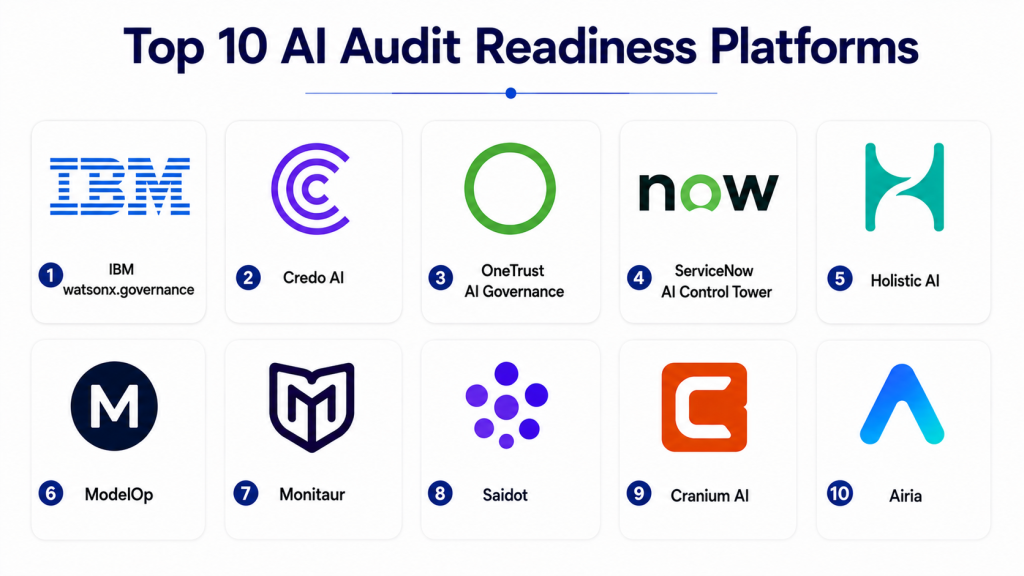
Top 10 AI Audit Readiness Platforms
1. IBM watsonx.governance
IBM watsonx.governance provides enterprise AI governance and audit management capabilities.
Key Features
- AI inventory
- Risk assessment
- Compliance reporting
- Model documentation
- Policy management
- Audit workflows
- Governance dashboards
- Monitoring
Pros
- Enterprise-grade platform
- Strong compliance capabilities
- Complete AI lifecycle governance
Cons
- Complex implementation
- Higher cost
2. OneTrust AI Governance
OneTrust provides AI governance and compliance management.
Key Features
- AI risk assessments
- Compliance tracking
- Policy management
- Audit documentation
- Privacy management
- Governance workflows
Pros
- Strong compliance focus
- Privacy capabilities
Cons
- Complex configuration
3. Microsoft Purview AI Governance
Microsoft Purview supports AI governance and compliance management.
Key Features
- AI discovery
- Data governance
- Compliance monitoring
- Policy controls
- Risk management
- Audit tracking
Pros
- Strong Microsoft integration
- Enterprise security
Cons
- Best for Microsoft users
4. Credo AI
Credo AI provides AI governance and risk management solutions.
Key Features
- AI inventory
- Risk assessment
- Compliance workflows
- Policy management
- Audit preparation
- Governance dashboards
Pros
- Strong AI governance approach
- Enterprise focused
Cons
- Premium pricing
5. ModelOp Center
ModelOp Center manages enterprise AI model governance.
Key Features
- Model inventory
- Lifecycle tracking
- Audit documentation
- Approval workflows
- Compliance management
Pros
- Strong model governance
- Enterprise workflows
Cons
- Requires expertise
6. ServiceNow AI Control Tower
ServiceNow provides AI governance workflow management.
Key Features
- AI inventory
- Workflow automation
- Risk tracking
- Approval management
- Compliance reporting
Pros
- Excellent workflow automation
- Enterprise IT integration
Cons
- ServiceNow dependency
7. Collibra AI Governance
Collibra provides data and AI governance capabilities.
Key Features
- AI documentation
- Policy management
- Data governance
- Compliance workflows
- Collaboration tools
Pros
- Strong governance framework
- Enterprise adoption
Cons
- Complex deployment
8. Dataiku Govern
Dataiku Govern supports AI project governance.
Key Features
- Model documentation
- Approval workflows
- Risk tracking
- Compliance records
- Collaboration
Pros
- User friendly
- Good AI lifecycle support
Cons
- Premium platform
9. Holistic AI
Holistic AI provides AI risk assessment and auditing solutions.
Key Features
- AI audits
- Risk evaluation
- Bias testing
- Compliance reporting
- Governance workflows
Pros
- Responsible AI focused
- Strong auditing capabilities
Cons
- Specialized solution
10. TrustArc AI Governance
TrustArc provides privacy and AI compliance solutions.
Key Features
- AI risk assessments
- Compliance documentation
- Privacy management
- Audit support
- Governance reporting
Pros
- Strong privacy expertise
- Compliance focused
Cons
- Less technical ML focus
Comparison Table: Top 10 AI Audit Readiness Platforms
| No. | Tool Name | Best For | Platform(s) Supported | Deployment | Standout Feature | Public Rating |
|---|---|---|---|---|---|---|
| 1 | IBM watsonx.governance | Enterprise AI audits | Cloud | Managed | Governance automation | 4.8/5 |
| 2 | OneTrust AI Governance | Compliance audits | Cloud | Managed | Risk management | 4.7/5 |
| 3 | Microsoft Purview | Enterprise governance | Cloud | Managed | Compliance tracking | 4.7/5 |
| 4 | Credo AI | AI governance | Cloud | Managed | Audit readiness | 4.6/5 |
| 5 | ModelOp Center | Model governance | Cloud | Enterprise | Lifecycle management | 4.6/5 |
| 6 | ServiceNow AI Control Tower | Workflow automation | Cloud | Managed | Governance workflows | 4.6/5 |
| 7 | Collibra | Data & AI governance | Cloud | Enterprise | Governance framework | 4.5/5 |
| 8 | Dataiku Govern | AI lifecycle management | Cloud | Managed | Collaboration | 4.5/5 |
| 9 | Holistic AI | AI auditing | Cloud | Managed | Risk evaluation | 4.5/5 |
| 10 | TrustArc | Privacy compliance | Cloud | Managed | Compliance management | 4.4/5 |
Weighted Evaluation Table
| No. | Tool Name | Audit Readiness 25% | Ease of Use 15% | AI Integration 15% | Security 10% | Scalability 10% | Compliance 10% | Value 15% | Total Score |
|---|---|---|---|---|---|---|---|---|---|
| 1 | IBM watsonx.governance | 25 | 14 | 15 | 10 | 10 | 10 | 14 | 98 |
| 2 | OneTrust AI Governance | 25 | 14 | 14 | 10 | 10 | 10 | 13 | 96 |
| 3 | Microsoft Purview | 24 | 15 | 15 | 10 | 10 | 10 | 13 | 97 |
| 4 | Credo AI | 24 | 14 | 14 | 10 | 10 | 10 | 13 | 95 |
| 5 | ModelOp Center | 24 | 13 | 14 | 10 | 10 | 10 | 13 | 94 |
| 6 | ServiceNow AI Control Tower | 24 | 14 | 14 | 10 | 10 | 10 | 13 | 95 |
| 7 | Collibra | 24 | 13 | 14 | 10 | 10 | 10 | 13 | 94 |
| 8 | Dataiku Govern | 23 | 15 | 14 | 9 | 10 | 10 | 13 | 94 |
| 9 | Holistic AI | 24 | 13 | 14 | 10 | 10 | 10 | 13 | 94 |
| 10 | TrustArc | 23 | 14 | 13 | 10 | 10 | 10 | 13 | 93 |
Which AI Audit Readiness Platform Is Right for You?
Choose IBM watsonx.governance for enterprise AI audits.
Choose OneTrust AI Governance for compliance-focused organizations.
Choose Microsoft Purview for Microsoft environments.
Choose Credo AI for AI governance programs.
Choose ModelOp Center for model lifecycle auditing.
Choose ServiceNow AI Control Tower for workflow automation.
Choose Collibra for data and AI governance.
Choose Dataiku Govern for collaborative AI teams.
Choose Holistic AI for responsible AI audits.
Choose TrustArc for privacy-focused compliance.
Implementation Playbook
Phase 1: Establish Audit Requirements
- Identify regulations
- Define governance standards
- Assign responsibilities
Phase 2: Build AI Inventory
- Register models
- Document ownership
- Track AI applications
Phase 3: Collect Evidence
- Store documentation
- Maintain audit records
- Track approvals
Phase 4: Evaluate Risks
- Test fairness
- Review security
- Validate compliance
Phase 5: Continuous Audit Readiness
- Monitor AI systems
- Update documentation
- Improve governance
Common Mistakes
- Preparing documentation only before audits
- Missing model ownership
- Poor evidence management
- No AI inventory
- Ignoring regulatory changes
- Lack of continuous monitoring
FAQs
1. What are AI Audit Readiness Platforms?
They are tools that help organizations prepare and maintain evidence for AI audits.
2. Why is AI audit readiness important?
It helps organizations prove that AI systems are safe, compliant, and responsibly managed.
3. What do AI audits evaluate?
They evaluate governance, security, fairness, documentation, and compliance.
4. Can audit readiness tools support generative AI?
Yes, many support LLM and AI application governance.
5. Who uses AI audit platforms?
AI teams, compliance teams, security teams, and enterprise leaders.
6. Are AI audits required by regulations?
Many industries are moving toward stronger AI governance requirements.
7. What documents are needed for AI audits?
Model cards, risk assessments, policies, testing reports, and monitoring records.
8. Can AI audit readiness be automated?
Yes, many platforms automate evidence collection and reporting.
9. How often should AI audits happen?
Organizations should continuously monitor AI systems and perform regular reviews.
10. What is the future of AI auditing?
Continuous automated AI auditing will become a standard practice.
Conclusion
AI Audit Readiness Platforms are becoming essential for organizations managing modern artificial intelligence systems. They help businesses maintain documentation, collect evidence, manage risks, and demonstrate compliance.Platforms such as IBM watsonx.governance, OneTrust AI Governance, Microsoft Purview, Credo AI, ModelOp Center, and ServiceNow AI Control Tower provide strong capabilities for preparing AI systems for audits.As AI regulations and governance expectations continue increasing, audit readiness will become a critical foundation for responsible, secure, and trustworthy AI adoption.