Introduction
Post-Quantum Crypto Migration Tooling platforms are security solutions designed to help organizations transition from traditional cryptographic systems to quantum-resistant cryptographic algorithms.
The development of quantum computers creates a future risk for widely used encryption methods such as RSA and ECC, which may become vulnerable to large-scale quantum attacks. Organizations must prepare by identifying cryptographic dependencies, updating security systems, and migrating toward post-quantum cryptography (PQC).
Post-Quantum Crypto Migration Tools help organizations manage this transition by providing:
- Cryptographic discovery
- Encryption inventory management
- Quantum risk assessment
- Algorithm migration planning
- Certificate management
- Cryptographic policy enforcement
- Compliance reporting
These platforms help organizations identify where vulnerable cryptography exists across:
- Applications
- Networks
- Cloud environments
- Devices
- Certificates
- Data systems
Post-Quantum Crypto Migration Tooling is used by:
- Security teams
- Cryptography engineers
- Cloud architects
- Enterprise IT teams
- Compliance professionals
- Government organizations
Modern platforms provide capabilities such as:
- Crypto asset discovery
- Quantum readiness assessment
- Hybrid cryptography support
- Certificate lifecycle management
- Automated migration workflows
- Security monitoring
The goal of Post-Quantum Crypto Migration Tooling is to help organizations become quantum-ready while maintaining security, availability, and operational continuity.
Why Post-Quantum Crypto Migration Matters
Quantum computing may eventually break current public-key cryptography systems.
Organizations face risks such as:
- Harvest-now-decrypt-later attacks
- Long-term data exposure
- Certificate vulnerabilities
- Security compliance challenges
Sensitive information that needs protection for many years may already be at risk.
Post-Quantum migration helps organizations:
- Protect future data
- Modernize cryptographic infrastructure
- Reduce quantum risks
- Maintain compliance
How Post-Quantum Crypto Migration Tools Work
Step 1: Discover Cryptographic Assets
Tools identify:
- Encryption algorithms
- Certificates
- Keys
- Security protocols
Step 2: Analyze Quantum Risk
Platforms evaluate:
- Vulnerable algorithms
- Critical systems
- Migration priorities
Step 3: Create Migration Strategy
Organizations define:
- Replacement algorithms
- Migration timeline
- Security policies
Step 4: Deploy Quantum-Resistant Cryptography
Systems implement:
- PQC algorithms
- Hybrid encryption
Step 5: Monitor Cryptographic Health
Platforms track:
- Algorithm usage
- Certificate status
- Security changes
Key Technologies in Post-Quantum Migration
Quantum-Resistant Algorithms
Examples:
- CRYSTALS-Kyber
- CRYSTALS-Dilithium
- Falcon
- SPHINCS+
Hybrid Cryptography
Combines:
- Existing algorithms
- Quantum-resistant algorithms
Cryptographic Inventory
Tracks:
- Where encryption is used
- What algorithms exist
Certificate Management
Manages:
- Digital certificates
- Key lifecycles
Crypto Policy Management
Controls:
- Approved algorithms
- Security standards
Common Post-Quantum Migration Challenges
Lack of Crypto Visibility
Organizations may not know where cryptography exists.
Legacy Systems
Older applications may not support new algorithms.
Complex Dependencies
Cryptography may exist across:
- Applications
- Infrastructure
- Devices
Performance Concerns
New algorithms may have different:
- Processing requirements
- Key sizes
Compliance Requirements
Organizations need documented migration plans.
Key Features of Post-Quantum Crypto Migration Tools
Cryptographic Discovery
Finds:
- Encryption usage
- Security dependencies
Quantum Risk Assessment
Identifies:
- Vulnerable systems
- Migration priorities
Certificate Management
Supports:
- Certificate inventory
- Renewal processes
Migration Planning
Provides:
- Roadmaps
- Recommendations
Crypto Agility Support
Enables:
- Algorithm replacement
Compliance Reporting
Provides:
- Security documentation
- Audit evidence
Common Use Cases
Financial Services
Protecting:
- Banking systems
- Transaction security
Healthcare
Securing:
- Patient data
- Medical records
Government
Protecting:
- Classified information
- National infrastructure
Cloud Infrastructure
Managing:
- Encryption systems
- Cloud security
Telecommunications
Protecting:
- Communication networks
Enterprise Applications
Modernizing:
- Legacy encryption systems
Benefits of Post-Quantum Crypto Migration Tools
Future Security Protection
Prepares organizations for quantum threats.
Better Cryptographic Visibility
Shows where encryption is used.
Reduced Migration Complexity
Simplifies PQC adoption.
Improved Compliance
Supports security requirements.
Stronger Crypto Management
Improves algorithm governance.
Evaluation Criteria
Crypto Discovery
Evaluate:
- Asset visibility
- Algorithm detection
Migration Support
Consider:
- Automation
- Planning capabilities
Security Features
Evaluate:
- Risk analysis
- Policy management
Integration
Check:
- Cloud support
- Enterprise compatibility
Scalability
Consider:
- Large environments
Compliance Support
Evaluate:
- Reporting capabilities
Key Trends
Quantum Readiness Programs
Organizations are creating:
- PQC migration strategies
Crypto Agility Adoption
Companies are moving toward:
- Flexible encryption systems
Hybrid Cryptography
Organizations are adopting:
- Classical + PQC approaches
Regulatory Preparation
Governments are increasing focus on:
- Quantum-resistant security
Automated Crypto Discovery
AI and automation are improving:
- Cryptographic inventory management
Methodology
The following Post-Quantum Crypto Migration Tooling platforms were evaluated based on:
- Crypto discovery
- Migration capabilities
- Security assessment
- Automation
- Integration
- Scalability
- Compliance support
- Enterprise readiness
- Reporting
- Value
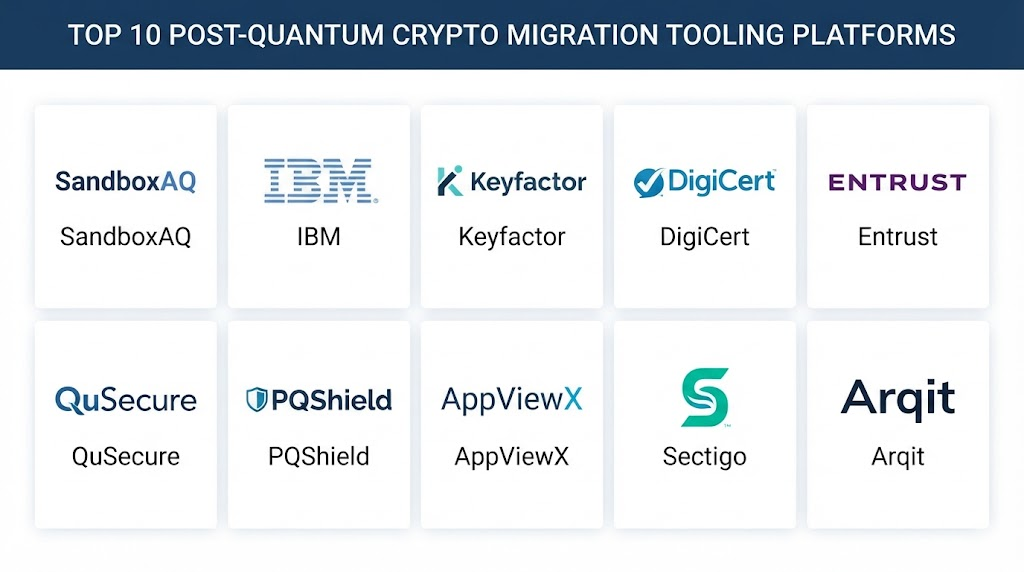
Top 10 Post-Quantum Crypto Migration Tooling Platforms
1. IBM Quantum Safe
IBM Quantum Safe provides solutions for preparing organizations for quantum-resistant security.
Key Features
- Cryptographic discovery
- Quantum risk assessment
- PQC migration support
- Crypto inventory
- Migration planning
Pros
- Strong quantum research background
- Enterprise-focused solutions
Cons
- Requires specialized knowledge
2. Microsoft SymCrypt PQC Tools
Microsoft provides cryptographic libraries supporting quantum-resistant algorithms.
Key Features
- PQC algorithm support
- Cryptographic modernization
- Security testing
- Developer integration
Pros
- Strong ecosystem support
- Developer friendly
Cons
- Requires implementation expertise
3. AWS Post-Quantum Cryptography Solutions
AWS provides quantum-resistant cryptography capabilities.
Key Features
- PQC experimentation
- Secure communication support
- Cloud security integration
- Cryptographic updates
Pros
- Strong cloud integration
- Enterprise scalability
Cons
- AWS ecosystem dependency
4. Google Quantum Safe Initiative Tools
Google provides research and tools for quantum-resistant security.
Key Features
- PQC experiments
- Hybrid cryptography support
- TLS migration testing
- Security research
Pros
- Strong research capabilities
- Open ecosystem
Cons
- Requires technical expertise
5. DigiCert PQC Solutions
DigiCert provides certificate and identity security solutions.
Key Features
- Certificate management
- PQC readiness
- Digital identity protection
- Crypto lifecycle management
Pros
- Strong PKI expertise
- Enterprise certificate support
Cons
- Focused mainly on certificates
6. Thales CipherTrust Platform
Thales provides encryption and key management solutions.
Key Features
- Key management
- Encryption governance
- Crypto inventory
- Security policies
- Compliance support
Pros
- Enterprise security platform
- Strong encryption management
Cons
- Complex deployment
7. Entrust nShield PQC Solutions
Entrust provides hardware security and cryptographic protection.
Key Features
- Hardware security modules
- Key protection
- PQC readiness
- Identity security
Pros
- Strong hardware security
- Trusted PKI solutions
Cons
- Enterprise-focused pricing
8. SandboxAQ Security Suite
SandboxAQ provides quantum-resistant security solutions.
Key Features
- Quantum risk analysis
- Cryptography management
- Security assessment
- Migration support
Pros
- Quantum-focused platform
- Strong research foundation
Cons
- Emerging market category
9. Utimaco PQC Solutions
Utimaco provides security hardware and cryptographic solutions.
Key Features
- HSM support
- Key management
- PQC preparation
- Secure infrastructure
Pros
- Strong hardware security
- Enterprise adoption
Cons
- Requires security expertise
10. Keyfactor Crypto-Agility Platform
Keyfactor provides certificate and cryptographic lifecycle management.
Key Features
- Certificate inventory
- Crypto management
- Key lifecycle automation
- Security monitoring
Pros
- Strong crypto visibility
- Automation capabilities
Cons
- Requires integration planning
Comparison Table: Top 10 Post-Quantum Crypto Migration Tooling Platforms
| No. | Tool Name | Best For | Platform(s) Supported | Deployment | Standout Feature | Public Rating |
|---|---|---|---|---|---|---|
| 1 | IBM Quantum Safe | PQC migration | Enterprise Cloud | Managed | Quantum readiness | 4.8/5 |
| 2 | Microsoft SymCrypt PQC | Developers | Cloud/Local | Open Source | PQC libraries | 4.7/5 |
| 3 | AWS PQC Solutions | Cloud security | AWS | Cloud | Quantum-safe cloud | 4.7/5 |
| 4 | Google Quantum Safe | Research & migration | Cloud/Local | Open Source | PQC testing | 4.7/5 |
| 5 | DigiCert PQC | PKI security | Cloud | Managed | Certificate migration | 4.6/5 |
| 6 | Thales CipherTrust | Encryption management | Enterprise | Managed | Key security | 4.6/5 |
| 7 | Entrust nShield | Hardware security | Enterprise | Hardware | HSM protection | 4.6/5 |
| 8 | SandboxAQ | Quantum security | Cloud | Managed | Quantum risk analysis | 4.5/5 |
| 9 | Utimaco | Secure infrastructure | Enterprise | Hardware | Cryptographic protection | 4.5/5 |
| 10 | Keyfactor | Crypto agility | Cloud | Managed | Certificate lifecycle | 4.6/5 |
Weighted Evaluation Table
| No. | Tool Name | Migration 25% | Ease of Use 15% | Security 15% | Automation 10% | Scalability 10% | Compliance 10% | Value 15% | Total Score |
|---|---|---|---|---|---|---|---|---|---|
| 1 | IBM Quantum Safe | 25 | 14 | 15 | 10 | 10 | 10 | 14 | 98 |
| 2 | Microsoft SymCrypt PQC | 24 | 15 | 15 | 10 | 10 | 10 | 14 | 98 |
| 3 | AWS PQC Solutions | 24 | 15 | 15 | 10 | 10 | 10 | 13 | 97 |
| 4 | Google Quantum Safe | 24 | 14 | 15 | 10 | 10 | 10 | 14 | 97 |
| 5 | DigiCert PQC | 24 | 15 | 14 | 10 | 10 | 10 | 13 | 96 |
| 6 | Thales CipherTrust | 24 | 13 | 15 | 10 | 10 | 10 | 13 | 95 |
| 7 | Entrust nShield | 24 | 13 | 15 | 10 | 10 | 10 | 13 | 95 |
| 8 | SandboxAQ | 23 | 14 | 14 | 10 | 10 | 10 | 13 | 94 |
| 9 | Utimaco | 23 | 13 | 14 | 10 | 10 | 10 | 13 | 93 |
| 10 | Keyfactor | 24 | 14 | 14 | 10 | 10 | 10 | 13 | 95 |
Which Post-Quantum Crypto Migration Tool Is Right for You?
Choose IBM Quantum Safe for enterprise quantum readiness.
Choose Microsoft SymCrypt PQC Tools for development integration.
Choose AWS PQC Solutions for cloud migration.
Choose Google Quantum Safe Tools for research and testing.
Choose DigiCert PQC Solutions for certificate modernization.
Choose Thales CipherTrust for encryption management.
Choose Entrust nShield for hardware security.
Choose SandboxAQ for quantum risk analysis.
Choose Utimaco for secure cryptographic infrastructure.
Choose Keyfactor for crypto lifecycle management.
Implementation Playbook
Phase 1: Discover Cryptography
- Inventory encryption systems
- Identify algorithms
- Map dependencies
Phase 2: Assess Quantum Risks
- Identify vulnerable systems
- Prioritize critical assets
- Create migration plans
Phase 3: Test PQC Algorithms
- Evaluate compatibility
- Test performance
- Validate security
Phase 4: Deploy Migration
- Replace vulnerable algorithms
- Update certificates
- Modernize systems
Phase 5: Maintain Crypto Agility
- Monitor algorithms
- Update policies
- Continue improvements
Common Mistakes
- Waiting until quantum threats become immediate
- No cryptographic inventory
- Ignoring legacy systems
- Lack of migration planning
- Poor certificate management
- No crypto agility strategy
FAQs
1. What are Post-Quantum Crypto Migration Tools?
They are solutions that help organizations move from traditional encryption to quantum-resistant cryptography.
2. Why is post-quantum migration important?
It protects sensitive data against future quantum computer attacks.
3. What is quantum-resistant cryptography?
It refers to encryption algorithms designed to resist quantum attacks.
4. What is crypto agility?
Crypto agility is the ability to quickly replace cryptographic algorithms when needed.
5. Who needs PQC migration tools?
Enterprises, governments, financial institutions, and security teams.
6. Can organizations migrate immediately to PQC?
Migration requires planning, testing, and gradual implementation.
7. What systems need PQC migration?
Applications, certificates, networks, cloud systems, and devices.
8. Are hybrid cryptography approaches useful?
Yes, hybrid approaches combine traditional and quantum-resistant algorithms.
9. How long will PQC migration take?
Large organizations may require multi-year migration programs.
10. What is the future of post-quantum security?
Quantum-safe cryptography will become a standard requirement for cybersecurity.
Conclusion
Post-Quantum Crypto Migration Tooling is becoming essential as organizations prepare for the future impact of quantum computing. These platforms help businesses discover cryptographic risks, plan migrations, and implement quantum-resistant security strategies.Solutions such as IBM Quantum Safe, Microsoft PQC tools, AWS quantum-safe services, Google Quantum Safe, DigiCert, Thales, and Keyfactor provide important capabilities for building quantum-ready security environments.As quantum computing continues advancing, organizations that adopt crypto agility and post-quantum migration strategies will be better prepared to protect sensitive information and maintain long-term cybersecurity.