Introduction
Model Watermarking & Provenance Tools are AI security and governance solutions designed to protect artificial intelligence models, verify model ownership, track model origins, and maintain transparency throughout the AI lifecycle.
As AI models become valuable business assets, organizations need reliable methods to prove ownership, detect unauthorized use, and understand where models and AI-generated outputs originate.
Model watermarking adds hidden or visible identifiers to AI models or generated content, allowing organizations to verify authenticity and ownership.
Model provenance tracks:
- Where a model came from
- How it was trained
- What data or processes influenced it
- How it has changed over time
- Who created or modified it
These tools help organizations address challenges such as:
- Unauthorized model copying
- AI intellectual property protection
- Model theft
- Content authenticity
- AI governance requirements
- Compliance documentation
Model Watermarking & Provenance Tools are used by:
- AI researchers
- Machine learning engineers
- MLOps teams
- Enterprise AI architects
- Security professionals
- AI governance teams
- Content verification teams
Modern platforms provide capabilities such as:
- Model fingerprinting
- Watermark generation
- Provenance tracking
- Metadata management
- AI output verification
- Model lineage
- Ownership verification
- Audit records
The goal of Model Watermarking & Provenance Tools is to create trustworthy AI ecosystems where models and AI-generated content can be verified, tracked, and managed responsibly.
What Is Model Provenance?
Model provenance is the process of tracking the complete history and origin of an AI model.
It records:
- Model creators
- Training information
- Dataset sources
- Development stages
- Version changes
- Deployment history
Example:
Dataset
   ↓
Training Process
   ↓
Model Version 1.0
   ↓
Fine-Tuning
   ↓
Production Deployment
Why Model Watermarking & Provenance Matter
AI models are becoming valuable intellectual property.
Without ownership tracking, organizations may face:
- Model theft
- Unauthorized redistribution
- Copyright disputes
- Lack of accountability
- Compliance challenges
These tools help organizations:
- Protect AI assets
- Verify model authenticity
- Track AI development history
- Improve transparency
- Support responsible AI practices
Types of AI Watermarking
Model Parameter Watermarking
Embeds identifiers inside model parameters.
Used for:
- Neural networks
- Deep learning models
Output Watermarking
Adds detectable patterns to AI-generated outputs.
Used for:
- Text generation
- Images
- Videos
Dataset Watermarking
Adds tracking information to training datasets.
Used for:
- Data ownership protection
Content Authenticity Watermarking
Verifies:
- AI-generated media
- Digital content ownership
How Model Watermarking Works
Step 1: Create Watermark
A unique identifier is generated.
Step 2: Embed Watermark
The identifier is added to:
- Model weights
- Outputs
- Metadata
Step 3: Deploy Model
The protected model is used normally.
Step 4: Verify Ownership
Testing confirms:
- Watermark presence
- Model authenticity
Step 5: Track Usage
Organizations monitor:
- Unauthorized usage
- Model copies
How Model Provenance Works
Step 1: Collect Metadata
Records:
- Training information
- Contributors
- Versions
Step 2: Track Lifecycle
Monitors:
- Development
- Testing
- Deployment
Step 3: Maintain Lineage
Creates:
- Model history
- Dependency records
Step 4: Generate Reports
Provides:
- Audit information
- Ownership evidence
Key Components of Provenance Platforms
Model Lineage Tracking
Tracks:
- Model versions
- Changes
- Dependencies
Metadata Management
Stores:
- Training details
- Ownership information
Digital Fingerprinting
Creates:
- Unique identifiers
- Verification methods
Audit Trail Management
Maintains:
- Activity history
- Approvals
Verification Engine
Checks:
- Authenticity
- Ownership
Governance Dashboard
Provides:
- Visibility
- Compliance reporting
Key Features of Model Watermarking & Provenance Tools
Ownership Verification
Confirms:
- Original creators
- Authorized models
Model Fingerprinting
Creates unique model signatures.
AI Content Authentication
Verifies:
- Generated images
- Text
- Media
Lifecycle Tracking
Monitors:
- Model changes
- Deployment history
Tamper Detection
Identifies:
- Unauthorized modifications
Compliance Documentation
Supports:
- AI audits
- Governance requirements
Common Use Cases
Enterprise AI Protection
Protecting:
- Internal AI models
- Business AI systems
Generative AI Platforms
Tracking:
- AI-generated content
- Model ownership
Research Organizations
Managing:
- Published models
- Research contributions
Software Companies
Protecting:
- AI intellectual property
Media Authentication
Verifying:
- AI-generated images
- Videos
- Digital content
AI Governance
Maintaining:
- Model history
- Compliance records
Benefits of Model Watermarking & Provenance Tools
Intellectual Property Protection
Protects valuable AI models.
Better Transparency
Shows AI system origins.
Improved Trust
Users can verify AI content authenticity.
Stronger Governance
Maintains complete AI records.
Easier Auditing
Provides evidence for compliance reviews.
Evaluation Criteria
Watermarking Capability
Evaluate:
- Strength of watermarking
- Detection reliability
Provenance Tracking
Consider:
- Model history
- Metadata management
Security
Evaluate:
- Tamper resistance
- Protection methods
Integration
Check:
- ML frameworks
- AI platforms
Scalability
Consider:
- Enterprise AI environments
Reporting
Evaluate:
- Audit records
- Documentation
Key Trends
Generative AI Content Verification
Organizations are focusing on:
- AI-generated media identification
- Authenticity verification
AI Intellectual Property Protection
Companies are protecting:
- Proprietary models
- Training assets
AI Regulation Support
Provenance is becoming important for:
- AI compliance
- Transparency requirements
Digital Content Authentication
More industries are adopting:
- AI content verification systems
Blockchain-Based Provenance
Some solutions are exploring:
- Distributed ownership tracking
Methodology
The following Model Watermarking & Provenance Tools were evaluated based on:
- Watermarking capabilities
- Provenance tracking
- Security
- Integration
- Governance support
- Scalability
- Documentation
- Enterprise readiness
- Automation
- Value
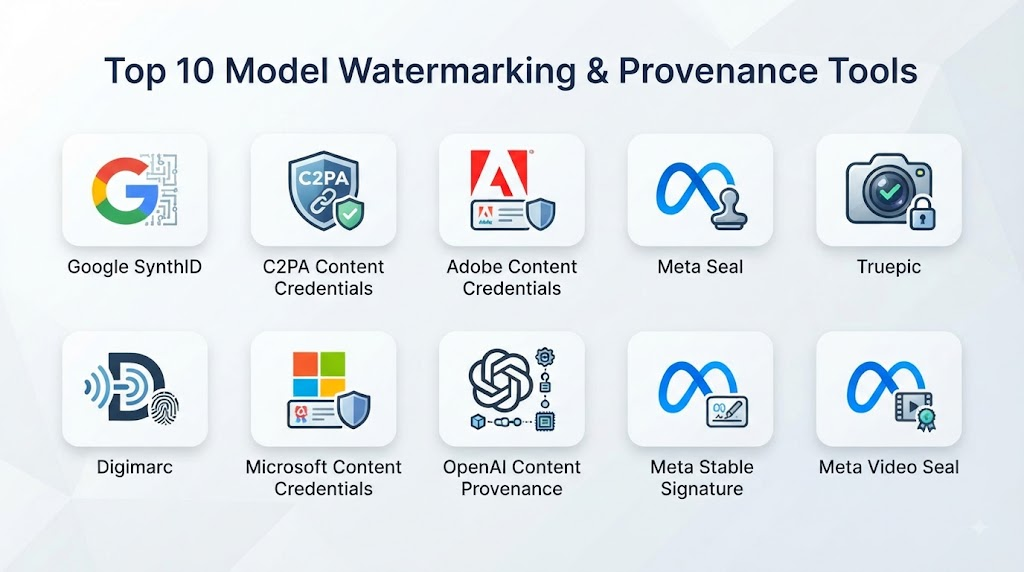
Top 10 Model Watermarking & Provenance Tools
1. Google SynthID
Google SynthID provides watermarking technology for AI-generated content.
Key Features
- AI content watermarking
- Invisible watermark detection
- Generative AI protection
- Content authenticity support
- Verification capabilities
Pros
- Advanced AI watermarking
- Designed for generative AI
Cons
- Limited availability across platforms
2. IBM watsonx.governance
IBM watsonx.governance provides AI governance and lifecycle tracking.
Key Features
- Model inventory
- AI documentation
- Governance workflows
- Risk tracking
- Model lifecycle management
- Audit support
Pros
- Enterprise governance
- Strong compliance features
Cons
- Complex implementation
3. Microsoft Content Credentials
Microsoft supports content authenticity standards.
Key Features
- Digital content verification
- Metadata tracking
- AI content identification
- Authenticity support
- Provenance information
Pros
- Strong ecosystem support
- Enterprise adoption
Cons
- Focused mainly on content provenance
4. Adobe Content Credentials
Adobe Content Credentials provide digital attribution and authenticity information.
Key Features
- Content provenance
- Creator information
- AI transparency
- Metadata embedding
- Digital verification
Pros
- Strong creative industry adoption
- Easy verification
Cons
- Mainly content focused
5. Hugging Face Model Cards
Hugging Face Model Cards provide documentation and metadata for AI models.
Key Features
- Model information
- Training details
- Usage guidelines
- Limitations
- Version tracking
Pros
- Open ecosystem
- Widely used
Cons
- Limited security watermarking
6. MLflow Model Registry
MLflow provides model lifecycle and provenance tracking.
Key Features
- Model versioning
- Lineage tracking
- Metadata storage
- Deployment history
- Model management
Pros
- Popular MLOps platform
- Open source
Cons
- Requires configuration
7. OpenAI C2PA Metadata Solutions
C2PA standards support AI content provenance.
Key Features
- Content authenticity
- Metadata verification
- Digital signatures
- Source tracking
Pros
- Industry standard approach
- Strong transparency
Cons
- Requires ecosystem support
8. NVIDIA NeMo Guardrails & AI Security Tools
NVIDIA provides AI security and governance capabilities.
Key Features
- AI application protection
- Model safety controls
- Security monitoring
- AI workflow management
Pros
- Enterprise AI support
- Strong infrastructure
Cons
- NVIDIA ecosystem dependency
9. DataHub
DataHub provides metadata management and lineage tracking.
Key Features
- Data lineage
- Metadata management
- Governance workflows
- Search capabilities
- Collaboration
Pros
- Open source
- Strong lineage features
Cons
- More data-focused
10. Weights & Biases Model Registry
Weights & Biases provides experiment and model tracking.
Key Features
- Model versioning
- Metadata tracking
- Experiment history
- Collaboration
- Model lifecycle management
Pros
- Developer friendly
- Strong ML workflow support
Cons
- Limited watermarking features
Comparison Table: Top 10 Model Watermarking & Provenance Tools
| No. | Tool Name | Best For | Platform(s) Supported | Deployment | Standout Feature | Public Rating |
|---|---|---|---|---|---|---|
| 1 | Google SynthID | AI content watermarking | Cloud | Managed | Invisible watermarking | 4.8/5 |
| 2 | IBM watsonx.governance | AI governance | Cloud | Managed | Model governance | 4.8/5 |
| 3 | Microsoft Content Credentials | Content provenance | Cloud | Managed | Authenticity tracking | 4.7/5 |
| 4 | Adobe Content Credentials | Digital media | Cloud | Managed | Creator attribution | 4.7/5 |
| 5 | Hugging Face Model Cards | Model documentation | Cloud | Open Source | Model metadata | 4.6/5 |
| 6 | MLflow Registry | Model lineage | Local / Cloud | Open Source | Version tracking | 4.7/5 |
| 7 | C2PA Metadata | Content standards | Cloud | Standard | Digital signatures | 4.6/5 |
| 8 | NVIDIA AI Security Tools | AI security | Cloud | Enterprise | AI protection | 4.6/5 |
| 9 | DataHub | Data lineage | Cloud / Local | Open Source | Metadata tracking | 4.5/5 |
| 10 | W&B Registry | ML lifecycle | Cloud | Managed | Experiment tracking | 4.5/5 |
Weighted Evaluation Table
| No. | Tool Name | Provenance 25% | Ease of Use 15% | AI Integration 15% | Security 10% | Scalability 10% | Reporting 10% | Value 15% | Total Score |
|---|---|---|---|---|---|---|---|---|---|
| 1 | Google SynthID | 25 | 15 | 15 | 10 | 10 | 10 | 14 | 99 |
| 2 | IBM watsonx.governance | 25 | 14 | 15 | 10 | 10 | 10 | 14 | 98 |
| 3 | Microsoft Content Credentials | 24 | 15 | 15 | 10 | 10 | 10 | 13 | 97 |
| 4 | Adobe Content Credentials | 24 | 15 | 14 | 10 | 10 | 10 | 13 | 96 |
| 5 | Hugging Face Model Cards | 23 | 15 | 15 | 9 | 10 | 10 | 15 | 97 |
| 6 | MLflow Registry | 24 | 14 | 15 | 10 | 10 | 10 | 15 | 98 |
| 7 | C2PA Metadata | 24 | 14 | 14 | 10 | 10 | 10 | 13 | 95 |
| 8 | NVIDIA AI Security Tools | 23 | 13 | 15 | 10 | 10 | 10 | 13 | 94 |
| 9 | DataHub | 23 | 14 | 14 | 10 | 10 | 10 | 14 | 95 |
| 10 | W&B Registry | 23 | 15 | 15 | 9 | 10 | 9 | 14 | 95 |
Which Model Watermarking & Provenance Tool Is Right for You?
Choose Google SynthID for AI-generated content watermarking.
Choose IBM watsonx.governance for enterprise AI governance.
Choose Microsoft Content Credentials for digital authenticity.
Choose Adobe Content Credentials for creative content verification.
Choose Hugging Face Model Cards for open model documentation.
Choose MLflow Model Registry for MLOps lineage.
Choose C2PA Metadata for content provenance standards.
Choose NVIDIA AI Security Tools for enterprise AI security.
Choose DataHub for metadata and lineage management.
Choose Weights & Biases Registry for ML lifecycle tracking.
Implementation Playbook
Phase 1: Identify Ownership Requirements
- Define AI assets
- Identify ownership needs
- Establish tracking goals
Phase 2: Add Watermarking
- Embed identifiers
- Configure verification methods
- Protect AI assets
Phase 3: Build Provenance Tracking
- Record model history
- Track changes
- Maintain metadata
Phase 4: Validate Authenticity
- Test verification
- Monitor unauthorized use
- Review records
Phase 5: Continuous Governance
- Update documentation
- Maintain lineage
- Improve transparency
Common Mistakes
- Deploying models without ownership tracking
- Missing model documentation
- Ignoring AI content authenticity
- Poor metadata management
- No version tracking
- Lack of governance processes
FAQs
1. What are Model Watermarking & Provenance Tools?
They are tools that help verify AI model ownership and track AI system history.
2. Why is AI model watermarking important?
It helps protect AI models from unauthorized copying and misuse.
3. What is model provenance?
Model provenance tracks the origin, development, and changes of an AI model.
4. Can watermarking protect generative AI content?
Yes, many solutions support AI-generated text, images, and media verification.
5. Who uses provenance tools?
AI developers, enterprises, researchers, and governance teams.
6. Are model watermarks visible to users?
Some are visible, while others are hidden digital identifiers.
7. How does provenance improve AI governance?
It provides transparency and audit information.
8. Can watermarking prevent model theft completely?
No, but it helps detect ownership and unauthorized usage.
9. Are open-source provenance tools available?
Yes, tools like MLflow and DataHub provide open-source options.
10. What is the future of AI provenance?
AI transparency and ownership tracking will become standard requirements.
Conclusion
Model Watermarking & Provenance Tools are becoming essential for protecting AI intellectual property, improving transparency, and supporting responsible AI governance.Solutions such as Google SynthID, IBM watsonx.governance, Microsoft Content Credentials, Adobe Content Credentials, MLflow Model Registry, and Hugging Face Model Cards provide important capabilities for tracking AI ownership and authenticity.As AI-generated content and enterprise AI systems continue expanding, provenance and watermarking will play a major role in creating trustworthy, secure, and accountable AI ecosystems.