Introduction
Content Authenticity Verification Tools are digital trust and verification solutions designed to identify, validate, and track the origin of digital content such as images, videos, documents, audio, and AI-generated media.
With the rapid growth of generative AI, distinguishing between human-created content and AI-generated content has become increasingly important. Organizations, creators, publishers, and enterprises need reliable methods to verify where content came from, whether it has been modified, and who created it.
Content authenticity tools help address challenges such as:
- AI-generated misinformation
- Deepfake detection
- Unauthorized content modification
- Copyright protection
- Digital identity verification
- Media transparency
These platforms use technologies such as:
- Digital signatures
- Metadata analysis
- Cryptographic verification
- Watermark detection
- Content provenance tracking
- AI-generated content detection
Content Authenticity Verification Tools are used by:
- Media organizations
- Journalists
- Digital creators
- Enterprises
- Security teams
- Government organizations
- AI governance teams
Modern authenticity platforms provide capabilities such as:
- Content origin tracking
- AI-generated content identification
- Metadata verification
- Tamper detection
- Creator attribution
- Provenance records
- Digital certificates
The goal of Content Authenticity Verification Tools is to create a trusted digital ecosystem where users can verify the authenticity, ownership, and history of digital content.
Why Content Authenticity Matters
Digital content can easily be copied, modified, or generated using artificial intelligence.
Without authenticity verification, organizations may face:
- Fake news distribution
- Deepfake attacks
- Copyright disputes
- Brand reputation damage
- Identity fraud
- Loss of public trust
Content authenticity solutions help organizations:
- Verify information sources
- Protect creators
- Improve transparency
- Reduce misinformation risks
Types of Content Authenticity Verification
Image Authenticity Verification
Checks:
- Image origin
- Editing history
- AI generation indicators
Video Verification
Analyzes:
- Deepfake indicators
- Video manipulation
- Source information
Audio Verification
Detects:
- Synthetic voices
- Audio modifications
- Recording authenticity
Document Verification
Validates:
- Digital signatures
- Document history
- Ownership
AI-Generated Content Detection
Identifies:
- AI-generated text
- Synthetic media
- Machine-created content
How Content Authenticity Verification Tools Work
Step 1: Content Collection
The system receives:
- Images
- Videos
- Audio
- Documents
Step 2: Metadata Analysis
Tools examine:
- Creation information
- Editing history
- Source details
Step 3: Digital Signature Verification
Systems validate:
- Creator identity
- Authenticity records
Step 4: AI Detection Analysis
Platforms check:
- AI-generated patterns
- Synthetic content signals
Step 5: Verification Report
Users receive:
- Authenticity status
- Content history
- Verification results
Key Components of Authenticity Platforms
Digital Signature System
Provides:
- Ownership proof
- Content verification
Metadata Management
Tracks:
- Creation details
- Modification history
Provenance Tracking
Records:
- Content journey
- Source information
AI Detection Engine
Identifies:
- Synthetic content
- AI-generated media
Tamper Detection
Finds:
- Unauthorized changes
- Manipulation attempts
Verification Dashboard
Displays:
- Authenticity results
- Content information
Key Features of Content Authenticity Verification Tools
Content Provenance Tracking
Tracks:
- Creator information
- Content history
Digital Watermark Detection
Identifies:
- Embedded authenticity markers
AI Content Detection
Detects:
- AI-generated media
Tampering Analysis
Finds:
- Edited content
- Manipulated files
Creator Attribution
Shows:
- Original source
- Ownership information
Verification Reports
Provides:
- Audit records
- Transparency information
Common Use Cases
Journalism and Media
Verifying:
- News images
- Video sources
- Digital evidence
Social Media Platforms
Managing:
- AI-generated content
- Fake media detection
Enterprise Communication
Protecting:
- Brand assets
- Marketing content
Legal and Compliance
Validating:
- Digital evidence
- Documents
Entertainment Industry
Protecting:
- Creative works
- Copyright ownership
Government Organizations
Supporting:
- Information verification
- Public trust
Benefits of Content Authenticity Verification Tools
Improved Trust
Helps users identify reliable content.
Protection Against Deepfakes
Reduces synthetic media risks.
Better Copyright Protection
Supports creator ownership.
Increased Transparency
Shows content history.
Stronger Digital Security
Reduces content-based fraud.
Evaluation Criteria
Verification Accuracy
Evaluate:
- Detection quality
- Authenticity confidence
Provenance Support
Consider:
- Source tracking
- Metadata management
Security
Evaluate:
- Digital signatures
- Tamper resistance
Integration
Check:
- Platform compatibility
- API availability
Scalability
Consider:
- Enterprise content volumes
Reporting
Evaluate:
- Verification reports
- Audit records
Key Trends
AI-Generated Content Verification
Organizations are adopting tools to identify:
- Synthetic images
- AI videos
- AI text
C2PA Adoption
More platforms are using:
- Content Credentials
- Digital provenance standards
Deepfake Detection Growth
Organizations are improving protection against:
- Fake videos
- Synthetic identities
Digital Trust Infrastructure
Content verification is becoming part of:
- Online identity systems
- Enterprise security
AI Governance Integration
Authenticity verification is becoming part of:
- Responsible AI programs
Methodology
The following Content Authenticity Verification Tools were evaluated based on:
- Verification capabilities
- Provenance tracking
- AI detection
- Security features
- Integration
- Scalability
- Reporting
- Enterprise adoption
- Ease of use
- Value
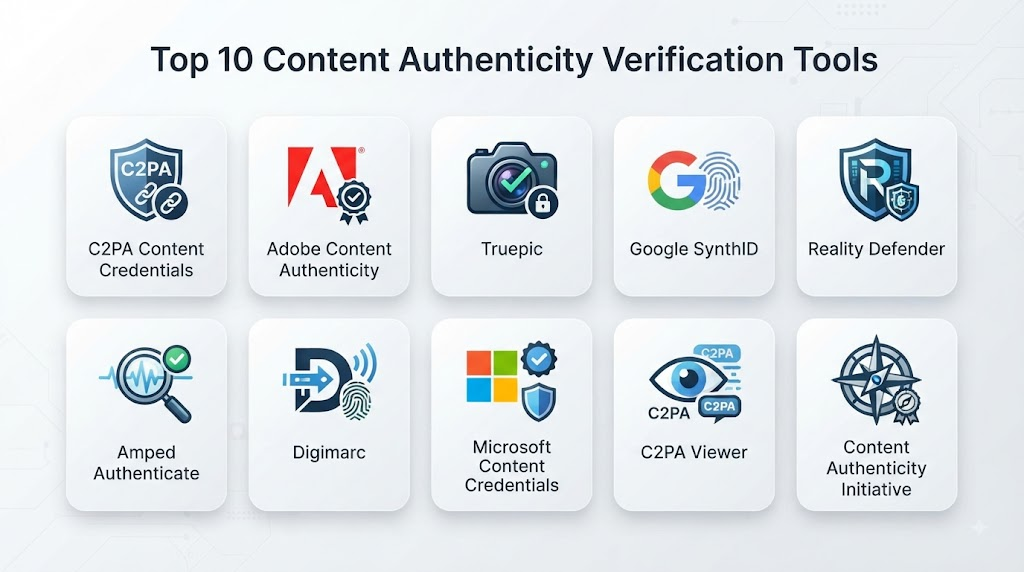
Top 10 Content Authenticity Verification Tools
1. Adobe Content Credentials
Adobe Content Credentials provides digital attribution and provenance information for creative content.
Key Features
- Content ownership tracking
- Creator attribution
- AI transparency
- Metadata embedding
- Digital authenticity records
- Provenance support
Pros
- Strong creative industry adoption
- Easy verification
- Supports content transparency
Cons
- Mainly focused on creative content
2. Microsoft Content Credentials
Microsoft supports content authenticity standards and verification technologies.
Key Features
- Digital content verification
- Provenance tracking
- AI transparency
- Metadata support
- Authenticity information
Pros
- Enterprise ecosystem
- Strong technology support
Cons
- Limited standalone verification features
3. Google SynthID
Google SynthID provides watermarking technology for AI-generated content.
Key Features
- Invisible watermarking
- AI-generated content identification
- Verification support
- Generative AI protection
Pros
- Advanced AI watermarking
- Designed for AI content
Cons
- Limited ecosystem availability
4. Truepic
Truepic provides digital authenticity solutions for images and videos.
Key Features
- Image verification
- Video authentication
- Secure capture
- Digital signatures
- Content provenance
Pros
- Strong media verification
- Enterprise solutions
Cons
- Focused on image and video content
5. Reality Defender
Reality Defender provides AI-generated media detection.
Key Features
- Deepfake detection
- Image analysis
- Video analysis
- Audio detection
- Enterprise security
Pros
- Strong synthetic media detection
- Security focused
Cons
- Detection-only focus
6. Sensity AI
Sensity AI provides deepfake detection technology.
Key Features
- Video analysis
- Facial manipulation detection
- Synthetic media detection
- Threat monitoring
Pros
- Strong deepfake capabilities
- Security applications
Cons
- Mainly focused on deepfake detection
7. Hive AI Detection
Hive provides AI content detection solutions.
Key Features
- AI image detection
- AI-generated content analysis
- Content moderation
- API integration
Pros
- Developer friendly
- Broad AI detection support
Cons
- Detection accuracy varies by content type
8. Deepware Scanner
Deepware Scanner focuses on deepfake video detection.
Key Features
- Video analysis
- Deepfake detection
- Media verification
- AI-based scanning
Pros
- Simple verification workflow
- Easy to use
Cons
- Limited enterprise governance features
9. Attestiv
Attestiv provides digital media authentication solutions.
Key Features
- Media verification
- Fraud detection
- Digital evidence protection
- Blockchain-based verification
Pros
- Strong fraud prevention
- Enterprise use cases
Cons
- Specialized platform
10. C2PA Tools
C2PA provides open standards for digital content provenance.
Key Features
- Content Credentials
- Digital signatures
- Source tracking
- Authenticity verification
Pros
- Industry standard approach
- Open framework
Cons
- Requires ecosystem adoption
Comparison Table: Top 10 Content Authenticity Verification Tools
| No. | Tool Name | Best For | Platform(s) Supported | Deployment | Standout Feature | Public Rating |
|---|---|---|---|---|---|---|
| 1 | Adobe Content Credentials | Creative authenticity | Cloud | Managed | Creator attribution | 4.8/5 |
| 2 | Microsoft Content Credentials | Enterprise verification | Cloud | Managed | Digital provenance | 4.7/5 |
| 3 | Google SynthID | AI content watermarking | Cloud | Managed | Invisible watermark | 4.8/5 |
| 4 | Truepic | Image/video verification | Cloud | Managed | Secure capture | 4.7/5 |
| 5 | Reality Defender | Deepfake detection | Cloud | Managed | Synthetic media detection | 4.6/5 |
| 6 | Sensity AI | Deepfake security | Cloud | Managed | Video analysis | 4.5/5 |
| 7 | Hive AI Detection | AI detection | Cloud | API | AI content analysis | 4.5/5 |
| 8 | Deepware Scanner | Deepfake scanning | Cloud | Managed | Video detection | 4.4/5 |
| 9 | Attestiv | Digital evidence | Cloud | Managed | Fraud prevention | 4.5/5 |
| 10 | C2PA Tools | Content standards | Cloud | Open Standard | Provenance framework | 4.7/5 |
Weighted Evaluation Table
| No. | Tool Name | Verification 25% | Ease of Use 15% | AI Detection 15% | Security 10% | Scalability 10% | Reporting 10% | Value 15% | Total Score |
|---|---|---|---|---|---|---|---|---|---|
| 1 | Adobe Content Credentials | 25 | 15 | 14 | 10 | 10 | 10 | 14 | 98 |
| 2 | Microsoft Content Credentials | 24 | 15 | 14 | 10 | 10 | 10 | 13 | 96 |
| 3 | Google SynthID | 25 | 15 | 15 | 10 | 10 | 10 | 14 | 99 |
| 4 | Truepic | 24 | 14 | 14 | 10 | 10 | 10 | 13 | 95 |
| 5 | Reality Defender | 24 | 14 | 15 | 10 | 10 | 10 | 13 | 96 |
| 6 | Sensity AI | 23 | 13 | 15 | 10 | 10 | 10 | 13 | 94 |
| 7 | Hive AI Detection | 23 | 15 | 14 | 9 | 10 | 9 | 14 | 94 |
| 8 | Deepware Scanner | 22 | 15 | 13 | 9 | 9 | 9 | 14 | 91 |
| 9 | Attestiv | 23 | 14 | 13 | 10 | 10 | 10 | 13 | 93 |
| 10 | C2PA Tools | 24 | 14 | 14 | 10 | 10 | 10 | 13 | 95 |
Which Content Authenticity Verification Tool Is Right for You?
Choose Adobe Content Credentials for creative content verification.
Choose Microsoft Content Credentials for enterprise authenticity workflows.
Choose Google SynthID for AI-generated content watermarking.
Choose Truepic for verified images and videos.
Choose Reality Defender for deepfake detection.
Choose Sensity AI for synthetic media security.
Choose Hive AI Detection for AI content analysis APIs.
Choose Deepware Scanner for quick deepfake scanning.
Choose Attestiv for digital evidence verification.
Choose C2PA Tools for open content provenance standards.
Implementation Playbook
Phase 1: Define Verification Goals
- Identify content types
- Define authenticity requirements
- Select verification methods
Phase 2: Add Provenance Controls
- Enable metadata tracking
- Add digital signatures
- Record ownership
Phase 3: Test Content
- Verify sources
- Detect manipulation
- Analyze AI generation
Phase 4: Monitor Content Usage
- Track modifications
- Review authenticity status
- Maintain records
Phase 5: Continuous Trust Management
- Update verification methods
- Improve detection
- Maintain transparency
Common Mistakes
- Publishing content without verification
- Ignoring AI-generated media risks
- Removing important metadata
- No ownership tracking
- Relying only on AI detection
- Missing provenance records
FAQs
1. What are Content Authenticity Verification Tools?
They are platforms that verify the origin, ownership, and authenticity of digital content.
2. Why is content authenticity important?
It helps prevent misinformation, deepfakes, and unauthorized content usage.
3. Can these tools detect AI-generated content?
Yes, many tools analyze AI-generated images, videos, and other media.
4. What is C2PA?
C2PA is a standard for adding provenance and authenticity information to digital content.
5. Who uses authenticity verification tools?
Media companies, creators, enterprises, governments, and security teams.
6. Can these tools detect deepfakes?
Yes, several platforms specialize in deepfake detection.
7. Does watermarking guarantee authenticity?
Watermarking helps verify content but works best with additional provenance methods.
8. Are these tools useful for AI governance?
Yes, they support transparency and responsible AI practices.
9. Can content authenticity be automated?
Yes, many platforms provide automated verification APIs.
10. What is the future of content verification?
Content provenance and authenticity verification will become standard for digital media.
Conclusion
Content Authenticity Verification Tools are becoming essential for building trust in the digital world. They help organizations verify content origins, detect manipulation, protect creators, and improve transparency.Platforms such as Adobe Content Credentials, Google SynthID, Microsoft Content Credentials, Truepic, Reality Defender, and C2PA provide important capabilities for verifying digital authenticity.As AI-generated content continues growing, content verification will play a critical role in creating a safer, more transparent, and trustworthy digital ecosystem.