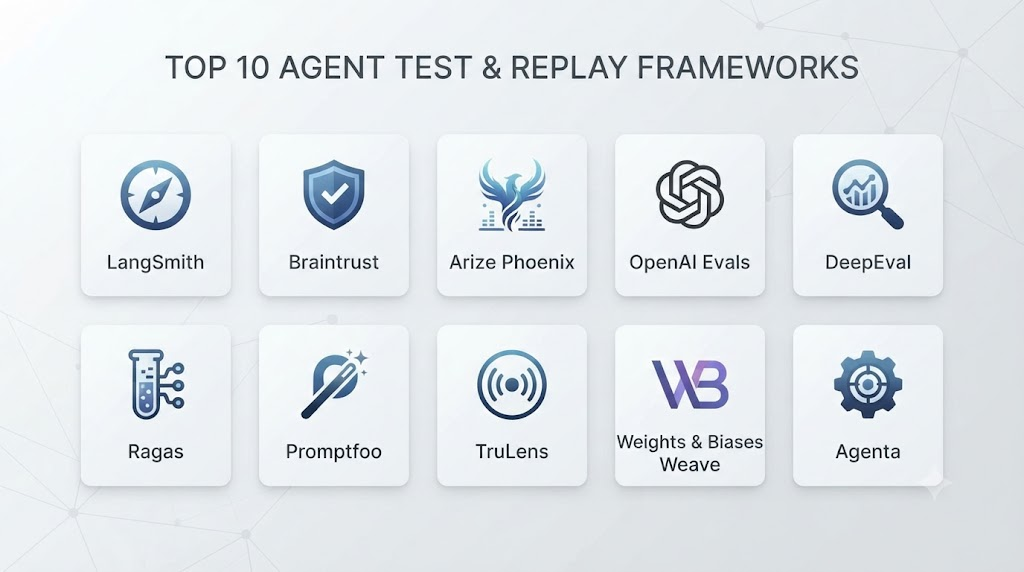
Introduction
Agent Test & Replay Frameworks are specialized platforms and tools designed to test, evaluate, debug, and reproduce the behavior of AI agents before and after deployment.
As AI agents become more autonomous, they handle complex tasks involving reasoning, planning, memory, tool usage, APIs, databases, and external systems. Testing these systems is challenging because agent behavior can change based on context, data, prompts, tools, and previous interactions.
Agent Test & Replay Frameworks help teams:
- Test AI agent workflows
- Reproduce agent failures
- Compare agent versions
- Validate changes safely
- Evaluate performance
- Debug unexpected behavior
- Improve reliability
Unlike traditional software testing, AI agent testing requires evaluating:
- Decision-making quality
- Reasoning patterns
- Tool selection
- Task completion
- Response accuracy
- Safety behavior
- Workflow execution
These frameworks are used by:
- AI engineers
- Machine learning teams
- MLOps engineers
- Software developers
- QA teams
- Enterprise AI teams
- Research organizations
Modern Agent Test & Replay Frameworks provide capabilities such as:
- Automated agent testing
- Execution replay
- Scenario simulation
- Trace comparison
- Regression testing
- Evaluation datasets
- Performance measurement
- Failure analysis
- Agent benchmarking
The goal of Agent Test & Replay Frameworks is to help organizations build reliable, predictable, and production-ready AI agents.
What Are Agent Test & Replay Frameworks?
Agent Test & Replay Frameworks are tools that allow developers to record, test, reproduce, and analyze AI agent behavior.
A typical workflow includes:
- Running an AI agent
- Recording its actions
- Saving execution traces
- Replaying previous scenarios
- Comparing results
- Improving agent performance
Why AI Agents Need Testing Frameworks
Traditional applications follow fixed logic, making testing easier.
AI agents are different because they:
- Generate dynamic responses
- Make decisions independently
- Use external tools
- Interact with changing data
- Follow reasoning paths
Without proper testing, organizations may face:
- Incorrect decisions
- Workflow failures
- Security problems
- Poor user experiences
- Unexpected agent behavior
Testing frameworks provide confidence before production deployment.
What Is Agent Replay?
Agent replay is the process of reproducing a previous AI agent execution using stored inputs, states, and actions.
Replay helps teams understand:
- Why an agent failed
- Which decision caused an issue
- How a new version performs
- Whether improvements actually work
Example:
Original execution:
User request → Agent reasoning → API call → Wrong result
Replay:
Same request → Updated agent → Improved result
Types of Agent Testing
Functional Testing
Checks whether the agent completes required tasks.
Examples:
- Answering questions
- Executing workflows
- Using tools correctly
Regression Testing
Ensures new changes do not break existing behavior.
Examples:
- Prompt updates
- Model changes
- Workflow modifications
Safety Testing
Evaluates:
- Unsafe responses
- Policy violations
- Data leakage
Performance Testing
Measures:
- Response speed
- Resource usage
- Scalability
Scenario Testing
Tests agents in different situations.
Examples:
- Customer requests
- Business workflows
- Edge cases
How Agent Test & Replay Frameworks Work
Execution Recording
The framework captures:
- User inputs
- Agent decisions
- Tool calls
- Model responses
- Workflow states
Test Case Creation
Teams create:
- Evaluation datasets
- Expected outcomes
- Success criteria
Agent Execution
The agent runs against test scenarios.
Result Comparison
The system compares:
- Previous outputs
- New outputs
- Performance metrics
Analysis
Developers identify:
- Failures
- Improvements
- Regression issues
Key Capabilities of Agent Test & Replay Frameworks
Execution Replay
Allows developers to reproduce previous agent behavior.
Benefits:
- Faster debugging
- Easier troubleshooting
- Reliable testing
Trace Comparison
Compares different agent versions.
Benefits:
- Identify improvements
- Detect regressions
Automated Evaluation
Measures:
- Accuracy
- Quality
- Task completion
Test Dataset Management
Manages:
- Prompts
- Scenarios
- User interactions
Agent Benchmarking
Compares:
- Models
- Workflows
- Agent architectures
Failure Analysis
Identifies:
- Errors
- Incorrect decisions
- Tool failures
Common Use Cases
Customer Support Agents
Testing:
- Response accuracy
- Escalation workflows
- Customer conversations
Coding Agents
Evaluating:
- Code generation
- Debugging ability
- Repository interactions
Enterprise Automation Agents
Testing:
- Business workflows
- Tool usage
- Decision quality
Research Agents
Evaluating:
- Reasoning
- Information gathering
- Task completion
Multi-Agent Systems
Testing:
- Agent communication
- Collaboration
- Coordination
AI Assistants
Improving:
- Personalization
- Reliability
- User experience
Why Agent Test & Replay Frameworks Matter
Better AI Reliability
Testing improves agent consistency.
Faster Debugging
Replay helps identify failures quickly.
Safer Deployment
Organizations can validate agents before release.
Continuous Improvement
Teams can measure improvements over time.
Better AI Governance
Testing creates accountability and transparency.
Evaluation Criteria for Buyers
Testing Capabilities
Evaluate:
- Automated testing
- Scenario support
- Regression testing
Replay Features
Important features:
- Execution recording
- Trace storage
- State restoration
AI Framework Compatibility
Support should include:
- LLM frameworks
- Agent platforms
- APIs
Evaluation Metrics
Look for:
- Accuracy measurement
- Quality scoring
- Performance tracking
Integration Support
Platforms should connect with:
- CI/CD pipelines
- Monitoring tools
- Development workflows
Scalability
Consider:
- Large test datasets
- Multiple agents
- Enterprise workloads
Key Trends
AI Quality Engineering
Organizations are creating dedicated testing practices for AI systems.
Automated Agent Evaluation
AI testing is becoming more automated.
Continuous AI Testing
Teams are integrating agent tests into development pipelines.
Synthetic Test Generation
AI is helping create realistic test scenarios.
AI Reliability Engineering
New practices are emerging around maintaining agent quality.
Production Replay Systems
Organizations are using real-world executions for improvement.
Methodology
The following Agent Test & Replay Frameworks were evaluated based on:
- Testing capabilities
- Replay functionality
- Agent support
- Evaluation features
- Integration ecosystem
- Scalability
- Developer experience
- Enterprise readiness
- Monitoring support
- Value
Top 10 Agent Test & Replay Frameworks
1. LangSmith Evaluation
LangSmith provides testing and evaluation capabilities for LLM applications and AI agents.
Key Features
- Agent tracing
- Test datasets
- Evaluation workflows
- Replay support
- Prompt testing
- Regression testing
- Performance analysis
- Experiment tracking
- Debugging
- Production monitoring
Pros
- Strong agent support
- Excellent debugging
- Easy evaluation workflows
- Good ecosystem
- Production-ready
Cons
- Best with LangChain ecosystem
- Requires setup
- Advanced features may require paid plans
Platforms
Cloud environments.
Deployment or Support
Production AI applications.
Security & Compliance
Depends on deployment.
Integrations & Ecosystem
LLMs, LangChain, APIs, AI applications.
Support & Community
Large developer community.
2. Braintrust AI
Braintrust provides AI evaluation and testing infrastructure.
Key Features
- AI evaluations
- Test cases
- Experiment tracking
- Regression testing
- Quality scoring
- Dataset management
- Prompt testing
- Developer workflows
- Performance analysis
- Collaboration tools
Pros
- Strong evaluation platform
- Developer-friendly
- Good experiment tracking
- Flexible testing
- Enterprise-ready
Cons
- Requires evaluation knowledge
- Cloud dependency
- Setup required
Platforms
Cloud environments.
Deployment or Support
Enterprise AI testing.
Security & Compliance
Enterprise options.
Integrations & Ecosystem
AI models and applications.
Support & Community
Developer community.
3. Arize Phoenix
Arize Phoenix provides open-source AI observability and evaluation capabilities.
Key Features
- Agent tracing
- Evaluation
- Debugging
- LLM monitoring
- Performance analysis
- Dataset testing
- Error analysis
- Open-source platform
- Workflow analysis
- AI quality monitoring
Pros
- Open-source
- Strong visualization
- Flexible deployment
- AI-focused
- Good evaluation tools
Cons
- Requires technical setup
- Infrastructure management needed
- Learning curve
Platforms
Cloud and self-hosted environments.
Deployment or Support
Enterprise AI monitoring.
Security & Compliance
Depends on deployment.
Integrations & Ecosystem
LLMs and AI frameworks.
Support & Community
Developer community.
4. Langfuse
Langfuse provides open-source testing and observability for LLM applications.
Key Features
- Prompt testing
- Trace analysis
- Evaluation
- Dataset management
- Replay support
- Cost tracking
- User analytics
- Performance monitoring
- API tracking
- Developer tools
Pros
- Open-source
- Flexible deployment
- Good testing workflows
- Cost visibility
- Developer-friendly
Cons
- Requires configuration
- Technical setup needed
- Enterprise features require planning
Platforms
Cloud and self-hosted environments.
Deployment or Support
AI application development.
Security & Compliance
Depends on deployment.
Integrations & Ecosystem
LLMs, APIs, AI frameworks.
Support & Community
Developer community.
5. TruLens
TruLens provides evaluation and feedback tools for AI applications.
Key Features
- AI evaluation
- Agent testing
- Feedback functions
- RAG evaluation
- Quality scoring
- Tracing
- Performance analysis
- Open-source framework
- Testing workflows
- Developer tools
Pros
- Strong evaluation capabilities
- Open-source
- Flexible
- Good RAG support
- Developer-friendly
Cons
- Requires technical knowledge
- Manual configuration
- Limited enterprise management
Platforms
Cloud and local environments.
Deployment or Support
AI development.
Security & Compliance
Depends on implementation.
Integrations & Ecosystem
LLMs and AI applications.
Support & Community
Developer community.
6. DeepEval
DeepEval is an open-source framework for testing LLM applications.
Key Features
- Automated testing
- Evaluation metrics
- LLM testing
- Regression testing
- Custom evaluations
- AI quality measurement
- Dataset testing
- CI/CD integration
- Developer tools
- Benchmarking
Pros
- Open-source
- Easy integration
- Good testing metrics
- Developer-focused
- Flexible
Cons
- Requires technical knowledge
- Limited monitoring features
- Evaluation setup needed
Platforms
Cloud and local environments.
Deployment or Support
Development workflows.
Security & Compliance
Depends on implementation.
Integrations & Ecosystem
LLMs and testing systems.
Support & Community
Developer community.
7. Promptfoo
Promptfoo provides testing tools for prompts and AI applications.
Key Features
- Prompt testing
- Model comparison
- Regression testing
- Evaluation datasets
- CI/CD integration
- Security testing
- Output comparison
- Performance analysis
- Developer workflows
- Automated testing
Pros
- Simple setup
- Developer-friendly
- Good regression testing
- Open-source
- Flexible
Cons
- More prompt-focused
- Limited agent features
- Requires customization
Platforms
Cloud and local environments.
Deployment or Support
Development environments.
Security & Compliance
Depends on implementation.
Integrations & Ecosystem
LLMs and APIs.
Support & Community
Developer community.
8. OpenAI Evals
OpenAI Evals provides evaluation frameworks for testing AI model performance.
Key Features
- Benchmark creation
- Model evaluation
- Custom tests
- Performance measurement
- Dataset evaluation
- AI quality analysis
- Research workflows
- Experiment tracking
- Model comparison
- Developer tools
Pros
- Strong evaluation foundation
- Research-backed
- Flexible
- Good benchmarking
- Developer-friendly
Cons
- Requires customization
- More model-focused
- Limited agent-specific workflows
Platforms
Cloud and local environments.
Deployment or Support
AI research and development.
Security & Compliance
Depends on implementation.
Integrations & Ecosystem
AI models and evaluation systems.
Support & Community
Developer community.
9. Ragas
Ragas provides evaluation frameworks for retrieval augmented generation systems.
Key Features
- RAG evaluation
- Quality metrics
- Dataset testing
- Response analysis
- Retrieval evaluation
- AI benchmarking
- Developer tools
- LLM evaluation
- Performance measurement
- Research support
Pros
- Excellent RAG testing
- Open-source
- Developer-friendly
- Useful metrics
- Research adoption
Cons
- RAG-focused
- Requires technical knowledge
- Limited general agent testing
Platforms
Cloud and local environments.
Deployment or Support
AI application development.
Security & Compliance
Depends on implementation.
Integrations & Ecosystem
RAG systems and LLMs.
Support & Community
Developer community.
10. AgentBench
AgentBench evaluates AI agents across multiple environments.
Key Features
- Agent benchmarking
- Multi-domain testing
- Performance evaluation
- Agent comparison
- Research datasets
- Scenario testing
- AI measurement
- Benchmark workflows
- Agent analysis
- Research support
Pros
- Agent-focused
- Multi-domain evaluation
- Research adoption
- Useful benchmarks
- Open-source
Cons
- Research-oriented
- Requires expertise
- Limited production tooling
Platforms
Cloud and local environments.
Deployment or Support
AI research.
Security & Compliance
Depends on implementation.
Integrations & Ecosystem
AI frameworks and research tools.
Support & Community
Research community.
Comparison Table
| Tool Name | Best For | Platform(s) Supported | Deployment | Standout Feature | Public Rating |
|---|---|---|---|---|---|
| LangSmith | Agent testing | Cloud | Production | Replay & evaluation | |
| Braintrust | AI evaluation | Cloud | Enterprise | Experiment tracking | |
| Arize Phoenix | AI monitoring | Cloud/Local | Enterprise | Open-source evaluation | |
| Langfuse | LLM testing | Cloud/Local | Flexible | Prompt analysis | |
| TruLens | Quality testing | Cloud/Local | Development | Feedback evaluation | |
| DeepEval | LLM testing | Cloud/Local | Development | Automated tests | |
| Promptfoo | Prompt testing | Cloud/Local | Flexible | Regression testing | |
| OpenAI Evals | Model evaluation | Cloud/Local | Research | Benchmarking | |
| Ragas | RAG testing | Cloud/Local | Development | Retrieval evaluation | |
| AgentBench | Agent benchmarks | Cloud/Local | Research | Multi-agent evaluation |
Weighted Evaluation
| Tool Name | Core Features 25% | Ease of Use 15% | Integrations & Ecosystem 15% | Security & Compliance 10% | Performance & Reliability 10% | Support & Community 10% | Price/Value 15% | Total |
|---|---|---|---|---|---|---|---|---|
| LangSmith | 25 | 14 | 15 | 10 | 10 | 10 | 14 | 98 |
| Braintrust | 24 | 14 | 15 | 10 | 10 | 10 | 14 | 97 |
| Arize Phoenix | 24 | 13 | 15 | 10 | 10 | 10 | 15 | 97 |
| Langfuse | 24 | 15 | 14 | 10 | 10 | 10 | 15 | 98 |
| TruLens | 23 | 14 | 14 | 10 | 10 | 10 | 15 | 96 |
| DeepEval | 23 | 15 | 14 | 10 | 10 | 10 | 15 | 97 |
| Promptfoo | 22 | 15 | 14 | 10 | 10 | 10 | 15 | 96 |
| OpenAI Evals | 23 | 13 | 14 | 10 | 10 | 10 | 14 | 94 |
| Ragas | 22 | 14 | 14 | 10 | 10 | 10 | 15 | 95 |
| AgentBench | 22 | 12 | 14 | 10 | 10 | 10 | 15 | 93 |
Which Agent Test & Replay Framework Is Right for You?
Choose LangSmith for complete agent testing and replay workflows.
Choose Braintrust for enterprise AI evaluation.
Choose Arize Phoenix for open-source AI testing.
Choose Langfuse for LLM testing and analytics.
Choose TruLens for AI quality evaluation.
Choose DeepEval for automated AI testing.
Choose Promptfoo for prompt regression testing.
Choose OpenAI Evals for model benchmarking.
Choose Ragas for RAG evaluation.
Choose AgentBench for agent research benchmarking.
Implementation Playbook
Phase 1: Define Testing Requirements
- Identify agent workflows
- Select evaluation goals
- Create test scenarios
Phase 2: Capture Agent Traces
- Record executions
- Store outputs
- Track tool usage
Phase 3: Build Evaluation System
- Create datasets
- Define metrics
- Configure tests
Phase 4: Run Replay Testing
- Reproduce failures
- Compare versions
- Measure improvements
Phase 5: Continuous Testing
- Add new scenarios
- Monitor production behavior
- Improve agents continuously
Common Mistakes
- Testing only successful scenarios
- Ignoring edge cases
- No regression testing
- Poor evaluation metrics
- Not storing execution traces
- No replay capability
- Ignoring user feedback
- Deploying without validation
FAQs
1. What are Agent Test & Replay Frameworks?
They are tools used to test, evaluate, and reproduce AI agent behavior.
2. Why do AI agents need replay testing?
Replay helps developers reproduce failures and improve agent performance.
3. What is agent regression testing?
It checks whether changes negatively affect previous agent behavior.
4. Who uses agent testing frameworks?
AI engineers, developers, QA teams, and enterprises use them.
5. Can agent tests run automatically?
Yes, many frameworks support automated evaluation pipelines.
6. What should AI teams measure?
Accuracy, reliability, latency, cost, and task completion.
7. Are agent testing tools different from software testing tools?
Yes. They focus on AI behavior, reasoning, and dynamic outputs.
8. Can these frameworks test multi-agent systems?
Yes, some support multi-agent evaluation.
9. How does replay improve debugging?
It allows teams to recreate previous agent executions.
10. What is the future of AI agent testing?
Continuous testing and automated evaluation will become standard for AI development.
Conclusion
Agent Test & Replay Frameworks are becoming essential for building reliable AI agents. They allow teams to test workflows, reproduce failures, evaluate performance, and improve AI systems before production deployment.Platforms such as LangSmith, Braintrust, Arize Phoenix, Langfuse, TruLens, DeepEval, Promptfoo, and AgentBench provide powerful capabilities for AI quality engineering.As autonomous AI agents continue to evolve, testing and replay frameworks will become a critical foundation for safe, scalable, and trustworthy AI applications.