Introduction
Generative artificial intelligence has fundamentally shifted how businesses, developers, marketers, and researchers produce content, write code, and solve complex operational problems. However, as teams integrate large language models (LLMs) into daily operations, they encounter a silent productivity killer: prompt sprawl. High-performing prompts—the precise instructions that turn generic AI outputs into high-value assets—are frequently scattered across personal notes, chat histories, code repositories, and team messaging channels. Without a centralized system, teams waste countless hours rewriting successful prompts, fixing inconsistent outputs, and duplicating effort across departments. Managing AI prompts as ephemeral text snippets rather than structured digital assets introduces significant friction into enterprise AI adoption. To overcome these challenges, modern organizations rely on an enterprise-grade AI prompt management tool. By standardizing prompt creation, testing, version control, and team collaboration, structured prompt management transforms chaotic AI usage into predictable, repeatable success. In this comprehensive guide, you will learn how structured prompt engineering, systematic quality scoring, and centralized prompt management can optimize your generative AI workflows. We will also explore how platforms like Promptosia help teams build, optimize, and maintain reusable prompt libraries to maximize their AI investments.
What is an AI Prompt Management Tool?
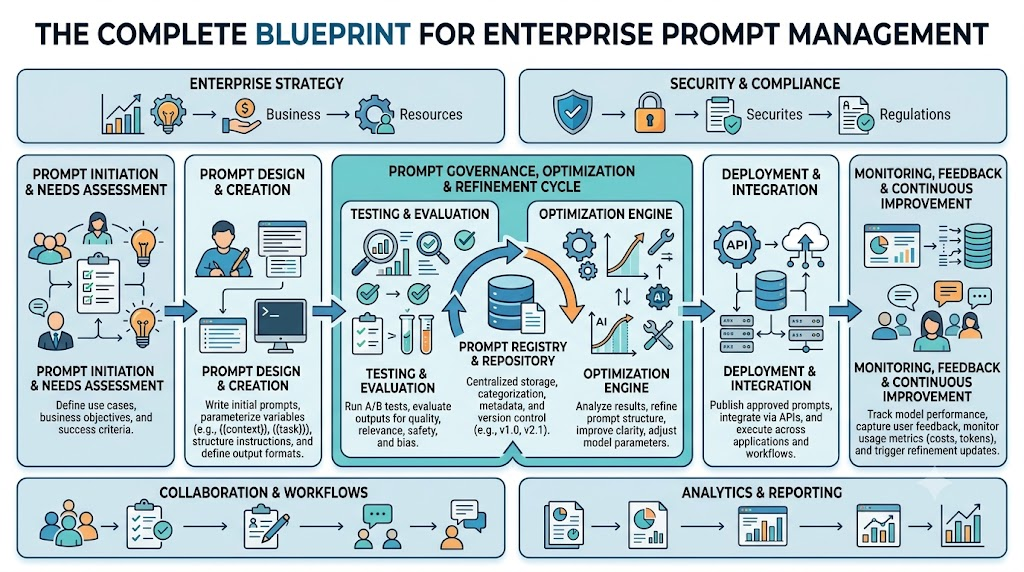
An AI prompt management tool is a specialized software platform designed to organize, store, optimize, test, version, and share prompts across individual users and organizations. Rather than leaving prompt creation to trial-and-error in isolated chat windows, a dedicated management tool treats prompts as core intellectual property and vital software assets.
+-------------------+      +-------------------+      +-------------------+
|  Prompt Creation  | ---> |   Optimization &  | ---> |  Centralized      |
|  & Variable Inputs|      |   Quality Scoring |      |  AI Prompt Library|
+-------------------+      +-------------------+      +-------------------+
                                                                |
+-------------------+      +-------------------+                v
| Version Control & | <--- | Comparative A/B   | <--- +-------------------+
| Analytics Tracking|      | Output Testing    |      | Multi-Model       |
+-------------------+      +-------------------+      | Execution         |
                                                      +-------------------+
Why Prompt Management Matters
As AI models become central to organizational workflows, maintaining prompt quality directly impacts product delivery, content strategy, and operational efficiency. Unorganized prompts lead to inconsistent branding, inaccurate code generation, and unpredictable AI behaviors. A robust AI prompt management tool brings software engineering discipline—such as versioning, modular design, and testing—to prompt engineering.
Common Prompt Challenges
- Lack of Centralization: Prompts remain trapped in individual team members’ private workspaces or browser histories.
- Inconsistent Results: Minor changes in phrasing or context can dramatically alter model output quality.
- Zero Version Tracking: Teams lose track of which iteration of a prompt yielded optimal results for a specific use case.
- Duplicate Effort: Multiple team members spend time engineering near-identical prompts to solve the same operational problems.
Benefits of an Organized AI Prompt Library
A centralized AI prompt library solves these pain points by offering a single source of truth. Users can categorize prompts by domain, tag them with relevant metadata, parameterize variables, and instantly retrieve proven templates. This structured approach reduces friction, accelerates onboarding, and ensures consistent quality across all AI outputs.
Understanding Prompt Engineering
Prompt engineering is the process of structuring, refining, and designing textual inputs to guide generative AI models toward precise, high-quality, and contextually accurate responses. According to official developer resources from OpenAI Documentation and Anthropic Documentation, effective prompt design requires balancing clarity, explicit constraints, and structured context.
+-----------------------------------------------------------------------+
|                         STRUCTURE OF A PROMPT                         |
+-----------------------------------------------------------------------+
| Role Definition : "Act as a Senior Technical Documentation Writer."  |
| Core Instruction: "Generate a API guide for OAuth2 authentication."   |
| Context Data    : "Target audience is junior backend engineers."      |
| Dynamic Variable: "{{api_endpoint_list}}"                             |
| Output Format   : "Return as Markdown with clear H2 headings."        |
| Constraints     : "Do not use passive voice. Keep under 1,000 words." |
+-----------------------------------------------------------------------+
Key Components of a Robust Prompt
A mature prompt engineering platform helps users construct prompts using standard structural elements:
- Role Definition: Instructs the AI model to adopt a specific persona, domain expertise, or cognitive framework.
- Core Instructions: Explicit, step-by-step task directives that clearly define what the model must execute.
- Context: Background information, domain rules, constraints, or reference data needed to inform the model’s reasoning.
- Dynamic Variables: Flexible placeholders (e.g.,
{{user_name}},{{target_language}},{{source_code}}) that turn static prompts into reusable templates. - Output Formatting: Explicit constraints dictating output structure, such as JSON schemas, Markdown tables, bulleted lists, or technical prose.
- Negative Constraints: Clear instructions explicitly defining what the model must not include or do.
Building an Organized AI Prompt Library
Without intuitive structure, even the most comprehensive prompt collection quickly becomes unusable. Utilizing a dedicated AI prompt organizer allows teams to categorize and surface valuable prompts instantly.
                       +-------------------------------+
                       |  Centralized Prompt Library   |
                       +-------------------------------+
                                       |
             +-------------------------+-------------------------+
             |                                                   |
             v                                                   v
  [Department Categories]                             [Functional Tagging]
  - Engineering                                       - #Python
  - Marketing                                         - #SEO
  - Customer Support                                  - #JSON
             |                                                   |
             +-------------------------+-------------------------+
                                       |
                                       v
                       +-------------------------------+
                       |  Parameterize & Dynamic Search|
                       +-------------------------------+
Taxonomy and Categorization
A structured library organizes prompts using multi-level taxonomies:
- Categories: Top-level domain classifications such as Software Engineering, Content Marketing, Customer Operations, or Data Science. Explore curated options on Promptosia’s Categories page.
- Tags: Granular metadata labels identifying specific technologies, output formats, or model compatibility (e.g.,
#Python,#JSON,#SEO,#GPT4). - Search & Discovery: High-speed semantic search indexing that enables users to find specific prompts based on intent, keyword, or past performance metrics.
- Prompt Collections: Grouped sets of interrelated prompts engineered to complete complex, multi-stage workflows (e.g., an end-to-end “Blog Production Pipeline”).
AI Prompt Optimization
Prompt optimization is the systematic process of refining prompt syntax, context, and structural instructions to maximize response quality, accuracy, and token efficiency.
[Unoptimized Prompt]
"Write a blog post about digital marketing tips."
       │
       ▼
[AI Prompt Optimizer Analysis]
- Identifies vagueness
- Requests target persona
- Adds structural rules
       │
       ▼
[Optimized Prompt]
"Act as a B2B Marketing Strategist. Write a 1,500-word guide on organic lead generation for SaaS startups. Structure with H2/H3 subheadings, use active voice, and provide three actionable case studies."
By leveraging an AI prompt optimizer, creators convert vague inputs into precise instructions. Standard optimization steps include:
- Eliminating Ambiguity: Replacing open-ended statements with concrete, measurable criteria.
- Adding Contextual Anchors: Providing domain-specific examples (few-shot prompting) to guide the AI’s reasoning.
- Structuring Input Fields: Standardizing input layouts so models can parse complex instructions without hallucination.
Discover how automated refinement works by utilizing the Prompt Optimizer on Promptosia.
AI Prompt Analysis
Before deploying prompts into production workflows, evaluating their underlying structural integrity is crucial. An AI prompt analyzer inspects a prompt’s architecture to identify potential failure points before execution.
+-----------------------------------------------------------------------+
|                        PROMPT ANALYSIS METRICS                        |
+-----------------------------------+-----------------------------------+
| Structural Elements               | Safety & Logic                    |
| - Instruction Clarity Index       | - Hallucination Risk Assessment   |
| - Context Completeness Score      | - Constraint Ambiguity Check      |
| - Variable Formatting Validation  | - Model Compatibility Rating      |
+-----------------------------------+-----------------------------------+
An effective analysis engine evaluates:
- Goal Alignment: Verifies whether the prompt gives the model a clearly defined objective.
- Variable Validation: Ensures all dynamic parameter placeholders are correctly declared and formatted.
- Safety & Alignment Checks: Scans for potential prompt injection vulnerabilities, toxic output risks, or ambiguous logic that could lead to model hallucinations.
Test your existing prompts for structural gaps using Promptosia’s Prompt Analyzer.
Prompt Quality Checking and Scoring Systems
Systematic quality control requires objective measurement. A specialized prompt quality checker scores prompts against established technical metrics to evaluate their operational readiness.
            +-----------------------------------------------+
            |          Prompt Quality Score: 88/100         |
            +-----------------------------------------------+
                                    |
     +------------------------------+------------------------------+
     |                              |                              |
     v                              v                              v
[Clarity: 95/100]              [Context: 80/100]             [Reusability: 90/100]
- Clear persona                - Missing sample output        - Well-defined variables
- Unambiguous task             - Sufficient background        - Standardized schema
Core Evaluation Metrics
- Clarity Score: Measures instruction precision and checks for conflicting directives.
- Contextual Density: Assesses whether the model has enough background data to respond accurately.
- Reusability Index: Evaluates how easily the prompt adapts to different input parameters via dynamic variables.
- Efficiency Metric: Checks whether the prompt achieves its goal without consuming excessive tokens.
Version Control for AI Prompts
Treating prompts as software code requires robust versioning. As generative AI models evolve and system prompts are refined, tracking every iteration prevents broken integrations and lost performance.
[Prompt v1.0] ───> [Prompt v1.1] ───> [Prompt v2.0]
 (Initial Draft)    (Added Constraints) (Integrated Dynamic Variables)
                           │
                           └── [Rollback to v1.1] (If v2.0 regresses output)
Using a dedicated prompt version control tool allows teams to:
- Maintain Change History: Log the exact text, author, and timestamp for every prompt revision.
- Perform Instant Rollbacks: Revert to previous high-performing prompt iterations if new model updates cause regressions.
- Support Team Collaboration: Enable multiple prompt engineers to branch, experiment with, and merge prompt improvements safely.
Review revision histories across all your assets with Promptosia’s Version History feature.
Testing AI Prompts with Comparative Frameworks
Prompt design is an empirical discipline. Determining which prompt variation delivers the best result requires comparative benchmarking across multiple criteria.
                                  +-----------------------+
                                  |   Base Prompt Input   |
                                  +-----------------------+
                                              |
                        +---------------------+---------------------+
                        |                                           |
                        v                                           v
             +---------------------+                     +---------------------+
             |  Prompt Variant A   |                     |  Prompt Variant B   |
             +---------------------+                     +---------------------+
                        |                                           |
                        v                                           v
             [Output Performance A]                       [Output Performance B]
                        \                                           /
                         \                                         /
                          v                                       v
                       +---------------------------------------+
                       |    Comparative Evaluation Dashboard   |
                       +---------------------------------------+
An AI prompt testing tool facilitates side-by-side A/B testing and performance benchmarking:
- Output Variance Comparison: Evaluates how slight prompt modifications alter response consistency across distinct test cases.
- Multi-Model Benchmarking: Tests the same prompt across different LLM architectures (e.g., GPT-4, Claude 3.5 Sonnet, Llama 3) to verify cross-model reliability, as detailed in Google AI Documentation and Hugging Face Documentation.
- Community Evaluation: Uses blind comparison protocols—similar to Promptosia’s interactive Prompt Duels—where evaluators vote on the superior output without knowing which prompt generated it.
Learn how to run structured evaluations using Promptosia’s Prompt Testing suite.
Reusable AI Prompt Templates Across Domains
Creating reusable AI prompt templates transforms repetitive manual writing into automated, reliable workflows across key business functions.
+-----------------------------------------------------------------------+
|                      ENTERPRISE TEMPLATE LIBRARY                      |
+-----------------------------------------------------------------------+
| Software Engineering  | - Unit Test Generation Template               |
|                       | - Refactoring & Code Documentation Template   |
+-----------------------+-----------------------------------------------+
| Content & Marketing   | - Search Intent-Aligned Outline Generator     |
|                       | - Multi-Channel Campaign Copy Modifier        |
+-----------------------+-----------------------------------------------+
| Operations & Research | - Unstructured PDF Data Extraction Template   |
|                       | - Executive Meeting Summary & Action Item Generator|
+-----------------------------------------------------------------------+
- Software Engineering: Standardized templates for generating unit tests, refactoring legacy code, or producing API documentation.
- Content Creation & Marketing: Parametric templates for long-form blog outlines, email nurturing sequences, and social copy tailored to specific buyer personas.
- Customer Support: Controlled response templates that synthesize technical documentation to answer user tickets accurately.
- Data Research & Analysis: Structured prompts designed to parse raw CSV, JSON, or unstructured text files and return clean summary tables.
How Different Roles Benefit from Promptosia
       +-------------------------------------------------------+
       |                  Promptosia Ecosystem                 |
       +-------------------------------------------------------+
                                   |
   +-------------------------------+-------------------------------+
   |                               |                               |
   v                               v                               v
[Developers & Engineers]     [Marketers & Creators]      [Enterprise & Operations]
- Parametric Code Generation - Brand Tone Standardization - Governance & Access Controls
- API Payload Validation     - Content Pipeline Prompts  - Audit Trails & Metrics
Developers and Software Engineers
Engineers use Promptosia to store, parameterize, and version control system prompts used in AI-powered applications. Centralized prompt assets reduce API integration bugs and streamline prompt maintenance.
Marketers and Content Teams
Marketing professionals use shared libraries to enforce brand tone, style guides, and formatting standards across all generative AI campaign materials.
Researchers and Academics
Researchers rely on versioning and quality analysis to build reproducible prompt chains, ensure consistent experimental conditions, and document methodology accurately.
Educators and Students
Educators build parametric prompts to generate custom lesson plans, quiz items, and interactive learning aids, while students learn prompt engineering best practices.
Enterprises and Agencies
Large organizations manage prompt access permissions, track operational usage metrics, enforce corporate compliance standards, and protect client-specific AI assets across departments.
Manual Storage vs. Promptosia Platform
| Feature / Capability | Manual Storage (Notes/Spreadsheets) | Promptosia Platform |
| Organization | Unstructured, difficult to search, subject to loss. | Categorized taxonomy with semantic tag indexing. |
| Version Control | Manual copy-pasting; prone to overwriting changes. | Automated, line-by-line version history and rollbacks. |
| Quality Analysis | Subjective human estimation. | Automated structural analysis and quality scoring. |
| Testing Environment | Isolated manual execution in chat windows. | Integrated A/B testing and comparative output tools. |
| Variables & Parameters | Hardcoded text requiring manual editing. | Dynamic dynamic variables ({{placeholder}}) support. |
| Team Collaboration | Fragmented across chat messages and documents. | Centralized library with shared team permissions. |
Best Practices for Prompt Management
To maintain an efficient prompt library, follow these battle-tested management principles:
- Maintain Descriptive Naming Conventions: Title prompts by intent and domain (e.g.,
[Marketing] B2B SaaS Email Newsletter Generator v2) rather than using vague labels. - Parameterize Repeated Inputs: Replace static text with dynamic variables to maximize template reusability across teams.
- Document Context and Model Compatibility: Note which specific model, temperature setting, and system instructions yield optimal outputs.
- Audit and Prune Libraries Regularly: Archive outdated or low-performing prompt variations to keep your primary library clean and easy to navigate.
- Establish Governance Workflows: Require quality checks and version reviews before approving new prompts for enterprise-wide deployment.
Common Prompt Engineering Mistakes to Avoid
- Vague Directives: Providing high-level instructions without explicit output guidelines leads to unpredictable model behavior.
- Neglecting Negative Constraints: Failing to specify what the AI should not do often results in bloated, irrelevant responses.
- Ignoring Model Limitations: Expecting a single prompt to solve complex, multi-step tasks without breaking them down into chained prompt sequences.
- Skipping Output Testing: Deploying prompts to production without evaluating them across diverse input scenarios.
- Overlooking Version Tracking: Editing live prompts directly without saving historical fallbacks makes troubleshooting difficult if outputs degrade.
The Future of Prompt Management and Generative AI
As AI models mature, prompt engineering is evolving from basic text creation into a disciplined operational strategy. Key trends shaping the future of prompt management include:
[Static Text Prompts]
         │
         ▼
[Parametric Multi-Model Libraries]
         │
         ▼
[Automated Prompt Optimization & Agentic Workflows]
- Automated Prompt Optimization: AI engines will continuously analyze execution metrics and automatically optimize prompt structures for higher precision and lower token costs.
- Standardization Across Organizations: Enterprise AI adoption will rely on standardized prompt asset frameworks—similar to digital asset management (DAM) systems in traditional media.
- Integration with Agentic Systems: As autonomous AI agents proliferate, structured prompt management systems will serve as the primary repository for agent system instructions, guardrails, and tool-calling parameters.
How Promptosia Transforms Your AI Operations
Promptosia provides a complete software platform designed to manage the entire lifecycle of your generative AI prompts.
+-----------------------------------------------------------------------+
|                         PROMPTOSIA PLATFORM                           |
+-----------------------------------+-----------------------------------+
| Management & Library              | Analysis & Optimization           |
| - Centralized Asset Storage       | - Automated Quality Scoring       |
| - Semantic Tagging & Taxonomies   | - Real-Time Structural Analysis   |
| - Dynamic Variable Parameterization| - AI-Assisted Prompt Refinement  |
+-----------------------------------+-----------------------------------+
| Evaluation & Governance           | Identity & Provenance             |
| - Comparative Output Testing      | - Verified Asset Credentials      |
| - Blind "Prompt Duels" Benchmarks | - Complete Immutable Change Logs |
| - Role-Based Team Permissions     | - Versioning & Rollback Controls  |
+-----------------------------------+-----------------------------------+
Core Platform Capabilities
- Centralized Prompt Library: Store, organize, tag, and search your prompts within an intuitive dashboard. Explore public assets in the Prompt Library.
- AI-Assisted Optimization: Identify structural weaknesses and refine prompt clarity instantly using the built-in Prompt Optimizer.
- Structural Analysis: Evaluate goal alignment, variable accuracy, and safety constraints using the Prompt Analyzer.
- Version History Tracking: Maintain a complete history of every prompt revision to safeguard your team’s intellectual property.
- Comparative Output Testing: Run side-by-side output evaluations across multiple models using Prompt Testing tools.
- Community Benchmarking: Participate in blind comparison evaluations using Prompt Duels to evaluate prompt performance objectively.
- Prompt Passports: Assign verified metadata, usage statistics, and authorship history to high-value prompt assets with Prompt Passports.
To learn more about our mission to standardize prompt management, visit our About Page or access user documentation in the Help Center.
Frequently Asked Questions
What is an AI prompt management tool?
An AI prompt management tool is a dedicated software platform used to create, organize, optimize, test, version, and share prompts for generative AI models. It helps individuals and organizations treat prompts as structured digital assets, improving output quality, team collaboration, and workflow efficiency across different AI applications.
Why should I use an organized AI prompt library instead of basic notes?
An organized AI prompt library provides structured taxonomies, semantic search, variable parameterization, and version tracking that basic note applications lack. It prevents prompt loss, eliminates duplicate work, allows instant retrieval, and ensures consistent output quality across teams.
What is prompt engineering?
Prompt engineering is the practice of designing, structuring, and refining text inputs to guide generative AI models toward accurate, contextually relevant, and properly formatted outputs. It involves defining roles, providing context, setting constraints, and formatting parameters effectively.
How does an AI prompt optimizer improve prompt performance?
An AI prompt optimizer analyzes prompt text to identify vague language, missing context, or conflicting directives. It then restructures the prompt by adding clear roles, explicit constraints, dynamic variables, and formatting rules to help the AI produce higher-quality, consistent outputs.
Why is version control important for AI prompts?
Version control maintains a complete historical record of every prompt iteration. If a model update or prompt edit causes poor outputs or errors in production, version tracking allows teams to compare changes line-by-line and immediately revert to a previous high-performing version.
How does an AI prompt analyzer evaluate prompt quality?
An AI prompt analyzer evaluates structural components such as instruction clarity, contextual completeness, variable formatting, safety considerations, and goal alignment. It highlights potential failure points or ambiguities before the prompt is executed in production workflows.
What is the role of dynamic variables in prompt templates?
Dynamic variables (e.g., {{variable_name}}) serve as dynamic placeholders that convert static prompts into flexible, reusable templates. Users can swap in specific context, data, or source material without rewriting the underlying prompt structure.
How do comparative prompt tests work?
Comparative prompt testing runs multiple prompt variations or models against identical input parameters. Users can evaluate side-by-side outputs to measure consistency, tone, accuracy, and formatting compliance before choosing the optimal prompt.
Can enterprise teams collaborate on prompt libraries?
Yes. Platforms like Promptosia offer team permissions, shared libraries, role-based access controls, and collaborative versioning, allowing enterprise teams to standardize AI outputs and protect valuable prompt assets across departments.
Who can benefit from using Promptosia?
Promptosia is designed for developers, content creators, marketers, educators, researchers, customer support teams, and enterprise organizations that use generative AI daily and need a reliable system to organize, optimize, and scale their prompt workflows.
What are Prompt Passports in Promptosia?
Prompt Passports provide verified metadata, performance tracking, authorship history, and usage analytics for individual prompts. They establish trust, attribution, and quality standards for prompts shared across community or enterprise libraries.
How does Promptosia assist with prompt quality checking?
Promptosia evaluates prompts against core technical benchmarks—including instruction clarity, context density, structural formatting, and reusability—providing actionable feedback and quality scores to help users refine their prompts.
Conclusion
Managing generative AI inputs effectively is essential for organizations looking to scale their AI operations. Relying on ad-hoc, unorganized prompts leads to inconsistent outputs, duplicated effort, and lost productivity. Treating prompts as core digital assets transforms generative AI from an unpredictable experiment into a structured, highly reliable business tool. Adopting a dedicated AI prompt management tool like Promptosia gives your team the infrastructure needed to organize, optimize, version, and test prompts at scale. By centralizing prompt storage, parameterizing reusable templates, enforcing quality standards, and tracking performance history, Promptosia helps you maximize the return on your AI investments.