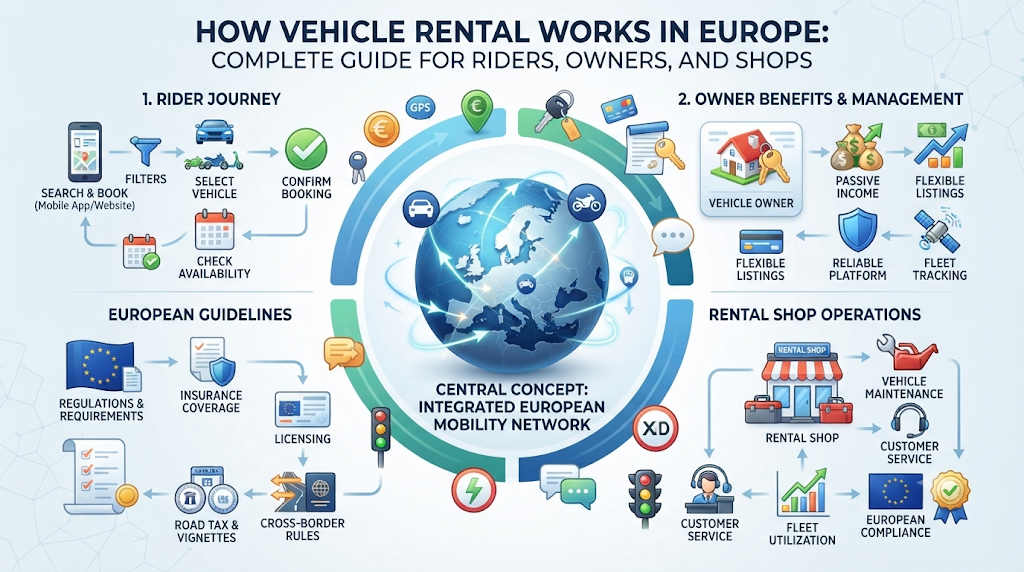
Planning a road trip across Europe or looking to turn a parked vehicle into extra income can feel confusing at first. Every European country has its own driving rules, insurance standards, and rental costs. At the same time, local rental shops often struggle with paper notebooks and messy schedules. Whether you want to book a bike for a coastal ride, earn money from a spare vehicle, or run a smooth rental business, understanding how modern European vehicle sharing works is the best place to start. Platforms like MotoShare Europe help bring travelers, private owners, and local rental shops together in one online marketplace.
In this guide, you will learn how motorcycle, scooter, and car rentals work across Europe. We will break down daily rental prices, peer-to-peer vehicle sharing rules, tips for private owners, and how digital tools help small rental shops manage daily bookings without stress.
Understanding Vehicle Rental in Europe
Europe offers some of the best scenic routes in the world, from the mountain passes of the Alps to the sunny coastal roads of Spain, Italy, and Greece. Because cities are historic and streets can be narrow, two-wheelers are just as popular as cars.
When travelers look for a motorcycle rental Europe option, they usually choose between two main models:
- Traditional Rental Agencies: These are established shops or big companies that own a fleet of bikes, scooters, or cars. They operate from fixed storefronts or airport desks and follow strict business hours.
- Peer-to-Peer Marketplaces: This newer model connects travelers directly with private vehicle owners or small local shops. Instead of renting from a large corporate counter, you book directly from a person or independent provider in the neighborhood.
Both models allow you to compare vehicles, check daily rates, and reserve your dates online before you travel. However, the booking steps, pickup rules, and insurance terms can differ quite a bit.
Traditional Rental vs. Peer-to-Peer Rental in Europe
Choosing between a traditional rental shop and a peer-to-peer platform depends on your budget, travel style, and flexibility needs.
| Feature | Traditional Rental Agency | Peer-to-Peer Rental Marketplace |
| Vehicle Owner | Large company or commercial shop | Private individual or independent local shop |
| Vehicle Variety | Standard newer models | Mix of unique, classic, and everyday models |
| Pricing Structure | Fixed rates plus counter add-ons | Owner-set rates with transparent upfront totals |
| Pickup & Drop-Off | Fixed shop hours and locations | Flexible times arranged directly with the host |
| Communication | Front desk or call center staff | Direct chat with the vehicle owner or local host |
A peer to peer motorcycle rental Europe experience often feels more personal. Owners frequently share local route tips, recommend safe parking spots, and offer flexible pickup times that traditional shops cannot match.
Motorcycle Rental Cost Europe: What Affects the Price?
One of the first questions travelers ask is how much a trip will cost. Because Europe includes over 40 countries with different tax rates and living costs, there is no single flat rate. Understanding the motorcycle rental cost Europe market helps you plan your budget and avoid surprise fees at pickup.
Several key factors shape your final rental price:
- Engine Size and Bike Type: A small 125cc city scooter costs much less per day than a heavy 1200cc touring motorcycle built for long highway trips.
- Season and Travel Dates: Prices rise sharply during peak summer months (June to August) in southern Europe. Booking in spring or autumn often saves money.
- Rental Length: Most providers offer lower daily rates if you book for a full week instead of just one or two days.
- Location and Country: Renting a bike in Switzerland or Norway usually costs more than renting a similar bike in Portugal, Spain, or Eastern Europe.
- Security Deposits: Nearly all providers hold a refundable security deposit on your credit card to cover minor scratches or late returns.
- Insurance and Excess: Basic third-party insurance is usually required by law, while full coverage that lowers your financial risk costs extra per day.
- Mileage and Fuel Rules: Some rentals include unlimited kilometers, while others charge a small fee per extra kilometer. Most follow a “full-to-full” fuel rule, meaning you return the tank as full as you received it.
- Gear and Accessories: Helmets, riding jackets, gloves, GPS mounts, and side luggage boxes may be included or rented for a small daily fee.
Illustrative Example of a Rental Cost Breakdown
Note: The following scenario is a hypothetical example to show how pricing works and does not represent an actual quote.
Imagine a rider booking a mid-size touring bike in Spain for 5 days in May. The base rate might be €75 per day (€375 total). Adding side luggage boxes for €10 per day adds €50, and choosing extra damage protection for €15 per day adds €75. The total trip cost comes to €500, plus a refundable €800 security deposit held on a credit card until the bike returns safely. Always check the full breakdown before confirming any reservation.
Licensing and Legal Rules Across European Countries
Europe is not a single legal zone when it comes to driving rules. What is legal in one country may not be allowed across the border. Before you book a ride, check the rules for every country on your route.
- Driving Licence Categories: In the European Union, motorcycle licences are split into tiers: AM (mopeds up to 50cc), A1 (light bikes up to 125cc), A2 (medium-power bikes up to 35 kW), and A (unrestricted motorcycles). Your home licence must match the engine power of the bike you rent.
- Car Licence Exceptions: Some countries—such as Spain, France, and Italy—allow drivers who have held a standard car licence (Category B) for two or three years to ride 125cc scooters within their own borders. However, this rule does not automatically carry over when crossing into another country.
- International Driving Permits (IDP): If your driving licence was issued outside the EU or is not printed in the Latin alphabet, many countries require an IDP alongside your original physical licence.
- Cross-Border Travel Rules: Never assume you can ride a rented bike into a neighboring country. Many insurance policies only cover the country where you picked up the vehicle unless you get written permission from the owner or rental shop first.
Guide for Vehicle Owners: Earning Income Safely
Many bikes, scooters, and cars sit unused in garages for weeks at a time. Sharing your vehicle with vetted travelers is a practical way to offset maintenance, tax, and insurance expenses.
How to Rent Out My Motorcycle
If you are a rider wondering, “How do I rent out my motorcycle safely?” start by checking your local laws and personal insurance policy. Standard personal insurance rarely covers commercial or peer-to-peer rentals, so you must verify what coverage applies before handing over your keys.
Follow these practical steps to prepare your bike:
- Check Mechanical Safety: Inspect tire tread depth, brake pads, chain tension, fluid levels, and all lights. A safe bike leads to happy riders and good reviews.
- Take Clear Photos: Photograph your bike in bright daylight from all angles, including close-ups of the dashboard, tires, and any existing scratches.
- Write an Honest Description: List the exact model year, engine size, seat height, and included gear like phone holders or top cases.
- Set Clear Rules: Decide on daily mileage limits, minimum rider age, and whether cross-border trips are allowed.
- Document the Handover: Walk around the bike with the renter at pickup and drop-off, taking timestamped photos together to avoid disputes.
How to List My Car for Rent
The process is very similar if you have a spare car and want to know how to list my car for rent. Clean the interior thoroughly, check the spare tire and emergency kit, and make sure all registration documents stay inside the glovebox. Clear communication about fuel type (petrol, diesel, hybrid, or electric) prevents costly refueling mistakes by visiting tourists.
Note: Never assume that listing a vehicle on any platform automatically provides legal protection or commercial insurance. Vehicle owners are always responsible for verifying local tax rules, transport laws, and valid insurance coverage in their country.
How Rental Businesses Streamline Daily Operations
Running an independent rental shop involves much more than handing over keys. Whether you manage ten scooters on a holiday island or fifty touring bikes in a major city, tracking bookings on paper or basic spreadsheets quickly leads to double bookings and lost revenue.
Modern vehicle rental management software replaces scattered notes with one organized digital dashboard. Instead of checking five different places to see which bike is free next Tuesday, shop owners can see their entire fleet status in seconds.
Key Tools Every Rental Shop Needs
Different vehicle types require slightly different workflows, so operators often look for specialized tools:
- Vehicle Rental Booking System: An online calendar and reservation engine that lets customers check real-time availability, request dates, and receive instant booking confirmations.
- Scooter Rental Software: Built for fast, high-turnover city rentals where customers rent for a few hours or days, focusing on quick check-ins, helmet tracking, and local ID checks.
- Bike Rental Software: Ideal for bicycle and e-bike shops managing hourly rentals, frame sizes, battery charging status, and group bookings.
- Free Car Rental Software: Helps small car agencies track mileage logs, fuel levels, damage diagrams, and multi-day customer agreements without heavy monthly subscription costs.
For new or small shops trying to keep overhead low, starting with free vehicle rental management software allows owners to organize customer records, track payments, and view basic revenue reports while growing their fleet at a steady pace.
Manual Fleet Tracking vs. Rental Management Software
Switching from paper logs to a digital system saves hours of administrative work every week.
| Daily Task | Manual Tracking (Paper / Spreadsheets) | Digital Rental Management Software |
| Checking Availability | Flipping through notebooks or searching files | Live visual calendar updated in real time |
| Preventing Double Bookings | High risk during busy weekend rushes | Automated date blocking for reserved vehicles |
| Customer Records | Stored in physical folders or scattered emails | Saved securely in one searchable profile |
| Payment & Revenue Tracking | Manual calculator work at month-end | Organized payment logs and revenue summaries |
| Handover Documentation | Handwritten forms that are easy to misplace | Digital records of dates, terms, and vehicle status |
Common Mistakes to Avoid
Whether you are renting a vehicle, sharing your own bike, or managing a small shop, avoiding these common mistakes saves time and money:
- For Travelers: Booking a heavy motorcycle without checking seat height or local licence rules, or skipping a careful photo walk-around before riding away.
- For Private Owners: Handing over keys without checking the renter’s physical driving licence, or failing to confirm if personal insurance allows paid rentals.
- For Rental Shops: Relying on memory or disconnected spreadsheets during peak tourist season, which often causes overlapping bookings and unhappy customers.
Best Practices for a Smooth Rental Experience
Follow these simple habits to keep every trip stress-free:
- Verify Documents Early: Always confirm driving licence validity, passport or ID requirements, and deposit rules at least 48 hours before pickup.
- Communicate Clearly: Agree on exact meeting times, fuel rules, and emergency contact numbers in writing before the rental starts.
- Inspect Together: Take five minutes at pickup and return to check tire pressure, lights, and body panels together.
- Keep Digital Records: Store booking confirmations, payment receipts, and handover photos in one accessible folder.
How MotoShare Europe Connects Renters, Owners, and Shops
MotoShare Europe operates as an online vehicle rental marketplace designed to connect travelers, motorcycle enthusiasts, local residents, private vehicle owners, and independent rental businesses across Europe. The platform focuses on motorcycles, bicycles, scooters, and cars, helping riders explore listings, compare transparent prices, and send booking requests directly to participating local providers.
For independent rental shops and fleet operators, MotoShare Europe also promotes free vehicle rental management software. According to its advertised features, the software is designed to help operators manage vehicle listings, reservations, customer records, fleet availability, payments, revenue tracking, and operational reporting in one place. Because platform inventory and software capabilities can vary by region and business setup, users and shop owners should always review current terms and test features directly to ensure they fit their specific local needs.
Conclusion
Renting or sharing a vehicle in Europe does not have to be complicated. For travelers, understanding local licence tiers, seasonal pricing, and insurance rules leads to safer, better-planned rides. For private owners and independent rental shops, clear communication, thorough vehicle checks, and organized digital booking tools turn daily operations into a smooth routine.
Your best next step is to review your local driving or business requirements, prepare a clear checklist for vehicle handovers, and explore modern online platforms that make European mobility simple and transparent.
Frequently Asked Questions (FAQs)
1. Can tourists rent a motorcycle in Europe with a non-European driving licence?
Yes, many European countries allow visitors to rent motorcycles using a valid home driving licence, provided it covers the exact engine size you plan to ride. However, if your licence is not from the EU or is not printed in the Latin alphabet, you will usually need an International Driving Permit (IDP) alongside your original licence.
2. How much is the average motorcycle rental cost Europe travelers pay?
Prices vary widely by country, season, and bike size. A small scooter in southern Europe may cost around €25 to €45 per day, while a large touring motorcycle in Western or Northern Europe can range from €80 to €150+ per day, excluding extra gear or full insurance coverage.
3. What is the difference between traditional and peer to peer motorcycle rental Europe options?
Traditional rentals are run by commercial shops with fixed business hours and standard fleets. Peer-to-peer rentals connect you directly with private vehicle owners or small local hosts, often giving you more flexible pickup times, personal route advice, and unique bike models.
4. Is insurance automatically included when I rent a vehicle from a private owner?
No, you should never assume insurance is automatically included. In Europe, every road vehicle must have valid third-party liability insurance, so you must verify with the owner or platform what coverage is active, what the damage excess is, and whether personal injury or theft is covered before riding.
5. Can I ride a rented motorcycle or car across borders into another European country?
Not always. Many rental agreements and insurance policies restrict travel to the country where you picked up the vehicle. Always ask the owner or rental shop in advance and get written approval before crossing any national border.
6. What do I need to check before I rent out my motorcycle to a traveler?
First, check your country’s local laws and confirm whether your insurance policy allows peer-to-peer rentals. Second, inspect your bike’s tires, brakes, lights, and fluids to ensure it is completely road-safe, and take clear photos of its condition before handing over the keys.
7. Is it safe to list my car for rent on an online marketplace?
Listing a car online can be safe when you follow clear verification steps. Always check the renter’s valid driving licence and ID in person, agree on mileage and fuel rules in writing, verify your insurance coverage, and take timestamped photos of the car at pickup and return.
8. What is vehicle rental management software and who needs it?
It is a digital tool that helps rental businesses manage their fleet, customer bookings, availability calendars, and payments in one system. Any independent motorcycle, scooter, bike, or car rental shop looking to avoid double bookings and save time on paperwork can benefit from it.
9. How does free vehicle rental management software differ from paid tools?
Free software typically covers core daily tasks like tracking vehicle availability, managing reservations, saving customer records, and logging payments. Paid enterprise systems often add advanced features like multi-branch accounting, automated dynamic pricing, or custom website integrations.
10. What features should I look for in scooter rental software or bike rental software?
Look for a real-time availability calendar, fast mobile check-in and check-out tools, helmet or accessory tracking, deposit logs, and simple damage checklists. Fast customer processing is especially important for short hourly or daily city rentals.
11. Why do small agencies use free car rental software instead of spreadsheets?
Spreadsheets do not automatically block dates when a car is booked, which easily leads to double bookings during busy travel seasons. Dedicated rental software keeps availability, customer details, and payment statuses updated in real time with far less manual effort.
12. What is a vehicle rental booking system?
A vehicle rental booking system is the online reservation calendar and checkout workflow that allows customers to search available dates, view total prices, and submit booking requests while automatically updating the provider’s schedule.