Introduction
In today’s hyper-connected digital economy, modern enterprises run on complex, distributed infrastructure across multi-cloud environments, Kubernetes clusters, microservices, and legacy systems. For organizations relying on digital channels, IT service availability is no longer just an operational metric—it is the backbone of customer experience, revenue generation, and enterprise reputation. Even a few minutes of unscheduled downtime can cost millions of dollars, trigger regulatory compliance fines, and erode consumer trust. This is where Artificial Intelligence for IT Operations (AIOps) steps in to fundamentally redefine how systems are monitored, managed, and optimized. By combining machine learning, natural language processing, real-time event correlation, and predictive analytics, AIOps transforms operations from a reactive fire-fighting model to a proactive, automated, self-healing framework. To master the concepts, tools, and real-world architectures driving this revolution, technology professionals turn to educational platforms like AIOpsSchool, where engineers and leaders build production-ready skills in AI-driven IT operations, observability, and site reliability engineering. In this guide, we explore how AIOps improves IT service availability, the underlying algorithms, enterprise use cases, and actionable strategies for implementation.
What is AIOps?
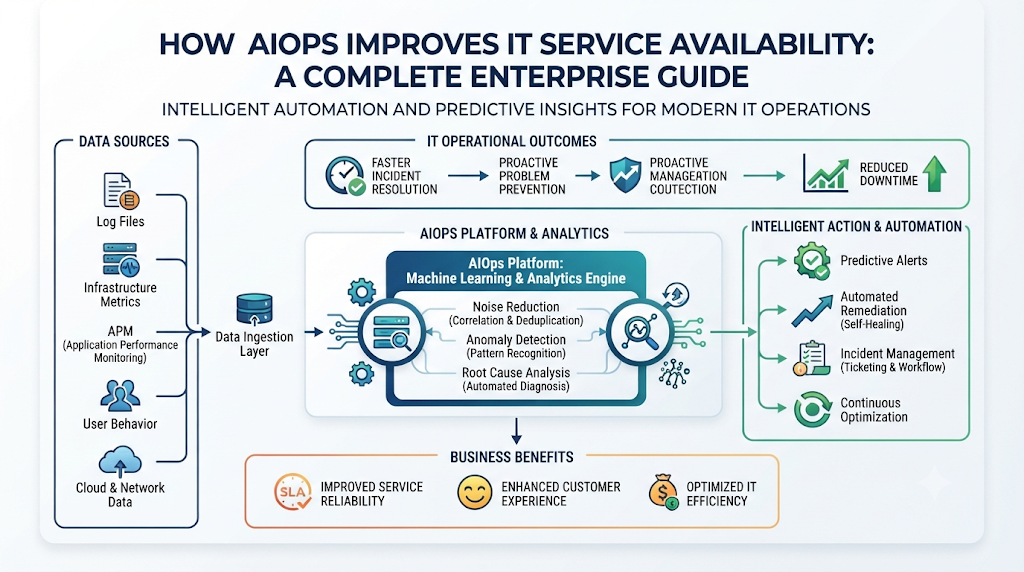
AIOps, short for Artificial Intelligence for IT Operations, is the application of machine learning (ML), artificial intelligence (AI), advanced analytics, and big data techniques to automate and streamline IT operations workflows. Coined by Gartner, AIOps bridges the gap between massive, noisy operational data and actionable automated intelligence.
+-----------------------------------------------------------------------+
|                        DATA INGESTION LAYER                           |
|      Logs  |  Metrics  |  Traces  |  Events  |  Topology Maps         |
+-----------------------------------------------------------------------+
                                   │
                                   ▼
+-----------------------------------------------------------------------+
|                        AIOPS ANALYTICS ENGINE                         |
|   Noise Reduction  ──>  Event Correlation  ──>  Anomaly Detection     |
+-----------------------------------------------------------------------+
                                   │
                                   ▼
+-----------------------------------------------------------------------+
|                      AUTOMATION & INSIGHT LAYER                        |
|  Predictive Alerts  │  Auto-Root Cause Analysis  │  Self-Healing      |
+-----------------------------------------------------------------------+
AIOps platforms operate at the intersection of three key domains:
- Big Data Data Ingestion: Aggregating structured and unstructured telemetry data from diverse IT environments (on-premises, cloud, serverless, edge) into a unified data lake.
- Machine Learning Analytics: Applying unsupervised learning (for anomaly detection), supervised learning (for failure prediction), graph theory (for dependency topology), and natural language processing (for log ingestion and ticketing context).
- Automation & Orchestration: Executing automated runbooks, self-healing scripts, auto-scaling commands, and intelligent ticket routing into ITSM tools.
Understanding IT Service Availability
IT Service Availability is the measure of time a system, application, or infrastructure component remains fully operational and accessible to end-users when needed. It is typically expressed as a percentage over a specified period (e.g., monthly or annually).
Mathematical Availability is calculated using the following formula:
$$Availability (\%) = \left( \frac{MTBF}{MTBF + MTTR} \right) \times 100$$
Where:
- MTBF (Mean Time Between Failures): The average operational time a system runs without experiencing a breakdown.
- MTTR (Mean Time to Repair/Resolution): The average time required to detect, diagnose, troubleshoot, and restore a failed system to full operational capability.
To maximize availability, IT organizations must execute two strategic moves:
- Increase MTBF: Prevent failures before they impact production.
- Decrease MTTR: Rapidly detect, pinpoint, and remediate incidents when they do occur.
High Availability Tiers (“The Nines”)
| Availability Tier | Downtime per Year | Downtime per Month | Target Enterprise Context |
| 99% (“Two Nines”) | 3.65 Days | 7.31 Hours | Non-critical internal tooling |
| 99.9% (“Three Nines”) | 8.76 Hours | 43.8 Minutes | Standard enterprise web applications |
| 99.99% (“Four Nines”) | 52.6 Minutes | 4.38 Minutes | Business-critical SaaS, e-commerce |
| 99.999% (“Five Nines”) | 5.26 Minutes | 25.9 Seconds | Financial trading, healthcare, telecom |
Achieving “Four Nines” or “Five Nines” availability manually is mathematically impossible in modern dynamic environments. Human intervention takes 15–30 minutes just to respond to an alert and organize a war-room—exceeding the entire annual downtime budget for a 99.99% system in a single event.
Why High Service Availability Matters for Modern Businesses
In the era of digital transformation, system availability directly impacts business survival. Outages reverberate across every vertical of the enterprise:
The Cost of Downtime: According to industry research, the average cost of IT downtime ranges from $5,600 per minute for mid-market firms to over $300,000 to $1,000,000+ per hour for global financial institutions and e-commerce platforms.
- Direct Financial Loss: E-commerce sites lose revenue for every second checkout is unreachable. Financial services risk massive trading penalties during service degradation.
- Customer Churn & Brand Damage: Modern users expect sub-second responsiveness. If an application crashes or freezes, users migrate to competitors within minutes.
- Operational Productivity: Internal system downtime halts operations for thousands of employees, degrading supply chain logistics, customer service, and development cycles.
- SLA Violations & Regulatory Penalties: B2B companies face steep contractual penalties for violating Service Level Agreements (SLAs). In regulated industries (banking, health), outages trigger government compliance audits and legal sanctions.
Common Causes of IT Service Downtime
To understand how AIOps improves availability, we must first analyze why systems break in the first place:
- Human Error & Configuration Drift: Manual deployment misconfigurations, incorrect policy updates, and undocumented environment changes account for over 60% of modern infrastructure outages.
- Cascade Failures in Microservices: A minor latency spike or unhandled exception in an obscure downstream service can cause connection pools to back up, triggering cascading crashes across the entire microservice architecture.
- Capacity Constraints & Resource Exhaustion: Unpredicted traffic bursts, memory leaks, unoptimized database queries, and disk space saturation deplete system resources.
- Third-Party Dependency Outages: Modern applications rely on external cloud APIs, payment gateways, and SaaS vendors. Outages in external dependencies cascade into internal service degradation.
- Alert Fatigue and Signal Noise: Monitoring tools generate thousands of non-actionable alerts during a minor incident. IT operators spend critical time sifting through duplicate alerts rather than troubleshooting the core failure.
How AIOps Improves IT Service Availability
AIOps acts as an intelligent operating layer across your entire technology stack. Instead of waiting for a component to breach a static threshold (e.g., CPU > 90%), AIOps shifts operations from reactive monitoring to predictive observability and automated action.
TRADITIONAL ITOPS vs. AIOPS DRIVEN SERVICE AVAILABILITY

+------------------------------------------------------------------------+
| TRADITIONAL ITOPS (Reactive)                                           |
| System Outage ──> Static Alert ──> War Room ──> Manual Root Cause ──> Fix |
| [MTTR: Hours / High Downtime Risk]                                     |
+------------------------------------------------------------------------+

+------------------------------------------------------------------------+
| AIOPS DRIVEN ITOPS (Predictive & Automated)                            |
| Anomaly Detected ──> AI Correlation ──> Auto Root Cause ──> Self-Healing |
| [MTTR: Seconds / Zero User Impact]                                     |
+------------------------------------------------------------------------+
Here is a detailed breakdown of the core core technical capabilities through which AIOps enhances IT service availability:
1. AI and Machine Learning in IT Operations
AIOps leverages specific machine learning mathematical approaches tailored for operational data:
- Unsupervised Clustering (DBSCAN, K-Means): Groups unstructured log lines and events into meaningful semantic categories without pre-existing training labels.
- Time-Series Forecasting (ARIMA, Prophet, LSTM networks): Models historical baseline behaviors for metrics (latency, throughput, memory consumption) to dynamically forecast expected values and detect abnormal variations.
- Graph Neural Networks (GNN): Analyzes dynamic topology graphs to map physical and virtual dependencies across compute nodes, pods, databases, and microservices in real time.
2. Real-Time Monitoring and Observability
Traditional monitoring asks “Is the server running?” Observability asks “Why is the system behaving this way?”
AIOps correlates the MELT telemetry pillars:
- Metrics: Numerical values sampled over time (CPU utilization, IOPS, memory usage).
- Events: Significant operational changes (deployments, auto-scaling events, pod restarts).
- Logs: Timestamped records generated by applications and system kernels.
- Traces: End-to-end paths of requests navigating through distributed microservices.
AIOps ingests MELT data at scale, providing a single pane of glass across multi-cloud and hybrid environments.
3. Intelligent Event Correlation & Alert Noise Reduction
During a network switch failure, traditional monitoring platforms send hundreds of alerts for every connected server, database, and application node. This creates an “alert storm.”
+----------------------------------------------------------------------+
|                       ALERT STORM INPUT                              |
|  [Alert 1: Database Slow]  [Alert 2: App Timeout]  [Alert 3: API 500]  |
|  [Alert 4: CPU Spike]      [Alert 5: Pod Crash]   [Alert 6: Disk High] |
+----------------------------------------------------------------------+
                                  │
                                  ▼
+----------------------------------------------------------------------+
|                     AIOPS EVENT CORRELATION                          |
|  * Deduplicates alerts                                               |
|  * Groups by time, topology, and cross-metric dependency              |
|  * Reduces alert volume by 90% - 99%                                 |
+----------------------------------------------------------------------+
                                  │
                                  ▼
+----------------------------------------------------------------------+
|                     ACTIONABLE INCIDENT                              |
|  "Single Incident #8402: Switch Top-of-Rack Failure in Region East-1"|
+----------------------------------------------------------------------+
AIOps platforms utilize machine learning algorithm pipelines to:
- Deduplicate: Filter identical alert signals instantly.
- Compress: Group related alerts into a single cohesive incident context based on time proximity and dependency topology.
- Filter Noise: Suppress non-actionable transient spikes that naturally recover without human intervention.
Result: Noise reduction rates of 90% to 99%, allowing on-call engineers to focus immediately on genuine critical events.
4. Anomaly Detection Using AI
Static thresholds are inherently flawed: a 90% CPU usage during a scheduled 2 AM database backup is normal, but 90% CPU usage at 2 PM on a Tuesday during low traffic indicates an issue.
AIOps uses Adaptive Thresholding:
- It learns baseline patterns considering seasonality (hourly, daily, weekly, and monthly trends).
- It sets dynamic confidence intervals around operational metrics.
- When a metric strays outside its dynamic pattern, an anomaly flag is generated—long before a hard threshold is breached.
5. Predictive Analytics for Preventing Failures
Rather than notifying teams after an outage occurs, predictive AIOps models forecast failures in advance:
- Disk Space Exhaustion: Predicts exactly when a partition will fill based on write acceleration trends, triggering automated log pruning days ahead.
- Memory Leaks: Identifies gradual heap memory growth patterns in application runtimes before an Out-Of-Memory (OOM) kill occurs.
- Hardware Degradation: Detects subtle latency and error rate increases in storage drives or network links prior to total hardware failure.
6. Automated Incident Detection and Response
When an anomaly passes critical validation, AIOps coordinates with incident response management platforms like PagerDuty or Opsgenie. It enriches tickets with diagnostic context—log snippets, trace waterfall graphs, and recent code deployments—and automatically assigns them to the exact team responsible for the impacted service component.
7. Root Cause Analysis (RCA) with AIOps
In distributed microservices, finding the root cause of an incident traditionally requires manual log diving and trace analysis across dozens of services.
AIOps automates RCA using Topology-Aware Causal Correlation:
- It traverses dynamic dependency maps to trace the flow of downstream errors back to the originating upstream component.
- It checks recent environment state changes (e.g., deployment commits, feature flag toggles, infrastructure updates) that occurred right before the anomaly began.
- It presents engineers with an immediate pinpoint cause: “Root Cause: Pod failure in Payment Gateway due to database connection string timeout introduced in Deployment Commit #a7f39b.”
8. Self-Healing Infrastructure and Automation
The pinnacle of AIOps maturity is Closed-Loop Remediation (Self-Healing):
+----------------------------------------------------------------------+
|                     CLOSED-LOOP REMEDIATION                          |
|                                                                      |
|  [Detect Anomaly] ──> [Root Cause Identified] ──> [Trigger Runbook]   |
|                             │                                        |
|                             ▼                                        |
|                     [Automated Action]                               |
|        - Restart Pod / Service                                       |
|        - Roll Back Bad Deployment                                    |
|        - Clear Cache / Clear Temp Disk                               |
|        - Auto-Scale Capacity                                         |
|                             │                                        |
|                             ▼                                        |
|                     [Verify Resolution]                              |
+----------------------------------------------------------------------+
When an incident is matched to a known issue pattern, AIOps triggers automated playbooks (via Ansible, Terraform, or Kubernetes Controllers) without human intervention:
- Auto-restarting unresponsive microservice containers.
- Rolling back faulty code deployments automatically if error rates exceed thresholds post-release.
- Expanding container replica counts or autoscaling groups in response to traffic surges.
9. Capacity Planning and Performance Optimization
Service availability is severely threatened when traffic exceeds system capacity. AIOps platforms run continuous predictive resource capacity models:
- They model future resource demands based on historical growth trends, sales cycles, and promotional events.
- They recommend exact node provisioning counts, preventing under-provisioning outages while eliminating cloud over-provisioning costs.
10. Integration with ITSM and DevOps Practices
AIOps enhances existing frameworks like IT Service Management (ITSM) and DevOps/SRE:
- ITSM Integration: Automatically creates, updates, enriches, and closes ServiceNow or Jira Service Management tickets, keeping audit logs pristine without manual entry.
- DevOps/CI/CD Feedback: Feeds production telemetry back into developer deployment pipelines, flagging unstable releases in canary testing before full deployment.
11. AIOps in Hybrid Cloud and Multi-Cloud Environments
Modern enterprises rarely operate in a single cloud. Managing availability across AWS, Azure, Google Cloud Platform (GCP), and on-premises VMware data centers creates massive visibility silos. AIOps acts as an abstraction engine, normalizing telemetry data across multi-cloud topologies into a unified operational view.
Traditional IT Operations vs. AIOps: Architectural Comparison
To clearly evaluate operational transformation, compare traditional ITOps against an AI-driven model:
| Operational Dimension | Traditional IT Operations | AI-Driven IT Operations (AIOps) |
| Monitoring Philosophy | Component-centric, static thresholds | Full-stack observability, dynamic baselines |
| Data Handling | Isolated data silos (metrics vs. logs vs. traces) | Unified Big Data ingestion (correlated MELT) |
| Event Correlation | Manual rules, regex filters, alert storms | Unsupervised ML, topological grouping, noise reduction |
| Root Cause Analysis | War rooms, manual log searches (Hours) | Automated topological dependency mapping (Seconds) |
| Incident Response | Reactive (Triggers after failure occurs) | Predictive & Proactive (Triggers before failure) |
| Remediation | Manual runbooks executed by engineers | Automated, closed-loop self-healing scripts |
| MTTR Impact | High MTTR (30 mins to 4+ hours) | Ultra-Low MTTR (Seconds to few minutes) |
Popular AIOps Tools: Enterprise Comparison
Selecting the right AIOps tool depends on enterprise environment complexity, existing monitoring stacks, and team technical maturity. Below is a comparative overview of leading enterprise AIOps tools:
| Tool Name | Key Features | Primary Use Cases | Major Benefits |
| Dynatrace | Davis® AI engine, automatic dependency discovery, end-to-end tracing, code-level diagnostics. | Enterprise multi-cloud observability and cloud-native application monitoring. | Precise, deterministic root-cause analysis with zero-configuration setup. |
| Splunk ITSI | Predictive thresholding, service-oriented dashboards, ML event aggregation, deep log analytics. | Large-scale security, ITOps, and log-heavy enterprise environments. | Deep historical analytics, customizable KPI tracking, enterprise ITSM integration. |
| Datadog AIOps | Watchdog AI engine, automated anomaly detection, metric forecast queries, log correlation. | Cloud-native applications, DevOps teams, microservice infrastructures. | Unified single-pane view for metrics, logs, traces, and synthetics. |
| BigPanda | Open AIOps architecture, alert correlation, BiggyAI engine, dynamic topology mapping. | Enterprise IT Operations Centers (NOCs) managing multi-vendor monitoring tools. | Massive alert noise reduction (95%+), integrates seamlessly with existing monitoring tools. |
| Moogsoft | Adaptive thresholding, noise reduction, real-time event clustering, collaborative Situation Rooms. | Incident management, reducing alert fatigue for SRE and NOC teams. | Fast setup, significant reduction in ticket volume, early anomaly detection. |
| IBM Cloud Pak for AIOps | GenAI incident summaries, cross-domain data integration, topology generation, augmented remediation. | Mission-critical enterprise hybrid cloud environments. | Deep integration with IT infrastructure, enterprise risk management, automated workflows. |
Real-World Enterprise Use Cases
Use Case 1: Global E-Commerce Giant Eliminates Black Friday Outages
- Challenge: A top global online retailer experienced frequent flash-sale outages due to unexpected microservice latency spikes and alert floods that overwhelmed their NOC.
- AIOps Solution: Implemented an AIOps platform to aggregate logs, metrics, and Kubernetes cluster events in real time. The platform utilized predictive analytics to identify memory saturation trends in the checkout microservice 20 minutes before failure.
- Outcome: Automated scaling triggered auto-healing runbooks prior to failure, reducing major incident volume by 82% and maintaining 99.995% service availability during peak holiday traffic.
Use Case 2: Multinational Bank Accelerates MTTR
- Challenge: A financial institution operated a complex hybrid cloud infrastructure spanning legacy mainframes and modern AWS environments. Identifying the root cause of online banking transaction failures required manual cross-departmental war rooms averaging 2.5 hours per incident.
- AIOps Solution: Deployed topology-aware AIOps with dynamic graph correlation across the entire hybrid stack.
- Outcome: Alert noise was compressed by 94%. When database latency degraded API responses, the platform instantly highlighted an unindexed database query introduced in a recent update. Average MTTR dropped from 150 minutes to under 8 minutes.
Benefits of AIOps for Business Continuity
Adopting AIOps delivers tangible strategic advantages across business and operational units:
- Minimized Unplanned Downtime: Proactive anomaly detection addresses technical debt and resource issues before users notice service degradation.
- Dramatic MTTR Reduction: Automated correlation and instant root cause analysis shave hours off incident diagnosis times.
- Elimination of Alert Fatigue: SREs and system engineers only receive high-fidelity, actionable incidents, mitigating burnout and turnover.
- Optimized Operational Costs: Auto-remediation lowers manual staffing overhead during off-hours, while predictive capacity planning eliminates unnecessary cloud over-provisioning.
- Accelerated Innovation Velocity: Engineering teams spend significantly less time on reactive fire-fighting and maintenance, allowing them to redirect focus toward building new product features.
Challenges and Limitations of AIOps
While powerful, implementing AIOps is not a plug-and-play solution. Organizations must navigate key engineering challenges:
- Data Quality and Telemetry Silos: AI models depend on high-quality input. Fragmented, missing, or un-timestamped telemetry data leads to poor ML recommendations (“Garbage in, garbage out”).
- High Initial Setup & Tuning Complexity: Machine learning baselines require time to learn system norms. Tuning noise correlation models requires domain expertise during initial setup.
- Cultural Resistance & Trust Gaps: Engineering teams are often reluctant to delegate remediation control (e.g., auto-restarting databases or executing automated rollbacks) to automated systems.
- Skills Gap: Implementing and orchestrating AIOps workflows requires specialized knowledge spanning SRE, Cloud Infrastructure, Machine Learning, and ITSM.
Best Practices for Implementing AIOps
To ensure high return on investment (ROI) and minimize operational risk, follow this phased implementation framework:
+------------------------------------------------------------------------+
|                      AIOPS ADOPTION ROADMAP                            |
|                                                                        |
| [Phase 1: Consolidate Data]  ──>  [Phase 2: Enable Noise Reduction]    |
|                                                  │                     |
|                                                  ▼                     |
| [Phase 4: Closed-Loop Auto]  <──  [Phase 3: Automated Root Cause]     |
+------------------------------------------------------------------------+
- Establish Full-Stack Observability First: Standardize data collection across logs, metrics, events, and distributed traces.
- Start with Alert Noise Reduction: Begin by configuring event correlation and alert deduplication to demonstrate quick wins and gain team buy-in.
- Incorporate Human-in-the-Loop Automation: Before implementing full self-healing automation, configure AIOps to suggest runbook remediation actions for human approval.
- Foster a Blameless Learning Culture: Treat machine learning models as continuous learners—regularly feed incident post-mortem data back into your AIOps platform to improve accuracy.
- Invest in Professional Education: Train operations, DevOps, and SRE teams through structured certifications and practical hands-on labs.
Common Mistakes Organizations Should Avoid
- Expecting Instant Plug-and-Play Results: AIOps ML models require time (typically 2 to 4 weeks) to gather baseline telemetry and establish accurate dynamic behavior boundaries.
- Automating Unstable Processes: Automating broken, poorly documented runbooks with AIOps simply accelerates failure. Standardize manual operational procedures first.
- Treating AIOps as a Replacement for Monitoring: AIOps does not replace underlying telemetry collection tools; it aggregates, correlates, and intelligently analyzes data across them.
- Ignoring Change Management: Failing to train engineers on how to interpret AI correlation outputs leads to low platform adoption and reliance on legacy workflows.
Career Opportunities in AIOps
As enterprises adopt AI-driven operations, demand for skilled professionals with expertise in AIOps, Observability, and Automation is growing rapidly.
Key In-Demand Roles:
- AIOps Architect / Engineer: Designs, deploys, and tunes enterprise AIOps platforms, data pipelines, and correlation engines.
- Site Reliability Engineer (SRE): Focuses on service availability, SLO/SLI tracking, automated incident response, and self-healing systems.
- Observability Engineer: Specializes in telemetry instrumentations (OpenTelemetry), log aggregation, and full-stack performance tracing.
- DevOps & Automation Consultant: Integrates AIOps engines into CI/CD deployment pipelines, ITSM frameworks, and multi-cloud infrastructure automation.
Career Impact: Professionals holding formal certifications in AIOps, SRE, and Observability command competitive salary premiums in the enterprise technology sector.
Future Trends in AI-Driven IT Operations
The evolution of AIOps is accelerating alongside broader artificial intelligence breakthroughs:
- Generative AI for Operations (GenAI Ops): Natural language interfaces enabling engineers to query infrastructure status using conversational prompts (e.g., “Show me all pods with memory anomalies in Europe West and auto-summarize the last 15 minutes of logs”).
- OpenTelemetry Standardization: Vendor-agnostic telemetry collection becoming the universal standard, making AIOps data ingestion faster and more consistent across diverse platforms.
- Autonomous IT (Zero-Touch Operations): Advanced closed-loop orchestration systems that independently detect, diagnose, remediate, and verify complex failures across multi-cloud topologies without human intervention.
- FinOps and AIOps Convergence: AI engines concurrently optimizing system availability while dynamically scaling down cloud infrastructure compute units to lower cloud spend.
Frequently Asked Questions (10 FAQs)
Q1: How does AIOps differ from traditional IT monitoring tools?
Traditional monitoring uses static, hardcoded thresholds to report whether a system component is up or down. AIOps ingests full-stack telemetry data across logs, metrics, events, and traces, applying machine learning algorithms to reduce noise, correlate events, detect anomalies, and identify root causes automatically.
Q2: Can AIOps completely replace human SREs and DevOps engineers?
No. AIOps is an augmentation platform designed to automate repetitive operational tasks, reduce noise, and present diagnostic insights. High-level architecture design, strategic decision-making, complex problem-solving, and continuous process improvements still require experienced human engineering judgment.
Q3: How much can AIOps reduce Mean Time to Resolution (MTTR)?
Organizations typically experience an MTTR reduction between 50% and 85% after fully implementing AIOps. By automating noise reduction, event correlation, and root cause analysis, engineers skip hours of manual log hunting and jump directly to fixing the issue.
Q4: What is the role of OpenTelemetry in AIOps?
OpenTelemetry provides a standardized, vendor-neutral framework for collecting and exporting metrics, logs, and traces. It serves as a unified telemetry pipeline that feeds raw operational data into AIOps engines for real-time analysis.
Q5: Is AIOps suitable for small and medium-sized businesses (SMBs)?
Yes. While historically used by large enterprises, modern SaaS-based AIOps tools feature flexible pricing models and low-code setups. SMBs managing complex cloud or microservice environments benefit greatly by automating ITOps without expanding headcount.
Q6: How does AIOps perform root cause analysis so quickly?
AIOps uses machine learning algorithms to evaluate real-time system topology, tracking dependencies across applications and infrastructure. During an incident, it correlates error spikes with recent code deployments, configuration updates, and resource limits to isolate the exact origin point.
Q7: What is dynamic thresholding in AIOps?
Dynamic thresholding uses time-series machine learning models to calculate flexible, context-aware baselines for system metrics based on historical seasonality (e.g., hour of day, day of week). This eliminates false alerts triggered by normal traffic variations.
Q8: How does AIOps help prevent alert fatigue?
AIOps applies alert deduplication, noise filtering, and correlation algorithms to group hundreds of duplicate alerts into a single actionable incident context. This reduces overall alert noise by up to 99%, eliminating on-call engineer burnout.
Q9: What is self-healing infrastructure in AIOps?
Self-healing infrastructure refers to automated remediation workflows where an AIOps engine triggers predefined runbooks (e.g., clearing cache, restarting failed pods, rolling back buggy deployments) to resolve detected issues without manual intervention.
Q10: What skills do I need to start a career in AIOps?
A strong career foundation in AIOps includes proficiency in cloud infrastructure (AWS, Azure, GCP), containerization (Kubernetes, Docker), site reliability engineering (SRE) principles, monitoring tools, basic machine learning concepts, and IT automation scripting (Python, Bash, Ansible).
Conclusion
Maximizing IT service availability is a core strategic priority for modern digital enterprises. As IT environments continue to expand across multi-cloud and microservice architectures, traditional, manual monitoring methodologies are no longer sufficient. AIOps bridges this operational complexity gap by converting raw telemetry noise into real-time operational intelligence. Through intelligent event correlation, predictive anomaly detection, rapid root cause analysis, and self-healing automation, AIOps enables organizations to prevent outages before they happen and resolve incidents in seconds. Embracing AI-driven operations is key to building resilient, zero-downtime infrastructure capable of powering modern enterprise digital transformation.