Introduction
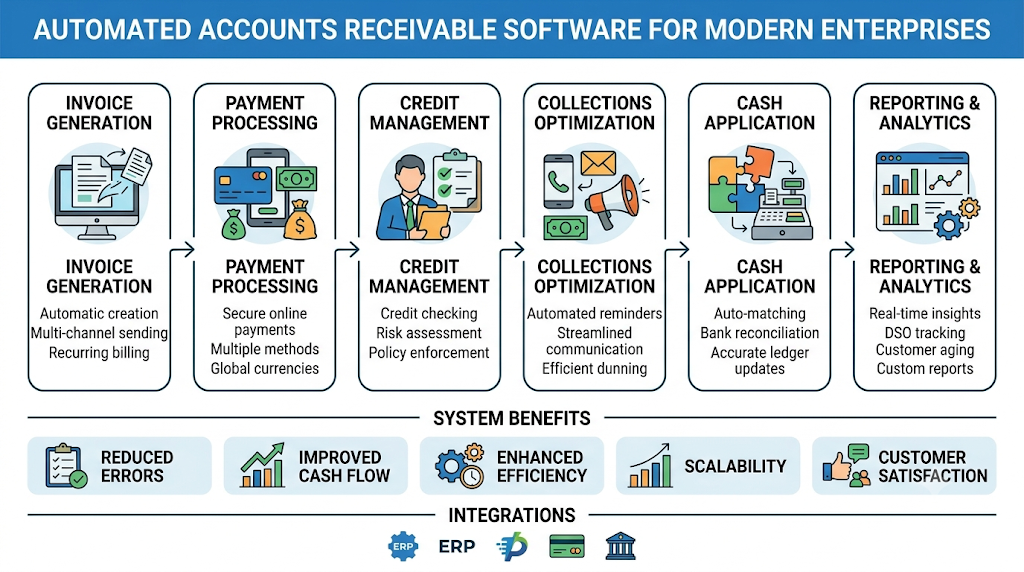
Managing accounts receivable and payment reconciliation remains a persistent operational challenge for growing businesses. Traditional financial operations rely heavily on manual processes, disparate spreadsheets, and disconnected payment gateways. Finance teams spend countless hours issuing individual billing documents, manually verifying incoming settlements, and chasing overdue accounts. These fragmented workflows create operational friction, delay cash realization, and increase human error across the invoice-to-cash cycle. Modern enterprises require robust invoice and payment management software to unify these critical financial functions. Automating the entire receivables lifecycle transforms billing from a reactive administrative burden into an efficient, predictable operational advantage. Centralizing invoice creation, multi-gateway link management, and real-time reconciliation enables finance leaders to maintain total control over cash flow. This comprehensive guide explores how end-to-end payment automation works, why automated reconciliation is vital for enterprise scalability, and how solutions like PayManagerPro help finance teams eliminate manual bottlenecks while maintaining full regulatory compliance.
What is Invoice and Payment Management Software?
An invoice and payment management software is an integrated technology solution designed to orchestrate, automate, and track the entire accounts receivable lifecycle. Rather than treating invoicing, payment processing, and accounting as isolated activities, a dedicated management platform links these workflows into a single system of record.
+-------------------+      +-------------------+      +-------------------+
|  Invoice Creation | ---> |  Payment Link &   | ---> |  Multi-Gateway    |
| & GST Compliance  |      |   Distribution    |      |    Collection     |
+-------------------+      +-------------------+      +-------------------+
                                                                |
+-------------------+      +-------------------+                v
| Real-time Audit & | <--- |   Automated Bank  | <--- +-------------------+
| Financial Reports |      |   Reconciliation  |      | Settlement & AR   |
+-------------------+      +-------------------+      |     Tracking      |
                                                      +-------------------+
Core Architecture and Components
A robust payment management engine relies on several interconnected core components:
- GST-Compliant Invoicing Engine: Generates tax-compliant invoices with unique sequence numbering, correct line-item tax calculations (CGST, SGST, IGST), and mandatory tax identifier fields.
- Multi-Gateway Payment Orchestration: Unifies diverse payment processors into a single management interface, giving customers multiple ways to settle invoices.
- Smart Payment Link Generator: Embeds secure payment links into digital invoices, allowing instant settlements via UPI, credit cards, debit cards, and net banking.
- Automated Reconciliation Module: Matches bank settlements, gateway transaction logs, and outstanding invoices without manual intervention.
- AR Tracking and Aging Analytics: Tracks pending balances, sends automated follow-up reminders, and generates aging schedules to minimize bad debt.
Strategic Business Benefits
Replacing manual ledger management with unified invoice and payment software provides tangible strategic benefits:
- Drastic Reduction in Days Sales Outstanding (DSO): Digital invoices embedded with direct payment options shorten the time between issuing an invoice and receiving funds.
- Elimination of Data Entry Errors: Automated line-item tax calculation and auto-matching eliminate keying errors in general ledgers.
- Complete Financial Visibility: Centralized dashboards give CFOs and finance managers real-time visibility into paid, pending, and overdue balances across all business units.
Why Modern Businesses Need Automated Payment Management
As transaction volumes scale, manual accounting systems inevitably break down. Expanding customer bases lead to exponential growth in line-item transactions across multiple distribution channels. Managing this complexity with manual tools creates operational bottlenecks that hinder growth.
Solving the Cash Flow Bottleneck
Cash flow issues rarely stem from a lack of sales; they are usually caused by delayed collections and poor visibility into receivables. When sales teams issue invoices through detached channels and finance teams track payments via disconnected bank portals, visibility suffers. Decisions are made using outdated financial snapshots, exposing the organization to liquidity shortages.
Automated payment infrastructure provides immediate clarity. Finance leaders can track incoming funds in real time, accurately project cash reserves, and deploy capital with confidence.
Streamlining Operations and Enhancing Customer Experience
Manual reconciliation wastes valuable hours that finance professionals could spend on strategic planning, budgeting, and financial analysis. Automation handles repetitive tasks—such as matching unique transaction references (UTR) to outstanding bills—freeing teams to focus on higher-value initiatives.
Manual Operations:
[Issue Invoice] ---> [Wait] ---> [Manual Follow-up] ---> [Bank Statement Match] ---> [Manual GL Update]

Automated Operations:
[Auto-Invoice + Link] ---> [Instant Digital Payment] ---> [Auto-Reconciliation] ---> [Real-Time Ledger Sync]
At the same time, friction-free payment experiences directly improve client retention. B2B buyers expect the convenience of modern consumer transactions. Offering customizable payment portals, automated receipts, and instant settlement channels makes doing business easy, professional, and reliable.
Key Features of PayManagerPro
PayManagerPro provides an enterprise-grade payment orchestration and receivable platform designed to simplify complex financial workflows.
+-----------------------------------------------------------------------+
|                            PAYMANAGERPRO                              |
+-----------------------------------+-----------------------------------+
| Invoicing & Compliance            | Payment Orchestration             |
| - Custom GST Invoices             | - Multi-Gateway Support           |
| - Consecutive Serial Numbering    | - Dynamic Payment Links           |
| - CGST/SGST/IGST Calculation      | - WhatsApp & Email Delivery       |
+-----------------------------------+-----------------------------------+
| Receivables & Reconciliation      | Enterprise Governance             |
| - Automated Settlement Matching   | - Role-Based Access Control       |
| - Real-Time AR Dashboards         | - Maker-Checker Workflows         |
| - Collection Ageing Analytics     | - Comprehensive Audit Trail       |
+-----------------------------------+-----------------------------------+
Comprehensive GST Invoicing and Serial Tracking
The platform allows teams to quickly create, customize, and issue fully compliant GST invoices. It ensures correct sequential numbering formats to maintain compliance with standard audit practices.
Unified Payment Collection Dashboard
PayManagerPro consolidates multi-channel transactions into a single dashboard. Finance managers no longer need to log into individual gateway accounts to verify incoming funds.
Dynamic Payment Links
Generate dynamic payment links tied directly to individual invoice IDs. Share these links via automated email workflows or instant messaging platforms like WhatsApp to enable fast, single-click client payments.
Seamless Gateway Integrations
Connect leading payment gateway providers—including Razorpay, Cashfree, and Paytm—into a single interface. This flexibility lets clients pay via their preferred methods while keeping your tracking centralized.
Automated Reconciliation and Audit Logs
PayManagerPro matches incoming gateway settlements against outstanding ledger items using intelligent transaction matching. Complete audit logs track every document action, status change, and payment attempt, ensuring enterprise-grade transparency.
Role-Based Approval Workflows
Enterprise governance requires controlled authorization. PayManagerPro supports maker-checker permission hierarchies, ensuring invoice generation, credit notes, and sensitive system settings remain subject to appropriate internal controls.
Navigating GST Invoice Software Standards in India
Maintaining strict tax compliance is essential for Indian businesses. The GST Council sets strict guidelines for invoice generation, tax reporting, and document formats. Non-compliance can lead to heavy penalties, input tax credit (ITC) blockages, and administrative delays.
Understanding Tax Split Rules
Invoicing software must accurately calculate split tax structures based on transaction location:
- Intra-State Transactions: Require an equal split between Central Goods and Services Tax (CGST) and State Goods and Services Tax (SGST).
- Inter-State Transactions: Apply the unified Integrated Goods and Services Tax (IGST).
                      Transaction Origin & Destination
                                    |
            +-----------------------+-----------------------+
            |                                               |
       Same State                                     Different State
            |                                               |
            v                                               v
  Intra-State Transaction                         Inter-State Transaction
            |                                               |
  +---------+---------+                                     |
  |                   |                                     v
  v                   v                              IGST Applied
CGST Applied       SGST Applied                     (Full Tax Rate)
 (Half Rate)        (Half Rate)
Tax structures must be determined dynamically using the customer’s Goods and Services Tax Identification Number (GSTIN) and the designated Place of Supply.
Essential Elements of a Compliant GST Invoice
To withstand regulatory scrutiny from the Income Tax Department and GST authorities, digital billing platforms must capture all required data fields:
- Legally registered business name, address, and GSTIN of both supplier and recipient.
- Unique, consecutive serial number specific to the financial year.
- Official date of issuance and place of supply.
- Harmonized System of Nomenclature (HSN) or Service Accounting Code (SAC).
- Detailed itemization, unit measurements, total taxable value, and applicable tax rates.
- Signature or digital authorization of the supplier.
Platforms like PayManagerPro automate these fields, ensuring compliance across every issued invoice. Learn more on our Reports page.
Intelligent Payment Link Management
Static bank details and manual wire transfers often create friction in B2B transactions. Dynamic payment link management transforms static billing into an interactive collection process.
[Invoice Created] ---> [Dynamic Link Generated] ---> [Shared via Email/WhatsApp]
                                                              |
[Receipt Issued]  <--- [Reconciliation Complete] <--- [Payment Executed]
Multi-Channel Distribution
Finance teams can send dynamic payment links directly to clients via automated email notifications or integrated WhatsApp messaging. Giving clients convenient digital access speeds up payment authorization.
Flexible Collection Rules
- Partial Payments: Configure billing links to accept structured partial installments for large contracts while maintaining clear balance tracking.
- Expiration Controls: Set dynamic expiry dates on payment links to align with short-term quote windows or specific credit terms.
- Real-Time Status Tracking: Monitor when a client receives, opens, and clicks a payment link, giving collection teams clear context for follow-up conversations.
To discover how these tools simplify receivables, visit our dedicated Payment Links feature breakdown.
Streamlining Automated Payment Collections
Providing diverse collection channels is vital for modern B2B settlement workflows. Restricting clients to single payment methods often causes unnecessary delays.
Multi-Mode Payment Acceptance
Integrated payment engines accept a wide range of modern payment methods:
- Unified Payments Interface (UPI): Facilitates instant, low-cost B2B and peer-to-merchant collections via standard UPI apps, supported by regulations from the NPCI.
- Credit and Debit Cards: Accepts major domestic and international card networks for high-value corporate purchases.
- Net Banking and Bank Transfers: Supports direct account-to-account transfers for enterprise clients using established corporate banking channels.
- Digital Wallets: Provides flexible alternative payment channels for modern business operations.
Automated Collection Tracking
Centralized dashboards track collections in real time across all available channels. Every transaction is tied to its originating invoice ID, giving finance teams instant status updates as soon as funds clear.
Comprehensive Invoice Payment Tracking and AR Analytics
Effective accounts receivable management requires proactive tracking. Waiting until the end of the month to review outstanding balances often leads to higher write-offs and extended collection cycles.
       +-------------------------------------------------------+
       |             Outstanding Receivables Dashboard         |
       +-------------------------------------------------------+
                                   |
            +----------------------+----------------------+
            |                                             |
            v                                             v
  [1 - 30 Days Overdue]                         [31 - 60+ Days Overdue]
  - Low Risk                                    - High Risk
  - Automated Friendly Email                    - Escalated Reminder + SMS
  - Direct Payment Link Included                - Account Manager Alerted
Key Metrics for AR Tracking
- Outstanding Invoice Balances: Real-time visibility into open balances across all customer accounts.
- Customer Balance Breakdown: Consolidated view of outstanding liabilities per client to enforce credit limits effectively.
- Collection Aging Analysis: Group receivables into clear aging buckets (0–30 days, 31–60 days, 61–90 days, and 90+ days) to identify at-risk accounts early.
- Automated Reminders: Schedule gentle automated reminders via email and SMS before due dates, and escalate follow-ups for past-due accounts.
Automated Payment Reconciliation
Manual reconciliation is one of the most time-consuming tasks in corporate accounting. Matching settlement files from multiple payment gateways against bank statements and open sales ledgers often leads to operational bottlenecks.
[Gateway Settlement File] ---+
                             |---> [Matching Algorithm] ---> [Auto-Reconciled Ledger]
[Bank Statement Data]    ---+              |
                                           v (Mismatch)
                                 [Exception Queue]
How Automated Reconciliation Works
Modern automated payment reconciliation software replaces manual statement checks with intelligent matching rules:
- Data Ingestion: The platform automatically imports settlement files from payment gateways and transaction data from connected bank accounts.
- Transaction Matching: Advanced algorithms cross-reference UTR numbers, exact transaction values, reference codes, and timestamps against outstanding invoice records.
- Exception Handling: Perfectly matched items are cleared automatically. Any discrepancies—such as unexpected gateway fee deductions or short payments—are flagged for quick human review.
- Audit Trail Generation: Every reconciled transaction maintains a complete, immutable audit record that aligns with standard Accounting Standards and regulatory requirements set by the Reserve Bank of India (RBI).
Enterprise Accounts Receivable Automation
Transitioning from manual billing to automated Accounts Receivable (AR) transforms how finance departments manage working capital.
          +-------------------------------------------------+
          |          Accounts Receivable Automation         |
          +-------------------------------------------------+
                                   |
    +------------------------------+------------------------------+
    |                              |                              |
    v                              v                              v
[Standardized Billing]     [Automated Reminders]        [Real-Time Cash Sync]
- Auto-generate invoices   - Scheduled outreach         - Immediate clearing
- Instant link attachment  - Multi-channel delivery     - Unified dashboard
Complete Workflow Automation
- Automated Invoice Generation: Trigger compliant billing documents automatically upon sales order confirmation or recurring billing cycles.
- Intelligent Reminders: Replace manual collection calls with automated, multi-channel payment reminders.
- Real-time Cash Synchronization: Clear paid items instantly across your accounting software, keeping ledger balances accurate at all times.
The End-to-End Invoice-to-Cash Lifecycle
To maximize operational efficiency, organizations must integrate every phase of the receivables lifecycle into a continuous, automated process.
  +--------------------+      +--------------------+      +--------------------+
  | 1. Invoice         | ---> | 2. Payment Link    | ---> | 3. Multi-Gateway   |
  |    Generation      |      |    Distribution    |      |    Collection      |
  +--------------------+      +--------------------+      +--------------------+
                                                                    |
  +--------------------+      +--------------------+                v
  | 6. Financial       | <--- | 5. Automated Bank  | <--- +--------------------+
  |    Reporting       |      |    Reconciliation  |      | 4. Settlement &    |
  +--------------------+      +--------------------+      |    Clearing        |
                                                          +--------------------+
- Invoice Generation: Generate a compliant invoice with customized line items, correct tax calculations, and a unique tracking code.
- Payment Link Distribution: Deliver the invoice alongside a dynamic payment link directly to the customer’s preferred communication channel.
- Multi-Gateway Collection: The client pays using their preferred payment method (UPI, Card, Net Banking) via a secure payment portal.
- Settlement Processing: The payment gateway processes the funds and transfers the settlement amount to your corporate bank account.
- Automated Reconciliation: Reconcile transaction logs, gateway fees, and bank credits automatically without manual data entry.
- Financial Reporting: Real-time dashboards update executive visibility into revenue, outstanding balances, and cash projections.
Enterprise Payment Management Infrastructure
Large organizations with multi-branch networks, complex corporate structures, and international operations require flexible payment infrastructure.
                       +-------------------------------+
                       |  Enterprise Parent Operations |
                       +-------------------------------+
                                       |
             +-------------------------+-------------------------+
             |                                                   |
             v                                                   v
  [Business Unit / Branch A]                          [Business Unit / Branch B]
  - Independent Gateways                              - Unified Billing Rules
  - Specific User Roles                               - Branch Ledger Isolation
             |                                                   |
             +-------------------------+-------------------------+
                                       |
                                       v
                       +-------------------------------+
                       |  Central Consolidated Analytics|
                       +-------------------------------+
Managing Multi-Branch Operations
Platforms built for scale allow parent entities to oversee financial operations across multiple branches and business units from a single administrative master account:
- Branch-Specific Configuration: Assign dedicated payment gateways, local GST numbers, and custom invoice prefixes to specific regional branches.
- Granular Role-Based Access Control: Define clear permission levels for entry-level staff, accountants, branch managers, and central financial controllers.
- Maker-Checker Authorization: Enforce strict controls requiring secondary approval for sensitive actions like issuing refunds, writing off debt, or editing bill details.
- Enterprise ERP Connectivity: Connect directly with enterprise accounting software and ERP platforms using secure custom endpoints. Learn more on our API documentation page.
Security, Governance, and Regulatory Compliance
Handling financial records and payment workflows requires strict security standards and full regulatory compliance.
Protecting Financial Infrastructure
- Data Encryption and Protection: Ensure all sensitive data remains encrypted at rest and in transit using current cryptographic standards.
- Immutable Audit Logs: Maintain complete, step-by-step audit trails tracking every invoice edit, payment attempt, user access, and configuration update.
- Regulatory Compliance: Design billing practices and financial reporting to align with standards set by the Ministry of Corporate Affairs (MCA) and RBI data security frameworks.
Integration Ecosystem Capabilities
Modern business software does not operate in isolation. Payment platforms must connect easily with existing technical infrastructure.
       +-------------------------------------------------------+
       |                     PayManagerPro                     |
       +-------------------------------------------------------+
                                   |
   +-------------------------------+-------------------------------+
   |                               |                               |
   v                               v                               v
[Payment Gateways]          [Accounting & ERP]                  [CRMs]
- Razorpay                  - Tally Prime                      - Salesforce
- Cashfree                  - Zoho Books                       - HubSpot
- Paytm                     - SAP / Oracle                     - Custom Stacks
Connecting Your Financial Stack
- Payment Gateways: Unify accounts from leading providers like Razorpay, Cashfree, and Paytm into a single administrative view.
- Accounting Software and ERPs: Sync sales data and reconciliation details seamlessly with systems like Tally, Zoho Books, SAP, and Oracle.
- CRM Systems: Enable sales teams to view invoice statuses, issue payment links, and check outstanding client balances directly inside platforms like Salesforce or HubSpot.
Vertical Solutions Across Key Industries
Custom billing requirements vary significantly depending on industry-specific operational demands.
Manufacturing and Distribution
Handle complex multi-line item billing, batch numbering, variable credit terms, and multi-branch tax calculations across distribution networks.
Healthcare Providers
Streamline patient billing, manage co-pay invoicing, automate insurance collection tracking, and handle recurring lab service fees.
Educational Institutions
Automate fee collection, manage recurring installment plans, issue instant tax receipts, and track payment status across large student populations.
Logistics and Supply Chain
Generate dynamic freight bills, track proof-of-delivery settlements, manage multi-stop transport invoicing, and accelerate driver payout matching.
Retail and E-Commerce Merchants
Bridge physical point-of-sale systems with online collections using unified payment link tracking and centralized multi-channel inventory reconciliation.
SaaS and Subscription Platforms
Manage recurring subscription billing, automate collection retry workflows for failed cards, and streamline tier-based usage invoicing.
Professional Services and Agencies
Bill against custom project milestones, issue retainer invoices, track billable hours, and send automated payment links directly within client progress updates.
Manual Processes vs. PayManagerPro
Transitioning from legacy manual systems to automated software drastically improves operational productivity across every billing phase.
| Operational Workflow | Legacy Manual Process | PayManagerPro Platform |
| Invoice Creation | Slow manual entry in spreadsheets; high risk of tax calculation errors. | Instant generation with automated GST templates and line-item checks. |
| Payment Collections | Manual distribution of bank details; reactive outreach for overdue accounts. | Dynamic payment links sent automatically via email and WhatsApp. |
| Payment Reconciliation | Line-by-line manual matching of bank statements with ledger entries. | Intelligent automated matching of settlements, gateway fees, and invoices. |
| Financial Reporting | Delayed end-of-month reporting based on static, disconnected spreadsheets. | Real-time centralized analytics dashboard covering all channels. |
| Operational Error Rate | Frequent keying errors, duplicate invoices, and incorrect tax applications. | Near-zero operational errors through automated validation rules. |
| Processing Time | Days spent every month on manual administrative and reconciliation work. | Real-time processing with automated background reconciliation. |
Core Operational Benefits
Implementing specialized payment management software delivers clear operational improvements for growing enterprise finance teams:
- Accelerated Cash Collections: Embedding clear digital payment links directly into invoices reduces friction and significantly lowers overall DSO.
- Improved Cash Flow Predictability: Real-time visibility into paid, pending, and past-due accounts gives CFOs a reliable view of working capital.
- Lower Operational Costs: Automating repetitive administrative tasks reduces overhead and frees staff to focus on strategic financial planning.
- Virtually Error-Free Ledgers: Automated calculation engines eliminate manual keying errors across tax calculations and ledger updates.
- Enhanced Client Experience: Modern, digital payment options make it easy for customers to review and settle their invoices quickly.
Best Practices for Invoice and Payment Management
To get the most out of your payment automation system, apply these proven operational strategies:
- Standardize Credit Terms Early: Clearly define payment timelines, late-fee structures, and early-settlement discounts directly on all invoice templates.
- Automate Delivery Channels: Send invoices and dynamic payment links immediately upon order completion or milestone approval.
- Set Up Multi-Tier Reminders: Schedule friendly pre-due notifications followed by structured escalations for overdue accounts.
- Reconcile Daily: Run automated reconciliation routines daily to spot discrepancies, short payments, or gateway errors early.
- Enforce Role-Based Permissions: Restrict administrative access to authorized personnel using strict maker-checker controls to ensure governance.
Common Mistakes to Avoid in Accounts Receivable Operations
Avoid these frequent operational mistakes that can delay collections and create accounting discrepancies:
- Relying on Manual Spreadsheet Tracking: Spreadsheets lack real-time synchronization, lack robust audit trails, and introduce keying errors as transaction volumes grow.
- Inconsistent Collection Follow-Ups: Inconsistent reminder schedules increase aging balances and raise the risk of uncollectible bad debt.
- Issuing Duplicate Invoices: Poor tracking can lead to duplicate billing, creating confusion for clients and complicating ledger management.
- Incorrect Tax Calculations: Applying wrong tax rates or missing required GST fields can lead to regulatory penalties and blocked input tax credits.
- Delaying Bank Reconciliation: Waiting until month-end to reconcile accounts makes it much harder to resolve payment mismatches and fee discrepancies.
The Future of Enterprise Payment Infrastructure
Digital billing and collection management continue to evolve rapidly, driven by automation and new financial technologies:
[Traditional Manual Systems]
               │
               ▼
[Automated API Platforms]
               │
               ▼
[Smart Predictive Finance (AI & Embedded Infrastructure)]
- Predictive Analytics: Advanced software models will analyze payment histories to accurately forecast cash flow trends and highlight potential defaults before they happen.
- Intelligent Auto-Matching: Self-learning reconciliation algorithms will match complex multi-line transactions, partial credits, and foreign exchange variances with minimal human oversight.
- Embedded Banking Workflows: Deeper integration between corporate bank accounts, payment gateways, and core accounting software will enable instant, end-to-end payment clearing.
- API-First Architecture: Open financial APIs will allow businesses to build custom, flexible payment workflows that connect seamlessly across their entire technology stack.
Frequently Asked Questions
What is invoice and payment management software?
Invoice and payment management software is a platform designed to automate the entire accounts receivable process. It handles GST-compliant invoice generation, payment link distribution, collection tracking, multi-gateway integration, and bank reconciliation within a single interface.
How does PayManagerPro simplify GST compliance?
PayManagerPro automatically calculates CGST, SGST, and IGST based on customer tax IDs and places of supply. It enforces standardized sequence numbering and captures mandatory tax details to ensure every issued document meets regulatory requirements.
What payment methods can clients use via PayManagerPro?
Clients can settle invoices using various channels, including UPI apps, major credit and debit cards, net banking across domestic institutions, and digital wallets. This flexibility helps accelerate collection times.
How does automated reconciliation handle gateway fees?
The reconciliation engine cross-references gross transaction values, net settlements, and payment gateway fee deductions. It matches incoming funds against outstanding invoice balances and flags discrepancies for fast review.
Can PayManagerPro manage multiple business branches?
Yes. The platform supports enterprise configurations with multiple branches, regional entities, and distinct business units under a master account. Administrators can set branch-specific billing rules, gateways, and role-based access permissions.
How do dynamic payment links accelerate collections?
Dynamic payment links embed invoice IDs, payment details, and exact balances directly into a clickable link. Sharing these links via email or WhatsApp lets clients pay instantly without entering details manually, reducing payment friction.
Does the system support automated payment reminders?
Yes. Users can configure customized reminder schedules that send automated follow-ups via email or SMS before and after due dates, keeping collections moving without manual effort.
Is automated payment management suitable for small businesses?
Yes. While built with enterprise capabilities, the software helps growing businesses eliminate manual bookkeeping, prevent late payments, reduce human error, and build professional billing operations early on.
What accounting software can integrate with payment management platforms?
Platforms like PayManagerPro connect easily with major enterprise ERPs and accounting applications, including Tally Prime, Zoho Books, SAP, and custom internal systems, via secure API endpoints.
How does automating receivables reduce DSO?
Automation reduces Days Sales Outstanding (DSO) by delivering invoices instantly, providing direct digital payment links, sending scheduled follow-up reminders, and clearing paid items automatically upon settlement.
What security measures protect financial data on the platform?
PayManagerPro protects data using end-to-end encryption in transit and at rest, granular role-based access controls, complete system audit logs, and compliance with applicable data privacy frameworks.
Conclusion
Manual invoicing, scattered payment gateways, and slow reconciliation routines create operational bottlenecks that hold growing businesses back. Modern finance teams need integrated technology to maintain visibility, streamline collections, and keep accounts accurate in real time. Adopting an enterprise-grade invoice and payment management software like PayManagerPro streamlines your entire receivables cycle. Unifying GST-compliant invoicing, dynamic payment link sharing, multi-gateway processing, and automated bank reconciliation transforms accounts receivable into a predictable, automated engine that fuels cash flow.