Introduction
Data Labeling & Annotation Platforms are AI data preparation tools that help organizations create high-quality training datasets for machine learning and artificial intelligence models.
AI systems require accurately labeled data to learn patterns, recognize objects, understand language, and make reliable predictions. Data annotation platforms help teams transform raw information such as images, text, audio, video, and documents into structured datasets that can be used for AI model training.
These platforms support different types of AI projects, including:
- Computer vision models
- Natural language processing systems
- Speech recognition applications
- Autonomous systems
- Generative AI models
- Machine learning pipelines
Data Labeling & Annotation Platforms are used by:
- Data scientists
- Machine learning engineers
- AI researchers
- MLOps teams
- Computer vision teams
- Enterprise AI developers
Modern annotation platforms provide capabilities such as:
- Image labeling
- Text annotation
- Video annotation
- Audio transcription
- Data quality management
- Annotation workflows
- Team collaboration
- AI-assisted labeling
- Quality review
- Dataset management
The goal of Data Labeling & Annotation Platforms is to create accurate, consistent, and scalable datasets that improve AI model performance.
What Is Data Labeling?
Data labeling is the process of adding meaningful information or tags to raw data so AI models can understand and learn from it.
Examples:
Image data:
Image → Label: Car, Person, Road
Text data:
Sentence → Label: Positive Sentiment
Audio data:
Voice Recording → Transcription
Video data:
Video → Object Tracking Labels
Labeled data acts as training material for machine learning models.
What Is Data Annotation?
Data annotation is a broader process of adding detailed information to datasets.
It includes:
- Classification
- Object detection
- Segmentation
- Entity recognition
- Sentiment analysis
- Transcription
- Image tagging
Annotation helps AI systems understand complex information.
Why Data Labeling Platforms Matter for AI
AI models depend heavily on training data quality.
Poor-quality datasets can cause:
- Incorrect predictions
- Model bias
- Reduced accuracy
- Poor AI performance
Data labeling platforms help organizations:
- Create reliable datasets
- Improve model accuracy
- Manage annotation teams
- Reduce manual work
- Scale AI development
How Data Labeling & Annotation Platforms Work
Data Collection
Organizations collect:
- Images
- Videos
- Text
- Audio
- Documents
Annotation Setup
Teams define:
- Labels
- Categories
- Rules
- Guidelines
Data Labeling
Annotators add:
- Tags
- Boundaries
- Classifications
- Metadata
Quality Review
The system checks:
- Accuracy
- Consistency
- Errors
Dataset Export
Completed datasets are exported for:
- Machine learning training
- AI model development
Types of Data Annotation
Image Annotation
Used for:
- Object detection
- Image classification
- Segmentation
Examples:
- Cars
- People
- Medical images
Text Annotation
Used for:
- NLP models
- Chatbots
- LLM training
Examples:
- Sentiment labeling
- Entity recognition
Audio Annotation
Used for:
- Speech AI
- Voice assistants
Examples:
- Transcription
- Speaker identification
Video Annotation
Used for:
- Autonomous systems
- Surveillance AI
Examples:
- Object tracking
- Motion analysis
Document Annotation
Used for:
- Document AI
- Information extraction
Examples:
- Forms
- Contracts
- Reports
Key Components of Annotation Platforms
Annotation Tools
Provide:
- Labeling interfaces
- Drawing tools
- Classification options
Workflow Management
Handles:
- Task assignment
- Team collaboration
- Progress tracking
Quality Control
Provides:
- Review systems
- Validation checks
- Accuracy measurement
AI-Assisted Labeling
Uses:
- Machine learning suggestions
- Automated annotation
Dataset Management
Supports:
- Storage
- Versioning
- Organization
Integration APIs
Connects with:
- ML platforms
- Cloud storage
- AI pipelines
Key Features of Data Labeling Platforms
Multi-Data Support
Supports:
- Images
- Text
- Audio
- Video
- Documents
Annotation Automation
Provides:
- AI suggestions
- Auto-labeling
- Assisted workflows
Collaboration Tools
Supports:
- Multiple annotators
- Review teams
- Project managers
Quality Management
Includes:
- Validation
- Consensus checking
- Error detection
Security Controls
Provides:
- Data privacy
- Access control
- Enterprise security
ML Integration
Connects with:
- Training pipelines
- AI platforms
- Cloud environments
Common Use Cases
Computer Vision
Training models for:
- Object detection
- Medical imaging
- Autonomous vehicles
Generative AI Training
Creating:
- Instruction datasets
- Preference datasets
Healthcare AI
Labeling:
- Medical images
- Clinical documents
Autonomous Vehicles
Annotating:
- Road objects
- Traffic scenarios
Customer Service AI
Preparing:
- Chat datasets
- Intent classification data
Financial AI
Processing:
- Documents
- Fraud detection datasets
Benefits of Data Labeling Platforms
Better Model Accuracy
High-quality labels improve AI performance.
Faster AI Development
Automation reduces preparation time.
Scalable Data Operations
Teams can handle large datasets.
Improved Data Quality
Review systems reduce errors.
Better AI Reliability
Accurate datasets create dependable models.
Evaluation Criteria
Annotation Quality
Evaluate:
- Accuracy
- Consistency
- Review workflows
Data Type Support
Check support for:
- Images
- Text
- Audio
- Video
Automation Features
Consider:
- AI-assisted labeling
- Auto annotation
Scalability
Evaluate:
- Large dataset handling
- Team management
Security
Consider:
- Data protection
- Access controls
Integration Support
Check:
- APIs
- ML platforms
- Cloud systems
Key Trends
AI-Assisted Annotation
AI models are helping reduce manual labeling effort.
Human-in-the-Loop Systems
Organizations combine:
- Automation
- Human review
Synthetic Data Generation
Companies are creating artificial training datasets.
LLM Data Annotation
Annotation is becoming important for:
- Instruction tuning
- Preference learning
- AI alignment
Automated Quality Checking
AI is improving annotation validation.
Methodology
The following Data Labeling & Annotation Platforms were evaluated based on:
- Annotation capabilities
- Data support
- AI automation
- Quality control
- Scalability
- Integration
- Security
- Enterprise readiness
- User experience
- Value
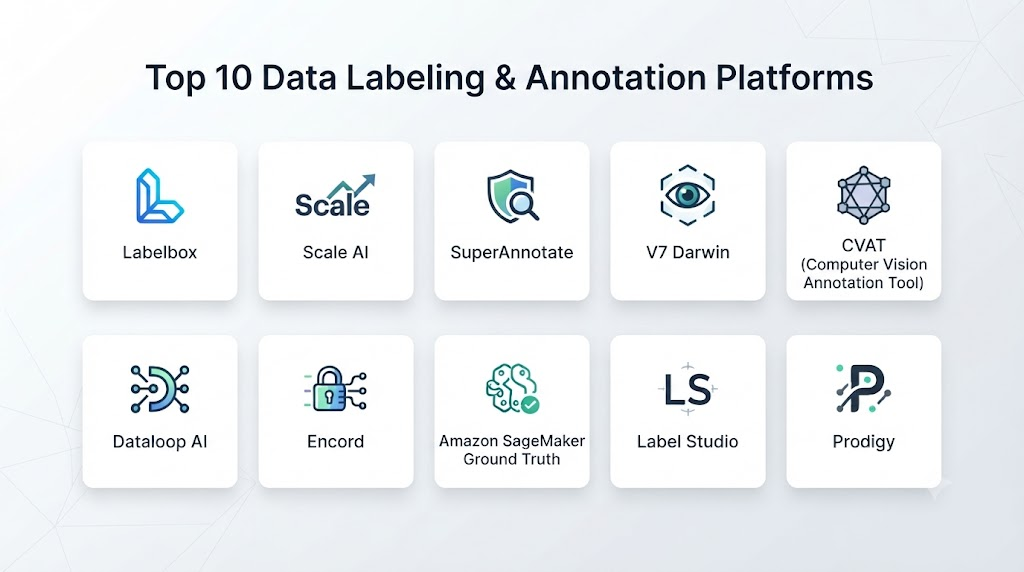
Top 10 Data Labeling & Annotation Platforms
1. Labelbox
Labelbox is an enterprise data labeling platform for building AI training datasets.
Key Features
- Image annotation
- Text labeling
- Video annotation
- AI-assisted labeling
- Dataset management
- Workflow automation
- Quality control
- Model integration
- Collaboration tools
- Enterprise security
Pros
- Enterprise focused
- Strong workflow management
- AI-assisted annotation
- Good integrations
Cons
- Premium pricing
- Requires setup for large projects
2. Scale AI
Scale AI provides managed data labeling services and AI data solutions.
Key Features
- Human annotation services
- Image labeling
- NLP annotation
- Autonomous vehicle data
- Quality management
- AI-assisted labeling
- Enterprise workflows
- Data processing
- Model evaluation
- Dataset creation
Pros
- High-quality annotation
- Enterprise scale
- Managed services
Cons
- Expensive
- Less control compared to self-managed platforms
3. SuperAnnotate
SuperAnnotate provides annotation and AI data management tools.
Key Features
- Image annotation
- Video labeling
- AI-assisted workflows
- Dataset management
- Team collaboration
- Quality control
- Automation
- Analytics
- Model integration
- Enterprise support
Pros
- User-friendly interface
- Strong automation
- Good collaboration
Cons
- Advanced features require paid plans
4. CVAT
CVAT is an open-source computer vision annotation platform.
Key Features
- Image labeling
- Video annotation
- Object tracking
- Segmentation
- Collaboration
- Automation tools
- Computer vision workflows
- Dataset export
- API support
- Open-source deployment
Pros
- Free and open source
- Strong computer vision features
- Flexible
Cons
- Requires technical setup
- Limited enterprise management
5. Label Studio
Label Studio is an open-source data labeling platform.
Key Features
- Multi-type annotation
- Image labeling
- Text annotation
- Audio labeling
- Video labeling
- Custom workflows
- Machine learning integration
- APIs
- Collaboration
- Dataset management
Pros
- Flexible
- Open source
- Supports many data types
Cons
- Requires configuration
- Enterprise features need setup
6. Appen
Appen provides human data annotation services.
Key Features
- Data collection
- Text annotation
- Speech data
- Image labeling
- Search relevance evaluation
- AI training datasets
- Global workforce
- Quality management
- Enterprise services
- Data processing
Pros
- Large annotation workforce
- Global coverage
- Managed services
Cons
- Higher cost
- Less customization
7. Prodigy
Prodigy is an annotation tool designed for machine learning workflows.
Key Features
- Text annotation
- NLP labeling
- Active learning
- Custom workflows
- Model-assisted labeling
- Data management
- Python integration
- ML workflows
- Dataset creation
- Developer tools
Pros
- Developer friendly
- Efficient annotation
- Strong NLP support
Cons
- Technical users required
- Limited enterprise features
8. Amazon SageMaker Ground Truth
Amazon SageMaker Ground Truth provides managed labeling workflows.
Key Features
- Image labeling
- Text annotation
- Automated labeling
- Human review
- AWS integration
- Dataset management
- ML workflow integration
- Security controls
- Quality management
- Enterprise scaling
Pros
- AWS integration
- Scalable
- Enterprise security
Cons
- AWS dependency
- Complex pricing
9. Hive Data Labeling
Hive provides AI data labeling services.
Key Features
- Image annotation
- Video labeling
- Content moderation
- AI training data
- Human review
- Automation
- Data workflows
- Enterprise support
- Quality control
- API integration
Pros
- Managed services
- Fast processing
- Enterprise support
Cons
- Commercial pricing
- Less customization
10. Dataloop
Dataloop provides an AI data management and annotation platform.
Key Features
- Data labeling
- Workflow automation
- Dataset management
- AI-assisted annotation
- Collaboration
- Model integration
- Quality control
- Data pipelines
- Analytics
- Enterprise security
Pros
- Complete AI data platform
- Strong automation
- Enterprise ready
Cons
- Learning curve
- Premium pricing
Comparison Table: Top 10 Data Labeling & Annotation Platforms
| No. | Tool Name | Best For | Platform(s) Supported | Deployment | Standout Feature | Public Rating |
|---|---|---|---|---|---|---|
| 1 | Labelbox | Enterprise AI datasets | Cloud | Managed | AI-assisted labeling | 4.8/5 |
| 2 | Scale AI | Managed annotation services | Cloud | Managed | Human data workforce | 4.7/5 |
| 3 | SuperAnnotate | AI data workflows | Cloud | Managed | Collaboration tools | 4.7/5 |
| 4 | CVAT | Computer vision projects | Local/Cloud | Open Source | Video annotation | 4.6/5 |
| 5 | Label Studio | Flexible annotation | Local/Cloud | Open Source | Multi-data support | 4.6/5 |
| 6 | Appen | Enterprise data services | Cloud | Managed | Global workforce | 4.5/5 |
| 7 | Prodigy | NLP annotation | Local | Paid | Active learning | 4.5/5 |
| 8 | SageMaker Ground Truth | AWS ML workflows | AWS | Managed | AWS integration | 4.5/5 |
| 9 | Hive | Managed labeling | Cloud | Managed | AI data services | 4.4/5 |
| 10 | Dataloop | AI data management | Cloud | Managed | Complete data platform | 4.4/5 |
Weighted Evaluation Table
| No. | Tool Name | Annotation Features 25% | Ease of Use 15% | AI Automation 15% | Security 10% | Scalability 10% | Integration 10% | Value 15% | Total Score |
|---|---|---|---|---|---|---|---|---|---|
| 1 | Labelbox | 25 | 15 | 15 | 10 | 10 | 10 | 14 | 99 |
| 2 | Scale AI | 25 | 14 | 15 | 10 | 10 | 10 | 13 | 97 |
| 3 | SuperAnnotate | 24 | 15 | 15 | 9 | 10 | 10 | 14 | 97 |
| 4 | CVAT | 23 | 13 | 14 | 9 | 10 | 10 | 15 | 94 |
| 5 | Label Studio | 24 | 14 | 14 | 9 | 10 | 10 | 14 | 95 |
| 6 | Appen | 24 | 14 | 13 | 10 | 10 | 10 | 13 | 94 |
| 7 | Prodigy | 23 | 15 | 14 | 9 | 9 | 10 | 14 | 94 |
| 8 | SageMaker Ground Truth | 24 | 13 | 14 | 10 | 10 | 10 | 13 | 94 |
| 9 | Hive | 23 | 14 | 14 | 9 | 10 | 10 | 13 | 93 |
| 10 | Dataloop | 24 | 14 | 15 | 10 | 10 | 10 | 13 | 96 |
Which Data Labeling Platform Is Right for You?
Choose Labelbox for enterprise AI dataset management.
Choose Scale AI for managed annotation services.
Choose SuperAnnotate for collaborative workflows.
Choose CVAT for open-source computer vision projects.
Choose Label Studio for flexible multi-data annotation.
Choose Appen for global annotation services.
Choose Prodigy for NLP-focused annotation.
Choose SageMaker Ground Truth for AWS environments.
Choose Hive for managed AI data services.
Choose Dataloop for complete AI data management.
Implementation Playbook
Phase 1: Define Data Requirements
- Identify AI objectives
- Select data types
- Create labeling guidelines
Phase 2: Setup Annotation Workflow
- Configure labels
- Assign tasks
- Train annotators
Phase 3: Perform Data Labeling
- Annotate datasets
- Review quality
- Correct errors
Phase 4: Validate Dataset
- Measure accuracy
- Remove inconsistencies
- Approve datasets
Phase 5: Integrate With ML Pipeline
- Export datasets
- Train models
- Monitor performance
Common Mistakes
- Poor labeling guidelines
- Inconsistent annotations
- Ignoring quality checks
- Lack of reviewer workflows
- Poor dataset management
- No security controls
FAQs
1. What are Data Labeling & Annotation Platforms?
They are tools used to create labeled datasets for AI model training.
2. Why is data labeling important for AI?
AI models require accurate labeled data to learn effectively.
3. What types of data can be annotated?
Images, text, audio, video, and documents can be labeled.
4. Can AI automate data labeling?
Yes, many platforms provide AI-assisted annotation features.
5. Who uses annotation platforms?
AI engineers, data scientists, and machine learning teams use them.
6. What is human-in-the-loop annotation?
It combines AI automation with human review.
7. Are open-source annotation tools available?
Yes, CVAT and Label Studio provide open-source options.
8. How do annotation platforms improve AI quality?
They create accurate datasets that improve model performance.
9. Can annotation platforms support LLM training?
Yes, they can create instruction and preference datasets.
10. What is the future of data labeling?
AI-assisted annotation and automated quality systems will become more common.
Conclusion
Data Labeling & Annotation Platforms are a critical foundation for building successful AI systems. High-quality labeled datasets improve machine learning accuracy, reduce errors, and help organizations create reliable AI applications.Platforms such as Labelbox, Scale AI, SuperAnnotate, CVAT, Label Studio, and Dataloop provide powerful solutions for managing AI data workflows.As Artificial Intelligence continues expanding into areas like Generative AI, autonomous systems, and enterprise automation, efficient data labeling will remain essential for developing accurate and trustworthy AI models.