Introduction
Large Language Model (LLM) Routing & Model Gateway Platforms are specialized infrastructure layers that sit between applications and one or more LLMs. They intelligently route requests to the most appropriate model or engine based on criteria such as cost, latency, performance, capabilities, and safety policies. These platforms help teams optimize LLM usage while maintaining governance, observability, failover support, and compliance.
As LLM adoption broadens across enterprises, the complexity of managing multiple models across providers, regions, and modalities has grown. Organizations increasingly prioritize cost optimization, latency constraints, regulatory compliance, vendor flexibility, and seamless integration with existing systems. Modern routing gateways enable dynamic model selection, usage metrics, policy enforcement, hybrid deployment support (cloud + on‑prem), and observability — reducing operational risk and increasing reliability.
Real‑world use cases include:
- Dynamically routing customer service queries to cost‑efficient or specialized LLMs.
- Prioritizing region‑specific data processing for privacy or compliance.
- Multi‑provider failover to maintain uptime during service interruptions.
- Splitting workloads by modality (text, code, image) across specialized engines.
- Cost‑based routing to reduce operational spend while maintaining SLAs.
- Centralized governance for safety policies, logging, and auditability.
What to evaluate (Buyer Criteria):
- Model routing logic and policies
- Support for BYO, public, and open‑source models
- Observability, latency & cost metrics
- Guardrails & safety enforcement
- Deployment flexibility (cloud, on‑prem, hybrid)
- Security & admin controls (SSO, RBAC, audit logs)
- Multi‑tenant or role‑based usage
- API/SDK ecosystem and extensibility
- RAG / vector DB integrations
- Cost optimization & model failover
Best for: AI engineers, platform teams, product architects, enterprises with hybrid multi‑LLM deployments, and regulated industries.
Not ideal for: Simple single‑model applications, solo developers with low volumes, or early prototypes that do not require orchestration or governance.
What’s Changed in LLM Routing & Model Gateway Platforms
- Dynamic cost‑based routing across multiple providers.
- Support for multimodal routing (text, image, audio, code).
- Real‑time observability dashboards with token/cost/latency metrics.
- Policy enforcement for guardrails, safety, and prompt filtering.
- Model selection based on context, task type, or user segmentation.
- BYO model hosting and hybrid cloud/on‑prem gateway support.
- Deep integration with RAG and vector‑search pipelines.
- Audit logs, RBAC, multi‑tenant administration.
- Pluggable plugins and extensibility for custom logic.
- Automated failover, redundancy, and fallback rules.
- Enhanced privacy controls (data residency and retention settings).
- Built‑in A/B routing for experimentation and benchmarking.
Quick Buyer Checklist (Scan‑Friendly)
- ✅ Multi‑model routing (hosted, BYO, open‑source)
- ✅ Observability (latency, tokens, cost breakdowns)
- ✅ Safety guardrails and policy enforcement
- ✅ Integrations with CI/CD and DevOps workflows
- ✅ RAG / vector database connectors
- ✅ Admin controls (SSO, RBAC, audit logs)
- ✅ Support for hybrid deployment
- ✅ A/B and canary routing
- ✅ Cost & SLA based policies
- ✅ Multi‑tenant support
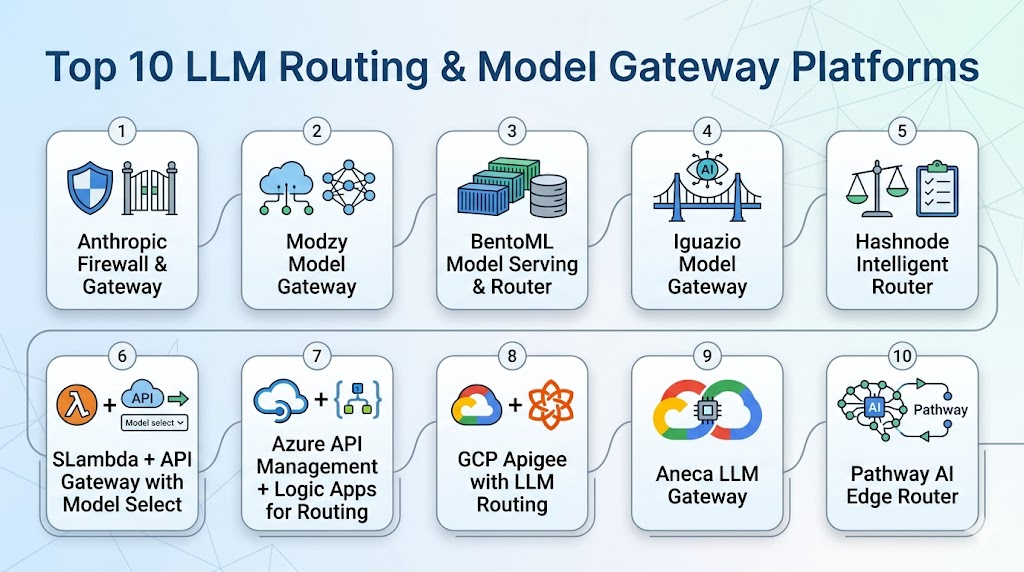
Top 10 LLM Routing & Model Gateway Platforms
#1 — Anthropic Firewall & Gateway
One‑line verdict: Centralized routing & governance platform optimized for Anthropic models and compliance.
Short description: Provides policy‑driven model selection, safety enforcement, and usage metrics tailored for enterprise deployments consuming Anthropic LLMs.
Standout Capabilities
- Model routing based on policies, tasks, or cost
- Safety policy enforcement and prompt filtering
- Token & cost inspection
- Enterprise observability dashboards
- Failover support and redundancy
- Integration with governance workflows
AI‑Specific Depth
- Model support: Hosted Anthropic LLMs
- RAG / knowledge integration: Varies / N/A
- Evaluation: Metrics tracking & policy enforcement
- Guardrails: Safety & prompt policies
- Observability: Detailed latency, token, cost metrics
Pros
- Strong safety policies tailored to Anthropic
- Observability at model & user level
- Enterprise‑friendly controls
Cons
- Limited to Anthropic ecosystem
- Guardrail customization: Varies / N/A
- Not open for all models
Security & Compliance
- Role‑based access controls
- Audit logs
- Enterprise encryption
Deployment & Platforms
- Cloud
Integrations & Ecosystem
- APIs, SDKs
- Governance system hooks
- Dashboard integrations
- DevOps workflows
Pricing Model
- Subscription; Not publicly stated
Best‑Fit Scenarios
- Enterprises standardizing on Anthropic
- Safety and guardrail prioritization
- Regulated usage environments
#2 — Modzy Model Gateway
One‑line verdict: Enterprise gateway for secure routing, observability, and governance across diverse models.
Short description: Model gateway focused on production governance, version control, and secure model delivery with enterprise tracking.
Standout Capabilities
- Centralized routing & versioned models
- Security policies & encryption
- Model usage quotas and monitoring
- RBAC and SSO integration
- Hybrid deployment support
- Token & latency metrics
AI‑Specific Depth
- Model support: BYO, hosted, open‑source
- RAG / knowledge integration: Connectors via API
- Evaluation: Performance & usage monitoring
- Guardrails: Secure policy enforcement
- Observability: Token, cost, latency dashboards
Pros
- Strong enterprise security integration
- Handles hybrid deployments
- Good model governance
Cons
- Complex setup
- UX learning curve
- Guardrails limited to security
Security & Compliance
- SSO, RBAC, audit logs
- Encryption at rest & transit
- Data governance controls
Deployment & Platforms
- Cloud, On‑prem, Hybrid
Integrations & Ecosystem
- API, CLI
- Model registry hooks
- MLOps pipelines
- Monitoring logging systems
Pricing Model
- Not publicly stated
Best‑Fit Scenarios
- Regulated industries
- Multi‑model hybrid routing
- Enterprise governance
#3 — BentoML Model Serving & Router
One‑line verdict: Flexible model serving and routing platform for multi‑framework LLM architecture.
Short description: Open‑architecture platform focusing on model serving, routing, and deployment automation.
Standout Capabilities
- Model routing by task, version, or performance
- Integration with model registries
- Canary/A/B routing
- Deployment orchestration
- Observability hooks
- Extensible plugin architecture
AI‑Specific Depth
- Model support: Open‑source, BYO
- RAG / knowledge integration: Plugin support
- Evaluation: Runtime metrics
- Guardrails: User‑defined logic
- Observability: Latency & throughput analytics
Pros
- Highly customizable
- Strong open‑source ecosystem
- Flexible routing logic
Cons
- Requires developer expertise
- Guardrails non‑opinionated
- Not packaged enterprise
Security & Compliance
- Varies / N/A
Deployment & Platforms
- Cloud, On‑prem, Hybrid
Integrations & Ecosystem
- Python APIs
- CLI tooling
- Model registries
- Deployment pipelines
Pricing Model
- Open‑source + enterprise offerings
Best‑Fit Scenarios
- Developer platforms
- Custom routing logic
- Hybrid multi‑model deployments
#4 — Iguazio Model Gateway
One‑line verdict: Data‑centric LLM gateway blending routing with observability and data governance.
Short description: Bridges models and datasets with real‑time routing, metrics, and governance for regulated workflows.
Standout Capabilities
- Real‑time routing and governance
- Data linkage and lineage
- Multi‑tenant support
- Observability dashboards
- Policy & quota enforcement
- Multi‑model failover
AI‑Specific Depth
- Model support: BYO, hosted models
- RAG / knowledge integration: Vector DB connectors
- Evaluation: Usage & policy metrics
- Guardrails: Policy enforcement
- Observability: Token & latency metrics
Pros
- Strong data governance
- Multi‑tenant controls
- Integrated lineage
Cons
- Complex for small teams
- Enterprise focus
- Pricing: Not public
Security & Compliance
- SSO/RBAC
- Audit logs
- Data resident policies
Deployment & Platforms
- Cloud, On‑prem
Integrations & Ecosystem
- APIs, SDKs
- Governance tools
- Logging systems
- Monitoring dashboards
Pricing Model
- Subscription; Not publicly stated
Best‑Fit Scenarios
- Regulated workflows
- Data‑linked model routing
- Multi‑tenant deployments
#5 — Hashnode Intelligent Router
One‑line verdict: Cost‑aware routing and SLA optimization platform for multi‑LLM infrastructures.
Short description: Focuses on routing decisions based on cost, SLA commitments, model performance, and context.
Standout Capabilities
- SLA‑based model selection
- Cost tracking & optimization
- Multi‑provider routing
- Fallback & redundancy logic
- Observability metrics
- API‑centric orchestration
AI‑Specific Depth
- Model support: BYO, hosted
- RAG / knowledge integration: Varies / N/A
- Evaluation: Performance & cost tracking
- Guardrails: SLA & cost policies
- Observability: Latency & cost dashboards
Pros
- Cost‑centric routing logic
- Redundancy support
- Multi‑provider failover
Cons
- Guardrails limited to cost/SLA rules
- Enterprise controls vary
- On‑prem deployment optional
Security & Compliance
- Varies / N/A
Deployment & Platforms
- Cloud, Hybrid
Integrations & Ecosystem
- API, CLI
- Cloud provider metrics
- Logging dashboards
Pricing Model
- Not publicly stated
Best‑Fit Scenarios
- Cost‑focused teams
- SLA‑critical applications
- Multi‑model routing
#6—- SLambda + API Gateway with Model Select
One‑line verdict: AWS‑native routing with flexible conditional logic and scaling.
Short description: Combines AWS management services to conditionally route to different LLM endpoints with security and scaling.
Standout Capabilities
- Conditional routing via Lambda logic
- Integration with cloud secrets & IAM
- Auto‑scaling
- Token & billing metrics via CloudWatch
- Region‑specific routing
- Fallback logic
AI‑Specific Depth
- Model support: Hosted & BYO via custom endpoints
- RAG / knowledge integration: Connectors via Lambda
- Evaluation: CloudWatch metrics
- Guardrails: Custom rule logic
- Observability: Latency & cost
Pros
- Native cloud scalability
- Full access control
- Customizable pipelines
Cons
- DIY complexity
- Requires AWS expertise
- Guardrails must be built
Security & Compliance
- IAM, VPC controls
- Audit logs
Deployment & Platforms
- Cloud (AWS)
Integrations & Ecosystem
- AWS services
- API management
- Monitoring & logging stacks
Pricing Model
- Usage‑based public cloud charges
Best‑Fit Scenarios
- AWS‑centric teams
- Custom routing needs
- Cloud‑native deployments
#7 — Azure API Management + Logic Apps for Routing
One‑line verdict: Microsoft cloud‑native gateway for policy‑driven LLM routing.
Short description: Uses API management and workflow automation to route LLM requests with access control and governance.
Standout Capabilities
- Policy enforcement via API management
- Workflow routing with Logic Apps
- RBAC & encryption
- Observability via Azure Monitor
- Multi‑provider endpoint support
- SLA tracking
AI‑Specific Depth
- Model support: Hosted/BYO via endpoints
- RAG / knowledge integration: Connectors via Logic Apps
- Evaluation: Azure metrics
- Guardrails: Policy enforcement
- Observability: Latency & usage
Pros
- Enterprise cloud integration
- Policy & access control
- Workflow automation
Cons
- Azure‑centric
- Custom logic required
- Guardrails non‑opinionated
Security & Compliance
- Azure Identity & RBAC
- Audit logs
Deployment & Platforms
- Cloud (Azure)
Integrations & Ecosystem
- API management
- Logic Apps
- Monitor & logging stacks
Pricing Model
- Consumption‑based cloud charges
Best‑Fit Scenarios
- Azure‑focused teams
- Policy‑driven routing
- Enterprise governance
#8 — GCP Apigee with LLM Routing
One‑line verdict: Google Cloud gateway with enterprise policy enforcement and multi‑LLM routing.
Short description: Combines API management, policy enforcement, and orchestration for routing LLM requests.
Standout Capabilities
- Conditional routing via API policies
- Multi‑provider LLM endpoints
- SLA & quota controls
- Observability via Stackdriver
- RBAC & encryption
AI‑Specific Depth
- Model support: Hosted/BYO via endpoints
- RAG / knowledge integration: Through connectors
- Evaluation: Latency & request metrics
- Guardrails: API policy enforcement
- Observability: Latency, usage dashboards
Pros
- Enterprise API management
- Easily extensible
- RBAC & audit logs
Cons
- Cloud provider dependence
- Developer custom logic
- Limited built‑in AI metrics
Security & Compliance
- IAM & audit logs
- Encryption
Deployment & Platforms
- Cloud (GCP)
Integrations & Ecosystem
- Apigee tooling
- Logging & monitoring
- Policy controls
Pricing Model
- Consumption‑based
Best‑Fit Scenarios
- GCP teams
- Policy‑centric routing
- Multi‑LLM orchestration
#9 — Aneca LLM Gateway
One‑line verdict: Flexible model gateway with policy guardrails, observability, and multimodal routing.
Short description: Provides multi‑model routing with guardrail enforcement, cost & latency tracking, and extensibility.
Standout Capabilities
- BYO and hosted model routing
- Policy enforcement
- Token & cost dashboards
- Canary/A/B routing
- REST APIs
- Extensible logic
AI‑Specific Depth
- Model support: BYO/hosted/open‑source
- RAG / knowledge integration: Vector DB connectors
- Evaluation: Observability metrics
- Guardrails: Policy rules
- Observability: Latency & cost
Pros
- Flexible multi‑framework support
- Cost & latency insights
- Extensible
Cons
- Smaller community
- Enterprise packaging varies
- Pricing: Not public
Security & Compliance
- Varies / N/A
Deployment & Platforms
- Cloud, Web, Linux
Integrations & Ecosystem
- Python, APIs, connectors, DevOps hooks
Pricing Model
- Not publicly stated
Best‑Fit Scenarios
- Custom routing logic
- Hybrid model deployments
- Cost‑aware LLM orchestration
#10 — Pathway AI Edge Router
One‑line verdict: Edge‑centric LLM gateway with low‑latency routing and failover for distributed applications.
Short description: Enables intelligent routing at the edge, with low‑latency decisions and service continuity.
Standout Capabilities
- Edge deployment for low latency
- Failover mechanisms
- Conditional routing rules
- Token tracking
- Observability on distributed fleets
- Offline fallback
AI‑Specific Depth
- Model support: Hosted & BYO at edge
- RAG / knowledge integration: Optional via local services
- Evaluation: Local metrics
- Guardrails: Conditional policies
- Observability: Edge telemetry
Pros
- Low‑latency edge routing
- Redundancy and failover
- Distributed observability
Cons
- Edge infrastructure complexity
- Guardrails limited
- Smaller ecosystem
Security & Compliance
- Varies / N/A
Deployment & Platforms
- Edge devices, Cloud, Hybrid
Integrations & Ecosystem
- Local telemetry
- APIs
- Edge orchestration
Pricing Model
- Not publicly stated
Best‑Fit Scenarios
- Edge‑first applications
- Distributed services
- Low‑latency routing
Comparison Table
| Tool Name | Best For | Deployment | Model Flexibility | Strength | Watch‑Out | Public Rating |
|---|---|---|---|---|---|---|
| Anthropic Firewall & Gateway | Anthropic users | Cloud | Hosted | Safety & policies | Anthropic‑only | N/A |
| Modzy Model Gateway | Enterprise governance | Cloud/On‑prem | BYO/Hosted | Security & control | Complex | N/A |
| BentoML Model Serving & Router | Dev platforms | Cloud/Hybrid | BYO/Open‑source | Custom routing | Requires dev expertise | N/A |
| Iguazio Model Gateway | Data‑centric enterprises | Cloud/On‑prem | BYO/Hosted | Data governance | Complex setup | N/A |
| Hashnode Intelligent Router | Cost & SLA routing | Cloud/Hybrid | BYO/Hosted | Cost logic | Limited guardrails | N/A |
| AWS Lambda + API GW | AWS ecosystems | Cloud | Hosted/BYO | Cloud scale | DIY complexity | N/A |
| Azure API Mgmt + Logic Apps | Microsoft ecosystems | Cloud | Hosted/BYO | Policy workflows | Azure‑centric | N/A |
| GCP Apigee with Routing | GCP teams | Cloud | Hosted/BYO | API governance | Cloud dependence | N/A |
| Aneca LLM Gateway | Flexible routing | Cloud/Hybrid | BYO/Hosted/Open | Extensible logic | Smaller community | N/A |
| Pathway AI Edge Router | Edge deployments | Edge/Cloud | BYO/Hosted | Low latency | Edge complexity | N/A |
Scoring & Evaluation
| Tool | Routing Logic | Guardrails | Observability | Integrations | Security/Admin | Ease | Total |
|---|---|---|---|---|---|---|---|
| Anthropic Gateway | 8 | 7 | 8 | 7 | 7 | 7 | 7.4 |
| Modzy Gateway | 7 | 8 | 8 | 8 | 8 | 6 | 7.8 |
| BentoML Router | 7 | 6 | 7 | 7 | 6 | 7 | 6.8 |
| Iguazio Gateway | 8 | 7 | 8 | 8 | 7 | 6 | 7.4 |
| Hashnode Router | 7 | 5 | 7 | 6 | 5 | 7 | 6.3 |
| AWS + API GW | 7 | 6 | 7 | 8 | 8 | 6 | 7.0 |
| Azure API Mgmt | 7 | 7 | 7 | 8 | 8 | 6 | 7.2 |
| GCP Apigee | 7 | 6 | 7 | 8 | 8 | 6 | 7.0 |
| Aneca Gateway | 8 | 7 | 8 | 7 | 6 | 6 | 7.0 |
| Pathway Edge Router | 6 | 5 | 7 | 6 | 5 | 6 | 6.2 |
Top 3 for Enterprise: Modzy Model Gateway, Iguazio Model Gateway, Azure API Management + Logic Apps
Top 3 for Dev / Hybrid: BentoML, Aneca LLM Gateway, AWS Lambda + API Gateway
Top 3 for Edge / Specialized: Pathway AI Edge Router, Hashnode Intelligent Router, GCP Apigee
Which LLM Routing & Model Gateway Platform Is Right for You?
Solo / Freelancer
BentoML or Aneca LLM Gateway for flexible BYO setups and extensible routing.
SMB
AWS Lambda + API Gateway or Hashnode Router for cost‑aware routing without big overhead.
Mid‑Market
Azure API Management or GCP Apigee for established cloud routing with governance.
Enterprise
Modzy Gateway or Iguazio Gateways offer governance, security, and multi‑model control.
Regulated Industries
Modzy Gateway or Iguazio with audit logs, RBAC, and enterprise security.
Cloud‑centric teams
Choose cloud provider native (AWS/Azure/GCP) for integrated scaling.
Hybrid / Edge deployments
Aneca Gateway or Pathway Edge Router for distributed routing across environments.
Implementation Playbook
30 Days
- Select routing platform based on deployment footprint.
- Define routing policies (cost, latency, SLA).
- Setup observability dashboards and token metrics.
60 Days
- Harden guardrails and policy enforcement.
- Integrate RAG connectors and CI/CD hooks.
- Implement failover and redundancy rules.
90 Days
- Automate A/B routing experiments.
- Optimize cost & SLA adherence.
- Formalize governance, audit logs, and on‑prem extension.
Common Mistakes & How to Avoid Them
- Ignoring cost metrics — define cost triggers early.
- Skipping guardrails — always enforce safety policies.
- No observability — track latency, tokens, and usage.
- Hardcoding endpoints — use policy logic instead.
- Vendor lock‑in — maintain abstraction layers.
- Missing failover rules — define redundancy early.
- No SLA routing — codify performance tiers.
- Lack of admin controls — enforce RBAC/SSO early.
- Ignoring regional policies — set data residency rules.
- Neglecting cloud security controls — enable encryption & logs.
FAQs
H3: What is an LLM Routing & Model Gateway Platform?
A middleware that routes requests intelligently to the best LLM based on policies like cost, performance, safety, and SLA.
H3: How is model routing defined?
It’s defined via rules or policies based on task type, cost, latency, or performance.
H3: Can these platforms route BYO models?
Yes, most support BYO, public, and open‑source models.
H3: Do routing platforms help reduce costs?
Yes — by routing requests to cost‑efficient models where possible.
H3: Are guardrails included?
Some have built‑in safety rules; others expose policy frameworks you configure.
H3: Can routing be A/B tested?
Yes — many support canary and A/B routing logic.
H3: How do observability metrics work?
They aggregate tokens, latency, usage, and cost for dashboards and alerts.
H3: What security controls should I expect?
SSO, RBAC, audit logs, encryption, and usage policies.
H3: Are these gateways customizable?
Platforms like BentoML or Aneca offer extensibility; cloud gateways rely on custom code.
H3: Can they be hybrid?
Yes — many support on‑prem and cloud hybrids.
H3: How do I choose the right platform?
Match priorities: governance, cost, cloud preference, observability, and scale.
H3: What’s a common starter configuration?
Start with basic routing by cost and SLA, then add guardrails and observability.
Conclusion
LLM Routing & Model Gateway Platforms are critical as multi‑model deployments grow, enabling cost‑optimized, safe, compliant, and performant orchestration of LLM usage. The right choice depends on organizational maturity, compliance requirements, cloud preferences, and routing complexity. Open‑source gateways like BentoML shine for developers, while enterprise solutions like Modzy and Iguazio deliver governance and observability out of the box.
One aspect that could be explored further is vendor lock-in risk. Many organizations adopt gateway platforms to simplify multi-model access, but over time custom integrations, policies, and workflows can become tightly coupled to a specific platform. Evaluating migration complexity early can be just as important as comparing features and performance.
LLM routing platforms are powerful, but the real challenge is how quickly they adapt when a model suddenly behaves differently after an update. Even small output changes can break downstream workflows.