Introduction
Open-Source Model Hub Platforms are centralized repositories where developers, data scientists, and enterprises can discover, share, and deploy AI models. These platforms simplify AI adoption by providing pre-trained models, version management, and deployment-ready assets. They are crucial for modern AI workflows because they accelerate development, reduce cost, and ensure reproducibility.
Real-world use cases include:
- Rapid prototyping and testing of AI models
- Enterprise AI deployment with compliance controls
- Retrieval-augmented generation (RAG) applications
- Multimodal workflows combining text, image, and audio
- AI research collaboration and reproducibility
- Cost-efficient experimentation and benchmarking
What buyers should evaluate:
- Model variety (NLP, CV, multimodal)
- Licensing and usage constraints
- BYO model support
- RAG and knowledge integration
- Security, compliance, and governance
- Observability and monitoring
- Guardrails against hallucinations and prompt injection
- Deployment flexibility (cloud/self-hosted/hybrid)
- Cost and latency management
- Community support and ecosystem maturity
- Version control and auditability
- Extensibility and APIs
Best for: AI engineers, ML ops teams, research labs, and enterprises needing reproducible open-source models.
Not ideal for: Small businesses without AI expertise, teams requiring fully managed proprietary models, or projects with strict SLA guarantees.
What’s Changed in Open-Source Model Hub Platforms
- Support for agentic workflows with tool-calling and chained reasoning
- Improved multimodal input support for text, images, and audio
- Robust evaluation pipelines for hallucinations and reliability
- Built-in guardrails for safe outputs and prompt injection prevention
- Enterprise privacy controls with data residency and retention
- Cost and latency optimization with model routing and BYO options
- Advanced observability dashboards: token metrics, inference logs, latency
- Flexible deployment: cloud, on-prem, hybrid
- Governance frameworks for audit logs, policy enforcement, compliance
- Greater community collaboration and reproducibility incentives
- On-prem and air-gapped support for sensitive workloads
- Streamlined integration with RAG pipelines and vector databases
Quick Buyer Checklist
- Data privacy and retention policies
- Model choice: hosted, BYO, or open-source
- Compatibility with vector DBs and RAG workflows
- Comprehensive evaluation and testing pipelines
- Guardrails against unsafe outputs
- Latency and cost controls
- Auditability, versioning, and admin features
- Vendor lock-in risk
- Community support and ecosystem maturity
- Deployment flexibility: cloud, self-hosted, hybrid
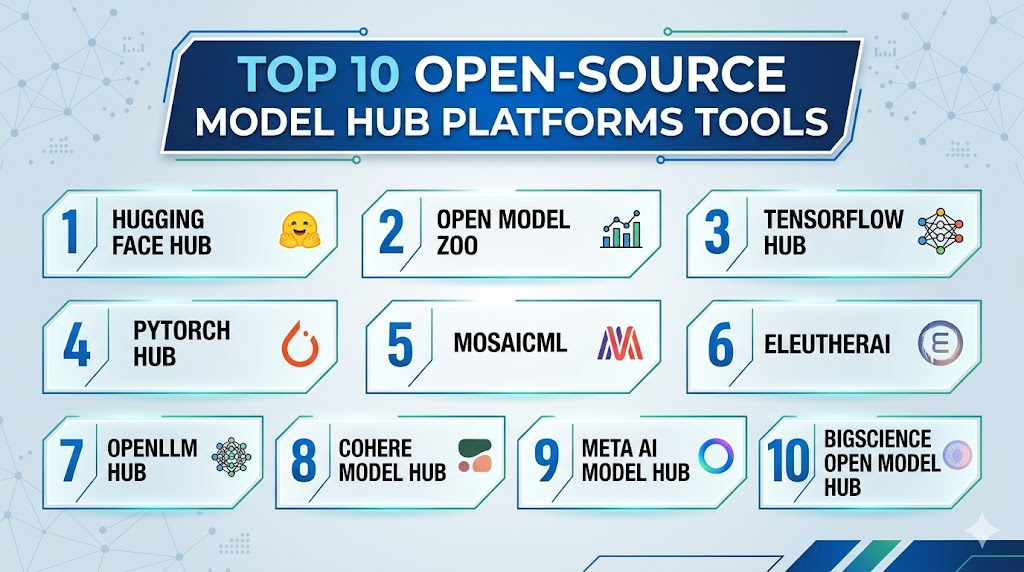
Top 10 Open-Source Model Hub Platforms Tools
1- Hugging Face Hub
One-line verdict: Best for NLP and multimodal projects with extensive community models.
Short description: Offers a large collection of open-source AI models and datasets for researchers and enterprises.
Standout Capabilities
- Extensive NLP, CV, and speech models
- Pre-trained models and fine-tuning pipelines
- Dataset management and versioning
- Multi-framework support (PyTorch, TensorFlow, JAX)
- Deployment via inference API and Spaces
- Hub Actions for workflow automation
- Community model cards
AI-Specific Depth
- Model support: Open-source / BYO
- RAG / knowledge integration: Vector DB compatible
- Evaluation: Benchmarks, community metrics
- Guardrails: Model cards, guidelines
- Observability: Token usage, inference logs
Pros
- Huge community support
- Easy discovery and deployment
- Multimodal model support
Cons
- Enterprise governance requires extra tooling
- Advanced features may need subscription
- Large model downloads require infrastructure
Deployment & Platforms
- Web, Linux, Windows, macOS
- Cloud / Hybrid / Self-hosted
Integrations & Ecosystem
- APIs, SDKs, Spaces, GitHub
- TensorFlow, PyTorch, ONNX
- MLflow connectors
- Docker support
Pricing Model
Open-source hub with optional enterprise tier
Best-Fit Scenarios
- Academic NLP research
- Rapid prototyping
- Multimodal AI projects
2- Open Model Zoo
One-line verdict: Optimized for computer vision tasks on edge and cloud.
Short description: Provides pre-trained CV models with deployment-ready pipelines for inference.
Standout Capabilities
- Optimized for Intel hardware
- CV models: classification, detection, segmentation
- Edge and cloud inference
- Pre- and post-processing tools
- Versioning and reproducibility
- Benchmarking metrics
AI-Specific Depth
- Model support: Open-source / BYO
- RAG / knowledge integration: N/A
- Evaluation: Benchmarking and test datasets
- Guardrails: N/A
- Observability: Inference performance metrics
Pros
- Optimized for edge AI
- Reliable CV benchmarking
- Open-source flexibility
Cons
- Limited NLP/multimodal support
- Smaller community
- Less documentation
Deployment & Platforms
- Linux, Windows, macOS
- Edge / Cloud / On-prem
Integrations & Ecosystem
- OpenVINO, TensorRT, ONNX
- Python scripts, CLI tools
- Containerized deployment
Pricing Model
Open-source
Best-Fit Scenarios
- Real-time CV applications
- Edge AI projects
- Model benchmarking
3- TensorFlow Hub
One-line verdict: Ideal for TensorFlow developers using pre-trained models for multiple domains.
Short description: Central repository for TensorFlow models supporting transfer learning and fine-tuning.
Standout Capabilities
- Pre-trained TensorFlow models
- Transfer learning pipelines
- Multi-task and multimodal models
- Dataset integration
- Community-contributed modules
AI-Specific Depth
- Model support: TensorFlow / Open-source
- RAG / knowledge integration: N/A
- Evaluation: Benchmark datasets, sample evaluation
- Guardrails: Varies / N/A
- Observability: Latency, model profiling
Pros
- Seamless TensorFlow integration
- Extensive model selection
- Easy fine-tuning
Cons
- Limited to TensorFlow
- Smaller community
- Less edge optimization
Deployment & Platforms
- Linux, Windows, macOS
- Cloud / Hybrid / On-prem
Integrations & Ecosystem
- TensorFlow Extended, Lite, Serving
- Python API, Keras
- Model optimization tools
Pricing Model
Open-source
Best-Fit Scenarios
- TensorFlow-based projects
- Transfer learning tasks
- Audio and image processing
4- PyTorch Hub
One-line verdict: Developer-first platform for research and production-ready PyTorch models.
Short description: Curated repository of PyTorch models with emphasis on research reproducibility.
Standout Capabilities
- Wide CV, NLP, generative models
- Versioned releases
- TorchServe integration
- Research-to-production workflows
AI-Specific Depth
- Model support: Open-source / PyTorch
- RAG / knowledge integration: N/A
- Evaluation: Benchmarks, regression tests
- Guardrails: Varies / N/A
- Observability: Token metrics, profiling
Pros
- Research-friendly
- Flexible fine-tuning
- PyTorch ecosystem
Cons
- Limited framework support
- Enterprise governance minimal
- Smaller community
Deployment & Platforms
- Linux, Windows, macOS
- Cloud / Hybrid / On-prem
Integrations & Ecosystem
- TorchServe, ONNX export
- Python API, CI/CD pipelines
Pricing Model
Open-source
Best-Fit Scenarios
- Research prototypes
- Generative AI experiments
- PyTorch production pipelines
5- MosaicML
One-line verdict: Enterprise-oriented hub for LLMs and efficient training workflows.
Short description: Provides pre-trained large language models with fine-tuning pipelines for scalable deployments.
Standout Capabilities
- Pre-trained LLMs
- Parameter-efficient fine-tuning
- Multimodal support
- Reproducible checkpoints
- Enterprise monitoring
AI-Specific Depth
- Model support: Open-source / BYO / Multi-model
- RAG / knowledge integration: Vector DB compatible
- Evaluation: Benchmarks, regression testing
- Guardrails: Safety checks
- Observability: Token metrics, latency
Pros
- Enterprise-ready LLMs
- Efficient fine-tuning
- Multimodal support
Cons
- Smaller community
- Limited non-ML framework support
- Some features enterprise-only
Deployment & Platforms
- Linux, Windows, macOS
- Cloud / On-prem / Hybrid
Integrations & Ecosystem
- APIs, Python SDKs, vector DBs, Kubeflow
Pricing Model
Open-source + enterprise tier
Best-Fit Scenarios
- LLM deployment
- Enterprise pipelines
- Multimodal projects
6- EleutherAI
One-line verdict: Research-first hub for GPT-style open LLMs for experimentation.
Short description: Democratizes access to LLMs with open checkpoints for fine-tuning and research.
Standout Capabilities
- Open GPT-style LLMs
- Fine-tuning pipelines
- Community evaluation
- Reproducible checkpoints
AI-Specific Depth
- Model support: Open-source LLMs
- RAG / knowledge integration: N/A
- Evaluation: Benchmarks, human review
- Guardrails: Varies / N/A
- Observability: Token metrics
Pros
- Fully open-source
- Ideal for research
- Transparent architecture
Cons
- Not enterprise-ready
- Minimal deployment support
- Smaller ecosystem
Deployment & Platforms
- Linux, macOS
- Cloud / On-prem
Integrations & Ecosystem
- Python API
- Hugging Face compatible
- Community datasets
Pricing Model
Open-source
Best-Fit Scenarios
- Research experiments
- Academic projects
- LLM fine-tuning
7- OpenLLM Hub
One-line verdict: Enterprise LLM hosting with versioning and monitoring for open models.
Short description: Manages LLMs with monitoring, versioning, and scalable deployment options.
Standout Capabilities
- LLM hosting and management
- Model versioning and rollback
- Monitoring dashboards
- BYO model support
- Fine-tuning pipelines
AI-Specific Depth
- Model support: Open-source / BYO / Multi-model
- RAG / knowledge integration: Vector DB compatible
- Evaluation: Benchmark pipelines
- Guardrails: Prompt injection detection
- Observability: Token/cost metrics
Pros
- Enterprise-ready
- Versioning and monitoring
- BYO model support
Cons
- Smaller community
- Limited multimodal support
- Documentation growing
Deployment & Platforms
- Linux, Windows
- Cloud / On-prem / Hybrid
Integrations & Ecosystem
- REST API, Python SDK, vector DB connectors
Pricing Model
Open-source + enterprise tier
Best-Fit Scenarios
- Enterprise LLM deployment
- BYO model projects
- AI research labs
8- Cohere Model Hub
One-line verdict: Developer-first LLM hub with API support and open model options.
Short description: Hosted and fine-tunable LLMs with APIs for research and production.
Standout Capabilities
- Hosted and fine-tunable LLMs
- API-first design
- Multilingual support
- Integrated evaluation metrics
- Guardrails for safety
AI-Specific Depth
- Model support: Hosted / Open-source / BYO
- RAG / knowledge integration: Vector DB connectors
- Evaluation: Benchmarks and regression tests
- Guardrails: Policy enforcement
- Observability: Token metrics, latency
Pros
- Flexible deployment
- Strong developer APIs
- Enterprise support
Cons
- Smaller open-source variety
- Some paid features
- Limited edge deployment
Deployment & Platforms
- Linux, macOS, Windows
- Cloud / Hybrid
Integrations & Ecosystem
- Python / REST APIs, RAG connectors
- Fine-tuning SDKs
- CI/CD pipelines
Pricing Model
Usage-based / tiered
Best-Fit Scenarios
- Developer applications
- Multilingual LLM projects
- Hybrid research & enterprise
9- Meta AI Model Hub
One-line verdict: Research labs seeking cutting-edge LLMs and multimodal models.
Short description: Offers open-source models from Meta with reproducibility and multimodal support.
Standout Capabilities
- Large LLMs and multimodal models
- Versioned research-grade checkpoints
- Community-driven evaluation
AI-Specific Depth
- Model support: Open-source / BYO
- RAG / knowledge integration: N/A
- Evaluation: Benchmarks, human review
- Guardrails: Varies / N/A
- Observability: Varies / N/A
Pros
- Cutting-edge research models
- Multimodal support
- Transparent reproducibility
Cons
- Not enterprise-ready
- Smaller deployment ecosystem
- Limited guardrails
Deployment & Platforms
- Linux, macOS
- Cloud / On-prem / Hybrid
Integrations & Ecosystem
- Python scripts, MLflow pipelines
Pricing Model
Open-source
Best-Fit Scenarios
- Academic research
- Multimodal AI projects
- LLM experimentation
10- BigScience Open Model Hub
One-line verdict: Community-driven LLM hub for collaborative research and multilingual models.
Short description: Collaborative platform providing open-source LLMs with transparent documentation and reproducibility.
Standout Capabilities
- Large community contributions
- Multilingual LLMs
- Versioned checkpoints and fine-tuning scripts
- Benchmarking tools and evaluation pipelines
AI-Specific Depth
- Model support: Open-source / BYO
- RAG / knowledge integration: N/A
- Evaluation: Benchmark datasets, community evaluation
- Guardrails: Varies / N/A
- Observability: Varies / N/A
Pros
- Fully open and collaborative
- Multilingual support
- Transparent reproducibility
Cons
- Minimal enterprise deployment
- Smaller tooling ecosystem
- No edge support
Deployment & Platforms
- Linux, macOS
- Cloud / On-prem / Hybrid
Integrations & Ecosystem
- Python SDKs
- Benchmark datasets
- Community pipelines
Pricing Model
Open-source
Best-Fit Scenarios
- Academic LLM research
- Collaborative AI projects
- Multilingual experimentation
Comparison Table (Top 10)
| Tool Name | Best For | Deployment | Model Flexibility | Strength | Watch-Out | Public Rating |
|---|---|---|---|---|---|---|
| Hugging Face Hub | NLP & multimodal | Cloud/Hybrid/Self-hosted | Open-source / BYO | Huge model catalog | Enterprise governance requires extra | N/A |
| Open Model Zoo | CV & edge AI | Edge/Cloud/On-prem | Open-source | Optimized CV models | Limited NLP support | N/A |
| TensorFlow Hub | TensorFlow devs | Cloud/Hybrid/On-prem | TensorFlow / Open-source | Pre-trained & transfer learning | Framework-limited | N/A |
| PyTorch Hub | PyTorch devs | Cloud/On-prem/Hybrid | PyTorch / Open-source | Research flexibility | Limited framework support | N/A |
| MosaicML | Enterprise LLM | Cloud/On-prem/Hybrid | Open-source / BYO / Multi-model | Efficient LLM fine-tuning | Smaller community | N/A |
| EleutherAI | LLM research | Cloud/On-prem | Open-source | Fully open & transparent | Not enterprise-ready | N/A |
| OpenLLM | Enterprise LLM | Cloud/On-prem/Hybrid | Open-source / BYO / Multi-model | Versioning & monitoring | Smaller community | N/A |
| Cohere | Developer LLM | Cloud/Hybrid | Hosted / Open-source / BYO | API-first, multilingual | Limited open-source variety | N/A |
| Meta AI | Research labs | Cloud/On-prem/Hybrid | Open-source / BYO | Cutting-edge models | Not enterprise-ready | N/A |
| BigScience | Collaborative research | Cloud/On-prem/Hybrid | Open-source / BYO | Community-driven, multilingual | Enterprise features minimal | N/A |
Conclusion
Open-Source Model Hub Platforms provide flexible, reproducible, and scalable AI solutions for developers, researchers, and enterprises. The choice depends on deployment needs, framework compatibility, guardrails, and enterprise governance. Prioritize the hub that fits your use case, whether it is research, enterprise deployment, or experimentation.
