Introduction
Private LLM Hosting (Air-Gapped) Platforms are specialized artificial intelligence infrastructure solutions that allow organizations to deploy, operate, and manage large language models (LLMs) within isolated private environments without relying on public cloud services or external network connections.
As enterprises adopt generative AI for sensitive workloads, concerns around data privacy, security, compliance, and intellectual property protection have increased. Private LLM hosting platforms provide organizations with complete control over AI models, infrastructure, data processing, and access management.
Air-gapped AI environments are designed for scenarios where systems must operate separately from public networks. These environments are commonly used by organizations handling highly sensitive information, including:
- Government agencies
- Defense organizations
- Financial institutions
- Healthcare providers
- Research organizations
- Large enterprises
Private LLM Hosting Platforms help organizations:
- Run AI models inside private infrastructure
- Keep sensitive data within controlled environments
- Reduce dependency on external AI providers
- Maintain compliance requirements
- Protect confidential information
- Customize AI models for internal use
- Deploy AI applications securely
These platforms support:
- Open-source LLM deployment
- Private model serving
- Local inference
- Secure AI workflows
- Model fine-tuning
- Enterprise AI applications
- Offline AI operations
The goal of Private LLM Hosting (Air-Gapped) Platforms is to provide secure, controlled, and reliable AI capabilities while maintaining maximum data privacy and operational independence.
What Is Private LLM Hosting?
Private LLM Hosting means deploying and running large language models within an organization’s own infrastructure instead of using public AI APIs.
Unlike public AI services, private hosting provides:
- Complete data ownership
- Infrastructure control
- Custom security policies
- Internal model management
- Private AI operations
Organizations can deploy LLMs on:
- Private data centers
- On-premise servers
- Dedicated cloud environments
- Secure government networks
- Isolated enterprise environments
What Is an Air-Gapped AI Environment?
An air-gapped environment is a computer system that is physically or logically isolated from external networks.
Air-gapped AI systems provide:
- No public internet access
- Controlled data movement
- Restricted external communication
- Strong security boundaries
These environments are used when organizations require maximum protection against:
- Data leakage
- Cyber attacks
- Unauthorized access
- External dependencies
How Private LLM Hosting Platforms Work
Model Deployment
Organizations deploy AI models inside private infrastructure.
Models may include:
- Llama-based models
- Mistral models
- Falcon models
- Custom enterprise models
- Domain-specific LLMs
Infrastructure Management
Platforms manage:
- GPUs
- Storage
- Networking
- Compute resources
- Model environments
Secure Inference
Applications communicate with privately hosted models through internal APIs.
Examples:
- Enterprise chat assistants
- Document analysis systems
- Internal knowledge assistants
Model Optimization
Organizations optimize models using:
- Quantization
- Fine-tuning
- Retrieval-Augmented Generation (RAG)
- Performance tuning
Monitoring and Governance
Platforms track:
- Usage
- Access
- Performance
- Security events
Key Capabilities of Private LLM Hosting Platforms
Local Model Deployment
Allows organizations to run models inside private infrastructure.
Benefits:
- Data control
- Privacy protection
- Customization
Offline AI Operations
Supports AI workloads without external connectivity.
Benefits:
- Secure environments
- Regulatory compliance
- Reduced external risk
Enterprise Security Controls
Provides:
- Authentication
- Authorization
- Encryption
- Access management
Model Management
Supports:
- Version control
- Updates
- Deployment workflows
AI Application Integration
Enables integration with:
- Internal applications
- Enterprise databases
- Business workflows
Common Use Cases
Government and Defense AI
Used for:
- Intelligence analysis
- Secure document processing
- Mission applications
Healthcare AI
Supports:
- Patient data analysis
- Medical research
- Clinical documentation
Financial Services
Used for:
- Risk analysis
- Fraud detection
- Compliance automation
Legal Organizations
Supports:
- Document review
- Contract analysis
- Research assistance
Enterprise Knowledge Systems
Used for:
- Internal search
- Employee assistants
- Knowledge management
Research Institutions
Supports:
- Private AI experiments
- Sensitive research workloads
Why Private LLM Hosting Platforms Matter
Data Privacy
Sensitive information remains inside controlled infrastructure.
Regulatory Compliance
Organizations can meet strict compliance requirements.
AI Customization
Businesses can customize models for specific needs.
Reduced Vendor Dependency
Organizations maintain control over AI operations.
Enhanced Security
Private deployment reduces external exposure.
Evaluation Criteria for Buyers
Security Features
Platforms should provide:
- Encryption
- Identity management
- Access controls
- Audit logging
Deployment Options
Important support includes:
- On-premise deployment
- Private cloud
- Offline environments
- Hybrid infrastructure
Model Compatibility
Platforms should support:
- Open-source LLMs
- Custom models
- Enterprise AI workloads
Hardware Support
Important compatibility includes:
- NVIDIA GPUs
- Enterprise servers
- AI accelerators
Management Capabilities
Important features include:
- Model lifecycle management
- Monitoring
- Deployment automation
Integration Support
Platforms should integrate with:
- Enterprise applications
- Databases
- Security systems
Key Trends
Growth of Private AI
Organizations are moving toward controlled AI environments.
Enterprise Open-Source LLM Adoption
Companies are deploying open models for customization.
AI Security Expansion
Security-focused AI infrastructure is becoming essential.
Sovereign AI Development
Governments and enterprises are building independent AI capabilities.
Edge and Offline AI
More organizations require AI systems without internet dependency.
Hybrid AI Infrastructure
Businesses are combining private and cloud AI environments.
Methodology
The following Private LLM Hosting Platforms were evaluated based on:
- Air-gapped deployment capability
- Security features
- Model support
- Infrastructure flexibility
- Enterprise readiness
- Performance
- Scalability
- Management capabilities
- Integration options
- Value
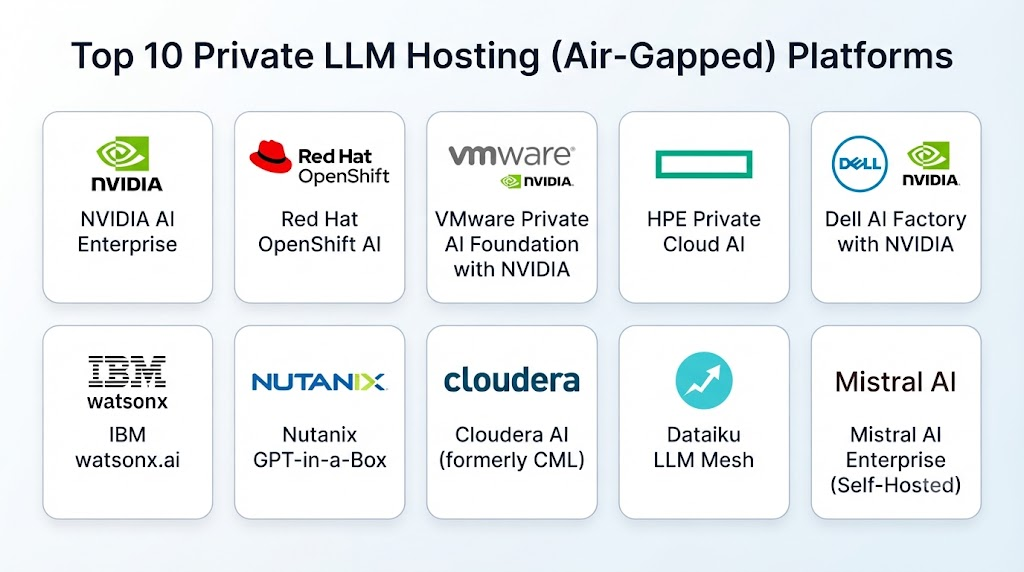
Top 10 Private LLM Hosting (Air-Gapped) Platforms
1. NVIDIA AI Enterprise
NVIDIA AI Enterprise provides an enterprise AI software platform for deploying and managing AI workloads securely.
Key Features
- Private AI deployment
- LLM inference
- GPU acceleration
- Model optimization
- Enterprise security
- AI workload management
- Production deployment
- Model serving
- Infrastructure integration
- Performance optimization
Pros
- Excellent GPU performance
- Enterprise-ready
- Strong AI ecosystem
- High scalability
- Optimized inference
Cons
- NVIDIA hardware dependency
- Higher infrastructure cost
- Requires specialized expertise
Platforms
On-premise, private cloud, and enterprise environments.
Deployment or Support
Enterprise deployment.
Security & Compliance
Supports secure AI infrastructure.
Integrations & Ecosystem
NVIDIA GPUs, enterprise systems, and AI frameworks.
Support & Community
Enterprise support.
2. Red Hat OpenShift AI
Red Hat OpenShift AI provides an enterprise platform for managing AI development and deployment.
Key Features
- Kubernetes-based AI platform
- Model deployment
- Machine learning workflows
- Private infrastructure support
- Security controls
- Model lifecycle management
- AI application integration
- Enterprise governance
- Hybrid cloud support
- Automation
Pros
- Enterprise Kubernetes support
- Strong security
- Hybrid cloud capability
- Flexible deployment
- Open ecosystem
Cons
- Complex setup
- Requires Kubernetes expertise
- Enterprise licensing
Platforms
Private cloud and on-premise environments.
Deployment or Support
Enterprise deployment.
Security & Compliance
Strong enterprise security.
Integrations & Ecosystem
Kubernetes, cloud platforms, and AI frameworks.
Support & Community
Enterprise support.
3. VMware Private AI Foundation
VMware provides infrastructure for deploying private AI workloads.
Key Features
- Private AI infrastructure
- Secure model deployment
- Enterprise virtualization
- GPU management
- AI workload support
- Data privacy controls
- Hybrid cloud support
- Model management
- Infrastructure automation
- Enterprise integration
Pros
- Strong enterprise infrastructure
- Good virtualization support
- Secure deployment
- Hybrid capability
- Enterprise adoption
Cons
- Requires VMware expertise
- Infrastructure cost
- Complex deployment
Platforms
Private cloud and data centers.
Deployment or Support
Enterprise deployment.
Security & Compliance
Enterprise security features.
Integrations & Ecosystem
VMware infrastructure and enterprise systems.
Support & Community
Enterprise support.
4. IBM watsonx.ai
IBM watsonx.ai provides enterprise AI development and deployment capabilities.
Key Features
- Foundation model support
- Private AI deployment
- Model governance
- AI lifecycle management
- Enterprise security
- Model customization
- Data integration
- Monitoring
- AI workflows
- Compliance support
Pros
- Strong enterprise governance
- Security-focused
- Good compliance support
- Enterprise AI capabilities
- Flexible deployment
Cons
- Complex platform
- Enterprise-focused pricing
- Requires expertise
Platforms
Cloud and private environments.
Deployment or Support
Enterprise deployment.
Security & Compliance
Strong governance capabilities.
Integrations & Ecosystem
IBM ecosystem and enterprise systems.
Support & Community
Enterprise support.
5. Dell AI Factory
Dell AI Factory provides infrastructure solutions for enterprise AI deployment.
Key Features
- Private AI infrastructure
- GPU servers
- AI workload management
- Model deployment
- Data security
- Enterprise hardware
- AI optimization
- Secure environments
- Deployment support
- Infrastructure management
Pros
- Strong hardware support
- Enterprise-ready
- Secure infrastructure
- Scalable deployment
- Data center integration
Cons
- Hardware dependency
- Infrastructure investment
- Requires expertise
Platforms
On-premise and private cloud.
Deployment or Support
Enterprise deployment.
Security & Compliance
Supports enterprise security.
Integrations & Ecosystem
Dell infrastructure and AI technologies.
Support & Community
Enterprise support.
6. HPE Machine Learning Development Environment
HPE provides AI infrastructure and machine learning deployment solutions.
Key Features
- ML development workflows
- Private AI deployment
- Model management
- Enterprise infrastructure
- Secure environments
- AI workload optimization
- Collaboration tools
- Resource management
- Deployment automation
- Monitoring
Pros
- Enterprise infrastructure
- Secure deployment
- Strong hardware ecosystem
- Scalable systems
- Private AI support
Cons
- Enterprise complexity
- Infrastructure cost
- Requires expertise
Platforms
On-premise and private environments.
Deployment or Support
Enterprise deployment.
Security & Compliance
Enterprise security support.
Integrations & Ecosystem
HPE systems and AI frameworks.
Support & Community
Enterprise support.
7. Kubernetes + KServe
KServe provides Kubernetes-native model serving for private AI deployments.
Key Features
- Private model serving
- Kubernetes integration
- Auto scaling
- API endpoints
- Model versioning
- Cloud-native deployment
- Multi-framework support
- Resource management
- Monitoring
- Enterprise workflows
Pros
- Open-source
- Highly flexible
- Cloud-native
- Supports private deployment
- Scalable
Cons
- Requires Kubernetes expertise
- Complex management
- Infrastructure responsibility
Platforms
Kubernetes environments.
Deployment or Support
Private and enterprise deployment.
Security & Compliance
Depends on Kubernetes security configuration.
Integrations & Ecosystem
Kubernetes and ML frameworks.
Support & Community
Open-source community.
8. OpenLLM
OpenLLM provides tools for running open-source language models in private environments.
Key Features
- Local LLM deployment
- Model serving
- API support
- Open-source models
- Developer workflows
- Private inference
- Model management
- Deployment tools
- Customization
- Integration support
Pros
- Open-source
- Flexible deployment
- Developer-friendly
- Supports private AI
- Cost-effective
Cons
- Requires technical skills
- Infrastructure management needed
- Limited enterprise features
Platforms
Local and private environments.
Deployment or Support
Self-hosted deployment.
Security & Compliance
Depends on deployment setup.
Integrations & Ecosystem
Open-source AI frameworks.
Support & Community
Developer community.
9. vLLM
vLLM is an open-source inference engine designed for efficient LLM serving.
Key Features
- Fast LLM inference
- Private deployment
- GPU optimization
- API compatibility
- High throughput serving
- Memory optimization
- Model support
- Production serving
- Developer tools
- Open-source architecture
Pros
- High performance
- Efficient inference
- Open-source
- Strong LLM support
- Developer adoption
Cons
- Requires infrastructure knowledge
- Limited management features
- Technical deployment needed
Platforms
Private cloud and local environments.
Deployment or Support
Self-hosted deployment.
Security & Compliance
Depends on infrastructure.
Integrations & Ecosystem
LLM frameworks and AI applications.
Support & Community
Open-source community.
10. Ollama Enterprise Deployment
Ollama enables local execution of open-source language models.
Key Features
- Local LLM hosting
- Private inference
- Model management
- Simple deployment
- API access
- Offline operation
- Developer workflows
- Model downloads
- Local testing
- AI experimentation
Pros
- Easy setup
- Local privacy
- Developer-friendly
- Lightweight
- Good experimentation
Cons
- Limited enterprise management
- Hardware limitations
- Requires deployment planning
Platforms
Local machines and private environments.
Deployment or Support
Self-hosted deployment.
Security & Compliance
Supports private execution.
Integrations & Ecosystem
Open-source models and AI applications.
Support & Community
Developer community.
Comparison Table
| Tool Name | Best For | Platform(s) Supported | Deployment | Standout Feature | Public Rating |
|---|---|---|---|---|---|
| NVIDIA AI Enterprise | Enterprise AI | Private Cloud | Enterprise | GPU optimization | |
| Red Hat OpenShift AI | Hybrid AI | On-premise/Cloud | Enterprise | Kubernetes AI | |
| VMware Private AI | Enterprise infrastructure | Data Center | Enterprise | Virtualized AI | |
| IBM watsonx.ai | Governed AI | Cloud/Private | Enterprise | AI governance | |
| Dell AI Factory | AI hardware | On-premise | Enterprise | Infrastructure | |
| HPE ML Environment | Enterprise ML | Private Cloud | Enterprise | Secure ML | |
| Kubernetes + KServe | Cloud-native AI | Kubernetes | Flexible | Open-source serving | |
| OpenLLM | Local LLMs | Local | Self-hosted | Private deployment | |
| vLLM | LLM inference | Private Cloud | Self-hosted | High throughput | |
| Ollama | Local AI | Local | Self-hosted | Simple deployment |
Weighted Evaluation
| Tool Name | Core Features 25% | Ease of Use 15% | Integrations & Ecosystem 15% | Security & Compliance 10% | Performance & Reliability 10% | Support & Community 10% | Price/Value 15% | Total |
|---|---|---|---|---|---|---|---|---|
| NVIDIA AI Enterprise | 25 | 12 | 15 | 10 | 10 | 10 | 12 | 94 |
| OpenShift AI | 24 | 12 | 15 | 10 | 10 | 10 | 13 | 94 |
| VMware Private AI | 24 | 12 | 14 | 10 | 10 | 10 | 12 | 92 |
| IBM watsonx.ai | 24 | 13 | 14 | 10 | 10 | 10 | 12 | 93 |
| Dell AI Factory | 23 | 12 | 14 | 10 | 10 | 10 | 12 | 91 |
| HPE ML Environment | 23 | 12 | 14 | 10 | 10 | 10 | 12 | 91 |
| Kubernetes + KServe | 24 | 11 | 15 | 10 | 10 | 10 | 15 | 95 |
| OpenLLM | 22 | 14 | 14 | 10 | 10 | 10 | 15 | 95 |
| vLLM | 24 | 13 | 15 | 10 | 10 | 10 | 15 | 97 |
| Ollama | 21 | 15 | 13 | 10 | 10 | 10 | 15 | 94 |
Which Private LLM Hosting Platform Is Right for You?
Choose NVIDIA AI Enterprise for enterprise GPU-based AI deployments.
Choose Red Hat OpenShift AI for Kubernetes-based enterprise AI.
Choose VMware Private AI Foundation for virtualized infrastructure.
Choose IBM watsonx.ai for AI governance and compliance.
Choose Dell AI Factory for private AI hardware infrastructure.
Choose HPE ML Environment for enterprise ML operations.
Choose Kubernetes + KServe for flexible cloud-native deployment.
Choose OpenLLM for private open-source LLM hosting.
Choose vLLM for high-performance LLM inference.
Choose Ollama for simple local AI deployment.
Implementation Playbook
Phase 1: Define Security Requirements
- Identify sensitive workloads
- Determine compliance needs
- Define network isolation requirements
- Select deployment model
Phase 2: Prepare Infrastructure
- Configure servers
- Install GPUs
- Setup storage
- Configure networking
Phase 3: Deploy Models
- Select LLMs
- Optimize models
- Configure inference
- Test performance
Phase 4: Secure Deployment
- Configure access control
- Enable monitoring
- Apply security policies
- Audit usage
Phase 5: Maintain AI Platform
- Update models
- Monitor performance
- Manage resources
- Improve security
Common Mistakes
- Choosing unsuitable hardware
- Ignoring security planning
- Poor resource management
- Lack of monitoring
- Not optimizing models
- Ignoring compliance needs
- Poor access control
- Underestimating infrastructure costs
FAQs
1. What is Private LLM Hosting?
Private LLM Hosting means running large language models inside an organization’s own controlled infrastructure.
2. What is an air-gapped AI environment?
An air-gapped AI environment is isolated from external networks for maximum security.
3. Why use private LLM hosting?
It protects sensitive data and provides greater control over AI operations.
4. Who needs air-gapped AI platforms?
Government, defense, healthcare, finance, and security-focused organizations use them.
5. Can private LLMs work without internet access?
Yes. Air-gapped systems are designed for offline AI operations.
6. Are private LLM platforms expensive?
Costs depend on hardware, infrastructure, and deployment requirements.
7. Can organizations customize private LLMs?
Yes. Models can be fine-tuned and adapted for specific business needs.
8. What hardware is needed for private LLM hosting?
Organizations typically use GPU servers and enterprise infrastructure.
9. Are private LLMs more secure than public APIs?
They provide greater control over data and infrastructure.
10. What is the future of private AI hosting?
Private AI hosting will continue growing as organizations prioritize security, compliance, and AI independence.
Conclusion
Private LLM Hosting (Air-Gapped) Platforms are becoming essential for organizations that require secure, controlled, and privacy-focused artificial intelligence solutions.Platforms such as NVIDIA AI Enterprise, Red Hat OpenShift AI, IBM watsonx.ai, Kubernetes + KServe, OpenLLM, vLLM, and Ollama provide powerful options for deploying AI models in private environments.As enterprises, governments, and regulated industries continue adopting generative AI, private LLM infrastructure will play a critical role in enabling secure, scalable, and trustworthy AI operations.