Introduction
Model Quantization Tooling provides artificial intelligence frameworks and optimization platforms that reduce the size and computational requirements of machine learning models by converting model parameters from higher precision formats into lower precision representations.
Modern AI models, especially large language models (LLMs), computer vision models, and deep learning networks, require significant memory and computing resources. Running these models efficiently on mobile devices, edge systems, and cost-sensitive cloud environments can be challenging.
Model quantization solves this problem by reducing numerical precision while maintaining acceptable model accuracy. For example, models using 32-bit floating-point numbers can be converted into smaller formats such as 16-bit or 8-bit representations.
Quantization helps organizations:
- Reduce model size
- Improve inference speed
- Lower memory consumption
- Reduce hardware requirements
- Enable edge AI deployment
- Improve energy efficiency
- Reduce AI infrastructure costs
Model Quantization Tooling is used by:
- Machine learning engineers
- AI researchers
- Enterprise AI teams
- Mobile developers
- Edge computing companies
- Cloud architects
- Robotics developers
- Data scientists
Modern quantization platforms support:
- Post-training quantization
- Quantization-aware training
- Weight compression
- LLM optimization
- Hardware acceleration
- Model conversion
- Performance benchmarking
- Deployment optimization
The goal of model quantization tooling is to make powerful AI models faster, smaller, and easier to deploy across different environments.
How Model Quantization Works
Original Model Representation
AI models normally use high-precision formats such as:
- FP32 (32-bit floating point)
- FP16 (16-bit floating point)
These formats provide accuracy but require more memory.
Precision Reduction
Quantization converts model values into lower precision formats such as:
- INT8
- INT4
- FP8
This reduces storage and computation requirements.
Calibration
The system analyzes model behavior and determines optimal conversion settings.
Calibration helps maintain:
- Accuracy
- Stability
- Performance
Quantized Inference
The optimized model performs inference using reduced precision operations.
Benefits include:
- Faster responses
- Lower memory usage
- Reduced power consumption
Deployment
Quantized models can run on:
- Mobile devices
- Edge hardware
- GPUs
- CPUs
- Embedded systems
Types of Model Quantization
Post-Training Quantization (PTQ)
PTQ converts an already trained model into a lower precision version.
Advantages:
- Faster implementation
- No retraining required
- Lower development cost
Challenges:
- Possible accuracy reduction
Quantization-Aware Training (QAT)
QAT simulates quantization during training.
Advantages:
- Better accuracy retention
- Improved model performance
Challenges:
- Requires additional training
Dynamic Quantization
Weights are quantized while some operations remain dynamic.
Commonly used for:
- NLP models
- Transformer models
Static Quantization
Uses calibration data before deployment.
Commonly used for:
- Computer vision
- Edge applications
Common Use Cases
Large Language Models
Quantization helps deploy LLMs with:
- Lower memory requirements
- Faster inference
- Reduced hardware costs
Mobile AI Applications
Developers use quantization for:
- Mobile assistants
- Translation apps
- Voice applications
Edge AI Systems
Organizations deploy optimized models on:
- IoT devices
- Industrial systems
- Embedded hardware
Computer Vision
Quantized models support:
- Object detection
- Image classification
- Video analytics
Enterprise AI
Businesses optimize models for:
- Lower cloud costs
- Faster applications
- Scalable deployment
Robotics
Efficient models improve:
- Real-time decisions
- Autonomous operations
Why Model Quantization Tooling Matters
Reduced Infrastructure Costs
Smaller models require fewer computing resources.
Faster AI Applications
Lower precision operations improve inference speed.
Better Hardware Utilization
Models can run effectively on limited hardware.
Energy Efficiency
Reduced computation lowers power consumption.
Wider AI Accessibility
More devices can support advanced AI capabilities.
Evaluation Criteria for Buyers
Quantization Support
Platforms should support:
- INT8 quantization
- INT4 quantization
- FP16 optimization
- Mixed precision
Model Compatibility
Important support includes:
- LLMs
- Vision models
- Neural networks
- Transformer models
Accuracy Preservation
Organizations should evaluate:
- Performance after quantization
- Accuracy impact
- Calibration methods
Hardware Support
Important compatibility includes:
- CPUs
- GPUs
- NPUs
- Edge accelerators
Developer Experience
Platforms should provide:
- APIs
- Documentation
- Conversion tools
- Testing workflows
Deployment Options
Important capabilities include:
- Cloud deployment
- Edge deployment
- Mobile deployment
Key Trends
LLM Quantization Growth
Large language models are increasingly optimized using:
- INT8
- INT4
- FP8
Edge AI Expansion
Quantization is enabling AI deployment on smaller devices.
Hardware-Specific Optimization
Platforms are creating specialized quantization methods for:
- GPUs
- CPUs
- AI chips
Efficient Generative AI
Organizations are reducing the cost of running generative AI systems.
Low-Power AI
Quantization supports energy-efficient AI applications.
Automated Optimization
AI platforms are simplifying model compression workflows.
Methodology
The following platforms were evaluated based on:
- Quantization capabilities
- Model support
- Hardware compatibility
- Accuracy preservation
- Developer experience
- Performance optimization
- Deployment flexibility
- Community support
- Enterprise readiness
- Value
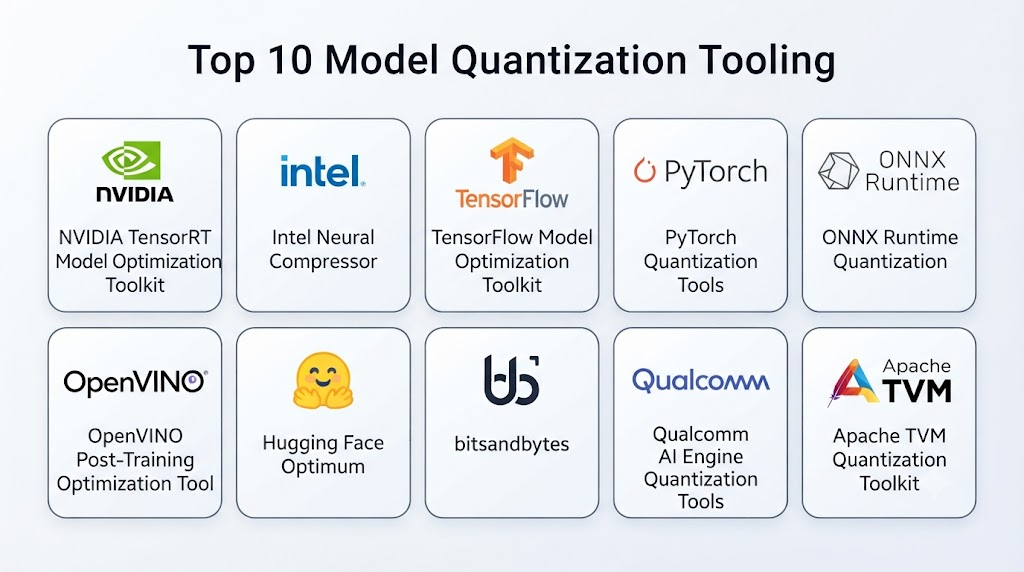
Top 10 Model Quantization Tooling
1. NVIDIA TensorRT Model Optimization Toolkit
NVIDIA TensorRT provides advanced optimization tools for improving AI inference performance through quantization and acceleration.
Key Features
- INT8 quantization
- FP8 optimization
- LLM quantization
- Model compression
- GPU acceleration
- Calibration tools
- Inference optimization
- Performance benchmarking
- Deployment support
- Hardware optimization
Pros
- Excellent GPU performance
- Enterprise-ready
- High inference speed
- Strong LLM support
- Production-focused
Cons
- Requires NVIDIA hardware
- Technical expertise needed
- Limited cross-platform usage
Platforms
GPU, cloud, and edge environments.
Deployment or Support
Enterprise deployment.
Security & Compliance
Supports enterprise AI deployment practices.
Integrations & Ecosystem
NVIDIA GPUs, AI frameworks, cloud platforms, and enterprise systems.
Support & Community
Enterprise support.
2. Intel Neural Compressor
Intel Neural Compressor provides automated model optimization and quantization capabilities.
Key Features
- INT8 quantization
- Accuracy-aware tuning
- Model compression
- Calibration
- Framework support
- Hardware optimization
- Benchmarking
- Automated workflows
- Deployment optimization
- Performance analysis
Pros
- Strong CPU optimization
- Enterprise-ready
- Automated workflows
- Framework flexibility
- Good accuracy control
Cons
- Intel-focused
- Requires configuration
- Technical knowledge needed
Platforms
Cloud, desktop, and edge environments.
Deployment or Support
Local and enterprise deployment.
Security & Compliance
Supports enterprise deployment requirements.
Integrations & Ecosystem
Intel hardware, AI frameworks, and deployment tools.
Support & Community
Developer and enterprise support.
3. TensorFlow Model Optimization Toolkit
TensorFlow Model Optimization Toolkit provides quantization and compression tools for TensorFlow models.
Key Features
- Quantization-aware training
- Post-training quantization
- Pruning
- Model optimization
- Mobile deployment
- Edge AI support
- Performance tuning
- TensorFlow integration
- Developer tools
- Model conversion
Pros
- Strong TensorFlow ecosystem
- Good documentation
- Mobile support
- Mature framework
- Easy integration
Cons
- TensorFlow dependency
- Limited framework flexibility
- Advanced optimization requires expertise
Platforms
Cloud, mobile, and edge environments.
Deployment or Support
Flexible deployment.
Security & Compliance
Supports secure model deployment.
Integrations & Ecosystem
TensorFlow ecosystem, mobile applications, and AI tools.
Support & Community
Large developer community.
4. PyTorch Quantization Tools
PyTorch provides flexible quantization capabilities for deep learning models.
Key Features
- Dynamic quantization
- Static quantization
- Quantization-aware training
- Model optimization
- Transformer support
- Custom workflows
- Research flexibility
- Deployment tools
- Performance testing
- Developer libraries
Pros
- Highly flexible
- Strong research adoption
- Large community
- Good customization
- Supports modern AI models
Cons
- Requires coding expertise
- Manual optimization needed
- Configuration complexity
Platforms
Cloud and local environments.
Deployment or Support
Flexible deployment.
Security & Compliance
Depends on implementation.
Integrations & Ecosystem
PyTorch ecosystem, AI frameworks, and research tools.
Support & Community
Large developer community.
5. ONNX Runtime Quantization
ONNX Runtime provides quantization tools for optimizing AI models across different hardware platforms.
Key Features
- Dynamic quantization
- Static quantization
- Model conversion
- Hardware acceleration
- Cross-platform inference
- Performance optimization
- Transformer support
- Model evaluation
- Deployment tools
- Developer APIs
Pros
- Broad hardware support
- Enterprise-friendly
- Flexible deployment
- Good optimization
- Open ecosystem
Cons
- Requires ONNX knowledge
- Conversion complexity
- Technical setup needed
Platforms
Cloud, edge, desktop, and mobile environments.
Deployment or Support
Local and enterprise deployment.
Security & Compliance
Supports secure local inference.
Integrations & Ecosystem
AI frameworks, hardware platforms, and enterprise applications.
Support & Community
Open-source and enterprise support.
6. OpenVINO Post-Training Optimization Tool
OpenVINO provides optimization tools for efficient AI deployment on Intel hardware.
Key Features
- INT8 quantization
- Model conversion
- Calibration
- Performance optimization
- Edge deployment
- Hardware acceleration
- AI inference optimization
- Benchmarking
- Deployment tools
- Model management
Pros
- Strong edge AI support
- Intel optimization
- Good performance
- Enterprise-ready
- Flexible deployment
Cons
- Intel-focused
- Requires optimization knowledge
- Hardware dependency
Platforms
Edge, desktop, and enterprise systems.
Deployment or Support
Local and enterprise deployment.
Security & Compliance
Supports secure AI deployment.
Integrations & Ecosystem
Intel hardware, AI frameworks, and edge platforms.
Support & Community
Developer community.
7. Hugging Face Optimum
Hugging Face Optimum provides optimization tools for transformer models.
Key Features
- Quantization support
- Hardware optimization
- Transformer acceleration
- Model conversion
- Inference optimization
- ONNX integration
- LLM optimization
- Deployment support
- Benchmarking
- Developer tools
Pros
- Strong transformer ecosystem
- Easy integration
- Large community
- Supports many models
- Good documentation
Cons
- Requires AI knowledge
- Hardware optimization varies
- Advanced tuning needed
Platforms
Cloud and local environments.
Deployment or Support
Flexible deployment.
Security & Compliance
Depends on implementation.
Integrations & Ecosystem
Hugging Face models, frameworks, and AI tools.
Support & Community
Large developer community.
8. bitsandbytes
bitsandbytes provides efficient low-bit quantization capabilities for large language models.
Key Features
- 8-bit quantization
- 4-bit quantization
- LLM optimization
- Memory reduction
- GPU acceleration
- Transformer integration
- Efficient inference
- Model loading optimization
- Developer tools
- Open-source library
Pros
- Excellent LLM support
- Reduces memory usage
- Easy integration
- Popular in AI community
- Efficient inference
Cons
- GPU dependency
- Limited enterprise management
- Technical setup required
Platforms
GPU-based environments.
Deployment or Support
Local and cloud deployment.
Security & Compliance
Depends on implementation.
Integrations & Ecosystem
Transformer models, AI frameworks, and LLM applications.
Support & Community
Open-source community.
9. Qualcomm AI Engine Quantization Tools
Qualcomm provides quantization and optimization tools for mobile and edge AI devices.
Key Features
- Mobile model optimization
- Quantization
- Neural processing support
- Hardware acceleration
- Power efficiency
- Edge deployment
- Model conversion
- Performance analysis
- AI application support
- Device optimization
Pros
- Strong mobile optimization
- Power efficient
- Hardware acceleration
- Edge AI support
- Good performance
Cons
- Qualcomm hardware dependency
- Specialized knowledge needed
- Limited ecosystem
Platforms
Mobile and edge devices.
Deployment or Support
Local deployment.
Security & Compliance
Supports device-level AI processing.
Integrations & Ecosystem
Qualcomm hardware, mobile platforms, and AI frameworks.
Support & Community
Developer support.
10. Apache TVM Quantization Toolkit
Apache TVM provides machine learning compilation and optimization tools.
Key Features
- Quantization
- Model compilation
- Hardware optimization
- Edge deployment
- Performance tuning
- Multiple hardware support
- AI runtime support
- Developer tools
- Research workflows
- Custom optimization
Pros
- Highly flexible
- Broad hardware support
- Research-friendly
- Open-source
- Advanced optimization
Cons
- Requires expertise
- Complex setup
- Developer-focused
Platforms
Cloud, edge, and embedded systems.
Deployment or Support
Flexible deployment.
Security & Compliance
Supports local execution.
Integrations & Ecosystem
AI frameworks, hardware platforms, and research tools.
Support & Community
Open-source community.
Comparison Table
| Tool Name | Best For | Platform(s) Supported | Deployment | Standout Feature | Public Rating |
|---|---|---|---|---|---|
| NVIDIA TensorRT Optimization | GPU AI acceleration | NVIDIA Hardware | Enterprise | High-performance quantization | N/A |
| Intel Neural Compressor | CPU optimization | Multi-platform | Enterprise | Automated tuning | N/A |
| TensorFlow Optimization | TensorFlow models | Cloud/Mobile | Flexible | QAT support | N/A |
| PyTorch Quantization | Research workflows | Cloud/Local | Flexible | Custom control | N/A |
| ONNX Runtime Quantization | Cross-platform AI | Multi-platform | Flexible | Hardware flexibility | N/A |
| OpenVINO Optimization | Edge AI | Intel Platforms | Local | INT8 optimization | N/A |
| Hugging Face Optimum | Transformer models | Cloud/Local | Flexible | LLM optimization | N/A |
| bitsandbytes | LLM compression | GPU | Local/Cloud | 4-bit quantization | N/A |
| Qualcomm Quantization Tools | Mobile AI | Qualcomm Devices | Local | Power efficiency | N/A |
| Apache TVM | AI compilation | Multi-platform | Flexible | Hardware optimization | N/A |
Weighted Evaluation
| Tool Name | Core Features 25% | Ease of Use 15% | Integrations & Ecosystem 15% | Security & Compliance 10% | Performance & Reliability 10% | Support & Community 10% | Price/Value 15% | Total |
|---|---|---|---|---|---|---|---|---|
| NVIDIA TensorRT | 25 | 12 | 14 | 10 | 10 | 10 | 11 | 92 |
| Intel Neural Compressor | 24 | 13 | 14 | 10 | 10 | 10 | 13 | 94 |
| TensorFlow Optimization | 23 | 14 | 15 | 10 | 10 | 10 | 14 | 96 |
| PyTorch Quantization | 24 | 13 | 15 | 10 | 10 | 10 | 14 | 96 |
| ONNX Runtime Quantization | 24 | 13 | 15 | 10 | 10 | 10 | 14 | 96 |
| OpenVINO Optimization | 23 | 13 | 14 | 10 | 10 | 10 | 13 | 93 |
| Hugging Face Optimum | 23 | 14 | 15 | 10 | 10 | 10 | 14 | 96 |
| bitsandbytes | 23 | 14 | 14 | 10 | 10 | 10 | 15 | 96 |
| Qualcomm Tools | 22 | 12 | 13 | 10 | 10 | 10 | 12 | 89 |
| Apache TVM | 23 | 11 | 14 | 10 | 10 | 10 | 13 | 91 |
Which Model Quantization Tooling Is Right for You?
Choose NVIDIA TensorRT Optimization when GPU performance is critical.
Choose Intel Neural Compressor for CPU and enterprise optimization.
Choose TensorFlow Model Optimization Toolkit for TensorFlow applications.
Choose PyTorch Quantization Tools for research and custom AI workflows.
Choose ONNX Runtime Quantization for cross-platform deployment.
Choose OpenVINO Optimization Toolkit for edge AI applications.
Choose Hugging Face Optimum for transformer and LLM optimization.
Choose bitsandbytes for efficient LLM quantization.
Choose Qualcomm AI Engine Tools for mobile AI optimization.
Choose Apache TVM for advanced hardware optimization.
Implementation Playbook
Phase 1: Analyze Model Requirements
- Measure current model size
- Identify deployment limitations
- Define performance goals
- Select quantization strategy
Phase 2: Prepare Model
- Select quantization method
- Collect calibration data
- Configure optimization settings
- Test compatibility
Phase 3: Apply Quantization
- Convert model precision
- Validate accuracy
- Benchmark performance
- Optimize parameters
Phase 4: Deploy Optimized Model
- Export model
- Integrate runtime
- Test hardware performance
- Monitor inference
Phase 5: Maintain Performance
- Track accuracy
- Update models
- Improve optimization
- Monitor resource usage
Common Mistakes
- Quantizing without accuracy testing
- Using incorrect precision levels
- Ignoring hardware compatibility
- Skipping calibration
- Poor benchmarking
- Optimizing too aggressively
- Ignoring deployment requirements
- Not monitoring model quality
FAQs
1. What is model quantization?
Model quantization is the process of reducing model precision to make AI models smaller and faster.
2. Why use quantization?
Quantization improves inference speed, reduces memory usage, and lowers deployment costs.
3. Does quantization reduce AI accuracy?
Some accuracy loss can occur, but advanced methods minimize the impact.
4. What is INT8 quantization?
INT8 quantization represents model values using 8-bit integer formats.
5. Can LLMs be quantized?
Yes. Many large language models use 8-bit and 4-bit quantization.
6. Who uses quantization tools?
AI developers, enterprises, researchers, and edge computing teams use them.
7. What is quantization-aware training?
It is a training method that prepares models for quantized deployment.
8. Is quantization useful for edge devices?
Yes. It enables AI models to run efficiently on smaller hardware.
9. How do organizations choose quantization tools?
They evaluate model support, hardware compatibility, accuracy, and performance.
10. What is the future of model quantization?
Quantization will continue growing as AI models become larger and organizations need efficient deployment.
Conclusion
Model Quantization Tooling is becoming essential for deploying modern AI systems efficiently. By reducing model size and computational requirements, quantization enables faster, cheaper, and more accessible AI applications.Platforms such as NVIDIA TensorRT, Intel Neural Compressor, TensorFlow Model Optimization, PyTorch Quantization, ONNX Runtime, Hugging Face Optimum, and bitsandbytes provide powerful solutions for optimizing AI models.As AI continues expanding across cloud, mobile, and edge environments, model quantization will remain a key technology for building efficient, scalable, and practical artificial intelligence systems.