Introduction
LLM Data Leakage Prevention Tools are AI security solutions designed to protect sensitive information from being exposed through large language models (LLMs), generative AI applications, AI assistants, and enterprise AI workflows.
As organizations increasingly use LLMs for customer support, coding assistance, knowledge management, document analysis, and business automation, preventing confidential information leakage has become a major security priority.
LLM applications often interact with sensitive information such as:
- Customer data
- Financial records
- Business documents
- Source code
- Internal communications
- Personal information
- Intellectual property
Without proper protection, users may accidentally or intentionally share sensitive information with AI systems, creating risks such as:
- Data exposure
- Privacy violations
- Compliance failures
- Intellectual property loss
- Unauthorized information access
LLM Data Leakage Prevention Tools help organizations secure AI interactions by providing:
- Sensitive data detection
- Prompt inspection
- Data masking
- Access controls
- Output filtering
- AI monitoring
- Policy enforcement
- Compliance reporting
These platforms are used by:
- Security teams
- AI engineers
- MLOps teams
- Data protection teams
- Compliance professionals
- Enterprise AI architects
The goal of LLM Data Leakage Prevention Tools is to ensure that AI systems provide useful responses while preventing unauthorized disclosure of sensitive information.
Why LLM Data Leakage Prevention Matters
Large language models can process huge amounts of information and connect with enterprise data sources.
This creates risks including:
- Employees sharing confidential documents
- AI responses exposing private information
- Unauthorized access to business knowledge
- Sensitive data appearing in logs
- Third-party AI service risks
LLM Data Leakage Prevention Tools help organizations:
- Protect confidential information
- Secure AI workflows
- Maintain privacy
- Improve compliance
- Reduce AI security risks
Types of LLM Data Leakage Risks
Prompt Data Leakage
Users may accidentally submit:
- Passwords
- Customer records
- Private documents
Model Output Leakage
AI systems may reveal:
- Sensitive information
- Internal knowledge
- Restricted data
Training Data Leakage
Models may expose:
- Memorized information
- Private training examples
Retrieval-Augmented Generation (RAG) Leakage
AI systems connected to enterprise documents may expose:
- Unauthorized files
- Restricted knowledge
AI Agent Data Exposure
Autonomous agents may incorrectly access:
- Databases
- APIs
- Internal systems
How LLM Data Leakage Prevention Tools Work
Step 1: Analyze User Inputs
Tools inspect:
- Prompts
- Uploaded files
- User requests
Step 2: Detect Sensitive Information
Systems identify:
- Personal data
- Confidential information
- Restricted content
Step 3: Apply Security Policies
Platforms enforce:
- Blocking rules
- Data masking
- Access restrictions
Step 4: Monitor AI Responses
Tools analyze:
- Generated outputs
- Potential leakage
Step 5: Generate Security Reports
Organizations receive:
- Risk alerts
- Compliance records
- Security insights
Key Components of LLM Data Leakage Prevention Platforms
Sensitive Data Detection Engine
Identifies:
- PII
- Financial information
- Confidential data
Prompt Security Layer
Protects:
- User inputs
- AI instructions
Output Filtering System
Checks:
- AI-generated responses
- Data exposure risks
Policy Management
Controls:
- AI usage rules
- Data permissions
Monitoring Dashboard
Tracks:
- AI activity
- Security events
Compliance Reporting
Provides:
- Audit documentation
- Security reports
Key Features of LLM Data Leakage Prevention Tools
PII Detection
Detects:
- Names
- Addresses
- Account information
- Personal identifiers
Data Masking
Protects sensitive information by:
- Removing data
- Replacing values
Prompt Monitoring
Tracks:
- User interactions
- AI requests
Output Protection
Prevents:
- Sensitive AI responses
Access Control
Manages:
- User permissions
- AI resources
Security Alerts
Notifies teams about:
- Leakage attempts
- Policy violations
Common Use Cases
Enterprise Chatbots
Protecting:
- Customer conversations
- Internal knowledge
AI Coding Assistants
Preventing exposure of:
- Source code
- Secrets
- Credentials
Healthcare AI
Protecting:
- Patient information
- Medical records
Financial AI
Securing:
- Banking information
- Transaction data
RAG Applications
Protecting:
- Enterprise documents
- Knowledge bases
AI Agents
Controlling:
- Data access
- Automated actions
Benefits of LLM Data Leakage Prevention Tools
Improved Data Security
Protects sensitive enterprise information.
Better Privacy Protection
Reduces exposure of personal data.
Stronger AI Governance
Supports responsible AI usage.
Regulatory Compliance
Helps organizations meet privacy requirements.
Safer AI Adoption
Allows businesses to use AI securely.
Evaluation Criteria
Data Protection
Evaluate:
- Sensitive information detection
- Leakage prevention
AI Integration
Consider:
- LLM compatibility
- AI workflow support
Security Controls
Evaluate:
- Policies
- Access management
Monitoring
Check:
- Real-time visibility
- Alerts
Compliance
Consider:
- Reporting
- Audit support
Scalability
Evaluate:
- Enterprise deployment
Key Trends
Enterprise LLM Security
Organizations are adding security layers around AI applications.
AI Data Loss Prevention
Traditional DLP capabilities are expanding toward AI systems.
Privacy-Preserving AI
Companies are adopting:
- Data masking
- Secure processing
RAG Security Growth
Organizations are protecting AI systems connected to private knowledge.
AI Agent Protection
Security teams are controlling:
- Agent permissions
- Data access
Methodology
The following LLM Data Leakage Prevention Tools were evaluated based on:
- Data protection capabilities
- AI security features
- Monitoring
- Integration
- Compliance support
- Scalability
- Enterprise readiness
- Automation
- Reporting
- Value
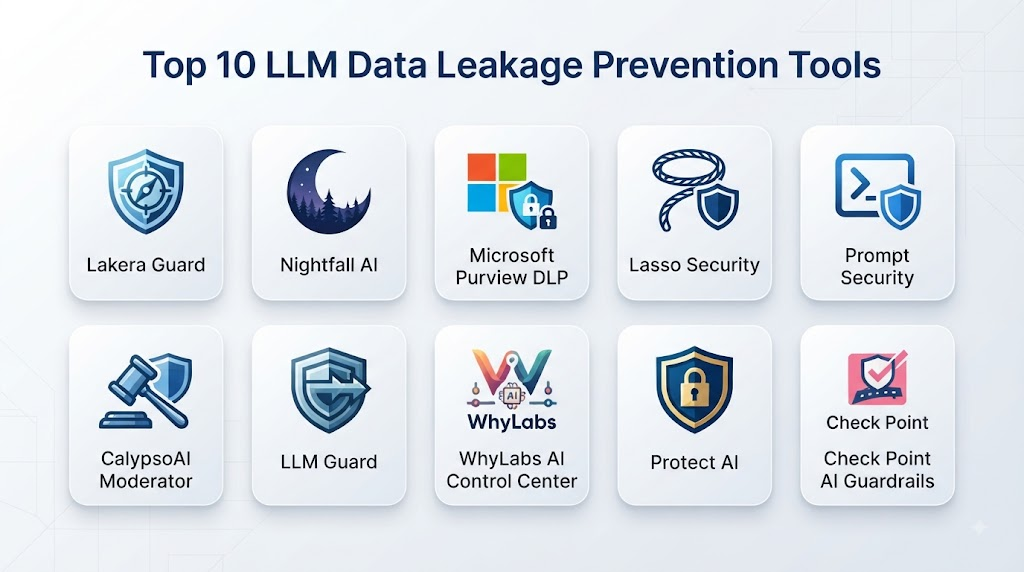
Top 10 LLM Data Leakage Prevention Tools
1. Microsoft Purview Data Loss Prevention
Microsoft Purview provides enterprise data protection and AI security capabilities.
Key Features
- Sensitive data discovery
- Data classification
- AI usage monitoring
- Policy enforcement
- Compliance reporting
- Microsoft 365 integration
Pros
- Enterprise-ready
- Strong data governance
- Broad security ecosystem
Cons
- Best for Microsoft environments
2. Google Cloud Sensitive Data Protection
Google Cloud Sensitive Data Protection helps identify and protect sensitive information.
Key Features
- Data discovery
- PII detection
- Data masking
- Classification
- Cloud AI integration
Pros
- Strong data protection
- Cloud scalability
Cons
- Google Cloud dependency
3. AWS Macie & Bedrock Security Controls
AWS provides data protection capabilities for AI applications.
Key Features
- Sensitive data discovery
- Privacy controls
- AI security policies
- Data monitoring
- AWS integration
Pros
- Strong AWS ecosystem
- Enterprise scalability
Cons
- AWS dependency
4. Lakera Guard
Lakera Guard provides security protection for LLM applications.
Key Features
- Prompt injection detection
- Sensitive data detection
- AI threat monitoring
- Runtime protection
- Data leakage prevention
Pros
- Specialized LLM security
- Real-time protection
Cons
- Focused mainly on generative AI
5. Nightfall AI
Nightfall provides cloud data loss prevention solutions.
Key Features
- Sensitive data detection
- AI security controls
- Data monitoring
- Policy enforcement
- Compliance support
Pros
- Strong DLP capabilities
- SaaS security focus
Cons
- Requires configuration
6. Protect AI
Protect AI provides AI security solutions for machine learning environments.
Key Features
- AI security monitoring
- Model protection
- Risk assessment
- Data protection
- AI supply chain security
Pros
- AI-focused security
- Enterprise capabilities
Cons
- Requires security expertise
7. Palo Alto Networks AI Security
Palo Alto Networks provides enterprise AI security solutions.
Key Features
- AI application protection
- Data security
- Threat prevention
- Security monitoring
- Policy controls
Pros
- Strong cybersecurity platform
- Enterprise adoption
Cons
- Complex deployment
8. Netskope AI Security
Netskope provides cloud security and AI protection.
Key Features
- AI application visibility
- Data protection
- User activity monitoring
- Policy enforcement
- Cloud security
Pros
- Strong cloud security
- Good visibility
Cons
- Enterprise-focused pricing
9. Symantec Data Loss Prevention
Symantec provides traditional DLP capabilities extended for modern environments.
Key Features
- Sensitive data discovery
- Data monitoring
- Policy controls
- Compliance reporting
- Enterprise protection
Pros
- Mature DLP technology
- Strong security history
Cons
- Less AI-specific
10. Private AI
Private AI provides privacy-preserving AI solutions.
Key Features
- PII detection
- Data anonymization
- Privacy protection
- Secure AI processing
- Compliance support
Pros
- Privacy focused
- Strong data protection
Cons
- Specialized use cases
Comparison Table: Top 10 LLM Data Leakage Prevention Tools
| No. | Tool Name | Best For | Platform(s) Supported | Deployment | Standout Feature | Public Rating |
|---|---|---|---|---|---|---|
| 1 | Microsoft Purview DLP | Enterprise data protection | Cloud | Managed | AI data governance | 4.8/5 |
| 2 | Google Sensitive Data Protection | Cloud data security | Google Cloud | Managed | PII discovery | 4.7/5 |
| 3 | AWS Macie & Bedrock Controls | AWS AI security | AWS | Managed | Data protection | 4.7/5 |
| 4 | Lakera Guard | LLM security | Cloud | Managed | AI leakage prevention | 4.8/5 |
| 5 | Nightfall AI | SaaS DLP | Cloud | Managed | Data monitoring | 4.6/5 |
| 6 | Protect AI | AI security | Cloud | Enterprise | AI protection | 4.6/5 |
| 7 | Palo Alto AI Security | Enterprise security | Cloud | Managed | Threat prevention | 4.7/5 |
| 8 | Netskope AI Security | Cloud AI security | Cloud | Managed | AI visibility | 4.6/5 |
| 9 | Symantec DLP | Enterprise DLP | Cloud / Local | Enterprise | Data protection | 4.5/5 |
| 10 | Private AI | Privacy protection | Cloud / Local | Managed | PII protection | 4.6/5 |
Weighted Evaluation Table
| No. | Tool Name | Data Protection 25% | Ease of Use 15% | AI Integration 15% | Security 10% | Scalability 10% | Monitoring 10% | Value 15% | Total Score |
|---|---|---|---|---|---|---|---|---|---|
| 1 | Microsoft Purview DLP | 25 | 15 | 15 | 10 | 10 | 10 | 14 | 99 |
| 2 | Google Sensitive Data Protection | 24 | 14 | 15 | 10 | 10 | 10 | 14 | 97 |
| 3 | AWS Macie & Bedrock Controls | 24 | 14 | 15 | 10 | 10 | 10 | 13 | 96 |
| 4 | Lakera Guard | 25 | 15 | 15 | 10 | 10 | 10 | 14 | 99 |
| 5 | Nightfall AI | 24 | 14 | 14 | 10 | 10 | 10 | 13 | 95 |
| 6 | Protect AI | 24 | 13 | 15 | 10 | 10 | 10 | 13 | 95 |
| 7 | Palo Alto AI Security | 24 | 13 | 15 | 10 | 10 | 10 | 13 | 95 |
| 8 | Netskope AI Security | 24 | 14 | 14 | 10 | 10 | 10 | 13 | 95 |
| 9 | Symantec DLP | 23 | 13 | 13 | 10 | 10 | 10 | 13 | 92 |
| 10 | Private AI | 24 | 14 | 14 | 10 | 10 | 10 | 14 | 96 |
Which LLM Data Leakage Prevention Tool Is Right for You?
Choose Microsoft Purview DLP for enterprise data governance.
Choose Google Sensitive Data Protection for Google Cloud environments.
Choose AWS Macie & Bedrock Controls for AWS AI systems.
Choose Lakera Guard for dedicated LLM security.
Choose Nightfall AI for SaaS data protection.
Choose Protect AI for AI security management.
Choose Palo Alto AI Security for enterprise cybersecurity.
Choose Netskope AI Security for cloud AI protection.
Choose Symantec DLP for mature DLP capabilities.
Choose Private AI for privacy-focused AI systems.
Implementation Playbook
Phase 1: Identify Sensitive Data
- Classify information
- Identify AI data flows
- Define protection requirements
Phase 2: Configure AI Security Policies
- Set access rules
- Configure detection
- Enable monitoring
Phase 3: Protect AI Workflows
- Filter prompts
- Secure outputs
- Control access
Phase 4: Monitor AI Usage
- Track activity
- Detect leakage attempts
- Review alerts
Phase 5: Continuous Improvement
- Update policies
- Improve controls
- Maintain compliance
Common Mistakes
- Allowing sensitive data in public AI tools
- No prompt monitoring
- Missing output filtering
- Poor access controls
- Ignoring RAG security
- No AI usage policies
FAQs
1. What are LLM Data Leakage Prevention Tools?
They are security tools that prevent sensitive information from being exposed through AI systems.
2. Why is LLM data protection important?
It protects confidential information from accidental or malicious exposure.
3. What type of data can these tools protect?
They protect personal data, financial information, business documents, and intellectual property.
4. Can these tools protect RAG applications?
Yes, many support document-based AI systems.
5. Who uses LLM data protection tools?
Security teams, AI teams, compliance teams, and enterprises.
6. Can these tools detect PII?
Yes, many include PII detection and classification.
7. Do these tools prevent prompt-based data leakage?
Yes, many analyze prompts and AI responses.
8. Are LLM DLP tools part of AI governance?
Yes, they support responsible AI security practices.
9. How often should AI data protection be monitored?
Continuous monitoring is recommended.
10. What is the future of LLM data protection?
AI-specific data security will become essential as enterprise AI adoption grows.
Conclusion
LLM Data Leakage Prevention Tools are becoming a critical security requirement for organizations adopting generative AI and large language models. These solutions help protect sensitive information, control AI usage, and reduce risks associated with AI-powered applications.Platforms such as Microsoft Purview DLP, Lakera Guard, Google Sensitive Data Protection, AWS security controls, Protect AI, and Palo Alto AI Security provide strong capabilities for securing AI data workflows.As organizations continue integrating LLMs into business processes, preventing data leakage will remain a fundamental requirement for safe, compliant, and trustworthy AI adoption.