Introduction
Agent Safety Guardrail Layers are security and control systems designed to help AI agents operate safely, reliably, and responsibly while interacting with users, tools, data sources, and external systems.
As AI agents become more autonomous, they are increasingly capable of performing complex tasks such as making decisions, accessing enterprise data, executing workflows, and interacting with applications. However, increased autonomy also creates new risks related to incorrect actions, unsafe outputs, data exposure, unauthorized access, and unexpected behavior.
Agent Safety Guardrail Layers provide protective mechanisms that control how AI agents behave and ensure that their actions follow defined rules, policies, and safety requirements.
These layers help organizations:
- Prevent unsafe AI behavior
- Control agent permissions
- Monitor AI decisions
- Protect sensitive information
- Validate agent outputs
- Reduce hallucinations
- Improve AI reliability
- Maintain compliance requirements
Agent Safety Guardrail Layers are used by:
- AI engineers
- Security teams
- Enterprise AI teams
- Compliance teams
- Software developers
- Data scientists
- Product managers
- Risk management teams
Modern AI safety guardrail solutions provide capabilities such as:
- Input validation
- Output filtering
- Policy enforcement
- Prompt protection
- Data privacy controls
- Tool access management
- Monitoring and auditing
- Human approval workflows
- Risk detection
The goal of Agent Safety Guardrail Layers is to create secure and trustworthy AI agents that can operate effectively while minimizing risks.
What Are AI Agent Safety Guardrails?
AI Agent Safety Guardrails are protective controls placed around AI systems to monitor, restrict, and guide agent behavior.
They act like a security framework that ensures AI agents:
- Follow organizational policies
- Avoid harmful actions
- Protect sensitive data
- Use tools responsibly
- Provide reliable responses
Why AI Agents Need Safety Guardrails
AI agents can perform autonomous actions, but they may create risks such as:
- Incorrect decisions
- Data leakage
- Unauthorized operations
- Unsafe recommendations
- Malicious prompt manipulation
- Tool misuse
Guardrail layers help organizations maintain control over autonomous AI systems.
Types of Agent Safety Guardrail Layers
Input Guardrails
Input guardrails analyze requests before they reach AI models.
They detect:
- Harmful instructions
- Sensitive information
- Malicious prompts
- Invalid requests
Output Guardrails
Output guardrails evaluate AI-generated responses.
They check:
- Accuracy
- Safety
- Compliance
- Sensitive information exposure
Tool Usage Guardrails
These controls manage how agents interact with external tools.
They control:
- API access
- Database permissions
- System actions
Data Protection Guardrails
Protect:
- Personal information
- Confidential data
- Enterprise knowledge
Policy Enforcement Layers
Ensure AI agents follow:
- Business rules
- Security policies
- Compliance requirements
Human Oversight Layers
Allow humans to review:
- Important decisions
- Sensitive actions
- High-risk workflows
How Agent Safety Guardrail Layers Work
User Request
A user sends a request to an AI agent.
Example:
“Process customer account information.”
Input Analysis
The guardrail system checks:
- User intent
- Security risks
- Policy violations
Agent Processing
The AI agent performs reasoning and planning.
Action Validation
Before executing actions, guardrails verify:
- Permissions
- Tool access
- Data usage
Output Checking
Generated responses are evaluated for:
- Safety
- Accuracy
- Compliance
Final Response
Only approved outputs are delivered.
Key Capabilities of Agent Safety Guardrail Layers
Prompt Protection
Protects AI systems from:
- Prompt injection
- Jailbreak attempts
- Malicious instructions
Content Filtering
Detects:
- Unsafe content
- Restricted information
- Policy violations
Identity and Access Management
Controls:
- User permissions
- Agent permissions
- Tool access
Data Privacy Protection
Prevents:
- Data leakage
- Unauthorized sharing
- Sensitive exposure
AI Monitoring
Tracks:
- Agent behavior
- Decisions
- Tool usage
- Security events
Risk Assessment
Identifies:
- Unsafe actions
- Suspicious behavior
- Compliance risks
Common Use Cases
Enterprise AI Assistants
Guardrails protect:
- Internal knowledge
- Employee data
- Business processes
Customer Service Agents
Safety layers control:
- Customer responses
- Personal information
- Automated actions
Financial AI Systems
Used for:
- Risk control
- Compliance monitoring
- Secure decision support
Healthcare AI
Protects:
- Patient information
- Medical workflows
- Sensitive recommendations
Coding Agents
Controls:
- Code execution
- Repository access
- Security risks
Autonomous Business Agents
Manages:
- Workflow permissions
- Automated decisions
- External actions
Why Agent Safety Guardrails Matter
Reduces AI Risks
Guardrails prevent unsafe AI behavior.
Improves Trust
Organizations can deploy AI more confidently.
Supports Compliance
Helps meet regulatory requirements.
Protects Data
Prevents unauthorized access.
Enables Enterprise Adoption
Businesses can safely use autonomous AI systems.
Evaluation Criteria for Buyers
Security Features
Evaluate:
- Threat detection
- Access control
- Data protection
AI Compatibility
Support should include:
- LLMs
- Agent frameworks
- AI applications
Monitoring Capabilities
Look for:
- Logs
- Alerts
- Analytics
- Auditing
Policy Management
Important features:
- Custom rules
- Compliance policies
- Workflow controls
Integration Support
Platforms should connect with:
- APIs
- Cloud systems
- Enterprise tools
Scalability
Consider:
- Enterprise workloads
- Multiple agents
- High request volumes
Key Trends
Growth of Agentic AI Security
As AI agents become more autonomous, safety systems are becoming essential.
AI Governance Expansion
Organizations are implementing stronger AI controls.
Runtime AI Monitoring
Real-time agent monitoring is becoming common.
Responsible AI Adoption
Businesses are focusing on:
- Transparency
- Safety
- Accountability
Enterprise AI Security Platforms
Companies are building complete AI security layers.
Automated Compliance
AI systems are increasingly monitored automatically.
Methodology
The following Agent Safety Guardrail Layers were evaluated based on:
- Safety capabilities
- Security features
- AI integration
- Policy management
- Monitoring
- Enterprise readiness
- Developer experience
- Scalability
- Compliance support
- Value
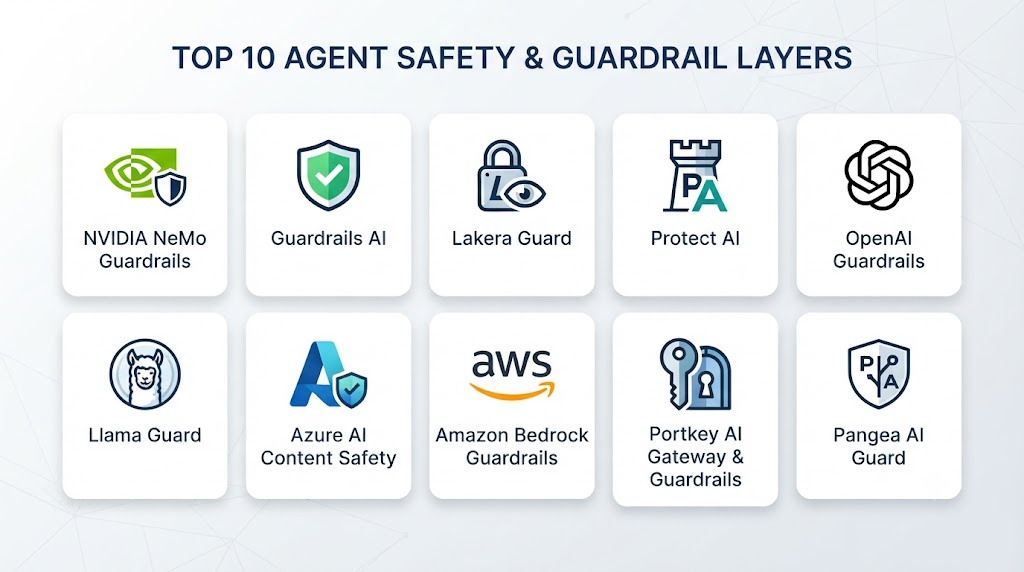
Top 10 Agent Safety Guardrail Layers
- NVIDIA NeMo Guardrails
- Guardrails AI
- Lakera Guard
- Microsoft Azure AI Content Safety
- AWS Bedrock Guardrails
- Google Vertex AI Safety Features
- OpenAI Moderation & Safety Tools
- Llama Guard
- Rebuff AI
- Protect AI
1. NVIDIA NeMo Guardrails
NVIDIA NeMo Guardrails provides programmable safety controls for AI applications and conversational agents.
Key Features
- Input protection
- Output filtering
- Policy controls
- Conversation management
- Topic control
- Security rules
- LLM integration
- Custom guardrails
- Agent safety workflows
- Enterprise AI support
Pros
- Designed for AI applications
- Flexible customization
- Strong enterprise support
- Open-source availability
- Good LLM integration
Cons
- Requires technical expertise
- Configuration complexity
- Deployment knowledge needed
Platforms
Cloud and local environments.
Deployment or Support
Enterprise AI deployment.
Security & Compliance
Supports AI safety controls.
Integrations & Ecosystem
LLMs, AI frameworks, and enterprise applications.
Support & Community
Developer community.
2. Guardrails AI
Guardrails AI provides validation frameworks for controlling AI outputs.
Key Features
- Output validation
- Input checks
- AI quality controls
- Custom validators
- Data validation
- Error detection
- LLM integration
- Developer APIs
- AI reliability tools
- Monitoring
Pros
- Flexible validation
- Developer-friendly
- Open-source
- Custom rules
- Easy integration
Cons
- Requires configuration
- Technical setup needed
- Focused mainly on validation
Platforms
Cloud and local environments.
Deployment or Support
AI application development.
Security & Compliance
Depends on implementation.
Integrations & Ecosystem
LLMs and AI applications.
Support & Community
Developer community.
3. Lakera Guard
Lakera Guard provides AI security protection against unsafe inputs and threats.
Key Features
- Prompt injection detection
- Jailbreak protection
- Content moderation
- Security monitoring
- Risk detection
- API protection
- AI threat analysis
- Real-time filtering
- Enterprise security
- Developer integration
Pros
- Strong AI security focus
- Real-time protection
- Easy integration
- Good threat detection
- Enterprise-ready
Cons
- Cloud dependency
- Pricing considerations
- Requires integration planning
Platforms
Cloud environments.
Deployment or Support
Enterprise deployment.
Security & Compliance
AI security focused.
Integrations & Ecosystem
LLMs, APIs, and AI applications.
Support & Community
Enterprise support.
4. Microsoft Azure AI Content Safety
Azure AI Content Safety provides AI content moderation and safety capabilities.
Key Features
- Content filtering
- Risk detection
- Safety classification
- Enterprise controls
- API access
- AI monitoring
- Policy enforcement
- Security integration
- Compliance support
- Cloud deployment
Pros
- Enterprise-ready
- Strong Microsoft ecosystem
- Easy Azure integration
- Compliance support
- Scalable
Cons
- Azure dependency
- Cloud-focused
- Requires Azure knowledge
Platforms
Microsoft Azure.
Deployment or Support
Enterprise cloud deployment.
Security & Compliance
Strong enterprise controls.
Integrations & Ecosystem
Azure AI services.
Support & Community
Enterprise support.
5. AWS Bedrock Guardrails
AWS Bedrock Guardrails provides safety controls for generative AI applications.
Key Features
- Content filtering
- Topic restrictions
- Privacy protection
- Policy management
- Model integration
- Enterprise security
- Monitoring
- AI governance
- API support
- Cloud deployment
Pros
- Strong AWS integration
- Enterprise security
- Easy model integration
- Scalable
- Governance features
Cons
- AWS dependency
- Cloud-only approach
- Complex pricing
Platforms
AWS cloud.
Deployment or Support
Enterprise cloud deployment.
Security & Compliance
AWS security framework.
Integrations & Ecosystem
AWS AI services and applications.
Support & Community
Enterprise support.
6. Google Vertex AI Safety Features
Google Vertex AI provides safety and responsible AI capabilities.
Key Features
- Content filtering
- Safety settings
- Model monitoring
- AI governance
- Enterprise controls
- Risk management
- API integration
- Security features
- AI deployment support
- Cloud integration
Pros
- Strong AI ecosystem
- Enterprise features
- Good scalability
- Google integration
- Safety controls
Cons
- Google Cloud dependency
- Requires expertise
- Complex configuration
Platforms
Google Cloud.
Deployment or Support
Enterprise deployment.
Security & Compliance
Google Cloud security.
Integrations & Ecosystem
Google AI services.
Support & Community
Enterprise support.
7. OpenAI Moderation & Safety Tools
OpenAI provides safety tools for detecting and filtering harmful content.
Key Features
- Content moderation
- Safety classification
- API integration
- Risk detection
- AI application protection
- Developer tools
- Policy enforcement
- Monitoring
- Model integration
- Application safety
Pros
- Easy integration
- Strong AI ecosystem
- Developer-friendly
- Reliable moderation
- Good documentation
Cons
- Provider dependency
- Limited customization
- Requires external workflows
Platforms
Cloud environments.
Deployment or Support
AI application development.
Security & Compliance
Safety-focused APIs.
Integrations & Ecosystem
OpenAI applications and APIs.
Support & Community
Developer community.
8. Llama Guard
Llama Guard provides safety classification capabilities for AI applications.
Key Features
- Content safety
- Risk classification
- Open-source model
- Input filtering
- Output filtering
- AI safety workflows
- Custom deployment
- LLM integration
- Security controls
- Research support
Pros
- Open-source
- Flexible deployment
- Customizable
- Privacy-friendly
- AI-focused
Cons
- Requires infrastructure
- Technical setup needed
- Model management required
Platforms
Cloud and local environments.
Deployment or Support
Self-hosted deployment.
Security & Compliance
Depends on deployment.
Integrations & Ecosystem
Open-source AI ecosystem.
Support & Community
Developer community.
9. Rebuff AI
Rebuff AI focuses on protecting applications against prompt injection attacks.
Key Features
- Prompt injection detection
- Security filtering
- AI protection
- Attack analysis
- API integration
- Agent security
- Threat detection
- Developer tools
- Monitoring
- AI safety workflows
Pros
- Specialized security
- Good prompt protection
- Developer-friendly
- Useful for agents
- Open-source approach
Cons
- Narrow focus
- Requires additional controls
- Security scope limitations
Platforms
Cloud and local environments.
Deployment or Support
AI application deployment.
Security & Compliance
Prompt security focused.
Integrations & Ecosystem
AI applications and APIs.
Support & Community
Developer community.
10. Protect AI
Protect AI provides security solutions for machine learning and AI systems.
Key Features
- AI security monitoring
- Model protection
- Vulnerability detection
- Risk management
- Compliance support
- Security workflows
- AI governance
- Enterprise controls
- Monitoring
- Threat management
Pros
- AI security focused
- Enterprise capabilities
- Strong monitoring
- Compliance support
- Broad AI protection
Cons
- Enterprise complexity
- Requires security expertise
- Higher investment
Platforms
Enterprise environments.
Deployment or Support
Enterprise deployment.
Security & Compliance
AI security platform.
Integrations & Ecosystem
ML platforms and enterprise systems.
Support & Community
Enterprise support.
Comparison Table
| Tool Name | Best For | Platform(s) Supported | Deployment | Standout Feature | Public Rating |
|---|---|---|---|---|---|
| NVIDIA NeMo Guardrails | AI safety controls | Cloud/Local | Enterprise | Programmable guardrails | |
| Guardrails AI | Output validation | Cloud/Local | Flexible | Custom validators | |
| Lakera Guard | AI security | Cloud | Enterprise | Prompt protection | |
| Azure AI Safety | Content safety | Azure | Enterprise | Microsoft integration | |
| AWS Bedrock Guardrails | GenAI safety | AWS | Enterprise | Cloud governance | |
| Vertex AI Safety | Google AI safety | Google Cloud | Enterprise | Safety controls | |
| OpenAI Safety Tools | AI moderation | Cloud | Flexible | Easy integration | |
| Llama Guard | Open safety models | Cloud/Local | Self-hosted | Open-source safety | |
| Rebuff AI | Prompt security | Cloud/Local | Flexible | Injection detection | |
| Protect AI | AI security | Enterprise | Enterprise | AI risk management |
Weighted Evaluation
| Tool Name | Core Features 25% | Ease of Use 15% | Integrations & Ecosystem 15% | Security & Compliance 10% | Performance & Reliability 10% | Support & Community 10% | Price/Value 15% | Total |
|---|---|---|---|---|---|---|---|---|
| NVIDIA NeMo Guardrails | 25 | 13 | 15 | 10 | 10 | 10 | 14 | 97 |
| Guardrails AI | 24 | 15 | 14 | 10 | 10 | 10 | 15 | 98 |
| Lakera Guard | 24 | 14 | 14 | 10 | 10 | 10 | 13 | 95 |
| Azure AI Safety | 24 | 13 | 15 | 10 | 10 | 10 | 13 | 95 |
| AWS Guardrails | 24 | 13 | 15 | 10 | 10 | 10 | 13 | 95 |
| Vertex AI Safety | 24 | 13 | 15 | 10 | 10 | 10 | 13 | 95 |
| OpenAI Safety Tools | 23 | 15 | 15 | 10 | 10 | 10 | 14 | 97 |
| Llama Guard | 23 | 12 | 14 | 10 | 10 | 10 | 15 | 94 |
| Rebuff AI | 22 | 14 | 13 | 10 | 10 | 10 | 15 | 94 |
| Protect AI | 24 | 12 | 14 | 10 | 10 | 10 | 12 | 92 |
Which Agent Safety Guardrail Layer Is Right for You?
Choose NVIDIA NeMo Guardrails for customizable enterprise AI safety.
Choose Guardrails AI for flexible validation.
Choose Lakera Guard for prompt security.
Choose Azure AI Content Safety for Microsoft environments.
Choose AWS Bedrock Guardrails for AWS applications.
Choose Google Vertex AI Safety for Google Cloud AI.
Choose OpenAI Safety Tools for AI application moderation.
Choose Llama Guard for open-source safety deployment.
Choose Rebuff AI for prompt injection protection.
Choose Protect AI for complete AI security management.
Implementation Playbook
Phase 1: Identify AI Risks
- Analyze agent workflows
- Identify sensitive operations
- Define safety requirements
Phase 2: Design Guardrail Architecture
- Add input checks
- Configure output validation
- Define policies
Phase 3: Integrate Guardrails
- Connect AI models
- Configure monitoring
- Test security controls
Phase 4: Deploy Safely
- Monitor agent behavior
- Review logs
- Manage permissions
Phase 5: Improve Continuously
- Update policies
- Analyze incidents
- Improve safety controls
Common Mistakes
- Deploying agents without controls
- Ignoring prompt injection risks
- Poor permission management
- No monitoring system
- Weak data protection
- Lack of human oversight
- Not testing failures
- Overtrusting AI decisions
FAQs
1. What are Agent Safety Guardrail Layers?
They are security controls that help AI agents operate safely and follow defined policies.
2. Why do AI agents need guardrails?
Guardrails reduce risks such as unsafe outputs, data leaks, and unauthorized actions.
3. What types of guardrails exist?
Input, output, tool, data, and policy guardrails are commonly used.
4. Who uses AI safety guardrails?
Enterprises, developers, security teams, and regulated industries use them.
5. Can guardrails prevent prompt injection attacks?
Many guardrail systems can detect and reduce prompt injection risks.
6. Are AI guardrails required for enterprise AI?
They are increasingly important for secure enterprise deployment.
7. Can guardrails work with multiple AI models?
Yes, many support different LLMs and AI applications.
8. How do guardrails improve AI trust?
They provide monitoring, control, and safer AI behavior.
9. Can organizations create custom policies?
Yes, many platforms support custom rules and controls.
10. What is the future of AI safety guardrails?
Guardrails will become a standard security layer for autonomous AI systems.
Conclusion
Agent Safety Guardrail Layers are becoming a critical requirement for organizations deploying autonomous AI agents. They provide protection, governance, and control needed to operate AI systems safely.Platforms such as NVIDIA NeMo Guardrails, Guardrails AI, Lakera Guard, Azure AI Content Safety, AWS Bedrock Guardrails, Llama Guard, and Protect AI help organizations build trustworthy AI applications.As AI agents become more powerful and autonomous, safety guardrails will play a central role in enabling secure, responsible, and enterprise-ready AI adoption.