Introduction
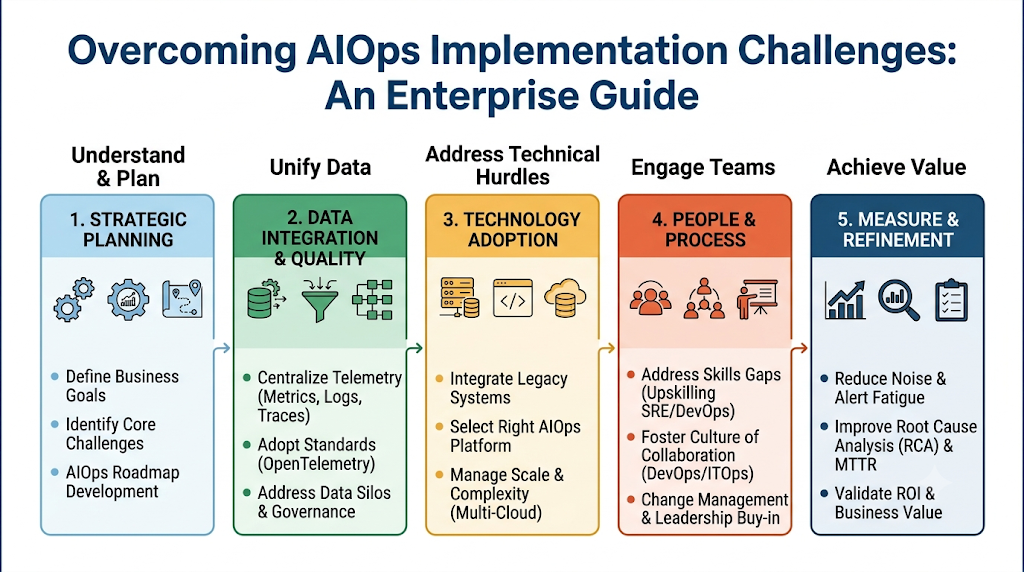
Modern enterprise technology environments have expanded far beyond the reach of manual human oversight. With microservice architectures, serverless functions, multi-cloud platforms, and container orchestration systems processing millions of transactions per minute, IT operations teams face unprecedented operational complexity. Traditional monitoring tools that rely on static thresholds and human-driven troubleshooting can no longer keep pace with this dynamic speed and scale. To solve this challenge, organizations are shifting toward Artificial Intelligence for IT Operations (AIOps). By combining machine learning, big data analytics, and automated response workflows, AIOps enables engineers to detect anomalies, discover root causes, and resolve incidents in real time. However, transitioning from traditional, reactive IT operations to an intelligent, automated AIOps ecosystem is rarely smooth. Many enterprises launch ambitious AIOps initiatives only to encounter technical roadblocks, data fragmentation, high false-positive rates, and cultural resistance. If you are exploring AIOps educational resources, hands-on tutorials, and career development programs, visit AIOpsSchool.com to master modern IT operations technologies. In this comprehensive guide, we examine the top challenges in implementing AIOps and outline practical, field-tested solutions to ensure your enterprise adoption succeeds.
What is AIOps?
AIOps, short for Artificial Intelligence for IT Operations, represents the application of artificial intelligence, machine learning, and advanced data analytics to modern IT operations. Coined by Gartner, the term describes platforms that continuously ingest, correlate, and analyze high-velocity telemetry data from across the enterprise stack to automate operational tasks.
Rather than requiring human engineers to manually aggregate log files, trace network requests, and review CPU utilization spikes across disparate dashboards, an AIOps platform acts as a centralized brain. It correlates vast amounts of unstructured and structured data to surface actionable operational insights.
+-----------------------------------------------------------------------+
|                       ENTERPRISE TELEMETRY                            |
|    [ Logs ]        [ Metrics ]        [ Events ]        [ Traces ]    |
+-----------------------------------------------------------------------+
                                   |
                                   v
+-----------------------------------------------------------------------+
|                           AIOPS PLATFORM                              |
|  1. Ingestion & Filtering  -->  2. ML Anomaly Detection              |
|  3. Event Correlation      -->  4. Automated Root Cause Analysis     |
+-----------------------------------------------------------------------+
                                   |
                                   v
+-----------------------------------------------------------------------+
|                         ACTIONABLE OUTCOMES                           |
|  * Noise Reduction    * Proactive Incident Alerting                   |
|  * Auto-Remediation   * Optimized Resource Allocation                 |
+-----------------------------------------------------------------------+
Core Components of an AIOps Platform
- Data Ingestion and Normalization: Gathering telemetry—metrics, logs, events, and traces—from hybrid clouds, legacy servers, databases, and microservices into a unified pipeline.
- Machine Learning Analytics: Utilizing supervised and unsupervised ML algorithms to establish dynamic baselines, detect subtle anomalies, and identify patterns that static alerts miss.
- Event Correlation and Topology Mapping: Grouping thousands of related system alerts into a single, cohesive incident context based on application dependencies.
- Automated Remediation: Executing pre-approved operational playbooks—such as restarting a container, clearing a full cache, or re-routing network traffic—without manual intervention.
Why Organizations Adopt AIOps
Enterprises adopt AIOps to overcome the operational constraints of traditional infrastructure monitoring. As digital services scale, human teams quickly become overwhelmed by volume and complexity.
| Feature / Capability | Traditional IT Operations | AI-Driven AIOps Environment |
| Operational Model | Reactive (responds after an outage occurs) | Proactive & Predictive (detects anomalies early) |
| Alerting Approach | Static thresholds (e.g., alert if CPU exceeds 85%) | Dynamic baselines tailored to temporal traffic trends |
| Alert Volume | High noise and severe alert fatigue | Up to 90% noise reduction through correlation |
| Root Cause Analysis (RCA) | Manual log searches across multiple siloed tools | Automated RCA linked to underlying infrastructure topology |
| Resolution Speed | Hours or days (high Mean Time to Resolve) | Minutes or seconds via automated remediation scripts |
| Data Scope | Isolated monitoring tools per department | Unified telemetry across multi-cloud and hybrid environments |
Key strategic drivers for adoption include:
- Drastic Reduction in Mean Time to Resolution (MTTR): By automatically pinpointing the exact microservice or configuration change causing an incident, engineering teams save hours of manual investigation.
- Elimination of Alert Fatigue: AIOps platforms reduce thousands of daily system alarms down to a handful of actionable incidents.
- Transition from Reactive to Proactive: Machine learning models identify subtle performance drifts before end-users experience service degradation.
- Cost Efficiency: Automating routine incident handling frees Site Reliability Engineers (SREs) and DevOps professionals to focus on core product innovation.
Understanding the AIOps Implementation Journey
Implementing AIOps is a phased journey rather than a single software deployment. Organizations that succeed typically navigate five distinct implementation stages:
[ Stage 1: Centralization ] ──> [ Stage 2: Noise Reduction ] ──> [ Stage 3: Automated RCA ]
                                                                             │
[ Stage 5: Predictive Ops ]  <──  [ Stage 4: Auto-Remediation ] <────────────┘
- Stage 1: Telemetry Centralization & Standardization – Consolidating logs, metrics, traces, and events from disparate systems into unified observability storage.
- Stage 2: Event Correlation & Noise Reduction – Suppressing duplicate alerts and grouping related symptoms into single incident tickets.
- Stage 3: Automated Root Cause Analysis – Utilizing topology data and machine learning to map dependency graphs and isolate the failure point.
- Stage 4: Low-Risk Auto-Remediation – Implementing self-healing actions for well-understood, repetitive failure modes.
- Stage 5: Predictive & Autonomous Operations – Forecasting resource exhaustion, capacity needs, and system failures before they impact business operations.
Top Challenges in Implementing AIOps
Despite the undeniable benefits of AIOps, enterprise adoption involves significant technical and organizational hurdles. Below are the top challenges organizations encounter during implementation, along with deep-dive strategies to solve them.
Data Quality and Data Silos
The Challenge
Machine learning algorithms depend entirely on the quality of the data fed into them. In most enterprise environments, data resides in isolated silos managed by separate teams—networking, database, application development, and security. Furthermore, telemetry data is often incomplete, unstructured, or unstandardized. Feeding inconsistent or noisy log formats into AI models leads to inaccurate baseline assumptions and unreliable predictions.
The Solution
- Adopt OpenTelemetry Standards: Standardize telemetry collection across all applications and infrastructure using vendor-neutral open protocols like OpenTelemetry.
- Implement Data Preprocessing Pipelines: Cleanse, parse, and structure raw log messages at the ingestion layer before passing them to machine learning models.
- Break Down Operational Silos: Mandate cross-team data access agreements so that network, infrastructure, and application telemetry flow into a shared platform.
Integrating Legacy Systems
The Challenge
While modern microservices natively expose metrics and logs via standard APIs, legacy enterprise systems—such as mainframes, monolithic applications, and older on-premise servers—frequently lack modern telemetry capabilities. Connecting legacy architectures with modern AIOps platforms often requires custom connectors, heavy parsing scripts, or specialized agents that increase system overhead.
The Solution
- Deploy API Gateways and Middleware Adapters: Use lightweight middleware agents and custom log shippers to convert legacy log formats into standardized JSON or OpenTelemetry formats.
- Prioritize High-Impact Systems: Begin the AIOps rollout with modern cloud workloads, gradually integrating critical legacy systems using specialized integration connectors.
- Implement Edge Aggregators: Use telemetry edge collectors to process and structure legacy data locally before sending it across the network.
Managing Large Volumes of Logs, Metrics, Events, and Traces
The Challenge
Modern distributed applications generate vast quantities of telemetry data every second. Ingesting, indexing, and storing billions of logs, high-cardinality metrics, and distributed traces creates massive storage overhead and astronomical cloud network costs. Organizations frequently discover that the financial cost of ingesting raw telemetry exceeds the operational value delivered by the AIOps platform.
The Solution
- Smart Data Sampling & Indexing: Implement dynamic trace sampling and drop low-priority debug logs at ingestion to control data storage expenses.
- Edge Stream Processing: Analyze and filter data in-flight before it hits centralized storage, keeping high-frequency metrics local and forwarding only aggregated summaries and anomaly events.
- Tiered Storage Architecture: Store real-time telemetry in high-performance hot storage for fast processing, automatically moving historical baseline data to low-cost cold storage.
AI Model Accuracy and False Positives
The Challenge
When machine learning models are deployed without proper training, they frequently generate excessive false-positive alerts or miss real anomalies entirely. An AI model that continuously triggers false alarms destroys engineer trust. If SREs find that automated recommendations are regularly incorrect, they will ignore the system, rendering the AIOps investment ineffective.
The Solution
- Supervised Model Fine-Tuning: Involve experienced SREs and domain experts in validating model outputs, providing feedback loops to refine ML algorithms.
- Contextual Baseline Training: Ensure models are trained on sufficient historical data that accounts for seasonal spikes, business promotions, and scheduled maintenance windows.
- Gradual Trust Building: Keep human operators in the loop (Human-in-the-Loop approach) for validating anomalies before enabling full automation.
Alert Noise and Event Correlation
The Challenge
During a major infrastructure incident, a single failing database node can cause cascading failures across hundreds of downstream microservices. This triggers thousands of individual alerts within seconds. Without intelligent event correlation, engineers face a wall of critical notifications and cannot determine which component failed first.
The Solution
- Topology-Aware Correlation Engine: Combine machine learning with dynamic dependency mapping so the AIOps platform understands how microservices, databases, and networks interact.
- Time-Series Clustering: Group alerts occurring within the same time window across connected infrastructure components into a single root-cause incident.
- Dynamic Thresholding: Replace static alert triggers with adaptive ML thresholds that adjust automatically based on traffic patterns and historical norms.
Skills Gap and Organizational Readiness
The Challenge
Implementing and maintaining an AIOps ecosystem requires a rare hybrid skill set combining software engineering, site reliability engineering, data science, machine learning, and enterprise IT infrastructure expertise. Most traditional IT operations staff lack formal training in data engineering or machine learning model management, creating a significant skills gap.
The Solution
- Invest in Structured Upskilling: Provide team members with targeted training programs, hands-on lab environments, and industry certifications in AIOps, DevOps, and Observability.
- Establish a Center of Excellence (CoE): Create a dedicated AIOps Enablement Team to guide best practices, build reusable integration templates, and assist operational units.
- Choose Accessible Platforms: Select AIOps tools with intuitive user interfaces, clear diagnostic explanations, and low-code integration frameworks.
Security, Privacy, and Compliance Challenges
The Challenge
Telemetry data frequently contains sensitive business records, personally identifiable information (PII), or confidential credentials embedded inside application logs and request headers. Ingesting raw telemetry into third-party cloud AIOps platforms risks breaching data protection regulations like GDPR, HIPAA, and SOC 2. Furthermore, granting automated AIOps engines permission to execute remediation actions on production infrastructure presents potential security vulnerabilities.
The Solution
- Automated PII Data Masking: Implement real-time log sanitization at ingestion pipelines to strip or hash sensitive data before sending it to the AIOps platform.
- Role-Based Access Control (RBAC): Enforce strict RBAC and least-privilege security policies for both human users and automated AIOps scripts.
- Comprehensive Execution Audit Logs: Maintain detailed, immutable audit trails of every action, analysis, and automated playbook executed by the AIOps engine.
Multi-Cloud and Hybrid Cloud Complexity
The Challenge
Modern enterprise workloads are spread across hybrid on-premise data centers, private clouds, and multiple public cloud providers like AWS, Microsoft Azure, and Google Cloud Platform. Each platform exposes telemetry through different APIs, metrics formats, and log structures. Maintaining real-time visibility across these heterogeneous, shifting environments is one of the most difficult engineering challenges in AIOps.
The Solution
- Vendor-Neutral Data Abstraction: Use vendor-agnostic observability collector architectures to normalize telemetry before shipping it to the central platform.
- Unified API Integration Layer: Connect multi-cloud environments via unified observability APIs rather than relying on cloud-native siloed tools.
- Centralized Configuration Management: Standardize monitoring rules and telemetry collection policies across all cloud regions using Infrastructure-as-Code (IaC) tools like Terraform.
Change Management and Team Collaboration
The Challenge
Technological change often meets cultural resistance. IT operations engineers may fear that automated systems will make their roles obsolete, or they may mistrust black-box machine learning models whose reasoning they cannot verify. Additionally, functional friction between software developers, SREs, and IT service management (ITSM) personnel can stall adoption.
The Solution
- Promote “Explainable AI” (XAI): Deploy AIOps tools that explain why an anomaly was flagged and present the underlying evidence directly to engineers.
- Position AIOps as an Assistant: Emphasize that AIOps removes repetitive manual toil, allowing engineers to focus on higher-value engineering tasks.
- Cross-Functional Collaboration Workflows: Integrate AIOps insights directly into existing communication channels like Slack, Microsoft Teams, and Jira to foster seamless collaboration.
Selecting the Right AIOps Platform
Choosing an enterprise-grade AIOps platform requires evaluating technical requirements against long-term operational goals.
                                  EVALUATION CRITERIA
                                           │
         ┌────────────────────────┬────────┴────────┬────────────────────────┐
         ▼                        ▼                 ▼                        ▼
  Data Ingestion         Anomaly Engine     System Integration     Security & Privacy
  - OpenTelemetry        - Explainable AI   - ITSM Tools           - Real-time PII Masking
  - Multi-Cloud APIs     - Dynamic Baseline - Webhooks & APIs      - RBAC Controls
Key features to look for include:
- Open Architecture & Extensibility: Support for open-source telemetry standards (OpenTelemetry, Prometheus) and flexible API access.
- Out-of-the-Box Integrations: Native connectors for major cloud providers, Kubernetes, CI/CD tools, and ITSM platforms (ServiceNow, Jira).
- Explainable AI Insights: Clear diagnostic reasoning that links anomalies directly back to raw logs, metrics, and dependency maps.
- Automated Remediation Workflows: Robust playbook engines that support both manual approval gates and fully automated execution.
- Scalability & Cost Governance: Transparent pricing models with built-in telemetry controls to prevent data cost overruns.
Measuring ROI and Business Value
To justify ongoing investment in AIOps, technology leaders must track concrete operational and business metrics.
+-------------------------------------------------------------------------+
|                         AIOPS SUCCESS METRICS                           |
+------------------------------------+------------------------------------+
|     OPERATIONAL IMPACT METRICS     |       BUSINESS VALUE METRICS       |
+------------------------------------+------------------------------------+
| * MTTR Reduction (Min/Hours Saved) | * Revenue Saved from Outages       |
| * Alert Noise Reduction (%)        | * SLA / SLO Compliance Rates       |
| * Incident Detection Speed (MTTD)  | * SRE Engineering Hours Reclaimed  |
| * Auto-Remediation Rate (%)        | * Cloud Observability Cost Savings |
+------------------------------------+------------------------------------+
- Mean Time to Detect (MTTD) & Mean Time to Resolve (MTTR): Measure the reduction in time required to identify and fix production issues.
- Alert Noise Reduction Percentage: Track the ratio of raw alert events suppressed or correlated into consolidated incident tickets.
- Automated Incident Resolution Rate: Monitor the percentage of routine incidents resolved autonomously without human intervention.
- SLA Compliance and Uptime Improvement: Measure overall application availability and customer-facing service level compliance.
- Engineering Hours Reclaimed: Quantify the reduction in manual troubleshooting hours, translating saved time into innovation productivity.
Best Practices for Successful AIOps Adoption
To avoid common traps and maximize implementation success, follow these industry best practices:
- Start Small with Specific Use Cases: Avoid attempting to transform your entire IT estate overnight. Begin with high-value, manageable use cases like alert noise reduction or log anomaly detection for a core microservice.
- Focus on Data Hygiene First: Cleanse, standardize, and organize telemetry data before feeding it into machine learning models.
- Keep Humans in the Loop: Maintain human oversight for automated actions until confidence in model accuracy is established.
- Integrate with Existing Workflows: Feed AIOps outputs directly into tools your team uses daily, such as Slack, Microsoft Teams, PagerDuty, or ServiceNow.
- Prioritize Continuous Team Upskilling: Invest in ongoing training programs to ensure engineers understand how to operate and refine AIOps platforms.
Common Mistakes Organizations Should Avoid
Organizations frequently trip over predictable implementation pitfalls. Steering clear of these errors will keep your rollout on schedule:
- Treating AIOps as a Replacement for Skilled Engineers: AIOps is an augmentation tool, not a total workforce replacement.
- Deploying AI on Top of Unhealthy Data Pipelines: Feeding fragmented, unparsed data into ML engines yields inaccurate insights and high false-positive rates.
- Attempting Autonomous Self-Healing Too Early: Automating actions before fully understanding failure dynamics can cause unintended outages.
- Ignoring Cultural Change Management: Neglecting team buy-in and failing to address job security concerns leads to low platform adoption.
- Purchasing Tools Without Clear Objectives: Acquiring software without predefined operational goals leads to scope creep and poor ROI.
Real-World Enterprise Case Studies
Case Study 1: Global E-Commerce Giant Eliminates Black Friday Outages
- The Challenge: A major online retailer suffered frequent performance bottlenecks during high-traffic holiday events. Traditional monitoring triggered thousands of uncoordinated alerts, leaving engineers unable to isolate root causes fast enough.
- The Solution: The company implemented an AIOps platform to correlate real-time telemetry across its payment gateway, inventory services, and cloud database clusters.
- The Result: The system achieved an 88% reduction in alert noise and reduced MTTR from 95 minutes down to 8 minutes, maintaining 100% platform availability during peak shopping events.
Case Study 2: Financial Services Provider Automates Incident Handling
- The Challenge: A multinational banking enterprise managed a hybrid environment consisting of legacy mainframe systems and modern Kubernetes clusters. Manual incident response led to high operational costs and SLA penalties.
- The Solution: The enterprise deployed an AIOps framework with OpenTelemetry collectors to ingest logs from both legacy and cloud workloads, creating a centralized anomaly detection engine.
- The Result: The bank automated 35% of routine infrastructure remediations, saving over 8,000 engineering hours annually while maintaining strict compliance standards.
Future Trends in AIOps Implementation
As artificial intelligence matures, several emerging trends are redefining the future of AIOps:
- Generative AI and Natural Language Operations (NL Ops): Engineers can query system health using conversational English (e.g., “Show me the root cause of the latency spike in service X”) and receive instant diagnostic summaries.
- Agentic AI Workflows: Autonomous AI agents capable of executing multi-step diagnostic investigations across networks, codebases, and cloud configurations with minimal human guidance.
- Generative AI Workload Observability: Specialized monitoring capabilities designed to track token consumption, vector database latency, and non-deterministic errors in LLM application pipelines.
- Shift-Left Observability: Integrating anomaly detection models directly into development and CI/CD pipelines to catch performance regressions before code hits production.
Skills Required for AIOps Engineers
Professional roles in SRE, DevOps, and cloud engineering are rapidly expanding to include AIOps competencies. Key skills needed in this domain include:
+-------------------------------------------------------------------------+
|                        AIOPS ENGINEER SKILL MATRIX                      |
+-----------------------------------+-------------------------------------+
| CORE IT & INFRASTRUCTURE SKILLS   | AI & DATA ENGINEERING SKILLS        |
+-----------------------------------+-------------------------------------+
| * Kubernetes & Container Ops      | * Machine Learning Fundamentals     |
| * Multi-Cloud (AWS, Azure, GCP)   | * Data Pipeline Architecture        |
| * Infrastructure-as-Code (IaC)    | * Time-Series Data Analytics        |
| * Modern Observability Standards  | * Python, Go, and Shell Scripting   |
+-----------------------------------+-------------------------------------+
- Observability & Telemetry Mastery: Deep understanding of logs, metrics, traces, events, and OpenTelemetry standards.
- Machine Learning & Data Engineering: Practical knowledge of anomaly detection algorithms, clustering techniques, and time-series data pipelines.
- Cloud & Container Infrastructure: Expertise in Kubernetes, Docker, serverless architectures, and multi-cloud environments.
- Automation & Scripting: Proficiency in Python, Go, Ansible, and Terraform to build self-healing remediation playbooks.
- Site Reliability Engineering (SRE) Principles: Understanding of SLOs, SLIs, error budgets, and blameless post-mortem practices.
Frequently Asked Questions (10 FAQs)
Q1: What is the primary difference between traditional IT monitoring and AIOps?
Traditional monitoring relies on static thresholds and human analysis to detect known failure modes. AIOps uses machine learning to dynamically learn system behavior, detect novel anomalies without manual rules, correlate complex events, and automate root-cause identification.
Q2: How long does a typical enterprise AIOps implementation take?
A phased AIOps deployment generally takes between 3 to 9 months. Initial stages like log centralization and alert noise reduction deliver value within weeks, while full autonomous self-healing matures gradually over several months.
Q3: Will AIOps replace Site Reliability Engineers and DevOps teams?
No. AIOps automates repetitive manual toil, incident triage, and noise reduction. This frees SREs and DevOps professionals to focus on strategic engineering tasks, architecture optimization, and product development.
Q4: What are the most common reasons AIOps implementations fail?
The most common failure causes are poor data quality, unorganized data silos, unrealistic expectations of immediate autonomous operations, failure to address cultural resistance, and lack of structured upskilling for staff.
Q5: How does AIOps help reduce alert fatigue?
AIOps platforms use clustering, time-series analysis, and topology-aware correlation engines to group hundreds of related alerts into a single actionable incident, cutting alert volume by up to 90%.
Q6: Can AIOps be implemented in a hybrid cloud environment?
Yes. Modern AIOps platforms are designed to ingest and normalize telemetry across on-premise data centers, legacy servers, and multi-cloud infrastructure like AWS, Azure, and Google Cloud.
Q7: What is the role of OpenTelemetry in AIOps?
OpenTelemetry provides a standardized, vendor-neutral framework for collecting and forwarding logs, metrics, and traces. It ensures clean, structured data ingestion across distributed systems, which is essential for accurate machine learning analysis.
Q8: How can organizations ensure data security and compliance with AIOps?
Organizations should implement real-time log sanitization and PII masking at the data ingestion layer, enforce role-based access controls, and maintain immutable audit logs of all automated actions.
Q9: What is “Explainable AI” in the context of IT operations?
Explainable AI (XAI) refers to machine learning outputs that clearly show the underlying evidence, metric correlations, and dependency graphs used to flag an anomaly. This transparency helps engineers verify diagnostic recommendations and build trust in the platform.
Q10: How do I get certified or build a career in AIOps?
Building a career in AIOps requires gaining expertise in observability, machine learning basics, cloud engineering, and SRE principles. Structured learning programs, hands-on labs, and industry certifications provide the fastest path to mastering these skills.
Conclusion
Implementing AIOps is one of the most effective strategies for managing modern, enterprise-scale IT operations. By transforming overwhelming volumes of telemetry into real-time operational intelligence, AIOps enables organizations to lower MTTR, eliminate alert noise, and shift from reactive firefighting to proactive, automated operations. While technical, data, and cultural challenges are real, they are entirely solvable with a structured, phased adoption strategy. By focusing on data hygiene, starting with targeted use cases, keeping human operators in the loop, and investing in team upskilling, your enterprise can successfully navigate the AIOps journey and unlock long-term operational resilience.