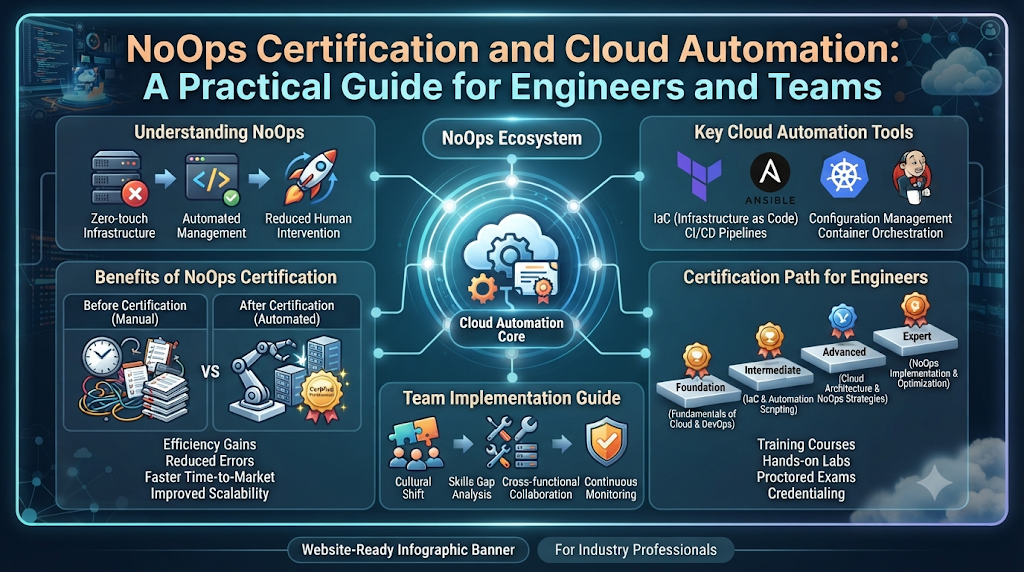
Manual server maintenance slows modern software teams down. When engineers spend hours clicking through cloud consoles, patching instances by hand, or chasing routine deployment glitches, product delivery stalls.
Understanding what is NoOps helps teams see how deep automation changes day-to-day operations. Rather than treating infrastructure as a pile of servers that need constant human babysitting, NoOps focuses on automated provisioning, self-healing workflows, declarative delivery, and policy-driven guardrails.
This guide explains how automation-driven operations work, where NoOps fits alongside DevOps, which skills and tools matter most, and how a NoOps certification or structured learning path supports career and team growth. For specialized courses, certifications, consulting, and freelancer resources focused on autonomous cloud operations, explore NoOpsSchool.
Understanding NoOps and Why It Matters
At its core, NoOps (“No Operations”) describes an operational approach where routine infrastructure provisioning, scaling, deployment, and recovery are handled through automation and cloud-native platform services. The goal is to minimize repetitive manual IT tickets so engineers can focus on application architecture, reliability engineering, and business value.
A common myth is that NoOps means “zero human work” or “no accountability.” In reality, software still needs clear ownership, security boundaries, cost controls, and architecture decisions. Automation removes repetitive manual toil—it does not erase human responsibility when complex failures or policy changes occur.
Core Principles Behind NoOps
- Declarative Desired State: Teams define what infrastructure and workloads should look like in code, and automation tools reconcile live systems to match that state.
- Self-Service and Guardrails: Developers request environments or ship releases through automated pipelines bounded by security and budget policies.
- Proactive Resilience: Health checks, autoscaling, and automated remediation handle common transient faults before users notice downtime.
- Continuous Observability: Metrics, logs, and traces feed automated alerts and workflows so teams spot anomalies fast.
NoOps vs DevOps and Traditional IT Operations
Many engineers ask how NoOps vs DevOps compares in daily practice. DevOps bridges development and operations through shared ownership, collaboration, and automated delivery pipelines. NoOps builds on DevOps and cloud-native foundations by pushing routine operational tasks further into automated workflows, managed platforms, and self-healing patterns.
| Dimension | Traditional IT Operations | DevOps | NoOps Approach |
| Infrastructure Provisioning | Manual tickets, scripts, and console clicks | Automated via Infrastructure as Code (IaC) and pipelines | Self-service, policy-driven, automated provisioning |
| Deployments | Scheduled change windows, manual steps | Automated CI/CD with frequent releases | Continuous, automated delivery and GitOps reconciliation |
| Routine Recovery | Manual troubleshooting and restarts | Automated alerts with semi-automated runbooks | Self-healing controls and automated remediation where safe |
| Human Role | Hands-on server and ticket management | Collaborative build, test, deploy, and operate | Architecture, governance, exception handling, and improvement |
Neither model replaces engineering judgment. Organizations often combine DevOps practices, platform engineering, and NoOps automation gradually based on workload maturity and risk tolerance.
NoOps Architecture and Key Automation Tools
Effective automation relies on several layers working together rather than a single magic tool. NoOps automation tools typically span infrastructure code, container orchestration, continuous delivery, telemetry, and cloud platforms.
- Infrastructure as Code (Terraform / OpenTofu): Tools like Terraform and OpenTofu define cloud networks, clusters, databases, and permissions as version-controlled code. They provide repeatable provisioning and drift visibility, though state management and provider upgrades require discipline.
- Containers and Kubernetes: Docker packages applications consistently, while Kubernetes schedules containers, scales replicas, and restarts unhealthy pods automatically. Kubernetes simplifies self-healing at the workload level, though cluster upgrades, networking, and security demand real expertise.
- CI/CD and GitOps (GitHub Actions, GitLab CI/CD, Argo CD): CI/CD pipelines build, test, and package changes automatically. GitOps controllers like Argo CD keep cluster state aligned with Git repositories, making rollbacks and audit trails clearer.
- Observability and AIOps (Prometheus, Grafana, OpenTelemetry): OpenTelemetry standardizes telemetry collection; Prometheus and Grafana track metrics and dashboards; AIOps techniques help spot unusual patterns across noisy signals. No tool eliminates bad alerts or unclear architecture on its own.
- Cloud and Serverless Platforms (AWS, Microsoft Azure, Google Cloud): Managed services and serverless functions shift low-level host patching and capacity management to the cloud provider, subject to platform limits and cost trade-offs.
Step-by-Step Guide to Adopting Automation Safely
Jumping straight into full automation without clean foundations often automates mistakes faster. Follow a measured sequence:
- Map Current Manual Work: List repetitive tasks—environment requests, manual deployments, certificate renewals, or recurring restarts—and measure how much time they consume.
- Stabilize First: Fix flaky builds, missing backups, and unclear ownership before automating a workflow.
- Adopt Version-Controlled IaC: Store infrastructure definitions in Git with code reviews and automated policy checks.
- Automate Delivery and Rollbacks: Build repeatable CI/CD and GitOps workflows with automated tests and safe rollback paths.
- Add Telemetry and Self-Healing: Instrument services early, set meaningful alerts, and enable automated restarts or scaling only where behavior is predictable.
- Keep Human Gates for High-Risk Changes: Require explicit review and approval for production database migrations, IAM changes, or major upgrades.
Terraform
resource "aws_s3_bucket" "artifacts" {
  bucket = "example-noops-artifacts-bucket"

  tags = {
    Environment = "production"
    ManagedBy   = "terraform"
  }
}
This Terraform snippet declares an S3 bucket with tags so infrastructure changes stay auditable and repeatable across environments.
Skills, Roles, and Career Paths in NoOps
Moving toward automation-heavy cloud operations rewards practical, hands-on engineering skills alongside clear communication:
- Foundations: Linux fundamentals, networking basics, scripting, and cloud architecture across AWS, Azure, or Google Cloud.
- Automation and Delivery: Infrastructure as Code, containerization, Kubernetes operations, CI/CD, and GitOps.
- Reliability and Security: Monitoring, observability, incident response, secret management, and least-privilege access.
Different roles emphasize different responsibilities:
- NoOps Engineer: Focuses on building and maintaining automated provisioning pipelines, CI/CD and GitOps workflows, container orchestration, and self-healing configurations.
- NoOps Architect: Focuses on cloud-native system design, automation strategy, reliability trade-offs, security boundaries, and scalable platform architecture.
- NoOps Manager: Focuses on aligning automation goals with business needs, team workflows, operational governance, risk management, and continuous improvement.
Structured study through a NoOps training course helps engineers connect isolated tools into end-to-end automated workflows. Earning a NoOps certification—such as a NoOps engineer certification, NoOps architect training path, or NoOps manager certification—can help validate knowledge and guide skill development for specific roles, while real hands-on practice remains essential for applying those concepts in production.
Practical Scenarios, Benefits, and Limitations
Consider two everyday examples:
- Automated Environment Provisioning: A platform team standardizes networking, Kubernetes namespaces, and access policies in code so feature teams spin up isolated test environments consistently without waiting days for manual tickets.
- Self-Healing Workload Recovery: A stateless microservice runs multiple replicas behind health probes and autoscaling rules. When a single container hangs or a node drains, traffic shifts cleanly and a fresh instance replaces the unhealthy one automatically.
Benefits vs. Realistic Limitations
Automation reduces repetitive manual toil, speeds up environment delivery, improves consistency, and lowers human error on routine tasks. At the same time, teams face real trade-offs: upfront engineering effort to write and test automation, skill gaps across cloud and Kubernetes tooling, security risks if pipelines or credentials are misconfigured, and ongoing maintenance as APIs and platforms evolve.
Common Mistakes to Avoid
- Automating Broken Processes: Automating a messy manual workflow only spreads errors faster. Clean up the process first.
- Treating Automation as “Set and Forget”: Automated pipelines and self-healing rules still need monitoring, testing, and periodic updates.
- Skipping Security in Automation: Never hardcode secrets in scripts or repositories, and keep permissions scoped tightly.
- Ignoring Rollback and Recovery Plans: Always test how to revert a bad automated change and how to recover from regional or dependency failures.
How NoOpsSchool Supports Learners and Organizations
NoOpsSchool focuses specifically on NoOps education, cloud infrastructure automation, and modern delivery practices. Individuals can explore role-aligned training and certifications—including NoOps engineer certification, NoOps architect training, and NoOps manager certification tracks—to build practical skills across Infrastructure as Code, Kubernetes, GitOps, CI/CD, and cloud automation.
Organizations looking for outside support can also explore NoOps consulting services for automation strategy, cloud-native modernization, and operational assessments, or look into options to hire NoOps freelancers for targeted technical tasks such as Terraform, Kubernetes, or automated monitoring. When evaluating any consultant or freelancer, define clear scope, security access boundaries, and deliverables up front.
Frequently Asked Questions (FAQs)
1. What is NoOps in simple terms?
NoOps is an operational approach that uses automation, Infrastructure as Code, and cloud-native platforms to reduce routine manual IT work while keeping clear engineering ownership and governance.
2. How does NoOps differ from DevOps?
DevOps emphasizes collaboration, shared ownership, and automated delivery between development and operations, while NoOps focuses on pushing repetitive operational tasks into automated workflows and self-healing systems.
3. Does NoOps mean there are no operations engineers or managers?
No. Engineers and managers still design architectures, enforce security and cost policies, handle complex incidents, and guide continuous improvement.
4. Who should consider a NoOps certification or training course?
Software developers, system administrators, DevOps engineers, cloud architects, and IT managers who want structured knowledge of cloud automation and modern delivery practices.
5. What is the difference between NoOps engineer, architect, and manager roles?
Engineers implement automation pipelines and infrastructure code, architects design scalable and secure automated systems, and managers focus on governance, planning, and team alignment.
6. Which tools are commonly used in NoOps workflows?
Teams commonly use Terraform or OpenTofu for IaC, Docker and Kubernetes for containers, GitHub Actions or GitLab CI/CD and Argo CD for delivery and GitOps, and Prometheus, Grafana, and OpenTelemetry for observability.
7. Can beginners start learning NoOps concepts?
Yes. Starting with basic Linux, Git, cloud fundamentals, and simple automation scripts makes it much easier to understand containers, IaC, and automated pipelines later.
8. What are the biggest risks of adopting NoOps automation?
Misconfigured automation can replicate errors quickly, expose secrets or overly broad permissions, or hide underlying issues if monitoring and alerts are weak.
9. When should an organization use NoOps consulting services?
Organizations often seek consulting when planning cloud modernization, assessing automation gaps, or designing standardized CI/CD and infrastructure-as-code workflows.
10. What should companies check before they hire NoOps freelancers?
Verify relevant hands-on experience with the required stack (such as Terraform, Kubernetes, or CI/CD), define clear milestones and deliverables, and enforce least-privilege access and confidentiality terms.
Conclusion
NoOps is not about abandoning operational discipline or trusting blind automation. It is about automating repetitive infrastructure and delivery work responsibly so engineering teams can focus on building reliable, secure, and useful software.
Start by identifying one manual bottleneck in your workflow this week and automating it safely with version control and clear monitoring. To explore structured courses, certifications, consulting, and specialist resources, visit NoOpsSchool.