Introduction
When we think about problems in the IT world, we usually imagine broken servers, crashed websites, or computers that just stop working. But here is a truth that many people don’t talk about: the biggest problem in IT is not the technology. It is the people. More specifically, it is getting different groups of people to talk to each other and work together nicely when something goes wrong.
In most companies, the IT department is not one big happy family. It is split into many small teams. There is a team for the network. There is a team for the database. There is a team for the software or the app. There is a team for the servers. Each team is full of smart people. But each team lives in its own little world. They have their own tools, their own screens, and their own way of doing things. So when a big problem happens, these teams often spend more time blaming each other than actually fixing the problem.
This is where AIOps comes in. AIOps means using Artificial Intelligence to help run IT operations. At its heart, AIOps is a tool for machines. But its biggest gift is actually for humans. It helps humans stop fighting and start working together. If you want to learn more about how this works in real life, you can check out the resources at Aiopsschool. In this blog, we will look at how AIOps turns a messy, stressful IT team into a calm, helpful, and collaborative group.
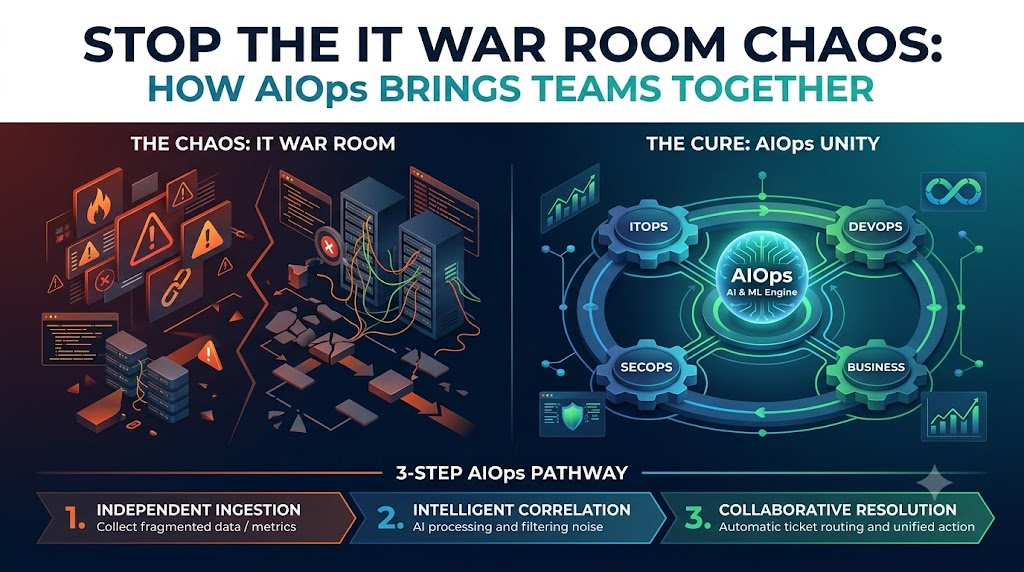
The Nightmare of the IT “War Room”
To understand why AIOps is so helpful, we first need to understand the problem. In the IT world, there is a famous idea called “silos.” A silo is a tall, closed tower. On a farm, a silo keeps grain separate from other grain. In a company, a silo keeps teams separate from other teams. The network team sits in one room. The database team sits in another. The app developers sit somewhere else. They might even be in different buildings or different countries.
Now imagine this: it is 3:00 in the morning. A big website has just crashed. Thousands of customers cannot buy anything. The company is losing money every single second. A “War Room” is opened. This is a big conference call where 20 tired engineers join. Everyone is sleepy. Everyone is stressed. And everyone is scared they will get blamed.
The network engineer says, “My network is fine. The problem must be the database.” The database engineer says, “My database is fine. The problem must be the app code.” The app developer says, “My code is fine. The problem must be the servers.” And on and on it goes. For two hours, these smart people do not fix anything. They just look at their own separate screens and point fingers. This is called the “Blame Game.” It is a huge waste of time and it makes everyone feel terrible.
The worst part is that nobody is lying. Each team really is looking at their own data. And their own data really does look fine. But because their data lives in separate places, nobody can see the whole picture. They are like blind people touching different parts of an elephant. One feels the trunk and says it is a snake. One feels the leg and says it is a tree. Nobody can agree because nobody can see the full animal. That is the sad reality of a siloed IT team.
How AIOps Becomes the Unbiased Referee
So how does AIOps fix this? Think of AIOps as a referee in a sports game. A good referee does not take sides. A good referee just watches the whole field and tells everyone what really happened. AIOps does the same thing for IT teams. It collects data from every single team, puts it all in one place, and then uses smart math to find the real problem. Let’s break this down into three big ideas.
Creating a Single Source of Truth
The first and most important thing AIOps does is create a “Single Source of Truth.” This simply means one place where everyone looks. Instead of the network team having one dashboard and the app team having another, AIOps brings all the data into one big, shared dashboard. The network data, the server data, the app data, and the database data all sit side by side. When a problem happens, everyone opens the same screen. They all see the same red alert. They all see the same timeline of events. This is a huge change. It is like the blind people suddenly getting their eyesight back. Now everyone can see the whole elephant together.
Stopping the Pointing Fingers
The second thing AIOps does is stop the blame game. Because AIOps looks at all the data at once, it can find the real root cause. The root cause is the very first thing that went wrong. Let’s say a network cable was cut, and that caused the database to slow down, and that caused the app to crash. A human might blame the app. But the AI looks at the timeline and says, “Actually, the network cable was cut first. That is the real problem.” The AI is not emotional. It is not tired. It is not trying to protect its job. It just shows the facts. When the facts are clear, the arguing stops. The network team says, “Oh, it was us. Sorry, team. Let’s fix it.” And then everyone helps.
Automating the Boring Work so Humans Can Talk
The third thing AIOps does is take away the boring, repeated work. In the old days, engineers spent hours just gathering information. They would run 50 different commands, copy the results into a document, and then talk. It was slow and painful. AIOps does all this gathering automatically in seconds. It also fixes small problems on its own. For example, if a server is getting too full, AIOps can restart it without asking anyone. This means the humans have more free time. And what do they do with that free time? They talk. They plan. They help each other. They do the human work of collaboration. The machine does the boring work, and the humans do the smart work together.
Comparing a Siloed IT Team vs. An AIOps Collaborative Team
Let’s put these two worlds side by side. The table below shows the big differences. Remember, both teams have smart people. The only difference is the tools and the culture.
| Feature | Traditional Siloed IT Team | AIOps Collaborative Team |
|---|---|---|
| Time Spent Arguing vs. Fixing | Most of the time is spent arguing and blaming. Only a little time is spent actually fixing. | Very little time is spent arguing. Almost all the time is spent fixing the problem together. |
| Team Stress Levels (Burnout) | Very high. People are tired, scared, and angry. Many good workers quit. | Much lower. People feel supported. They trust their teammates and sleep better. |
| Where the Data Lives | Data is hidden in separate tools for each team. Nobody sees the whole picture. | Data lives in one shared AI platform. Everyone sees the same clear picture. |
| The “War Room” Feeling | A scary, loud, and stressful fight. People try to hide their mistakes. | A calm, focused, and friendly problem-solving session. People feel safe to share. |
| Speed of Fixing Problems | Slow. It can take hours or even days to find the real cause. | Fast. The AI finds the real cause in minutes. |
| Who Gets the Blame | The weakest team or the newest person usually gets the blame. | Nobody gets blamed. The system is fixed, and the team learns together. |
Looking at this table, we can see that the AIOps team is not just faster. It is also happier. This is very important. In the old model, the stress of the blame game makes people sick. It makes them want to leave their jobs. In the new model, people feel like they are on the same side. They feel like a real team. The data is not hidden in private rooms anymore. It is out in the open for everyone to see and use.
Another big difference is the speed. In a siloed team, finding the root cause is like looking for a needle in a haystack. In an AIOps team, the AI has already found the needle for you. It points right at it and says, “Here it is.” This means the team can fix the problem before the customers even notice. And when the team fixes problems fast, they feel proud. They feel good about their work. That good feeling builds up over time and creates a strong, healthy team culture.
Real-World Scenario: Fixing a Black Friday Crash Together
Let’s make this real with a story. Imagine a big online store. It is Black Friday. This is the busiest shopping day of the year. Millions of people are trying to buy things at the same time. Suddenly, the checkout page stops working. Customers click “Buy” and nothing happens. The company is losing thousands of dollars every minute.
In the Old World (Siloed Team):
A War Room is opened. The app developer says, “The code is perfect. It must be the database.” The database engineer says, “The database is fine. It must be the network.” The network engineer says, “The network is fine. It must be the servers.” They argue for 45 minutes. Nobody looks at the whole picture. Finally, a junior engineer notices a small error in the logs. But by then, 45 minutes are gone. The company lost a lot of money. And everyone is angry and tired.
In the New World (AIOps Team):
The AIOps system sees the problem before any human does. It looks at all the data at once. It sees that the network is fine. It sees that the servers are fine. But it sees that the database is getting a strange, slow response from a specific piece of code in the checkout app. The AI sends a clear alert to one shared dashboard. It says, “Root cause: A slow database query in the checkout app code. Here is the exact line.”
The app developer and the database engineer open the same dashboard at the same time. They see the same alert. There is no arguing. The app developer says, “Oh, I see it. That is my code. Let me fix it.” The database engineer says, “I will help you test it.” They work together. In 10 minutes, the code is fixed. The checkout page works again. The customers are happy. The company makes money. And the team feels like heroes. They did not fight. They collaborated. And the AI was the referee that made it all possible.
This story shows the real power of AIOps. It is not just about fancy technology. It is about giving humans the clear information they need to be their best selves. When people are not scared and confused, they are kind and helpful. AIOps removes the fear and confusion. It lets the good side of human nature shine.
Building a Culture of Trust with AI
Now, here is a big question. If you are a manager and you bring in AIOps, your team might be scared. They might think, “Is this AI going to replace me? Is it going to watch my every move and get me fired?” This is a very normal fear. Building trust is the most important job for any leader who wants to use AIOps.
The first step is to be honest. Tell your team, “This AI is not here to replace you. It is here to take away the boring parts of your job. It is here to stop the 3 AM blame game. It is here to make your life easier.” Then, show them. Let them use the tool. Let them see how it finds problems in seconds. Let them see how it gives them more time to do the interesting work.
The second step is to change how you measure success. In the old world, managers often asked, “Who caused this problem?” In the new world, managers should ask, “How fast did we fix this together?” and “What did we learn?” When the team sees that the manager is not looking for someone to blame, they will stop hiding things. They will start sharing things. And that is when true collaboration begins.
The third step is to celebrate the wins. When the team uses AIOps to fix a big problem quickly, celebrate it. Order pizza. Say thank you. Make it a happy moment. This builds a good feeling around the new tool. Over time, the team will not see the AI as a spy. They will see it as a helpful teammate. They will trust it. And they will trust each other more too. That is the real magic of AIOps. It is a tool that builds human trust.
FAQs
1. What is AIOps in very simple words?
AIOps means using smart computer programs (AI) to help IT teams watch their systems. It collects data from everywhere and finds problems fast. Think of it as a super-smart helper for computer teams.
2. How does AIOps stop the “Blame Game” in IT?
AIOps puts all the data in one place. Everyone sees the same facts. When the facts are clear, there is nothing to argue about. The AI shows the real problem, so the teams can fix it together instead of fighting.
3. Is AIOps going to replace human IT workers?
No. AIOps is a tool to help humans, not replace them. It does the boring, repeated work. This gives humans more time to do the smart, creative work. It makes their jobs easier and less stressful.
4. What is a “Single Source of Truth” in AIOps?
It means one shared place where all the data lives. Instead of each team having its own private data, everyone looks at the same dashboard. This helps everyone see the whole picture at the same time.
5. Why is the old “War Room” so bad for teams?
The old War Room is full of stress and blame. People are tired and scared. They spend more time arguing than fixing. This makes people sick and makes them want to quit their jobs.
6. Can a small IT team use AIOps?
Yes. AIOps is not just for big companies. Even a small team can use it. It helps small teams work faster and smarter. It stops them from wasting time on small problems.
7. How does AIOps help with employee burnout?
Burnout comes from stress and doing boring work. AIOps takes away the boring work. It also stops the blame game. This means less stress and happier workers. Happy workers do not burn out as fast.
8. Do I need to be a computer genius to use AIOps?
No. Modern AIOps tools are made to be easy. They have simple dashboards. They use clear language. You do not need to be a genius. You just need to be willing to learn.
9. What is the biggest benefit of AIOps for a team?
The biggest benefit is better teamwork. When people stop blaming each other and start helping each other, the whole team gets stronger. They fix problems faster and feel better about their work.
10. How do I convince my team to trust AIOps?
Be honest with them. Tell them it is a helper, not a replacement. Show them how it makes their life easier. Celebrate wins together. When they see the good results, they will trust it.
Conclusion
In the end, the biggest challenge in IT is not fixing computers. It is getting humans to work together. For too long, IT teams have been trapped in silos. They have wasted precious hours in stressful War Rooms, playing the blame game while customers suffer. This old way of working is bad for business and bad for people. It creates burnout, anger, and a bad culture.
AIOps offers a beautiful way out. By collecting all the data in one place, AIOps creates a Single Source of Truth. By finding the real root cause, it acts as an unbiased referee. By automating boring work, it gives humans time to talk and help each other. The comparison is clear. A siloed team is slow and sad. An AIOps collaborative team is fast and happy. Real-world stories, like fixing a Black Friday crash, show how AIOps can turn a 45-minute argument into a 10-minute team win.
Yes, we must be careful. We must build trust. We must show our teams that AI is a helper, not a replacement. But if we do that, the rewards are huge. We get faster fixes, happier engineers, and a stronger company. AIOps is not just a technology. It is a new way of working. It is a way of bringing people together. And that is the most powerful thing any tool can do.