Introduction
Modern cloud setups have grown too large and intricate for human eyes. When thousands of microservices run across multiple clouds, scrolling through wall-to-wall dashboard charts during an outage simply fails.
Smart engineering teams no longer use basic tools that just bunch up noisy alerts. Instead, artificial intelligence has grown into an active co-pilot that spots trouble early and helps stop downtime before your customers notice.
If you want to master these practical skills, learning resources like AIOpsSchool.com show you how to build and manage modern intelligent pipelines.
In this guide, we will unpack how smart systems fix themselves, how language models read your code traces, and the exact steps you can take today to prepare your infrastructure.
Simple Definition & Basics
AIOps uses machine learning and data science to automate routine IT operations, spot subtle system anomalies, and fix software glitches before they cause downtime.
Years ago, system admins relied on simple static rules. A computer sent a loud text message whenever memory or CPU crossed 90 percent.
Modern cloud computing changed that game. Workloads jump up and down every second, making static rules ring false alarms all day.
Next-gen operations use smart statistical models instead. These models learn normal daily traffic patterns, ignore brief spikes, and spot genuine system rot before a crash happens.
6 Core Pillars of Modern AIOps Architectures
Every reliable intelligent operations platform relies on six foundational building blocks.
1. Unified Telemetry Streaming
- Single-pipe ingestion: The platform pulls in logs, system metrics, network traces, and security events together into one real-time data stream.
- Open standards support: Using open collectors prevents vendor lock-in and keeps telemetry flowing cleanly from every cluster.
2. Dynamic Noise Filtering
- Context-aware filtering: The engine ignores predictable spikes during busy shopping hours or planned batch jobs.
- Alert deduplication: Hundreds of repetitive ping errors get grouped into a single, clean incident card.
3. Autonomous Root-Cause Tracing
- Topology mapping: The system tracks how every container, database, and API connects across your network.
- Instant blame checks: When an API slows down, the tool follows the dependency graph straight to the slow database query.
4. Safe Automated Actions
- Guarded execution: The engine triggers safe scripts to clear disk caches or restart hung pods without waking an engineer.
- Blast-radius control: Guardrails stop scripts from restarting critical core databases without a senior human review.
5. Natural Language Incident Summaries
- Plain-text briefs: Language models read complex system errors and write simple incident summaries for engineers.
- Commit linking: The platform checks recent code commits and points out which exact pull request broke the build.
6. Closed-Loop Feedback
- Human-in-the-loop tuning: Every time an engineer accepts or skips a recommendation, the model learns the team’s preference.
- Continuous score tracking: The system monitors its own auto-fixes to ensure they actually restore service health.
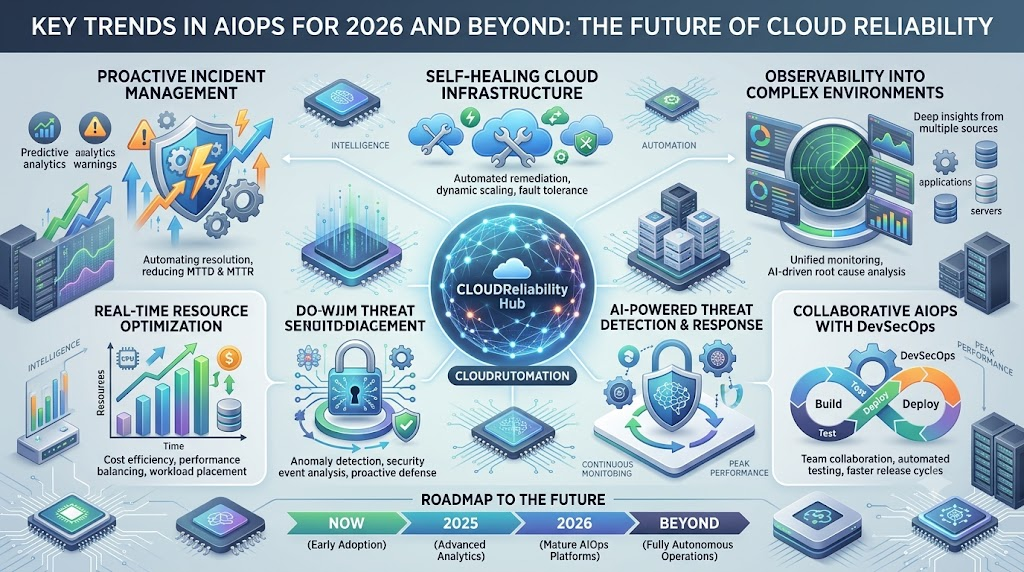
Key Trends in AIOps for 2026 and Beyond
The landscape of cloud reliability is shifting rapidly toward full automation. Here are the core movements shaping intelligent infrastructure.
Autonomous Self-Healing Infrastructure
Think of self-healing systems like the human body’s immune system. When a tiny bug enters your body, white blood cells fight it off without you having to think about it.
Future cloud infrastructure works the same way. If a memory leak chokes an application pod at 3 AM, the platform drains traffic, restarts the container, and verifies health checks.
Engineers wake up to a green status dashboard and a clean post-incident log rather than a ringing alarm clock.
Language Models as Ops Agents
Generative AI is moving far past simple chat widgets. Modern ops agents live inside your incident response channels.
When a service throws an error, the agent reads the stack trace, digs through git logs, and finds the exact line of bad code.
The agent can then draft a pull request to roll back the change and explain the fix in plain English for review.
The Shift from MTTR to MTTP
Teams used to brag about Mean Time to Repair (MTTR), which measures how fast you patch an active fire.
The new gold standard is Mean Time to Prevention (MTTP). Systems look for early warning signs, such as slowly filling connection pools or micro-latency spikes.
Fixing tiny imbalances early keeps the system stable so true outages never start in the first place.
Green and Cost-Aware Compute
Cloud bills and carbon output now drive architectural choices.
Next-gen operations platforms track power grids and pricing swings across regions in real time.
The system moves large, non-urgent data batch jobs to server farms running on clean solar or wind energy when local power is cheapest.
Convergence of MLOps and AIOps
Teams now treat operations models with the same strict care they give to core software code.
If an anomaly model drifts or misses new patterns, automated test suites catch the flaw in a sandbox.
This tight bond ensures that the AI watching your systems remains accurate, fast, and dependable.
AIOpsSchool.com Guide to Future-Proofing Ops Skills
Learning new operations tools does not require massive enterprise budgets. You can build hands-on skills directly on your own computer.
Start by setting up a local Kubernetes cluster using lightweight tools. Feed basic application metrics and log streams into an open-source analytics pipeline.
Next, write small Python scripts that flag sudden error spikes using simple moving averages.
Run chaotic experiments by randomly stopping test pods. Then, write automation scripts that detect the stopped container and bring it back online safely.
Practicing these feedback loops in safe sandbox labs gives you the exact skills needed to run enterprise-grade autonomous systems.
Real-World Applications
Intelligent operations keep mission-critical digital systems running across every major industry.
- Global Retail Checkouts: During holiday flash sales, smart engines balance payment gateway traffic across cloud regions, stopping shopping cart crashes.
- Banking and Instant Payments: Real-time stream filters watch millions of card swipes, isolating broken network paths within milliseconds without delaying transactions.
- Healthcare Patient Portals: Automated systems catch memory leaks in hospital records software, rolling out fresh containers before nurses experience screen freezes.
- Cloud-Native Streaming: Video platforms use dynamic scaling models to prepare server fleets minutes before a live championship match kicks off.
Comparison Table
| Feature Area | Early AIOps | Next-Gen AIOps (2026 and Beyond) |
| Primary Role | Static alert aggregator | Active autonomous co-pilot |
| Alert Handling | Simple grouping by rule sets | Smart root-cause discovery |
| Action Style | Manual clicks on dashboards | Safe self-healing scripts |
| Human Interaction | Engineer investigates raw logs | Agent drafts fix summaries |
| Main Focus | Fast repair after crashes (MTTR) | Early outage prevention (MTTP) |
Why Tracking These Trends Matters
Ignoring the evolution of operations creates brittle infrastructure and exhausted teams.
Engineers trapped in old operational models spend their best hours fighting repetitive firefighting cycles. Learning automated techniques frees you to work on high-value features and system design.
For businesses, smart operations protect revenue. When systems spot and heal their own flaws, customer trust stays high and cloud waste drops quickly.
Common Roadblocks & How to Overcome Them
Adopting smart automation comes with real hurdles. Here is how you can clear them.
1. Dirty and Fragmented Data
- The Problem: Logs live in silos with mismatched timestamps and messy formatting, confusing machine learning models.
- The Fix: Adopt standardized open telemetry formats across all teams before applying machine learning tools.
2. Fear of Unchecked Automation
- The Problem: Leaders worry an automated script will accidentally wipe a live production database.
- The Fix: Start with read-only recommendations. Let the system suggest fixes to human operators until you verify its accuracy.
3. Siloed Engineering Teams
- The Problem: Software developers write code without knowing how the operations tools monitor live health.
- The Fix: Pair developers with operations engineers to write shared automated runbooks for common services.
5 Easy Steps to Prepare Your Infrastructure Today
You do not need to overhaul your entire platform overnight. Follow this simple checklist to build a solid foundation.
- Standardize your telemetry: Send all logs, metrics, and network traces through unified open-source collectors.
- Clean up noisy alerts: Turn off legacy alerts that nobody looks at to eliminate alert fatigue.
- Map your service dependencies: Ensure your monitoring platform clearly sees which services talk to each database.
- Draft basic runbooks: Turn your standard manual fixes into version-controlled scripts with strict parameters.
- Test small automated actions: Allow your tools to auto-restart stateless pods in your staging environment first.
Emerging Career Roles in AIOps
The move toward autonomous operations creates exciting new career opportunities.
- AIOps Platform Engineer: Builds and runs the data pipelines that ingest and clean enterprise telemetry feeds.
- Autonomous Systems Architect: Designs guardrails, safety policies, and self-healing systems across multi-cloud environments.
- Reliability Automation Specialist: Writes safe scripts and event-driven workflows that resolve common production alerts.
- MLOps-Ops Bridge Engineer: Keeps operations machine learning models accurate, trained, and free from data drift.
- Incident Telemetry Analyst: Audits complex system logs and shapes observability data to help AI agents troubleshoot faster.
The Long-Term Horizon for Operations
The future of infrastructure points toward invisible maintenance.
We will soon see autonomous platforms perform rolling operating system upgrades without human scheduling meetings.
Clusters will dynamically swap failing cloud hardware vendors in real time without dropping a single active network connection.
Operations engineers will manage vast global server fleets by speaking natural instructions to intelligent control rooms.
Common Myths Debunked
Let us clear up four frequent misunderstandings about intelligent operations.
- Myth 1: AI will eliminate all DevOps and sysadmin jobs.Reality: Automation removes boring, repetitive chores like clearing full disks, letting engineers focus on creative system architecture.
- Myth 2: Modern operations tools work without human oversight.Reality: People set the safety rules, write the policies, and review high-risk actions before execution.
- Myth 3: You need billions of dollars to use smart ops.Reality: Modern open-source tools and lightweight cloud utilities let small teams adopt smart monitoring quickly.
- Myth 4: Automation fixes bad application code automatically.Reality: Self-healing systems keep infrastructure stable, but software developers still need to fix the root bugs in their code.
Frequently Asked Questions
1. What is the main difference between traditional monitoring and AIOps?
Traditional monitoring tells you when a server breaks after a static limit is crossed. Modern intelligent operations spot subtle metric trends early and can trigger automated fixes before systems crash.
2. Can small startups benefit from these operations trends?
Yes, small teams benefit greatly because automated tools handle routine maintenance without needing a large 24/7 support staff. Using modern cloud monitoring keeps lean teams productive.
3. Does autonomous self-healing put live production data at risk?
No, because well-designed platforms use strict guardrails. Safe systems only handle low-risk tasks like restarting stateless pods, leaving stateful database actions to human engineers.
4. How do large language models help during a major outage?
Language models read thousands of messy error lines and turn them into plain-English summaries. They also check recent git commits to highlight code changes that might have caused the issue.
5. What is the difference between MTTR and MTTP?
MTTR measures the average time it takes to fix a system after it breaks down. MTTP measures how often your tools catch and resolve warning signs before a real failure happens.
6. Do I need to be a data scientist to work in modern cloud operations?
No, you do not need a data science degree. Most platforms package complex models into simple settings, so engineers only need solid cloud fundamentals and basic scripting skills.
7. How does smart infrastructure reduce monthly cloud bills?
Intelligent schedulers spot idle compute power and shrink unused instances automatically. They also move batch processing workloads to lower-cost cloud regions during off-peak hours.
8. What is telemetry data in modern cloud computing?
Telemetry data refers to the raw logs, system metrics, network traces, and events that servers produce every second. Modern operations platforms analyze these streams together to understand overall system health.
9. Can AIOps tools prevent human coding mistakes?
They cannot stop an engineer from writing a bug, but they can detect abnormal behavior immediately in staging pipelines. This quick feedback stops faulty builds from reaching your end users.
10. Where should an engineering student start learning these concepts?
Begin by learning Linux basics, container tools, and open-source metric gathering. Once you understand normal traffic patterns, practice writing basic automation scripts to handle simulated system faults.
Modern cloud reliability is entering a thrilling new chapter where human creativity pairs with intelligent, self-healing platforms. Instead of losing sleep over midnight alerts, engineers can now build resilient systems that defend themselves. Embracing these new skills will keep your career sharp and your services running smoothly. Explore the community projects and learning guides at AIOpsSchool.com to start building the future of automated operations today.