Introduction
AI Student Success Prediction tools use artificial intelligence, machine learning, and learning analytics to identify patterns that may indicate whether a student is likely to succeed, struggle, disengage, or need additional academic support. These platforms analyze signals such as attendance, grades, assignment completion, course activity, assessment performance, and engagement patterns to help educators make earlier and more informed interventions.
The goal is not simply to predict a final grade. A well-designed student-success system can help institutions identify students who may benefit from tutoring, advising, additional learning resources, or personalized suSchools, colleges, universities, online education providers, tutoring organizations, and education teams managing large numbers of learneVery small classrooms where educators already have direct knowledge of every learner, environments without sufficient student data, or organizations looking for a fully automated system that makes student decisions without human review.
What Is AI Student Success Prediction?
AI Student Success Prediction refers to the use of data analytics, machine learning, and AI to estimate the likelihood of different student outcomes.
A conventional educational workflow might identify struggling students only after:
- Grades decline
- Assignments are missed
- Attendance drops
- A student stops participating
- An exam is failed
Predictive analytics attempts to identify these patterns earlier.
For example, a system might detect that a student has:
- Increasingly missed assignments
- Declining assessment scores
- Reduced learning-platform activity
- Low attendance
- A sudden change in engagement
The platform may then assign an elevated risk level to that student.
The prediction itself should not be treated as a definitive statement about the student’s future. It is better understood as a signal that educators can investigate.
How AI Student Success Prediction Works
Data Collection
Predictive systems can use multiple data sources, depending on the institution and platform.
Potential signals include:
- Grades
- Assessment results
- Attendance
- Assignment submissions
- LMS activity
- Course participation
- Login patterns
- Academic history
- Advising interactions
- Course enrollment
- Engagement indicators
Not every platform uses all of these signals.
Feature Analysis
Machine-learning systems identify relationships between historical data and student outcomes.
For example, historical analysis might reveal that combinations of low assessment performance and declining course engagement are associated with increased withdrawal risk.
Risk Prediction
The system can generate predictions such as:
- Low risk
- Moderate risk
- High risk
Some systems may instead produce probabilities or risk scores.
Early Intervention
Educators, advisors, or student-success teams can review the prediction and decide whether intervention is appropriate.
Possible interventions include:
- Tutoring
- Advising
- Study resources
- Instructor outreach
- Academic planning
- Financial or support referrals
- Additional learning materials
Outcome Monitoring
The institution can monitor whether interventions actually improve outcomes.
This is important because prediction alone does not create student success.
Why AI Student Success Prediction Matters
Educational institutions often struggle to identify students who need help early enough.
A student may appear to be doing reasonably well while subtle changes in behavior indicate emerging difficulties.
Predictive analytics can help institutions move from:
Reactive support → Early identification → Targeted intervention → Outcome measurement
Potential benefits include:
- Earlier support
- Better advisor prioritization
- Improved retention workflows
- More personalized intervention
- Better use of student-success resources
- Faster identification of engagement changes
- Institution-wide visibility
However, predictive systems can also introduce significant risks.
A model trained on historical data may reproduce historical inequalities. A prediction can also be misunderstood as a judgment about an individual student.
Human review, transparency, fairness testing, and careful governance are therefore essential.
Key Features to Look For
When evaluating AI Student Success Prediction platforms, consider:
- Early-warning alerts
- Risk scoring
- Predictive analytics
- Student dashboards
- Advisor dashboards
- Retention analytics
- Engagement monitoring
- Grade analysis
- Attendance integration
- LMS integration
- Intervention workflows
- Case management
- Student segmentation
- Cohort analysis
- Explainable predictions
- Model monitoring
- Bias testing
- Role-based access
- Audit logs
- Data governance
- Privacy controls
- API support
- Reporting
- Outcome tracking
Major Use Cases
Early-Warning Systems
Institutions can identify students whose academic or engagement patterns have changed.
Retention Programs
Student-success teams can prioritize outreach toward learners who may require additional support.
Academic Advising
Advisors can use predictive signals to determine which students may need attention.
Course Performance
Faculty can identify students who may struggle with a course before final assessments.
Online Learning
Online institutions can analyze engagement patterns that may indicate disengagement.
Personalized Support
Predictions can trigger targeted interventions instead of applying identical support programs to every student.
Institutional Planning
Administrators can identify patterns across courses, departments, programs, and cohorts.
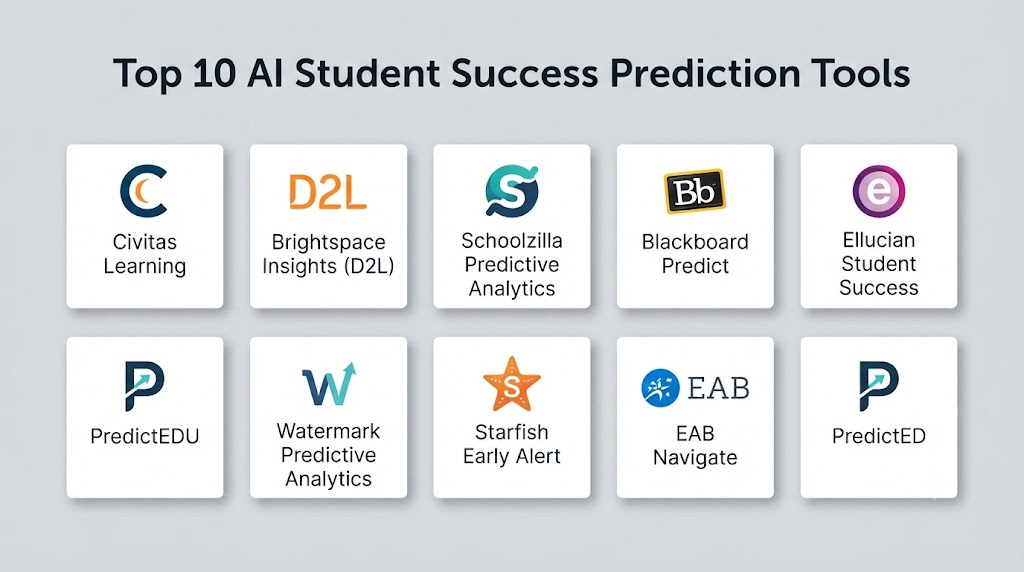
Top 10 AI Student Success Prediction Tools
1. Civitas Learning
One-line verdict: Best for institutions seeking predictive analytics and personalized student-success decision support at scale.
Short description:
Civitas Learning provides higher-education analytics and student-success solutions designed to help institutions understand learner behavior, identify opportunities for intervention, and support student outcomes.
Standout Capabilities
- Student-success analytics
- Predictive insights
- Student engagement analysis
- Intervention support
- Institutional analytics
- Personalized recommendations
- Cohort analysis
- Student-success workflows
AI-Specific Depth
- Model support: Proprietary/managed predictive analytics; exact model architecture varies.
- RAG / knowledge integration: Education data integrations rather than conventional RAG.
- Evaluation: Predictive model performance and institutional outcomes should be evaluated.
- Guardrails: Governance and institutional controls vary.
- Observability: Analytics and student-success reporting.
Pros
- Strong higher-education focus
- Designed around student-success use cases
- Useful for institution-wide analytics
Cons
- Primarily aimed at institutions rather than individual educators
- Requires meaningful institutional data
- Implementation can require organizational change
Security & Compliance
Security, privacy, access controls, retention, and compliance should be verified for the specific institutional deployment.
Deployment & Platforms
- Deployment: Cloud
- Platforms: Web
- Self-hosted: Not publicly stated
Integrations & Ecosystem
Civitas Learning is designed to work with institutional education data and student-success workflows.
- Student information systems
- Learning platforms
- Academic data
- Engagement data
- Student-success systems
- Analytics workflows
Pricing Model
Institutional pricing is not publicly stated.
Best-Fit Scenarios
- University retention programs
- Student-success analytics
- Large-scale early intervention
2. EAB Navigate360
One-line verdict: Best for institutions combining predictive student insights with advising, intervention, and student-success workflows.
Short description:
Navigate360 is a student-success platform designed to support advising, student engagement, communication, and intervention workflows. Predictive analytics can help institutions identify students who may need additional support.
Standout Capabilities
- Student-success analytics
- Advising workflows
- Early alerts
- Student outreach
- Intervention management
- Case management
- Student engagement
- Institutional reporting
AI-Specific Depth
- Model support: Managed predictive analytics; exact model architecture varies.
- RAG / knowledge integration: Institutional student data integrations.
- Evaluation: Institutions should validate predictive performance and intervention outcomes.
- Guardrails: Administrative controls vary.
- Observability: Student-success analytics and reporting.
Pros
- Combines prediction with intervention
- Strong advising orientation
- Useful for institutional student-success teams
Cons
- Enterprise-oriented
- Requires institutional implementation
- Predictive results require human interpretation
Security & Compliance
Institutions should verify current security, privacy, data retention, identity, and compliance requirements.
Deployment & Platforms
- Deployment: Cloud
- Platforms: Web and supported mobile experiences
- Self-hosted: Not publicly stated
Integrations & Ecosystem
- Student information systems
- LMS
- Advising
- Communication
- Early alerts
- Case management
- Analytics
Pricing Model
Institutional pricing varies.
Best-Fit Scenarios
- University advising
- Retention initiatives
- Student intervention
3. Blackboard
One-line verdict: Best for institutions seeking learning analytics alongside a broader learning management and student-support environment.
Short description:
Blackboard provides a learning management environment with analytics and student-engagement capabilities. Institutions can use learning data to understand course participation and student performance.
Standout Capabilities
- Learning analytics
- Student engagement data
- Course performance
- Early-warning workflows
- LMS integration
- Instructor dashboards
- Institutional reporting
- Learning management
AI-Specific Depth
- Model support: Managed analytics and AI capabilities vary.
- RAG / knowledge integration: LMS and institutional learning data.
- Evaluation: Analytics models should be validated against institutional outcomes.
- Guardrails: Administrative controls vary.
- Observability: Learning and engagement analytics.
Pros
- Broad LMS ecosystem
- Strong institutional adoption
- Learning data is integrated into the education workflow
Cons
- Student-success prediction is only one part of the platform
- Advanced predictive capabilities vary
- Institutions may need additional student-success tools
Security & Compliance
Verify current institutional security, privacy, retention, access-control, and compliance information.
Deployment & Platforms
- Deployment: Cloud
- Platforms: Web and supported mobile applications
- Self-hosted: Availability varies
Integrations & Ecosystem
- LMS
- Student information systems
- Assessment tools
- Learning analytics
- Course content
- Institutional systems
Pricing Model
Institutional pricing varies.
Best-Fit Scenarios
- LMS-based analytics
- Course engagement monitoring
- Institutional learning analytics
4. Canvas
One-line verdict: Best for institutions wanting learning analytics and student engagement signals within a widely used LMS environment.
Short description:
Canvas is a learning management platform with analytics, assessment, course activity, and student engagement capabilities. These data can support student-success workflows and institutional predictive analytics.
Standout Capabilities
- Course analytics
- Student activity data
- Assignment tracking
- Assessment analytics
- Instructor dashboards
- LMS integrations
- Student engagement
- Reporting
AI-Specific Depth
- Model support: Managed AI capabilities vary by feature.
- RAG / knowledge integration: LMS content and educational data.
- Evaluation: Institutional analytics should be validated.
- Guardrails: Administrative controls vary.
- Observability: Course and learner activity analytics.
Pros
- Strong LMS foundation
- Rich learning activity data
- Broad integration ecosystem
Cons
- Not primarily a dedicated predictive student-success platform
- Advanced prediction may require additional tools
- Data interpretation requires institutional expertise
Security & Compliance
Verify current institutional security and privacy requirements.
Deployment & Platforms
- Deployment: Cloud
- Platforms: Web and mobile
- Self-hosted: Not publicly stated
Integrations & Ecosystem
- LMS
- Student information systems
- Assessment platforms
- Learning tools
- Analytics
- APIs and integrations
Pricing Model
Institutional pricing varies.
Best-Fit Scenarios
- LMS analytics
- Course engagement
- Student-success data infrastructure
5. D2L Brightspace
One-line verdict: Best for learning analytics, early-warning workflows, and personalized learning within an LMS ecosystem.
Short description:
D2L Brightspace provides learning management and analytics capabilities designed to help educators and institutions understand learner progress, engagement, and performance.
Standout Capabilities
- Learning analytics
- Student engagement
- Predictive insights
- Early-warning indicators
- Personalized learning
- Course analytics
- Assessment data
- Instructor dashboards
AI-Specific Depth
- Model support: Managed AI and analytics; exact model architecture varies.
- RAG / knowledge integration: Learning and course data.
- Evaluation: Institutions should monitor prediction quality.
- Guardrails: Education and administrative controls vary.
- Observability: Learning analytics and reporting.
Pros
- Strong LMS ecosystem
- Useful learning analytics
- Supports personalized learning
Cons
- Broader than student prediction alone
- Advanced capabilities depend on configuration
- Institutional implementation can be complex
Security & Compliance
Verify current security, privacy, retention, and compliance requirements.
Deployment & Platforms
- Deployment: Cloud
- Platforms: Web and mobile
- Self-hosted: Not publicly stated
Integrations & Ecosystem
- LMS
- Student information systems
- Assessments
- Analytics
- Learning tools
- APIs
Pricing Model
Institutional pricing varies.
Best-Fit Scenarios
- University learning analytics
- Personalized learning
- Early intervention
6. Watermark Student Success & Engagement
One-line verdict: Best for institutions combining student engagement analytics with advising and retention-oriented workflows.
Short description:
Watermark provides higher-education solutions that can support student engagement, assessment, advising, and institutional effectiveness. Its ecosystem can help institutions bring multiple student-success processes together.
Standout Capabilities
- Student engagement
- Advising
- Assessment
- Institutional analytics
- Student-success workflows
- Data collection
- Reporting
- Outcome tracking
AI-Specific Depth
- Model support: Managed analytics; exact AI architecture varies.
- RAG / knowledge integration: Institutional education data.
- Evaluation: Outcome and analytics validation.
- Guardrails: Administrative controls vary.
- Observability: Institutional reporting and analytics.
Pros
- Higher-education focus
- Broad student-success ecosystem
- Useful institutional reporting
Cons
- Enterprise-oriented
- Capabilities vary across products
- Requires institutional data integration
Security & Compliance
Verify current security, privacy, retention, and compliance information.
Deployment & Platforms
- Deployment: Cloud
- Platforms: Web
- Self-hosted: Not publicly stated
Integrations & Ecosystem
- Student information systems
- Advising
- Assessment
- Institutional research
- Reporting
- Student-success workflows
Pricing Model
Institutional pricing varies.
Best-Fit Scenarios
- Higher-education analytics
- Advising
- Student engagement
7. Anthology Student
One-line verdict: Best for institutions wanting student information, analytics, and administrative workflows in a broader higher-education ecosystem.
Short description:
Anthology Student provides student information and higher-education management capabilities. Its data environment can support institutional analysis and student-success initiatives.
Standout Capabilities
- Student information management
- Academic records
- Student data
- Analytics
- Enrollment workflows
- Reporting
- Institutional operations
- Student lifecycle management
AI-Specific Depth
- Model support: Managed analytics and AI capabilities vary.
- RAG / knowledge integration: Institutional student data.
- Evaluation: Predictive capabilities should be validated against local outcomes.
- Guardrails: Administrative controls vary.
- Observability: Institutional analytics and reporting.
Pros
- Broad student information ecosystem
- Useful institutional data foundation
- Supports large organizations
Cons
- Not solely focused on prediction
- Implementation can be complex
- Requires strong data governance
Security & Compliance
Institutional security, privacy, retention, and compliance requirements should be verified before deployment.
Deployment & Platforms
- Deployment: Cloud
- Platforms: Web
- Self-hosted: Availability varies
Integrations & Ecosystem
- Student information systems
- LMS
- Enrollment
- Academic records
- Reporting
- Institutional analytics
Pricing Model
Institutional pricing varies.
Best-Fit Scenarios
- Large universities
- Student lifecycle analytics
- Institutional data management
8. Starfish
One-line verdict: Best for colleges implementing coordinated early-alert, advising, referral, and student-support workflows.
Short description:
Starfish focuses on student-success and intervention workflows. It helps institutions coordinate alerts, referrals, advising, and student support.
Standout Capabilities
- Early alerts
- Student referrals
- Advising
- Student support
- Case management
- Intervention workflows
- Student engagement
- Institutional reporting
AI-Specific Depth
- Model support: Predictive and analytics capabilities vary.
- RAG / knowledge integration: Student and institutional data.
- Evaluation: Institutions should evaluate intervention effectiveness.
- Guardrails: Role-based administrative controls vary.
- Observability: Student-success reporting.
Pros
- Strong intervention workflow
- Supports coordinated student services
- Useful for advisor teams
Cons
- More intervention-oriented than pure AI prediction
- Institutional implementation required
- Predictive functionality varies
Security & Compliance
Verify current security and privacy requirements.
Deployment & Platforms
- Deployment: Cloud
- Platforms: Web
- Self-hosted: Not publicly stated
Integrations & Ecosystem
- LMS
- Student information systems
- Advising
- Early alerts
- Referrals
- Student-support services
Pricing Model
Institutional pricing varies.
Best-Fit Scenarios
- Early-warning programs
- Academic advising
- Student-support coordination
9. Ellucian
One-line verdict: Best for higher-education institutions integrating student data, analytics, advising, and institutional operations.
Short description:
Ellucian provides higher-education technology covering student information, enrollment, advising, analytics, and institutional operations. Its ecosystem can provide data used for student-success initiatives.
Standout Capabilities
- Student information
- Analytics
- Advising
- Enrollment
- Academic data
- Student lifecycle management
- Reporting
- Institutional workflows
AI-Specific Depth
- Model support: Managed AI and analytics capabilities vary.
- RAG / knowledge integration: Institutional data integrations.
- Evaluation: Local model validation is important.
- Guardrails: Enterprise administrative controls vary.
- Observability: Analytics and reporting.
Pros
- Broad higher-education ecosystem
- Strong institutional data capabilities
- Useful for large organizations
Cons
- Broad platform rather than a dedicated prediction product
- Implementation can be complex
- Advanced predictive functionality varies
Security & Compliance
Verify current institutional security, privacy, retention, and compliance information.
Deployment & Platforms
- Deployment: Cloud
- Platforms: Web
- Self-hosted: Availability varies
Integrations & Ecosystem
- Student information systems
- LMS
- Advising
- Enrollment
- Analytics
- Institutional systems
Pricing Model
Institutional pricing varies.
Best-Fit Scenarios
- University administration
- Student-success data
- Institutional analytics
10. Mainstay
One-line verdict: Best for institutions combining student engagement communications with data-driven retention and intervention strategies.
Short description:
Mainstay focuses on student engagement and communication. Institutions can use its platform to deliver personalized communications and support student-success initiatives.
Standout Capabilities
- Student engagement
- Personalized messaging
- Automated communication
- Student support
- Outreach campaigns
- Engagement analytics
- Retention workflows
- Student services
AI-Specific Depth
- Model support: Managed AI capabilities vary.
- RAG / knowledge integration: Institutional student information and communication context.
- Evaluation: Engagement and intervention outcomes.
- Guardrails: Administrative controls vary.
- Observability: Communication and engagement analytics.
Pros
- Strong student communication
- Useful for proactive outreach
- Can complement predictive analytics
Cons
- More engagement-focused than pure prediction
- Requires institutional data and workflows
- AI capabilities vary by feature
Security & Compliance
Verify current security, privacy, retention, and institutional compliance requirements.
Deployment & Platforms
- Deployment: Cloud
- Platforms: Web and messaging channels
- Self-hosted: Not publicly stated
Integrations & Ecosystem
- Student information systems
- Messaging
- Student-success platforms
- Engagement analytics
- Communication workflows
- Institutional systems
Pricing Model
Institutional pricing varies.
Best-Fit Scenarios
- Student outreach
- Retention campaigns
- Engagement programs
Comparison Table
| Tool | Best For | Deployment | Model Flexibility | Strength | Watch-Out | Public Rating |
|---|---|---|---|---|---|---|
| Civitas Learning | Predictive student success | Cloud | Managed | Student-success analytics | Enterprise implementation | N/A |
| EAB Navigate360 | Advising and intervention | Cloud | Managed | Early intervention | Complex institutional workflows | N/A |
| Blackboard | LMS analytics | Cloud | Managed | Integrated learning data | Prediction is not its only focus | N/A |
| Canvas | Course analytics | Cloud | Managed | Broad LMS ecosystem | May need additional prediction tools | N/A |
| D2L Brightspace | Learning analytics | Cloud | Managed | Personalized learning | Configuration dependent | N/A |
| Watermark | Student engagement | Cloud | Managed | Higher-ed workflows | Product capabilities vary | N/A |
| Anthology Student | Student data | Cloud | Managed | Institutional ecosystem | Broad rather than prediction-only | N/A |
| Starfish | Early alerts | Cloud | Managed | Intervention workflows | Prediction capabilities vary | N/A |
| Ellucian | Institutional analytics | Cloud | Managed | Student lifecycle data | Enterprise complexity | N/A |
| Mainstay | Student engagement | Cloud | Managed | Personalized outreach | More engagement-focused | N/A |
Scoring & Evaluation
These scores are comparative editorial assessments rather than official vendor ratings. Student-success prediction should be evaluated using local institutional data because a model that works well in one student population may perform differently in another.
| Tool | Core | Reliability/Eval | Guardrails | Integrations | Ease | Perf/Cost | Security/Admin | Support | Weighted Total |
|---|---|---|---|---|---|---|---|---|---|
| Civitas Learning | 10 | 9 | 9 | 9 | 8 | 8 | 9 | 9 | 9.00 |
| EAB Navigate360 | 10 | 9 | 9 | 10 | 8 | 8 | 9 | 10 | 9.15 |
| Blackboard | 9 | 8 | 9 | 10 | 8 | 8 | 9 | 10 | 8.90 |
| Canvas | 9 | 8 | 9 | 10 | 9 | 9 | 9 | 10 | 9.15 |
| D2L Brightspace | 9 | 9 | 9 | 10 | 8 | 8 | 9 | 9 | 9.05 |
| Watermark | 9 | 8 | 9 | 9 | 8 | 8 | 9 | 9 | 8.75 |
| Anthology Student | 9 | 8 | 9 | 10 | 7 | 8 | 9 | 10 | 8.90 |
| Starfish | 9 | 8 | 9 | 9 | 8 | 8 | 9 | 9 | 8.75 |
| Ellucian | 9 | 8 | 9 | 10 | 7 | 8 | 9 | 10 | 8.85 |
| Mainstay | 8 | 8 | 9 | 8 | 9 | 9 | 8 | 9 | 8.50 |
Top 3 for Enterprise
- EAB Navigate360
- Civitas Learning
- D2L Brightspace
Top 3 for SMB
- Mainstay
- Starfish
- Canvas
Top 3 for Developers
- Canvas
- D2L Brightspace
- Blackboard
Which AI Student Success Prediction Tool Is Right for You?
Solo / Freelancer
Individual tutors and independent educators generally do not need enterprise predictive analytics.
For a small number of students, direct observation and simpler analytics may be more effective.
Prioritize:
- Attendance tracking
- Grade monitoring
- Assignment analysis
- Engagement indicators
- Simple dashboards
SMB
Small education providers should focus on practical early-warning capabilities.
Look for:
- Automated alerts
- Student dashboards
- Engagement tracking
- Intervention workflows
- Easy data import
- Reporting
Avoid implementing complex predictive systems without enough historical data.
Mid-Market
Mid-sized colleges and education organizations should consider:
- LMS integration
- Student information systems
- Predictive models
- Advisor workflows
- Early alerts
- Intervention tracking
- Outcome measurement
- Data governance
The ability to connect predictions to actual interventions is particularly important.
Enterprise
Large institutions should treat student-success prediction as an organizational AI system rather than simply another analytics dashboard.
Important requirements include:
- Centralized data governance
- Model monitoring
- Explainability
- Fairness testing
- Privacy controls
- Role-based access
- Auditability
- Intervention workflows
- API access
- Data portability
- Model performance monitoring
- Human oversight
Regulated Industries
Education itself has significant privacy considerations, particularly when systems process student records.
Organizations should evaluate:
- Student data protection
- Access controls
- Data retention
- Data residency
- Encryption
- Audit logging
- Consent requirements
- Model fairness
- Automated decision-making policies
A prediction should not automatically become an adverse decision about a student.
Budget vs Premium
Budget solutions may be appropriate when the institution primarily needs:
- Basic analytics
- Attendance monitoring
- Course engagement
- Simple alerts
Premium platforms become more attractive when institutions need:
- Predictive modeling
- Institution-wide analytics
- Advising workflows
- Student case management
- Advanced integrations
- Personalized interventions
Build vs Buy
Buy when:
- You need predictive analytics quickly.
- You want established education integrations.
- Your team does not specialize in machine learning.
- You need advisor and intervention workflows.
Build when:
- You have unique institutional data.
- Your prediction methodology is strategically important.
- You require complete model control.
- You have experienced data-science and engineering teams.
Implementation Playbook: 30 / 60 / 90 Days
First 30 Days: Data and Pilot
Start with one student-success use case.
Examples:
- Course failure risk
- Assignment disengagement
- Withdrawal risk
- Low engagement
Identify available data sources.
Then:
- Define the target outcome.
- Establish baseline performance.
- Clean historical data.
- Identify missing fields.
- Define acceptable false-positive rates.
- Select an initial student cohort.
Do not begin with institution-wide automation.
Days 31–60: Evaluation and Governance
Evaluate the model using historical and current data.
Measure:
- Precision
- Recall
- False positives
- False negatives
- Calibration
- Stability
- Performance across student groups
Also evaluate fairness.
Check whether predictions systematically differ across relevant demographic or socioeconomic groups.
Introduce:
- Human review
- Intervention rules
- Access controls
- Audit logging
- Data-retention policies
- Model documentation
Days 61–90: Intervention and Scale
Once predictions are reliable enough for the intended use:
- Connect alerts to advisors.
- Define intervention playbooks.
- Track intervention outcomes.
- Monitor model drift.
- Review false positives.
- Measure student outcomes.
- Improve data pipelines.
- Establish governance.
- Expand carefully to additional courses or programs.
The key metric should not be prediction accuracy alone.
Measure whether interventions actually improve student outcomes.
Common Mistakes and How to Avoid Them
- Treating predictions as facts: A risk score is a signal, not a certainty.
- Using poor-quality historical data: Bad data produces unreliable predictions.
- Ignoring model bias: Historical institutional data may contain existing inequalities.
- No human review: Advisors should investigate important predictions.
- Predicting without intervention: A warning has little value if nobody acts on it.
- Optimizing only for accuracy: Precision, recall, calibration, fairness, and intervention outcomes also matter.
- Using too many variables: Collect only data that is justified for the intended purpose.
- Ignoring privacy: Student data requires careful governance.
- No explanation: Educators need to understand why a student was flagged.
- Automating adverse decisions: Predictions should not automatically determine academic consequences.
- Ignoring model drift: Student behavior and institutional policies change over time.
- No intervention measurement: Track whether support actually improves outcomes.
- Over-alerting advisors: Too many alerts can create alert fatigue.
- Ignoring false positives: Incorrectly flagging students can create unnecessary concern.
- Deploying without student-support alignment: Technology cannot replace effective advising and educational support.
FAQs
What is AI Student Success Prediction?
AI Student Success Prediction uses machine learning and analytics to identify patterns associated with outcomes such as course performance, engagement, retention, or potential academic difficulty.
What data does student-success prediction use?
Depending on the system, it may use grades, attendance, assignment completion, LMS activity, assessment performance, enrollment information, and engagement data.
Can AI predict whether a student will graduate?
Some predictive systems can estimate outcomes associated with retention or completion, but predictions are probabilistic and depend heavily on data quality and institutional context.
Can AI identify at-risk students?
Yes. Early-warning systems can identify students whose academic or engagement patterns resemble historical patterns associated with difficulty.
Is AI student prediction accurate?
Accuracy varies significantly by institution, student population, data quality, prediction target, and model design. Institutions should validate models using their own data.
Can predictive analytics improve student retention?
It can help institutions identify students earlier and prioritize interventions. However, improved prediction alone does not guarantee improved retention.
Is student-success prediction biased?
It can be. Models trained on historical data may reproduce existing institutional inequalities. Fairness testing and ongoing monitoring are important.
Should students be told they are classified as high risk?
This depends on institutional policy, applicable requirements, and how the prediction is used. Institutions should carefully consider transparency and potential consequences.
Can AI predictions replace academic advisors?
No. Predictive systems can help advisors prioritize attention, but human advisors provide context that automated models cannot fully capture.
Can student-success tools integrate with an LMS?
Many institutional platforms integrate with LMS and student information systems, but exact integrations vary by vendor and deployment.
What is an early-warning system?
An early-warning system identifies signals that may indicate a student needs support and presents them to educators, advisors, or student-success teams.
How should organizations evaluate a prediction model?
Evaluate predictive accuracy, calibration, false positives, false negatives, fairness, stability, explainability, and the real-world effectiveness of resulting interventions.
Can small colleges use AI student-success prediction?
Yes, but the available historical data should be sufficient to support meaningful analysis. Smaller institutions may benefit from simpler analytics before implementing complex predictive models.
What is the difference between prediction and intervention?
Prediction identifies a potential risk or opportunity. Intervention is the action taken afterward, such as tutoring, advising, outreach, or additional learning support.
Conclusion
AI Student Success Prediction can help education organizations identify students who may need support earlier than traditional reactive approaches.The most valuable systems do not simply produce a risk score. They connect data, prediction, human judgment, intervention, and outcome measurement.A strong student-success workflow looks like:Platforms such as Civitas Learning and EAB Navigate360 are particularly relevant for institutions seeking dedicated student-success and intervention capabilities, while Canvas, Blackboard, and D2L Brightspace can provide valuable learning data and analytics within broader LMS ecosystems.