Introduction
AI Patient Triage Chatbots are healthcare-focused conversational systems designed to collect information about a patient’s symptoms, assess potential urgency, provide appropriate care-navigation guidance, and help connect the patient with the right healthcare service. Unlike a general-purpose chatbot, a dedicated patient-triage system typically combines conversational AI with medical knowledge, structured questioning, clinical reasoning, safety rules, and escalation workflows.These platforms can support patients before an appointment, outside normal clinic hours, during digital intake, or when they are uncertain about where to seek care. Depending on the implementation, a chatbot may recommend self-care information, telehealth, primary care, urgent care, emergency services, or another appropriate healthcare pathway.Modern systems are moving from rigid symptom forms toward natural conversations. Some platforms can understand vague descriptions, spelling errors, colloquial language, multiple symptoms, demographic information, risk factors, and previous responses. Enterprise solutions can also connect triage results with patient portals, telehealth services, scheduling, call centers, EHR workflows, and healthcare navigation.
What’s Changing in AI Patient Triage Chatbots
- Conversational triage is replacing rigid questionnaires. Patients increasingly expect to describe their symptoms naturally instead of selecting from long lists.
- Agentic healthcare workflows are emerging. Modern systems can dynamically ask follow-up questions, collect missing information, identify relevant risk factors, and guide patients through a multi-step assessment.
- Medical reasoning is becoming more important than generic language generation. A healthcare triage chatbot should not depend solely on a general-purpose language model. Combining conversational AI with verified medical knowledge and structured reasoning can provide stronger safety controls.
- Natural-language understanding is improving. Newer systems can handle misspellings, colloquial descriptions, vague symptom language, and additional details introduced during a conversation.
- Triage is becoming part of the digital front door. Instead of stopping at symptom assessment, chatbots can increasingly direct patients toward appointments, telehealth, self-care information, urgent services, or other healthcare pathways.
- Multimodal healthcare interactions are emerging. Future triage workflows may combine text, voice, images, wearable information, patient records, and structured health data, although capabilities vary significantly.
- Voice-based triage is expanding. Healthcare organizations can use AI voice agents to collect symptoms before handing the case to nurses or other clinical staff.
- Human escalation is becoming a core safety feature. High-risk or uncertain situations should be capable of moving from automated interaction to a qualified healthcare professional.
- Evaluation is moving beyond chatbot quality. Buyers should evaluate missed emergencies, inappropriate reassurance, unnecessary escalation, consistency, clinical reasoning, and performance across patient populations.
- Prompt-injection defense matters. Patient-facing AI systems need safeguards against attempts to manipulate the model into ignoring medical instructions or producing unsafe responses.
- Privacy and data governance are becoming central buying criteria. Organizations should understand how patient conversations are processed, stored, retained, accessed, and deleted.
- Model flexibility is becoming strategically important. Some organizations want proprietary healthcare AI, while others may prefer multi-model architectures or the ability to change underlying models without rebuilding the entire workflow.
- Observability is becoming essential. Healthcare organizations increasingly need to understand what happened during a conversation, which information influenced the recommendation, and when an escalation occurred.
- Multilingual triage is becoming more important. Global healthcare organizations need systems capable of supporting patients who communicate in different languages.
- Clinical explainability is becoming a priority. Triage recommendations are easier to govern when organizations can understand the evidence, reasoning pathway, and rules behind the recommendation.
Quick Buyer Checklist
- Verify how patient conversations are collected and stored.
- Check data retention and deletion policies.
- Determine whether patient data can be used for model training.
- Review data residency requirements.
- Check available encryption and access controls.
- Verify SSO and RBAC capabilities for enterprise deployments.
- Determine whether the platform uses proprietary models, external models, open-source models, or a hybrid approach.
- Ask whether organizations can use their own model infrastructure.
- Evaluate clinical knowledge sources.
- Test symptom recognition using real-world patient language.
- Test spelling mistakes and colloquial descriptions.
- Test multiple simultaneous symptoms.
- Test high-risk and emergency scenarios.
- Test hallucination behavior.
- Test prompt-injection resistance.
- Review human escalation workflows.
- Examine clinical evaluation methodology.
- Check whether regression testing is available after model updates.
- Review latency under realistic patient traffic.
- Understand usage-based AI costs.
- Evaluate EHR and patient-portal integrations.
- Check API and SDK availability.
- Review audit logging.
- Assess vendor lock-in.
- Determine whether triage rules can be customized.
- Test accessibility and multilingual support.
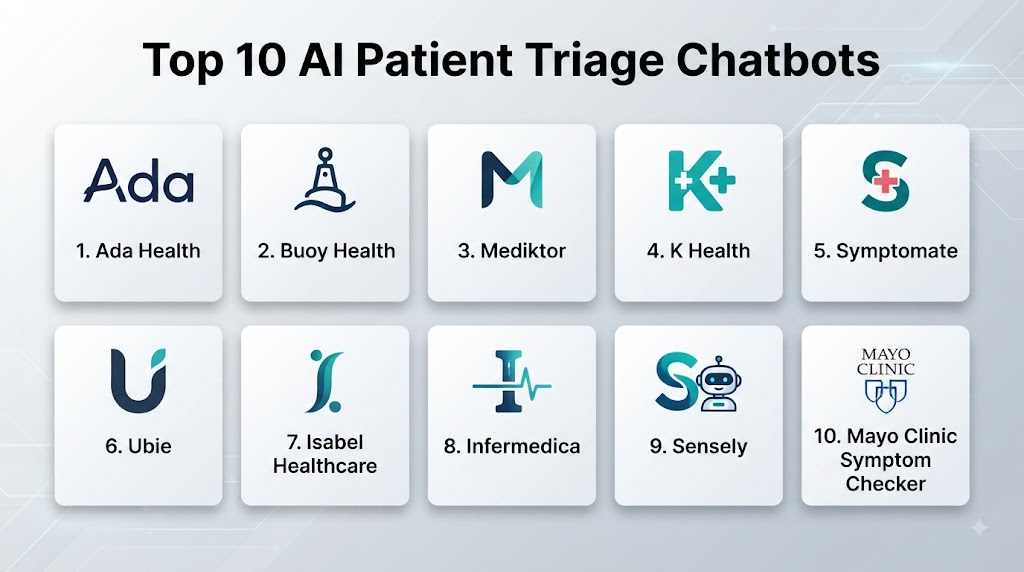
Top 10 AI Patient Triage Chatbots
1. Infermedica Triage
One-line verdict: Best for healthcare organizations seeking clinically focused AI triage, patient navigation, and enterprise healthcare integration.
Short description:
Infermedica Triage is a healthcare-focused AI triage platform designed to assess patient symptoms, collect additional information, identify possible conditions, and recommend an appropriate level of care.
Its technology is designed for healthcare providers, insurers, telemedicine organizations, and other healthcare businesses that want to embed triage into websites, applications, patient portals, or other workflows.
Standout Capabilities
- AI-powered symptom assessment.
- Dynamic patient interviews.
- Triage recommendations.
- Care-level guidance.
- Possible-condition analysis.
- Patient intake.
- Digital front-door integration.
- Healthcare-service navigation.
AI-Specific Depth
- Model support: Proprietary medical reasoning technology with conversational AI capabilities.
- RAG / knowledge integration: Structured medical knowledge base and clinical reasoning; general-purpose RAG compatibility is Varies / N/A.
- Evaluation: Clinical validation and medical knowledge review are emphasized.
- Guardrails: Clinical reasoning, predefined medical logic, triage pathways, and escalation mechanisms.
- Observability: Reporting and activity analytics are available; detailed token-level cost metrics are Not publicly stated.
Pros
- Designed specifically for healthcare triage.
- Strong enterprise and API orientation.
- Supports patient navigation in addition to symptom assessment.
Cons
- More appropriate for organizations than individual consumers.
- Implementation requires healthcare technology resources.
- Enterprise pricing is Not publicly stated.
Security & Compliance
The platform publicly describes healthcare-focused security and regulatory capabilities. Specific controls should still be verified for the intended deployment and jurisdiction. Certification and compliance scope can vary by product configuration.
Deployment & Platforms
- Cloud.
- API.
- Web applications.
- Mobile applications.
- Telehealth platforms.
- Embedded healthcare workflows.
Self-hosted deployment: Not publicly stated.
Integrations & Ecosystem
Infermedica is designed as an integration-oriented healthcare platform.
- APIs.
- Patient portals.
- Telehealth.
- Digital front doors.
- Healthcare providers.
- Insurance workflows.
- Call-center workflows.
Pricing Model
Enterprise and usage-based commercial arrangements may apply. Exact pricing is Not publicly stated.
Best-Fit Scenarios
- Hospitals implementing digital triage.
- Insurers building member health-navigation services.
- Telehealth platforms requiring structured symptom assessment.
2. Ada Health
One-line verdict: Best for organizations and consumers seeking mature AI-powered symptom assessment with personalized clinical reasoning.
Short description:
Ada Health provides an AI-powered symptom assessment experience designed to understand symptoms, ask relevant follow-up questions, and present possible causes and care guidance.
Its platform combines conversational interaction with structured medical reasoning rather than treating symptom triage as a simple general-purpose chatbot conversation.
Standout Capabilities
- Personalized symptom assessment.
- Adaptive questioning.
- AI clinical reasoning.
- Medical knowledge.
- Possible-condition analysis.
- Health-profile information.
- Care guidance.
- Consumer and healthcare applications.
AI-Specific Depth
- Model support: Proprietary AI and clinical reasoning technology.
- RAG / knowledge integration: Structured medical knowledge; general-purpose vector database integration is Not publicly stated.
- Evaluation: Clinical research and evaluation have been publicly discussed.
- Guardrails: Medical reasoning and care-guidance boundaries are built into the assessment workflow.
- Observability: Assessment-level information is available; detailed model telemetry is Not publicly stated.
Pros
- Mature symptom-assessment experience.
- Strong personalization.
- Established healthcare AI focus.
Cons
- Not intended to replace professional medical care.
- Exact model architecture is not publicly stated.
- Enterprise capabilities depend on the specific deployment.
Security & Compliance
Healthcare privacy and security controls vary according to the product and deployment. Specific certifications, retention settings, residency, and enterprise identity controls should be verified.
Deployment & Platforms
- Web.
- Mobile.
- Cloud.
- Healthcare integrations.
Self-hosted deployment: Not publicly stated.
Integrations & Ecosystem
Ada can support patient-facing healthcare experiences and digital-health workflows.
- Symptom assessment.
- Healthcare organizations.
- Patient engagement.
- Clinical knowledge.
- Digital health.
- Care navigation.
Pricing Model
Consumer and enterprise arrangements vary. Exact enterprise pricing is Not publicly stated.
Best-Fit Scenarios
- Consumer symptom assessment.
- Digital healthcare applications.
- Healthcare organizations seeking established AI assessment technology.
3. K Health
One-line verdict: Best for combining AI-powered patient assessment with primary care, telehealth, and clinician-supported healthcare workflows.
Short description:
K Health combines AI-supported health assessment with healthcare delivery. Instead of limiting the experience to a standalone triage chatbot, the platform connects AI-supported intake and assessment with primary-care and telehealth workflows.
This makes it particularly interesting for organizations looking for a pathway from automated patient interaction to human clinical care.
Standout Capabilities
- AI-supported symptom assessment.
- Patient intake.
- Clinical triage.
- Primary care.
- Telehealth.
- Physician escalation.
- Clinical documentation.
- Healthcare workflows.
AI-Specific Depth
- Model support: Proprietary clinical AI; exact model architecture is Not publicly stated.
- RAG / knowledge integration: Clinical and patient information can be incorporated into workflows; detailed RAG architecture is Not publicly stated.
- Evaluation: Clinical deployment is emphasized; detailed public AI benchmark methodology is Not publicly stated.
- Guardrails: Clinician involvement and healthcare workflow controls.
- Observability: Operational workflow information may be available; detailed model-level token and cost metrics are Not publicly stated.
Pros
- Combines AI assessment with clinician access.
- Strong healthcare-delivery orientation.
- Useful for telehealth workflows.
Cons
- Service availability varies geographically.
- More comprehensive than a basic chatbot.
- Exact AI architecture is not publicly stated.
Security & Compliance
Healthcare privacy and security requirements apply to the relevant service. Exact certification, encryption, retention, residency, and access-control details should be verified for the intended implementation.
Deployment & Platforms
- Web.
- Mobile.
- Telehealth.
- Healthcare systems.
- Cloud.
Self-hosted deployment: Not publicly stated.
Integrations & Ecosystem
K Health combines AI with healthcare delivery.
- Patient intake.
- Primary care.
- Telehealth.
- Clinical workflows.
- Patient data.
- Physician services.
- Healthcare systems.
Pricing Model
Pricing varies by healthcare service and location. Enterprise pricing is Not publicly stated.
Best-Fit Scenarios
- Digital primary-care organizations.
- Telehealth companies.
- Healthcare providers wanting AI-supported intake.
4. Buoy Health
One-line verdict: Best for conversational patient guidance that combines symptom assessment with healthcare navigation.
Short description:
Buoy Health focuses on helping people understand symptoms and decide what type of healthcare action may be appropriate. Its conversational approach is designed to make symptom assessment easier for users who may not know medical terminology.
The platform is particularly relevant to digital-health organizations focused on patient engagement and care navigation.
Standout Capabilities
- Conversational symptom assessment.
- Dynamic questions.
- Possible-condition guidance.
- Care navigation.
- Patient education.
- Healthcare-service guidance.
- Natural-language interaction.
- Digital-health workflows.
AI-Specific Depth
- Model support: Proprietary AI-based health assessment; specific model architecture is Not publicly stated.
- RAG / knowledge integration: Medical information is incorporated; detailed RAG implementation is Not publicly stated.
- Evaluation: Research and evaluation of the platform have been publicly discussed.
- Guardrails: Care-navigation boundaries and medical limitations.
- Observability: Detailed AI telemetry is Not publicly stated.
Pros
- Natural conversational experience.
- Strong care-navigation orientation.
- Accessible to consumers.
Cons
- Not a replacement for professional diagnosis.
- Enterprise integration details vary.
- Exact model architecture is not publicly stated.
Security & Compliance
Specific security and compliance capabilities should be verified for the applicable deployment. Certifications: Not publicly stated.
Deployment & Platforms
- Web.
- Cloud.
- Patient-facing digital experiences.
Self-hosted deployment: Not publicly stated.
Integrations & Ecosystem
Buoy can support digital patient-navigation experiences.
- Symptom assessment.
- Patient education.
- Care navigation.
- Healthcare services.
- Digital-health workflows.
- Patient engagement.
Pricing Model
Consumer and enterprise arrangements vary. Exact enterprise pricing is Not publicly stated.
Best-Fit Scenarios
- Digital front-door programs.
- Patient-navigation services.
- Consumer health applications.
5. Microsoft Azure Health Bot
One-line verdict: Best for healthcare organizations needing configurable conversational AI and integration within a broader enterprise cloud environment.
Short description:
Microsoft Azure Health Bot is a healthcare-oriented conversational platform designed to help organizations build patient-facing and clinical conversational experiences.
Rather than being only a prebuilt symptom-checking application, it provides a framework for healthcare organizations to develop customized conversational workflows, including symptom and triage experiences.
Standout Capabilities
- Healthcare conversational AI.
- Custom triage workflows.
- Patient engagement.
- Healthcare knowledge integration.
- Enterprise cloud infrastructure.
- Configurable conversational experiences.
- Healthcare application integration.
- Developer-oriented architecture.
AI-Specific Depth
- Model support: Microsoft healthcare conversational technologies; exact model configuration varies.
- RAG / knowledge integration: Healthcare knowledge and organization-specific content can be integrated.
- Evaluation: Evaluation depends partly on the implementation and organization-created scenarios.
- Guardrails: Healthcare-specific conversational controls and configured clinical logic.
- Observability: Enterprise cloud monitoring capabilities can support operational visibility; detailed model-level healthcare metrics vary.
Pros
- Highly configurable.
- Strong enterprise-cloud ecosystem.
- Suitable for organizations building customized healthcare experiences.
Cons
- Requires more technical implementation than a ready-made chatbot.
- Clinical safety depends significantly on implementation.
- Cloud configuration can become complex.
Security & Compliance
Microsoft provides broad enterprise security and compliance capabilities, but organizations must verify the specific services, configuration, data-processing agreements, and applicable certifications for their implementation.
Deployment & Platforms
- Cloud.
- Web.
- Mobile applications.
- Enterprise applications.
- APIs.
Self-hosted deployment: Not publicly stated.
Integrations & Ecosystem
The platform is designed for healthcare application development.
- APIs.
- Cloud services.
- Healthcare data.
- Patient portals.
- Enterprise identity.
- Analytics.
- Custom applications.
Pricing Model
Cloud and usage-based pricing models may apply. Exact pricing depends on configuration and usage.
Best-Fit Scenarios
- Enterprise health systems.
- Healthcare software developers.
- Organizations already using Microsoft cloud infrastructure.
6. Hyro
One-line verdict: Best for healthcare organizations automating patient conversations, navigation, triage, and administrative workflows across digital channels.
Short description:
Hyro provides conversational AI for healthcare organizations, with an emphasis on automating patient interactions across websites, call centers, and other digital channels.
Its healthcare use cases can extend beyond symptom triage into scheduling, patient questions, navigation, and administrative workflows.
Standout Capabilities
- Conversational patient engagement.
- Healthcare website automation.
- Patient navigation.
- Symptom-related interactions.
- Appointment support.
- Call-center automation.
- Knowledge-based responses.
- Omnichannel workflows.
AI-Specific Depth
- Model support: Conversational AI architecture; exact model configuration is Not publicly stated.
- RAG / knowledge integration: Knowledge-based healthcare information integration.
- Evaluation: Organization-specific evaluation is important; detailed public clinical benchmark methodology is Not publicly stated.
- Guardrails: Healthcare-specific workflows and controlled knowledge sources.
- Observability: Enterprise analytics and conversation reporting may be available; detailed token-level metrics are Not publicly stated.
Pros
- Broad healthcare conversational automation.
- Useful beyond pure symptom triage.
- Strong patient-engagement orientation.
Cons
- More general healthcare automation than dedicated clinical triage.
- Clinical triage quality depends on implementation.
- Enterprise pricing is Not publicly stated.
Security & Compliance
Healthcare organizations should verify security architecture, data retention, access controls, certifications, and contractual requirements for the intended deployment.
Deployment & Platforms
- Cloud.
- Healthcare websites.
- Call centers.
- Digital patient channels.
- Enterprise systems.
Self-hosted availability: Not publicly stated.
Integrations & Ecosystem
Hyro is designed for healthcare conversational workflows.
- Websites.
- Call centers.
- Patient portals.
- Scheduling.
- Healthcare knowledge.
- Digital navigation.
- Enterprise systems.
Pricing Model
Enterprise quote-based pricing. Exact pricing is Not publicly stated.
Best-Fit Scenarios
- Hospital digital front doors.
- Healthcare call centers.
- Patient-navigation programs.
7. Orbita
One-line verdict: Best for healthcare organizations building voice and conversational patient-engagement experiences across clinical and post-acute environments.
Short description:
Orbita provides conversational AI capabilities for healthcare, including voice and chat experiences. Its platform is relevant to organizations looking to create patient engagement, navigation, and healthcare-support workflows across different channels.
Standout Capabilities
- Conversational AI.
- Voice interfaces.
- Patient engagement.
- Healthcare navigation.
- Digital health workflows.
- Post-acute care support.
- Custom conversational experiences.
- Enterprise healthcare applications.
AI-Specific Depth
- Model support: Conversational AI; exact underlying model architecture is Not publicly stated.
- RAG / knowledge integration: Healthcare information and organization-specific content can be incorporated; detailed vector infrastructure is Not publicly stated.
- Evaluation: Detailed current clinical benchmark information is Not publicly stated.
- Guardrails: Configurable healthcare workflows and controlled responses.
- Observability: Operational analytics may be available; detailed token and model-cost telemetry is Not publicly stated.
Pros
- Supports both voice and conversational experiences.
- Flexible healthcare application possibilities.
- Useful for patient engagement beyond symptom checking.
Cons
- Requires careful configuration for clinical triage.
- More platform-oriented than consumer-ready.
- Pricing is Not publicly stated.
Security & Compliance
Healthcare organizations should verify security controls and applicable compliance requirements for their specific deployment.
Deployment & Platforms
- Cloud.
- Voice.
- Web.
- Mobile.
- Healthcare applications.
Self-hosted availability: Not publicly stated.
Integrations & Ecosystem
Orbita can support healthcare conversational workflows.
- Voice assistants.
- Chat interfaces.
- Healthcare applications.
- Patient engagement.
- Post-acute care.
- Digital health.
- APIs.
Pricing Model
Enterprise pricing is Not publicly stated.
Best-Fit Scenarios
- Healthcare organizations building voice-enabled services.
- Patient-engagement programs.
- Post-acute healthcare workflows.
8. Ada Health
One-line verdict: Best for organizations wanting a mature symptom-assessment engine that can support patient-facing triage experiences.
Short description:
Ada Health provides AI-powered health assessment technology that can analyze symptoms, ask personalized follow-up questions, and provide information about possible conditions and appropriate next steps.
Its structured approach makes it relevant for organizations that prefer clinically focused assessment rather than an unrestricted general-purpose chatbot.
Standout Capabilities
- Symptom assessment.
- Adaptive questioning.
- Personalized health assessment.
- Medical knowledge.
- Possible-condition analysis.
- Patient education.
- Care guidance.
- Digital-health integration.
AI-Specific Depth
- Model support: Proprietary AI and clinical reasoning.
- RAG / knowledge integration: Structured medical knowledge; generic RAG compatibility is Not publicly stated.
- Evaluation: Clinical research and evaluation have been publicly discussed.
- Guardrails: Structured assessment and healthcare-focused reasoning.
- Observability: Detailed model-level telemetry is Not publicly stated.
Pros
- Mature clinical assessment technology.
- Strong consumer usability.
- Structured rather than purely generative interaction.
Cons
- Exact model architecture is not publicly stated.
- Not intended to replace professional care.
- Enterprise implementation details vary.
Security & Compliance
Security and privacy details depend on the relevant service and region. Exact certifications and deployment-specific controls should be verified.
Deployment & Platforms
- Web.
- Mobile.
- Cloud.
- Healthcare integrations.
Self-hosted availability: Not publicly stated.
Integrations & Ecosystem
Ada supports patient-facing digital-health workflows.
- Symptom assessment.
- Healthcare services.
- Patient engagement.
- Clinical knowledge.
- Digital-health applications.
- Care navigation.
Pricing Model
Enterprise pricing is Not publicly stated.
Best-Fit Scenarios
- Digital health companies.
- Healthcare organizations.
- Patient-facing symptom assessment.
9. Kore.ai
One-line verdict: Best for enterprises wanting highly configurable conversational AI across patient service, triage, and healthcare operations.
Short description:
Kore.ai provides enterprise conversational AI and orchestration technology that can be adapted to healthcare workflows. Healthcare organizations can use such platforms to build patient-facing conversational experiences covering information, navigation, intake, and other workflows.
Its flexibility is a major advantage for organizations with strong technical teams.
Standout Capabilities
- Enterprise conversational AI.
- Workflow orchestration.
- Patient engagement.
- Healthcare automation.
- Omnichannel experiences.
- Voice and chat.
- Backend integrations.
- Custom healthcare workflows.
AI-Specific Depth
- Model support: Multi-model conversational AI capabilities; exact available models depend on configuration.
- RAG / knowledge integration: Knowledge retrieval and enterprise data integration capabilities.
- Evaluation: Enterprise AI testing and workflow evaluation capabilities may be available; healthcare-specific clinical validation depends on implementation.
- Guardrails: Enterprise AI governance and configurable conversational controls.
- Observability: Enterprise conversation analytics and monitoring capabilities.
Pros
- Highly customizable.
- Strong integration capabilities.
- Suitable for complex enterprise workflows.
Cons
- Requires technical implementation.
- Clinical safety depends heavily on configuration.
- May be excessive for organizations seeking a simple prebuilt triage tool.
Security & Compliance
Enterprise security capabilities should be evaluated against the organization’s specific requirements. Exact certifications and controls should be verified for the relevant deployment.
Deployment & Platforms
- Cloud.
- Enterprise applications.
- Web.
- Mobile.
- Voice.
- Hybrid options may vary.
Integrations & Ecosystem
Kore.ai is designed for extensive enterprise integration.
- APIs.
- Enterprise applications.
- CRM systems.
- Patient portals.
- Voice channels.
- Knowledge bases.
- Backend healthcare systems.
Pricing Model
Enterprise quote-based pricing. Exact pricing is Not publicly stated.
Best-Fit Scenarios
- Large healthcare enterprises.
- Healthcare technology teams.
- Organizations building customized patient-facing AI.
10. Woebot Health
One-line verdict: Best for organizations exploring conversational AI for behavioral-health engagement rather than broad physical symptom triage.
Short description:
Woebot Health has focused on conversational AI for mental and behavioral health. It is relevant to patient-engagement strategies where conversational support, behavioral-health education, and structured digital interventions are important.
It should not be treated as a general-purpose emergency or physical-health triage system.
Standout Capabilities
- Behavioral-health conversations.
- Patient engagement.
- Conversational support.
- Structured digital interventions.
- Mental-health workflows.
- Personalized interaction.
- Healthcare-oriented conversational design.
AI-Specific Depth
- Model support: Proprietary conversational AI; exact model architecture is Not publicly stated.
- RAG / knowledge integration: Structured behavioral-health content; detailed RAG architecture is Not publicly stated.
- Evaluation: Clinical research has been associated with Woebot’s technology and behavioral-health interventions.
- Guardrails: Behavioral-health safety boundaries and escalation considerations.
- Observability: Detailed model-level token and cost telemetry is Not publicly stated.
Pros
- Strong behavioral-health specialization.
- Conversational patient experience.
- More focused than generic healthcare chatbots for mental-health engagement.
Cons
- Not a broad physical symptom-triage platform.
- Appropriate use cases are narrower.
- Exact current product availability and commercial model may vary.
Security & Compliance
Healthcare organizations should verify privacy, security, data retention, access controls, and regulatory requirements for the specific implementation.
Deployment & Platforms
- Digital healthcare applications.
- Conversational interfaces.
- Cloud-based healthcare workflows.
- Specific deployment options vary.
Integrations & Ecosystem
Woebot’s ecosystem is focused primarily on behavioral-health applications.
- Behavioral health.
- Patient engagement.
- Conversational AI.
- Digital interventions.
- Healthcare providers.
- Research-oriented healthcare workflows.
Pricing Model
Enterprise and healthcare arrangements may vary. Exact pricing is Not publicly stated.
Best-Fit Scenarios
- Behavioral-health programs.
- Digital mental-health services.
- Healthcare organizations developing conversational patient support.
Comparison Table
| Tool Name | Best For | Deployment | Model Flexibility | Strength | Watch-Out | Public Rating |
|---|---|---|---|---|---|---|
| Infermedica Triage | Clinical AI triage | Cloud / API / Embedded | Proprietary | Medical reasoning | Enterprise implementation | N/A |
| Ada Health | Structured symptom assessment | Cloud / Web / Mobile | Proprietary | Personalized assessment | Not a diagnosis | N/A |
| K Health | AI + primary care | Cloud / Web / Mobile | Proprietary | Clinician escalation | Availability varies | N/A |
| Buoy Health | Patient navigation | Web / Cloud | Proprietary | Conversational triage | Clinical scope varies | N/A |
| Microsoft Azure Health Bot | Custom healthcare chatbots | Cloud | Configurable / Multi-model | Enterprise flexibility | Requires technical work | N/A |
| Hyro | Healthcare automation | Cloud / Web / Voice | Configurable | Patient engagement | Broader than triage | N/A |
| Orbita | Voice and healthcare engagement | Cloud / Voice / Web | Configurable | Voice workflows | Triage configuration required | N/A |
| Ada Health | AI symptom assessment | Cloud / Web / Mobile | Proprietary | Clinical assessment | Consumer orientation | N/A |
| Kore.ai | Enterprise conversational AI | Cloud / Hybrid | Multi-model / Configurable | Orchestration | Complex implementation | N/A |
| Woebot Health | Behavioral-health conversations | Digital / Cloud | Proprietary | Mental-health specialization | Narrower scope | N/A |
Scoring & Evaluation
The scoring below is a comparative editorial framework, not a clinical certification or official vendor score.
Scores should be interpreted relative to the category and intended use case. A highly configurable enterprise platform may score lower for ease of use while being substantially more suitable for a large health system.
For healthcare deployment, safety and clinical evaluation should take priority over conversational quality.
| Tool | Core | Reliability/Eval | Guardrails | Integrations | Ease | Perf/Cost | Security/Admin | Support | Weighted Total |
|---|---|---|---|---|---|---|---|---|---|
| Infermedica Triage | 9.7 | 9.5 | 9.6 | 9.5 | 8.5 | 8.5 | 9.3 | 9.2 | 9.3 |
| Ada Health | 9.3 | 9.3 | 9.2 | 8.5 | 9.2 | 8.7 | 8.8 | 8.8 | 9.0 |
| K Health | 9.1 | 8.8 | 9.1 | 9.2 | 8.8 | 8.2 | 8.8 | 9.0 | 8.8 |
| Buoy Health | 8.8 | 8.5 | 8.6 | 8.5 | 9.2 | 8.9 | 8.2 | 8.2 | 8.6 |
| Microsoft Azure Health Bot | 9.2 | 8.6 | 9.0 | 9.7 | 7.8 | 8.2 | 9.5 | 9.2 | 8.9 |
| Hyro | 9.0 | 8.2 | 8.8 | 9.3 | 8.5 | 8.3 | 9.0 | 8.8 | 8.7 |
| Orbita | 8.7 | 8.2 | 8.6 | 8.8 | 8.3 | 8.0 | 8.7 | 8.5 | 8.5 |
| Ada Health | 9.3 | 9.3 | 9.2 | 8.5 | 9.2 | 8.7 | 8.8 | 8.8 | 9.0 |
| Kore.ai | 9.1 | 8.5 | 9.0 | 9.6 | 7.8 | 8.1 | 9.3 | 9.2 | 8.8 |
| Woebot Health | 8.5 | 8.7 | 9.0 | 7.8 | 9.0 | 8.4 | 8.5 | 8.5 | 8.6 |
Top 3 for Enterprise
- Infermedica Triage — Strong fit when clinically focused triage and care navigation are the primary objectives.
- Microsoft Azure Health Bot — Strong choice for organizations requiring extensive customization and enterprise cloud integration.
- Kore.ai — Suitable for complex conversational healthcare workflows spanning multiple systems and channels.
Top 3 for SMB
- Ada Health — Strong structured assessment experience.
- Buoy Health — Useful for patient-facing navigation and symptom guidance.
- K Health — Attractive when AI assessment needs to connect to healthcare services.
Top 3 for Developers
- Infermedica Triage — Strong healthcare-specific triage infrastructure.
- Microsoft Azure Health Bot — Flexible environment for building customized healthcare conversations.
- Kore.ai — Strong orchestration and integration capabilities.
Which AI Patient Triage Chatbot Is Right for You?
Solo / Freelancer
Individual users generally do not need an enterprise triage platform.
The most important factors are:
- Clear symptom questions.
- Simple conversational interaction.
- Appropriate care guidance.
- Privacy.
- Language support.
- Strong safety boundaries.
- Clear emergency warnings.
For personal health information, a dedicated symptom-assessment platform may be more appropriate than an unrestricted general-purpose chatbot.
No AI chatbot should be relied upon for an emergency.
SMB
Small healthcare organizations should prioritize simplicity and patient engagement.
Look for:
- Easy implementation.
- Patient-friendly conversations.
- Basic triage.
- Appointment routing.
- Patient intake.
- Privacy.
- Reporting.
- Human escalation.
A small clinic usually does not need a highly customized conversational platform if its requirements are limited to basic symptom intake and navigation.
Mid-Market
Mid-sized healthcare organizations should evaluate the chatbot as part of their complete patient journey.
Important capabilities include:
- Patient intake.
- Triage.
- Scheduling.
- Telehealth.
- Patient portals.
- EHR connectivity.
- Care navigation.
- Reporting.
- Administrative controls.
At this stage, integration often becomes as important as the AI itself.
Enterprise
Large health systems should approach AI triage as clinical infrastructure.
Key requirements include:
- Clinical validation.
- Security.
- Privacy.
- Data residency.
- Auditability.
- EHR integration.
- Identity management.
- Model governance.
- Human escalation.
- Disaster recovery.
- Vendor management.
- Performance monitoring.
Enterprise buyers should require realistic clinical pilots before broad deployment.
Regulated Industries
Healthcare organizations must consider the regulatory environment in every jurisdiction where the chatbot operates.
Important questions include:
- Is the product considered a medical device?
- What clinical claims does the vendor make?
- What evidence supports those claims?
- How is patient data processed?
- Where is data stored?
- How is consent managed?
- How are emergency situations handled?
- What human escalation options exist?
- How are model changes controlled?
Compliance should be verified for the exact product and deployment rather than assumed from general vendor statements.
Budget vs Premium
Free or low-cost chatbot solutions may be suitable for simple patient-information use cases.
Enterprise clinical triage can involve considerably more costs, including:
- Licensing.
- API usage.
- Integration.
- EHR connectivity.
- Security assessments.
- Clinical validation.
- Implementation.
- Training.
- Monitoring.
- Support.
- Customization.
Healthcare organizations should calculate total cost of ownership instead of comparing subscription prices alone.
Build vs Buy
Building a patient triage chatbot internally is possible, but the difficult part is not creating the conversation interface.
The challenging components are:
- Clinical knowledge.
- Medical reasoning.
- Triage protocols.
- Safety-critical testing.
- Hallucination control.
- Emergency escalation.
- Privacy.
- Security.
- Regulatory governance.
- Continuous medical-content updates.
- Model monitoring.
A general-purpose LLM can produce an impressive conversation, but that does not make it a safe clinical triage system.
For most organizations, buying or integrating a healthcare-focused triage platform is more practical unless they already have substantial clinical AI expertise.
Implementation Playbook
First 30 Days: Pilot + Success Metrics
Start with a controlled pilot.
Key activities:
- Define the target patient population.
- Identify supported symptoms.
- Define supported care pathways.
- Establish emergency escalation rules.
- Identify the clinical owner.
- Define patient-consent requirements.
- Review privacy requirements.
- Create clinical test cases.
- Test common symptoms.
- Test rare but dangerous symptoms.
- Test ambiguous symptoms.
- Test multiple symptoms.
- Test colloquial language.
- Test misspellings.
- Establish baseline patient-navigation metrics.
Track:
- Completion rate.
- Triage accuracy.
- Escalation accuracy.
- False reassurance.
- Unnecessary escalation.
- Patient satisfaction.
- Response time.
- Human handoff rate.
Days 31–60: Security + Evaluation + Rollout Preparation
Once the pilot demonstrates value, strengthen governance.
Key activities:
- Configure access controls.
- Review data retention.
- Review data deletion.
- Verify data residency.
- Review subprocessors.
- Test encryption requirements.
- Configure SSO and RBAC where required.
- Establish audit logging.
- Create an AI evaluation harness.
- Build regression test cases.
- Test prompt injection.
- Test jailbreak attempts.
- Test adversarial symptom descriptions.
- Test hallucination behavior.
- Review clinical escalation.
- Establish incident-management procedures.
- Create model-change approval procedures.
Clinical safety testing should include cases where a wrong recommendation could cause significant harm.
Days 61–90: Optimize Cost + Governance + Scale
After safety and security validation, begin controlled expansion.
Key activities:
- Expand patient populations.
- Add additional symptoms.
- Add languages.
- Integrate scheduling.
- Integrate telehealth.
- Connect patient portals.
- Monitor latency.
- Monitor infrastructure costs.
- Review AI usage patterns.
- Track escalation rates.
- Analyze patient feedback.
- Monitor demographic performance.
- Review model updates.
- Establish periodic clinical evaluation.
- Create executive reporting.
- Establish long-term AI governance.
The objective should be a reliable healthcare navigation system rather than simply a chatbot with medical terminology.
Common Mistakes & How to Avoid Them
- Using a general-purpose chatbot for clinical triage: A general chatbot is not automatically clinically validated.
- Prioritizing conversational quality over clinical safety: A chatbot can sound intelligent while producing unsafe recommendations.
- Skipping clinical evaluation: Test the system against realistic and clinically reviewed scenarios.
- Failing to test emergency cases: Safety-critical scenarios should be part of every evaluation program.
- Ignoring false reassurance: A patient incorrectly told that a serious condition is minor can create significant clinical risk.
- Over-escalating every symptom: Excessive emergency recommendations can overwhelm healthcare services and reduce user trust.
- Ignoring patient privacy: Conversations can contain highly sensitive health information.
- Keeping unnecessary patient data: Define retention and deletion policies before deployment.
- Failing to control model updates: Changes to models or prompts can change triage behavior.
- Ignoring prompt injection: Patient-facing systems should be tested against attempts to manipulate their instructions.
- No human escalation: High-risk or uncertain interactions should have appropriate pathways to human healthcare professionals.
- Ignoring language differences: Performance can vary across languages, dialects, and communication styles.
- Testing only healthy adults: Evaluate relevant populations including older adults, children, and other groups where applicable.
- Ignoring accessibility: Patients with disabilities may require voice, screen-reader, language, or alternative interaction support.
- Failing to integrate with the patient journey: Triage should lead to a useful next step rather than simply displaying a recommendation.
- Measuring only chatbot engagement: High conversation volume does not prove clinical value.
FAQs
What is an AI Patient Triage Chatbot?
An AI Patient Triage Chatbot is a healthcare conversational system that collects symptom information, asks follow-up questions, assesses potential urgency, and helps guide patients toward an appropriate healthcare pathway.
It is designed for preliminary assessment and navigation rather than replacing professional diagnosis.
How does an AI patient triage chatbot work?
A typical system starts by collecting symptoms and relevant patient information.
It then asks additional questions, evaluates the collected information using medical knowledge and reasoning, and produces a care recommendation or escalation pathway.
Can AI triage chatbots diagnose diseases?
They may identify possible conditions or causes, but a triage recommendation should not be treated as a confirmed diagnosis.
Diagnosis can require physical examination, laboratory tests, imaging, medical history, and professional clinical judgment.
Can AI triage chatbots detect emergencies?
Some platforms are specifically designed to identify potentially urgent symptoms and recommend appropriate escalation.
However, patients should never depend solely on an AI chatbot during a suspected emergency.
Are AI patient triage chatbots safe?
Safety depends on the underlying technology, medical knowledge, evaluation, clinical governance, escalation mechanisms, and deployment configuration.
A chatbot should be thoroughly evaluated before being used for patient-facing clinical decisions.
What is the difference between an AI triage chatbot and a symptom checker?
The two categories overlap.
A symptom checker primarily analyzes symptoms and possible conditions, while a triage chatbot places greater emphasis on determining the appropriate level of care and guiding the patient toward the next step.
Can AI triage chatbots understand natural language?
Modern systems increasingly support natural-language symptom descriptions.
However, organizations should test real patient language, slang, misspellings, ambiguous descriptions, accents, and multilingual inputs before deployment.
Can AI triage chatbots work with EHR systems?
Some enterprise platforms provide APIs and integration capabilities.
The exact level of EHR integration varies from basic data exchange to deeper workflows involving patient intake, clinical records, scheduling, and care navigation.
Can AI triage chatbots be integrated into patient portals?
Yes. Healthcare organizations can integrate triage experiences into websites, mobile applications, patient portals, and digital front doors when the selected platform supports the required integration method.
Can AI triage chatbots work with telehealth?
Yes. Triage can be used before telehealth appointments to collect symptoms and determine whether virtual care is appropriate.
Some platforms can also direct patients toward other healthcare services when telehealth is not suitable.
Do AI triage chatbots use large language models?
Some modern platforms use LLMs or conversational AI, while others rely more heavily on structured medical reasoning, statistical algorithms, clinical knowledge bases, or hybrid architectures.
The exact technology varies by vendor.
What is agentic AI in patient triage?
Agentic AI can dynamically manage a multi-step interaction instead of simply answering individual questions.
For example, it may recognize a symptom, determine what additional information is needed, ask follow-up questions, evaluate risk factors, and guide the patient toward the next healthcare step.
What is RAG in healthcare chatbots?
Retrieval-augmented generation allows an AI system to retrieve information from approved knowledge sources before generating a response.
In healthcare, this can help ground answers in controlled information, but RAG alone does not guarantee clinical safety.
What are guardrails in AI patient triage?
Guardrails are technical and clinical controls designed to reduce unsafe AI behavior.
They can include approved knowledge sources, emergency escalation rules, restricted actions, human review, content policies, access controls, and monitoring.
How should healthcare organizations evaluate an AI triage chatbot?
Organizations should evaluate:
- Clinical accuracy.
- Triage accuracy.
- False reassurance.
- Over-escalation.
- Hallucinations.
- Emergency detection.
- Patient comprehension.
- Privacy.
- Security.
- Integration.
- Latency.
- Cost.
- Accessibility.
Conclusion
AI Patient Triage Chatbots are becoming an important component of modern digital healthcare. They can help patients describe symptoms, answer follow-up questions, understand potential urgency, navigate healthcare services, and prepare information before interacting with clinicians.The category is also moving beyond simple chatbot functionality.Modern systems increasingly combine conversational AI with medical knowledge, clinical reasoning, dynamic interviews, care navigation, patient intake, voice interfaces, enterprise integrations, and human escalation. This creates opportunities for healthcare organizations to improve access while reducing unnecessary administrative workload.