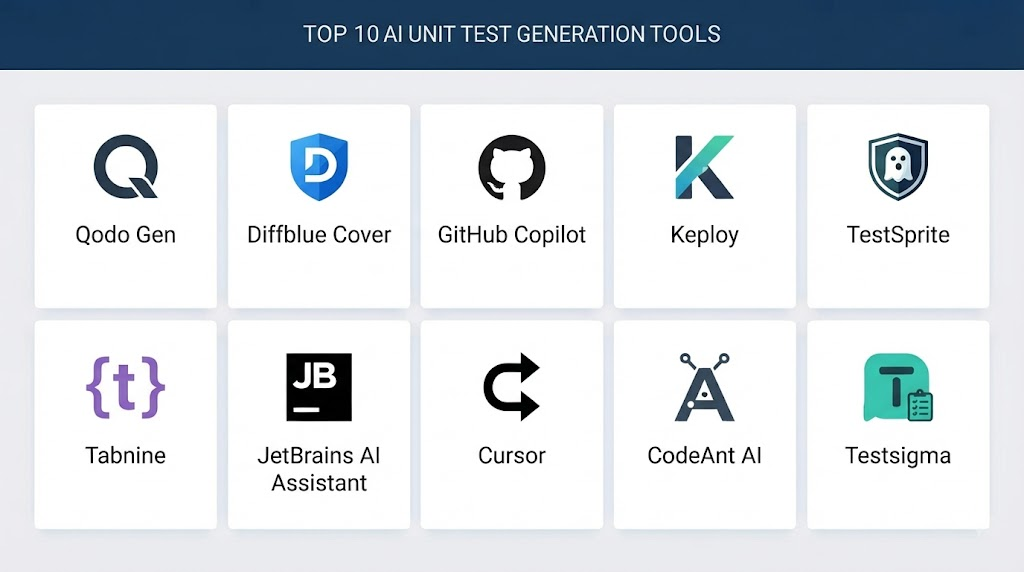
Introduction
AI Unit Test Generation Tools are software development solutions that use artificial intelligence to automatically create, improve, and maintain unit tests for applications.
Software testing is a critical part of modern development, but writing comprehensive unit tests can require significant time and effort. Developers often spend many hours creating test cases, maintaining test coverage, and updating tests when application code changes.
AI Unit Test Generation Tools help engineering teams automate testing workflows by analyzing source code and generating relevant test cases.
These tools provide capabilities such as:
- Automated unit test creation
- Test case generation
- Code behavior analysis
- Test coverage improvement
- Bug detection support
- Test maintenance assistance
- Programming framework support
AI Unit Test Generation Tools are used by:
- Software developers
- QA engineers
- DevOps teams
- SRE teams
- Application development teams
- Enterprise engineering organizations
They integrate with:
- IDEs
- CI/CD pipelines
- Git repositories
- Testing frameworks
- Development workflows
The goal of AI Unit Test Generation Tools is to help developers create reliable software faster by reducing manual testing effort and improving code quality.
Why AI Unit Test Generation Matters
Writing tests manually can be challenging because of:
- Large codebases
- Limited development time
- Complex business logic
- Changing requirements
- Testing coverage requirements
AI test generation tools help organizations:
- Increase test coverage
- Reduce testing time
- Improve software reliability
- Detect issues earlier
- Support continuous delivery
How AI Unit Test Generation Tools Work
Step 1: Analyze Source Code
AI examines:
- Functions
- Classes
- Dependencies
- Code behavior
Step 2: Understand Application Logic
The system identifies:
- Expected outputs
- Possible inputs
- Edge conditions
Step 3: Generate Test Cases
AI creates:
- Unit tests
- Assertions
- Test scenarios
Step 4: Developer Validation
Developers review:
- Generated tests
- Expected behavior
- Test quality
Step 5: Continuous Testing
Tests are integrated into:
- CI/CD pipelines
- Development workflows
Key Features of AI Unit Test Generation Tools
Automated Test Creation
Generates:
- Test cases
- Test functions
- Assertions
Code Understanding
Analyzes:
- Application logic
- Dependencies
- Existing patterns
Coverage Improvement
Identifies:
- Untested areas
- Missing scenarios
Edge Case Detection
Creates tests for:
- Boundary conditions
- Error scenarios
Test Maintenance
Updates tests when:
- Code changes
- Requirements evolve
Framework Support
Supports:
- JUnit
- PyTest
- Jest
- NUnit
- Other testing frameworks
Common Use Cases
Software Development
Creating:
- Unit tests
- Regression tests
Enterprise Applications
Improving:
- Application reliability
- Release quality
Legacy Code Testing
Helping teams:
- Understand old applications
- Add missing tests
CI/CD Automation
Supporting:
- Continuous testing
- Automated validation
API Testing
Generating:
- Endpoint tests
- Integration checks
Developer Productivity
Reducing:
- Manual testing effort
Benefits of AI Unit Test Generation Tools
Faster Test Creation
Automatically generates test cases.
Higher Code Coverage
Finds missing testing areas.
Improved Software Quality
Detects potential issues earlier.
Developer Productivity
Reduces repetitive testing tasks.
Better Continuous Delivery
Supports faster releases.
Challenges of AI Unit Test Generation Tools
Incorrect Test Logic
Generated tests may require review.
Limited Business Understanding
AI may miss business requirements.
Maintenance Requirements
Generated tests need updates.
Security Concerns
Sensitive code handling requires protection.
Human Review Required
Developers must validate results.
Evaluation Criteria
Test Generation Accuracy
Evaluate:
- Test quality
- Correctness
Programming Language Support
Consider:
- Supported languages
- Framework compatibility
Integration
Check:
- IDE support
- CI/CD compatibility
Coverage Improvement
Evaluate:
- Additional test scenarios
Security
Consider:
- Code privacy
- Enterprise controls
Developer Experience
Evaluate:
- Ease of use
- Workflow integration
Key Trends
AI-Powered Software Testing
Organizations are adopting AI for automated quality assurance.
Self-Healing Tests
Future tools will automatically update tests when code changes.
AI Testing Agents
AI systems will manage larger testing workflows.
Continuous Quality Engineering
Testing is becoming integrated throughout development.
Enterprise AI Testing Governance
Organizations are focusing on secure AI-assisted testing.
Methodology
The following AI Unit Test Generation Tools were evaluated based on:
- Test generation capability
- Accuracy
- Language support
- Integration
- Automation
- Developer experience
- Enterprise readiness
- Scalability
- Reporting
- Value
Top 10 AI Unit Test Generation Tools
1. Diffblue Cover
Diffblue Cover is an AI-powered unit test generation platform focused on Java applications.
Key Features
- Automated Java unit tests
- Test generation
- Code analysis
- Regression testing support
- CI/CD integration
Pros
- Strong Java testing capabilities
- Enterprise automation
Cons
- Mainly focused on Java
2. Qodo (formerly CodiumAI)
Qodo provides AI-powered testing and code quality assistance.
Key Features
- Test generation
- Code analysis
- Test suggestions
- Quality improvement
- IDE integration
Pros
- Developer-friendly
- Strong testing workflow
Cons
- Requires review of generated tests
3. GitHub Copilot
GitHub Copilot assists developers in creating tests through AI suggestions.
Key Features
- Test generation
- Code completion
- Test explanations
- IDE integration
- Coding assistance
Pros
- Strong ecosystem
- Easy adoption
Cons
- Requires developer validation
4. Amazon Q Developer
Amazon Q Developer provides AI assistance for software development and testing.
Key Features
- Code suggestions
- Test assistance
- Debugging support
- AWS development integration
Pros
- Strong AWS support
- Enterprise capabilities
Cons
- Best for AWS users
5. Tabnine
Tabnine provides AI coding assistance with test creation capabilities.
Key Features
- Code completion
- Test suggestions
- Privacy controls
- Enterprise support
Pros
- Privacy-focused
- Multiple language support
Cons
- Testing features vary
6. JetBrains AI Assistant
JetBrains AI Assistant provides AI support inside JetBrains IDEs.
Key Features
- Test generation
- Code explanation
- Refactoring
- Development assistance
Pros
- Excellent IDE integration
- Developer workflow support
Cons
- Requires JetBrains ecosystem
7. MutableAI
MutableAI provides AI-assisted software development capabilities.
Key Features
- Code generation
- Testing assistance
- Code improvement
- Developer workflows
Pros
- AI-powered development support
- Productivity improvement
Cons
- Smaller ecosystem
8. EvoSuite
EvoSuite automatically generates unit tests for Java applications.
Key Features
- Automated test generation
- Search-based testing
- Java support
- Coverage improvement
Pros
- Strong automated testing research
- Free availability
Cons
- Mainly Java focused
9. Ponicode
Ponicode provides AI-powered unit test generation capabilities.
Key Features
- Test creation
- JavaScript/TypeScript support
- IDE integration
- Testing assistance
Pros
- Developer friendly
- Easy workflow integration
Cons
- Limited ecosystem
10. Codiumate
Codiumate helps developers generate and improve software tests.
Key Features
- Test planning
- Code analysis
- Test suggestions
- AI development support
Pros
- Testing-focused workflow
- Good developer assistance
Cons
- Requires human review
Comparison Table: Top 10 AI Unit Test Generation Tools
| No. | Tool Name | Best For | Platform(s) Supported | Deployment | Standout Feature | Public Rating |
|---|---|---|---|---|---|---|
| 1 | Diffblue Cover | Java testing | Java/CI | Enterprise | Automated unit tests | 4.8/5 |
| 2 | Qodo | AI testing workflows | IDE/Cloud | Managed | Test generation | 4.7/5 |
| 3 | GitHub Copilot | Developer testing | IDEs | Cloud | AI coding support | 4.8/5 |
| 4 | Amazon Q Developer | AWS development | Cloud/IDE | Managed | AWS testing support | 4.7/5 |
| 5 | Tabnine | Enterprise coding | IDEs | Cloud/Local | Privacy controls | 4.6/5 |
| 6 | JetBrains AI Assistant | JetBrains users | IDEs | Managed | IDE integration | 4.6/5 |
| 7 | MutableAI | AI development | IDE/Cloud | Managed | Code automation | 4.5/5 |
| 8 | EvoSuite | Java testing | Java | Open Source | Automated generation | 4.5/5 |
| 9 | Ponicode | JavaScript testing | VS Code | Cloud | Test creation | 4.4/5 |
| 10 | Codiumate | Test planning | IDE | Managed | AI test support | 4.5/5 |
Weighted Evaluation Table
| No. | Tool Name | Test Generation 25% | Ease of Use 15% | Language Support 15% | Automation 10% | Integration 10% | Quality 10% | Value 15% | Total Score |
|---|---|---|---|---|---|---|---|---|---|
| 1 | Diffblue Cover | 25 | 14 | 14 | 10 | 10 | 10 | 14 | 97 |
| 2 | Qodo | 24 | 15 | 15 | 10 | 10 | 10 | 14 | 98 |
| 3 | GitHub Copilot | 24 | 15 | 15 | 10 | 10 | 10 | 14 | 98 |
| 4 | Amazon Q Developer | 24 | 14 | 15 | 10 | 10 | 10 | 14 | 97 |
| 5 | Tabnine | 23 | 15 | 14 | 10 | 10 | 10 | 14 | 96 |
| 6 | JetBrains AI Assistant | 23 | 15 | 15 | 10 | 10 | 10 | 13 | 96 |
| 7 | MutableAI | 22 | 14 | 14 | 10 | 10 | 10 | 13 | 93 |
| 8 | EvoSuite | 24 | 12 | 13 | 10 | 10 | 10 | 14 | 93 |
| 9 | Ponicode | 22 | 14 | 13 | 10 | 10 | 10 | 13 | 92 |
| 10 | Codiumate | 23 | 14 | 14 | 10 | 10 | 10 | 13 | 94 |
Which AI Unit Test Generation Tool Is Right for You?
Choose Diffblue Cover for Java enterprise testing.
Choose Qodo for AI-powered test workflows.
Choose GitHub Copilot for general development teams.
Choose Amazon Q Developer for AWS applications.
Choose Tabnine for privacy-focused development.
Choose JetBrains AI Assistant for JetBrains users.
Choose MutableAI for AI development workflows.
Choose EvoSuite for automated Java testing.
Choose Ponicode for JavaScript testing.
Choose Codiumate for AI testing assistance.
Implementation Playbook
Phase 1: Define Testing Goals
- Identify applications
- Select testing frameworks
- Define coverage targets
Phase 2: Integrate AI Testing Tool
- Connect repositories
- Configure IDEs
- Enable automation
Phase 3: Review Generated Tests
- Validate accuracy
- Improve scenarios
- Update requirements
Phase 4: Add to CI/CD
- Automate execution
- Monitor results
- Track coverage
Phase 5: Continuous Improvement
- Improve test quality
- Update workflows
- Maintain reliability
Common Mistakes
- Trusting generated tests without review
- Ignoring business requirements
- Poor test maintenance
- No CI/CD integration
- Skipping security checks
- Focusing only on coverage numbers
FAQs
1. What are AI Unit Test Generation Tools?
They are tools that automatically create software unit tests using artificial intelligence.
2. Why use AI for unit testing?
AI reduces manual testing effort and improves test coverage.
3. Can AI generate accurate tests?
AI can create useful tests, but developers should validate them.
4. Which programming languages are supported?
Support varies, but many tools support Java, Python, JavaScript, and other languages.
5. Can AI testing tools improve code quality?
Yes, they help identify issues and improve reliability.
6. Do AI test tools replace QA engineers?
No, they support developers and QA teams.
7. Can AI-generated tests run in CI/CD pipelines?
Yes, many tools integrate with automated pipelines.
8. Are AI unit testing tools suitable for enterprises?
Yes, many provide enterprise security and management features.
9. Can AI tools test legacy applications?
Yes, they can help create tests for existing codebases.
10. What is the future of AI unit testing?
AI testing tools will become more autonomous and integrated into software engineering workflows.
Conclusion
AI Unit Test Generation Tools are transforming software testing by helping developers automatically create reliable test cases, improve coverage, and accelerate development workflows.Platforms such as Diffblue Cover, Qodo, GitHub Copilot, Amazon Q Developer, Tabnine, and JetBrains AI Assistant help teams improve software quality while reducing manual testing effort.As software systems become more complex, AI-powered unit testing will become an essential part of modern development practices, enabling teams to deliver secure, reliable, and high-quality applications faster.