Introduction
Adversarial Robustness Testing Tools are AI security and evaluation solutions designed to test how machine learning models behave when exposed to manipulated, malicious, or unexpected inputs.
Modern AI systems are increasingly used in critical areas such as healthcare, finance, autonomous systems, cybersecurity, and enterprise automation. While these models can achieve high accuracy, they may become vulnerable when attackers create specially designed inputs to confuse or manipulate them.
Adversarial robustness testing helps organizations understand:
- How resistant models are against attacks
- Where AI systems can fail
- How models behave under unusual conditions
- What security improvements are required
These tools help identify vulnerabilities such as:
- Adversarial examples
- Data poisoning
- Model evasion attacks
- Input manipulation
- Model extraction risks
- AI reliability issues
Adversarial Robustness Testing Tools are used by:
- Machine learning engineers
- AI security researchers
- Data scientists
- MLOps teams
- Cybersecurity professionals
- Responsible AI teams
Modern adversarial testing platforms provide capabilities such as:
- Attack simulation
- Robustness evaluation
- Defense testing
- Model vulnerability analysis
- Security benchmarking
- Risk reporting
The goal of Adversarial Robustness Testing Tools is to help organizations create AI models that remain reliable, secure, and trustworthy even under hostile conditions.
Why Adversarial Robustness Matters
AI models often operate in environments where incorrect decisions can create serious consequences.
Examples:
- Autonomous vehicles making wrong decisions
- Healthcare models producing incorrect diagnoses
- Fraud detection systems missing attacks
- Security systems being bypassed
Adversarial robustness testing helps organizations:
- Improve model reliability
- Detect vulnerabilities
- Strengthen AI security
- Reduce operational risks
- Build trustworthy AI systems
Types of Adversarial Attacks
Evasion Attacks
Attackers modify input data to fool deployed models.
Examples:
- Image manipulation
- Text modification
- Audio changes
Data Poisoning Attacks
Attackers manipulate training data to affect model behavior.
Model Extraction Attacks
Attackers attempt to recreate model behavior.
Membership Inference Attacks
Attackers attempt to determine whether specific data was used during training.
Adversarial Examples
Small input changes create incorrect model predictions.
Prompt-Based Attacks
Used against:
- Large language models
- Generative AI systems
How Adversarial Robustness Testing Tools Work
Step 1: Model Input Analysis
Tools analyze:
- Data inputs
- Model architecture
- Prediction behavior
Step 2: Generate Adversarial Attacks
Platforms create:
- Modified inputs
- Attack scenarios
- Stress tests
Step 3: Evaluate Model Response
Systems measure:
- Accuracy changes
- Security weaknesses
- Model stability
Step 4: Apply Defense Techniques
Teams improve:
- Training methods
- Security controls
- Model architecture
Step 5: Continuous Testing
Organizations regularly test:
- New model versions
- Production systems
Key Components of Adversarial Testing Platforms
Attack Generation Engine
Creates:
- Adversarial examples
- Security scenarios
Robustness Evaluation Module
Measures:
- Model resistance
- Performance degradation
Defense Testing System
Evaluates:
- Protection methods
- Security improvements
Visualization Dashboard
Displays:
- Attack results
- Model behavior
Reporting System
Generates:
- Security reports
- Testing documentation
Integration Layer
Connects with:
- ML frameworks
- AI pipelines
- MLOps platforms
Common Adversarial Testing Techniques
Fast Gradient Sign Method (FGSM)
Creates adversarial examples by modifying input gradients.
Projected Gradient Descent (PGD)
Tests model robustness using stronger iterative attacks.
Carlini & Wagner Attack
Evaluates model resistance against advanced attacks.
Boundary Attacks
Tests decision boundaries.
Text Adversarial Attacks
Evaluates:
- NLP models
- LLM systems
Key Features of Adversarial Robustness Testing Tools
Attack Simulation
Creates realistic AI attacks.
Vulnerability Detection
Identifies:
- Weak models
- Security gaps
Robustness Scoring
Measures:
- Model resilience
- Attack resistance
Defense Evaluation
Tests:
- Security improvements
- Model hardening
Automated Testing
Supports:
- Continuous AI security testing
Compliance Reporting
Provides:
- Security evidence
- Audit documentation
Common Use Cases
Computer Vision
Testing:
- Image classification
- Object detection systems
Natural Language Processing
Evaluating:
- Text models
- Language systems
Autonomous Vehicles
Testing:
- Safety systems
- Perception models
Healthcare AI
Validating:
- Medical prediction models
Financial AI
Protecting:
- Fraud detection
- Risk models
Generative AI
Testing:
- LLM reliability
- AI safety
Benefits of Adversarial Robustness Testing Tools
Stronger AI Security
Identifies vulnerabilities before deployment.
Better Model Reliability
Improves performance under difficult conditions.
Reduced Attack Risk
Protects against malicious manipulation.
Improved AI Governance
Supports responsible AI practices.
Higher Trust
Creates more dependable AI systems.
Evaluation Criteria
Attack Coverage
Evaluate:
- Number of attack methods
- Security scenarios
Framework Support
Consider:
- TensorFlow
- PyTorch
- ML frameworks
Automation
Evaluate:
- Automated testing
- Continuous evaluation
Reporting
Consider:
- Risk reports
- Security documentation
Scalability
Evaluate:
- Enterprise workloads
Integration
Check:
- MLOps compatibility
- Cloud support
Key Trends
AI Security Testing Growth
Organizations are investing more in AI vulnerability testing.
Generative AI Robustness Testing
Companies are testing:
- LLM attacks
- AI hallucinations
- Unsafe outputs
Automated Adversarial Testing
AI-powered testing systems are improving attack discovery.
Responsible AI Adoption
Robustness testing is becoming part of AI governance.
AI Regulation Requirements
Future AI standards will require stronger security validation.
Methodology
The following Adversarial Robustness Testing Tools were evaluated based on:
- Attack capabilities
- Defense testing
- AI framework support
- Automation
- Reporting
- Scalability
- Security features
- Enterprise readiness
- Integration
- Value
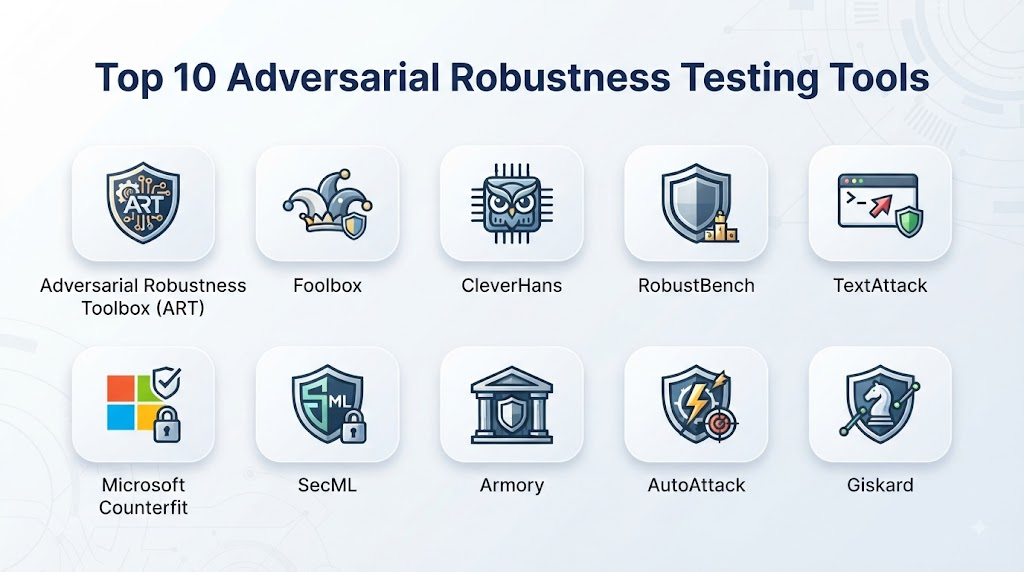
Top 10 Adversarial Robustness Testing Tools
1. IBM Adversarial Robustness 360 Toolbox (ART)
IBM ART is an open-source toolkit for testing and defending machine learning models against adversarial attacks.
Key Features
- Adversarial attack generation
- Defense evaluation
- Model robustness testing
- Multiple ML framework support
- Security benchmarking
- Attack simulation
Pros
- Research-backed
- Supports many attack methods
- Open source
Cons
- Requires technical expertise
2. Microsoft Counterfit
Microsoft Counterfit is an open-source AI security testing framework.
Key Features
- AI attack simulation
- Model vulnerability testing
- Security evaluation
- Automated testing workflows
- ML model assessment
Pros
- Microsoft-supported
- Flexible framework
- Open source
Cons
- Requires cybersecurity knowledge
3. NVIDIA Morpheus AI Security Tools
NVIDIA provides AI security solutions for enterprise AI workloads.
Key Features
- AI threat detection
- Security analytics
- Model protection
- Real-time monitoring
- GPU acceleration
Pros
- Enterprise performance
- Strong AI infrastructure support
Cons
- NVIDIA ecosystem dependency
4. CleverHans
CleverHans is an open-source adversarial machine learning library.
Key Features
- Attack generation
- Robustness testing
- ML model evaluation
- Research experiments
- Defense testing
Pros
- Popular research tool
- Free and open source
Cons
- Requires ML knowledge
5. Foolbox
Foolbox provides adversarial attack algorithms for machine learning models.
Key Features
- Attack generation
- Model testing
- Robustness evaluation
- Multiple framework support
- Research capabilities
Pros
- Lightweight
- Research friendly
Cons
- Limited enterprise features
6. Adversarial Robustness Toolbox (ART)
ART provides tools for testing and defending AI systems.
Key Features
- Attack algorithms
- Defense methods
- Model evaluation
- Framework support
- Security testing
Pros
- Comprehensive toolkit
- Strong community support
Cons
- Technical learning curve
7. TensorFlow Privacy & Robustness Tools
TensorFlow provides security and robustness resources.
Key Features
- Privacy protection
- Model evaluation
- Security analysis
- ML integration
- Research tools
Pros
- Strong ecosystem
- Open source
Cons
- Requires TensorFlow expertise
8. Robust Intelligence AI Security Platform
Robust Intelligence provides enterprise AI security testing.
Key Features
- Model testing
- Vulnerability detection
- AI risk assessment
- Security monitoring
- Robustness analysis
Pros
- Enterprise focused
- Complete AI security approach
Cons
- Commercial pricing
9. Mindgard AI Security Platform
Mindgard provides AI security testing capabilities.
Key Features
- AI penetration testing
- Vulnerability assessment
- Adversarial testing
- Risk reporting
- LLM security testing
Pros
- Security focused
- Enterprise capabilities
Cons
- Newer platform
10. Giskard AI
Giskard provides AI testing and quality assurance tools.
Key Features
- Model testing
- Bias detection
- Robustness evaluation
- Security analysis
- LLM testing
Pros
- Developer friendly
- Open-source options
Cons
- Requires AI testing knowledge
Comparison Table: Top 10 Adversarial Robustness Testing Tools
| No. | Tool Name | Best For | Platform(s) Supported | Deployment | Standout Feature | Public Rating |
|---|---|---|---|---|---|---|
| 1 | IBM ART | ML robustness testing | Local / Cloud | Open Source | Adversarial attacks | 4.8/5 |
| 2 | Microsoft Counterfit | AI security testing | Local / Cloud | Open Source | Attack simulation | 4.7/5 |
| 3 | NVIDIA Security Tools | Enterprise AI security | Cloud | Enterprise | AI threat detection | 4.6/5 |
| 4 | CleverHans | Research testing | Local | Open Source | Attack algorithms | 4.6/5 |
| 5 | Foolbox | Attack generation | Local | Open Source | Lightweight testing | 4.5/5 |
| 6 | ART Toolkit | AI security research | Local / Cloud | Open Source | Defense testing | 4.8/5 |
| 7 | TensorFlow Tools | ML developers | Local / Cloud | Open Source | ML integration | 4.5/5 |
| 8 | Robust Intelligence | Enterprise security | Cloud | Enterprise | AI testing platform | 4.6/5 |
| 9 | Mindgard | AI penetration testing | Cloud | Managed | Security assessment | 4.5/5 |
| 10 | Giskard AI | AI quality testing | Cloud / Local | Open Source | AI validation | 4.5/5 |
Weighted Evaluation Table
| No. | Tool Name | Robustness Testing 25% | Ease of Use 15% | AI Integration 15% | Attack Coverage 10% | Scalability 10% | Reporting 10% | Value 15% | Total Score |
|---|---|---|---|---|---|---|---|---|---|
| 1 | IBM ART | 25 | 13 | 15 | 10 | 10 | 10 | 15 | 98 |
| 2 | Microsoft Counterfit | 24 | 14 | 15 | 10 | 10 | 10 | 15 | 98 |
| 3 | NVIDIA Security Tools | 24 | 13 | 15 | 10 | 10 | 10 | 13 | 95 |
| 4 | CleverHans | 23 | 14 | 14 | 10 | 9 | 9 | 15 | 94 |
| 5 | Foolbox | 23 | 15 | 14 | 9 | 9 | 9 | 15 | 94 |
| 6 | ART Toolkit | 25 | 13 | 15 | 10 | 10 | 10 | 15 | 98 |
| 7 | TensorFlow Tools | 22 | 14 | 15 | 9 | 10 | 9 | 15 | 94 |
| 8 | Robust Intelligence | 24 | 13 | 15 | 10 | 10 | 10 | 13 | 95 |
| 9 | Mindgard | 23 | 13 | 14 | 10 | 10 | 10 | 13 | 93 |
| 10 | Giskard AI | 23 | 14 | 14 | 9 | 10 | 10 | 14 | 94 |
Which Adversarial Robustness Testing Tool Is Right for You?
Choose IBM ART for comprehensive adversarial testing.
Choose Microsoft Counterfit for AI security research.
Choose NVIDIA Security Tools for enterprise AI infrastructure.
Choose CleverHans for academic research.
Choose Foolbox for lightweight attack testing.
Choose TensorFlow Tools for TensorFlow-based projects.
Choose Robust Intelligence for enterprise AI security.
Choose Mindgard for AI penetration testing.
Choose Giskard AI for AI quality and security testing.
Implementation Playbook
Phase 1: Identify AI Security Requirements
- Select critical models
- Define attack scenarios
- Identify risks
Phase 2: Run Robustness Tests
- Generate attacks
- Evaluate model behavior
- Measure vulnerabilities
Phase 3: Improve Models
- Apply defenses
- Retrain models
- Improve data quality
Phase 4: Validate Security
- Repeat testing
- Review improvements
- Document results
Phase 5: Continuous Monitoring
- Test new models
- Monitor threats
- Update defenses
Common Mistakes
- Deploying models without robustness testing
- Ignoring adversarial attacks
- Testing only accuracy
- No security validation
- Poor documentation
- Lack of continuous evaluation
FAQs
1. What are Adversarial Robustness Testing Tools?
They are tools that evaluate whether AI models can resist malicious or manipulated inputs.
2. Why is adversarial testing important?
It helps identify weaknesses before attackers exploit AI systems.
3. What attacks can these tools detect?
They test adversarial examples, model attacks, data poisoning, and manipulation techniques.
4. Can adversarial testing tools evaluate deep learning models?
Yes, many support neural networks and modern ML frameworks.
5. Who uses adversarial robustness tools?
Researchers, AI engineers, security teams, and enterprises.
6. Are adversarial testing tools part of AI security?
Yes, they are an important part of AI security practices.
7. Can adversarial attacks be completely prevented?
No, but testing helps significantly improve model resistance.
8. Do these tools support LLM security?
Many modern platforms are expanding support for generative AI systems.
9. How often should robustness testing happen?
It should be performed throughout the AI lifecycle.
10. What is the future of adversarial robustness testing?
Continuous automated AI security testing will become standard for reliable AI systems.
Conclusion
Adversarial Robustness Testing Tools are essential for organizations developing secure and dependable AI systems. They help identify weaknesses, simulate attacks, improve defenses, and ensure models perform reliably under challenging conditions.Platforms such as IBM Adversarial Robustness 360 Toolbox, Microsoft Counterfit, NVIDIA security solutions, Robust Intelligence, and Giskard AI provide powerful capabilities for evaluating AI robustness.As AI systems become more critical across industries, adversarial testing will remain a key requirement for building secure, resilient, and trustworthy artificial intelligence solutions.