Introduction
AI Model Cards & Documentation Tools are platforms that help organizations create, manage, publish, and maintain detailed documentation about artificial intelligence and machine learning models.
As AI systems become more complex and widely deployed, organizations need clear documentation to explain how models work, what data they use, what limitations they have, and how they should be used responsibly.
Model documentation helps improve:
- AI transparency
- Model accountability
- Governance processes
- Regulatory compliance
- Collaboration between teams
- Responsible AI practices
AI Model Cards provide structured information about machine learning models, including:
- Model purpose
- Training data information
- Performance metrics
- Evaluation results
- Limitations
- Ethical considerations
- Intended use cases
- Risk information
These tools are used by:
- Data scientists
- Machine learning engineers
- MLOps teams
- AI governance teams
- Compliance professionals
- Research organizations
- Enterprise AI developers
Modern AI Model Documentation platforms provide capabilities such as:
- Automated documentation generation
- Model metadata tracking
- Model lineage
- Version management
- Performance reporting
- Risk documentation
- Compliance records
- Collaboration workflows
The goal of AI Model Cards & Documentation Tools is to make AI systems easier to understand, manage, audit, and trust.
Why Model Documentation Matters
AI models can create risks when organizations do not understand:
- How models were trained
- What data influenced decisions
- Where models may fail
- Who owns the model
Poor documentation can lead to:
- Compliance problems
- Incorrect usage
- Security risks
- Lack of accountability
Model documentation helps organizations:
- Improve transparency
- Manage AI risks
- Support audits
- Enable responsible AI adoption
What Information Should AI Model Cards Include?
Model Overview
Includes:
- Model name
- Version
- Purpose
- Owner
Training Information
Documents:
- Training datasets
- Data sources
- Training methods
Performance Metrics
Includes:
- Accuracy
- Precision
- Recall
- Evaluation results
Intended Use
Defines:
- Recommended applications
- Target users
Limitations
Documents:
- Known weaknesses
- Failure scenarios
Ethical Considerations
Covers:
- Bias risks
- Fairness concerns
- Privacy issues
How AI Model Documentation Tools Work
Step 1: Collect Model Information
Platforms gather:
- Metadata
- Training details
- Performance data
Step 2: Generate Documentation
Tools create:
- Model cards
- Reports
- Documentation templates
Step 3: Track Model Changes
Systems monitor:
- Versions
- Updates
- Performance changes
Step 4: Review and Approval
Teams validate:
- Accuracy
- Compliance
- Governance requirements
Step 5: Publish Documentation
Documentation is shared with:
- Developers
- Auditors
- Business teams
Key Components of Model Documentation Platforms
Model Registry Integration
Tracks:
- Models
- Versions
- Ownership
Metadata Management
Stores:
- Training information
- Technical details
Documentation Generator
Creates:
- Model cards
- Reports
- Summaries
Governance Workflow
Manages:
- Reviews
- Approvals
- Compliance
Audit Tracking
Maintains:
- Change history
- Documentation records
Collaboration Features
Supports:
- Team reviews
- Knowledge sharing
Types of AI Documentation Tools
Model Registry Platforms
Examples:
- MLflow
- Amazon SageMaker Model Registry
Used for model lifecycle management.
AI Governance Platforms
Examples:
- IBM watsonx.governance
- ModelOp Center
Used for enterprise governance.
Open-Source Documentation Tools
Examples:
- Hugging Face Model Cards
- Model Card Toolkit
Used by researchers and developers.
Key Features of AI Model Cards & Documentation Tools
Automated Model Cards
Creates documentation automatically.
Model Metadata Tracking
Maintains:
- Model details
- Ownership
- History
Version Control
Tracks:
- Model updates
- Changes
Performance Documentation
Records:
- Evaluation metrics
- Testing results
Risk Documentation
Captures:
- Bias risks
- Limitations
- Security concerns
Compliance Reporting
Supports:
- Audits
- Governance requirements
Common Use Cases
Enterprise AI Governance
Managing:
- AI model inventories
- Compliance documentation
Machine Learning Operations
Tracking:
- Model versions
- Deployment details
Generative AI Systems
Documenting:
- LLM capabilities
- Prompt behavior
- Limitations
Healthcare AI
Maintaining:
- Medical AI documentation
- Safety records
Financial AI
Documenting:
- Risk models
- Decision systems
Research Projects
Sharing:
- Model details
- Evaluation results
Benefits of AI Model Cards & Documentation Tools
Better Transparency
Users understand how AI systems work.
Improved Governance
Organizations maintain proper AI records.
Easier Auditing
Teams can review model history.
Reduced AI Risk
Limitations and risks are clearly documented.
Better Collaboration
Teams share common model information.
Evaluation Criteria
Documentation Capabilities
Evaluate:
- Model card generation
- Reporting features
Model Management
Consider:
- Registry support
- Version tracking
Governance Support
Evaluate:
- Compliance workflows
- Audit features
Automation
Check:
- Automatic documentation
- Metadata collection
Integration
Consider:
- ML frameworks
- Cloud platforms
Scalability
Evaluate:
- Enterprise model management
Key Trends
Automated AI Documentation
Organizations are using AI to generate and maintain model documentation.
Generative AI Model Cards
New documentation methods are emerging for:
- LLMs
- AI agents
- Foundation models
AI Governance Integration
Model cards are becoming part of enterprise AI governance.
Continuous Documentation
Documentation is moving from static files to live model records.
Regulatory Documentation Requirements
Organizations are preparing for:
- AI audits
- Compliance reviews
Methodology
The following AI Model Cards & Documentation Tools were evaluated based on:
- Documentation capabilities
- Model management
- Governance features
- Automation
- Integration
- Version control
- Compliance support
- Scalability
- Enterprise adoption
- Value
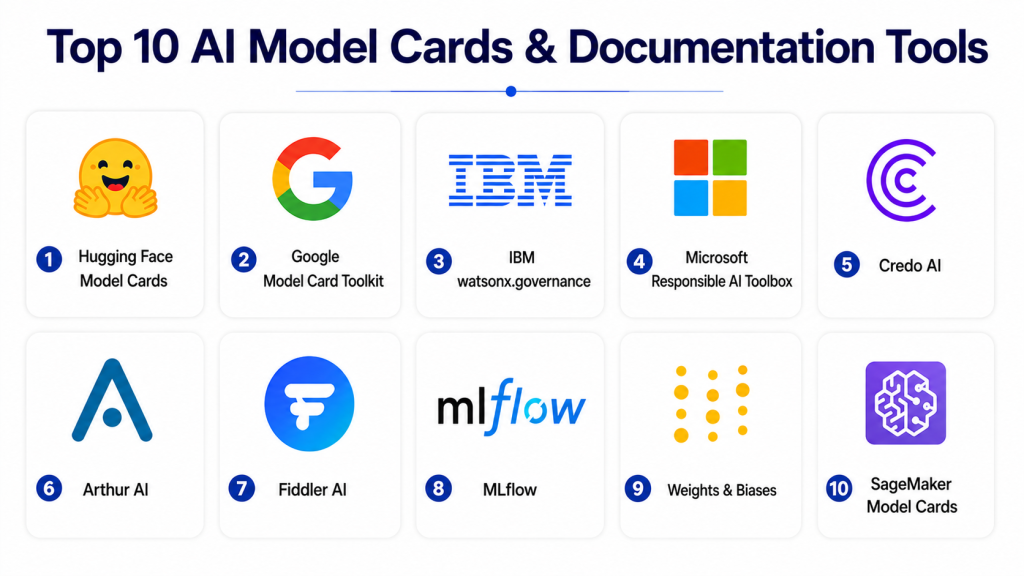
Top 10 AI Model Cards & Documentation Tools
1. Hugging Face Model Cards
Hugging Face Model Cards provide standardized documentation for machine learning and AI models.
Key Features
- Model documentation templates
- Model metadata
- Training details
- Evaluation metrics
- Usage guidelines
- Limitations documentation
- Community sharing
- Version tracking
Pros
- Widely adopted
- Open ecosystem
- Developer friendly
Cons
- Limited enterprise governance features
2. MLflow Model Registry
MLflow Model Registry provides model lifecycle management and documentation capabilities.
Key Features
- Model versioning
- Metadata tracking
- Model lineage
- Documentation
- Approval workflows
- Deployment tracking
Pros
- Open source
- Strong MLOps integration
- Popular ecosystem
Cons
- Requires configuration
3. Google Model Card Toolkit
Google Model Card Toolkit helps create standardized AI model documentation.
Key Features
- Model card generation
- Documentation templates
- Evaluation reporting
- Responsible AI support
- Metadata management
Pros
- Open source
- Responsible AI focused
Cons
- Requires technical implementation
4. IBM watsonx.governance
IBM watsonx.governance provides enterprise AI governance and documentation management.
Key Features
- Model inventory
- Documentation workflows
- Risk tracking
- Compliance reporting
- Governance automation
- Model monitoring
Pros
- Enterprise governance
- Strong compliance
Cons
- Complex deployment
5. Microsoft Responsible AI Dashboard
Microsoft Responsible AI Dashboard supports model analysis and documentation.
Key Features
- Model insights
- Error analysis
- Explainability
- Fairness evaluation
- Reporting
- Documentation support
Pros
- Strong visualization
- Azure integration
Cons
- Best for Microsoft environments
6. Amazon SageMaker Model Registry
Amazon SageMaker Model Registry manages ML model versions and metadata.
Key Features
- Model versioning
- Approval workflows
- Metadata tracking
- Deployment history
- Governance support
Pros
- AWS integration
- Enterprise scalability
Cons
- AWS dependency
7. ModelOp Center
ModelOp Center provides enterprise AI model governance.
Key Features
- Model inventory
- Documentation management
- Lifecycle tracking
- Compliance workflows
- Approval processes
Pros
- Strong governance
- Enterprise workflows
Cons
- Requires expertise
8. Dataiku Govern
Dataiku Govern supports AI lifecycle management and documentation.
Key Features
- Model documentation
- Governance workflows
- Approval processes
- Risk tracking
- Collaboration
Pros
- User friendly
- Enterprise focused
Cons
- Premium pricing
9. Weights & Biases Model Registry
Weights & Biases provides experiment and model management.
Key Features
- Model tracking
- Version management
- Experiment records
- Metadata storage
- Collaboration
Pros
- Strong ML workflow support
- Developer friendly
Cons
- Less focused on governance
10. Neptune.ai
Neptune.ai provides experiment tracking and ML metadata management.
Key Features
- Experiment tracking
- Model metadata
- Version history
- Documentation support
- Collaboration tools
Pros
- Easy ML tracking
- Good usability
Cons
- Limited governance capabilities
Comparison Table: Top 10 AI Model Cards & Documentation Tools
| No. | Tool Name | Best For | Platform(s) Supported | Deployment | Standout Feature | Public Rating |
|---|---|---|---|---|---|---|
| 1 | Hugging Face Model Cards | AI documentation | Cloud / Local | Open Source | Standard model cards | 4.8/5 |
| 2 | MLflow Model Registry | MLOps lifecycle | Cloud / Local | Open Source | Model versioning | 4.7/5 |
| 3 | Google Model Card Toolkit | Responsible AI docs | Cloud / Local | Open Source | Documentation templates | 4.7/5 |
| 4 | IBM watsonx.governance | Enterprise governance | Cloud | Managed | AI documentation workflows | 4.8/5 |
| 5 | Microsoft Responsible AI Dashboard | Model analysis | Azure | Managed | AI transparency | 4.7/5 |
| 6 | SageMaker Model Registry | AWS ML management | AWS | Managed | Model lifecycle | 4.6/5 |
| 7 | ModelOp Center | Enterprise models | Cloud | Enterprise | Governance workflows | 4.6/5 |
| 8 | Dataiku Govern | AI governance | Cloud | Managed | Collaboration | 4.5/5 |
| 9 | Weights & Biases | ML tracking | Cloud | Managed | Experiment management | 4.5/5 |
| 10 | Neptune.ai | ML metadata | Cloud | Managed | Experiment tracking | 4.4/5 |
Weighted Evaluation Table
| No. | Tool Name | Documentation 25% | Ease of Use 15% | AI Integration 15% | Security 10% | Scalability 10% | Governance 10% | Value 15% | Total Score |
|---|---|---|---|---|---|---|---|---|---|
| 1 | Hugging Face Model Cards | 25 | 15 | 15 | 9 | 10 | 9 | 15 | 98 |
| 2 | MLflow Model Registry | 24 | 14 | 15 | 10 | 10 | 10 | 15 | 98 |
| 3 | Google Model Card Toolkit | 25 | 13 | 14 | 9 | 10 | 10 | 15 | 96 |
| 4 | IBM watsonx.governance | 25 | 14 | 15 | 10 | 10 | 10 | 14 | 98 |
| 5 | Microsoft Responsible AI Dashboard | 24 | 15 | 15 | 10 | 10 | 10 | 13 | 97 |
| 6 | SageMaker Model Registry | 24 | 14 | 15 | 10 | 10 | 10 | 13 | 96 |
| 7 | ModelOp Center | 24 | 13 | 14 | 10 | 10 | 10 | 13 | 94 |
| 8 | Dataiku Govern | 23 | 15 | 14 | 9 | 10 | 10 | 13 | 94 |
| 9 | Weights & Biases | 23 | 15 | 15 | 9 | 10 | 9 | 14 | 95 |
| 10 | Neptune.ai | 22 | 15 | 14 | 9 | 9 | 9 | 14 | 92 |
Which AI Model Documentation Tool Is Right for You?
Choose Hugging Face Model Cards for open AI model documentation.
Choose MLflow Model Registry for MLOps workflows.
Choose Google Model Card Toolkit for responsible AI documentation.
Choose IBM watsonx.governance for enterprise governance.
Choose Microsoft Responsible AI Dashboard for Azure AI workflows.
Choose Amazon SageMaker Model Registry for AWS environments.
Choose ModelOp Center for enterprise model governance.
Choose Dataiku Govern for collaborative AI management.
Choose Weights & Biases for ML experiment tracking.
Choose Neptune.ai for ML metadata management.
Implementation Playbook
Phase 1: Define Documentation Standards
- Create model card templates
- Define required information
- Assign ownership
Phase 2: Collect Model Information
- Capture metadata
- Record training details
- Store evaluation results
Phase 3: Generate Documentation
- Create model cards
- Document limitations
- Add performance details
Phase 4: Review and Approve
- Validate information
- Complete governance checks
- Approve documentation
Phase 5: Maintain Continuously
- Update model versions
- Track changes
- Refresh documentation
Common Mistakes
- Deploying models without documentation
- Missing model limitations
- Poor version tracking
- No ownership information
- Ignoring compliance records
- Treating documentation as a one-time task
FAQs
1. What are AI Model Cards?
AI Model Cards are documents that describe an AI model’s purpose, performance, limitations, and usage guidelines.
2. Why is model documentation important?
It improves transparency, accountability, and responsible AI practices.
3. What information should a model card contain?
It should include model purpose, training data, performance, limitations, and risks.
4. Can model cards support AI governance?
Yes, they provide important documentation for governance and audits.
5. Are model cards useful for LLMs?
Yes, they help document foundation models and generative AI systems.
6. Who creates model documentation?
Data scientists, AI engineers, and governance teams usually create them.
7. Can documentation be automated?
Yes, many platforms automatically collect metadata and generate reports.
8. Are open-source model documentation tools available?
Yes, Hugging Face Model Cards and Google Model Card Toolkit are popular options.
9. How often should model cards be updated?
They should be updated whenever models or data change.
10. What is the future of AI model documentation?
Automated and continuously updated model documentation will become standard in AI governance.
Conclusion
AI Model Cards & Documentation Tools are becoming essential for building transparent and responsible AI systems. They help organizations understand, manage, and communicate important information about AI models.Platforms such as Hugging Face Model Cards, MLflow Model Registry, Google Model Card Toolkit, IBM watsonx.governance, and Microsoft Responsible AI Dashboard provide powerful capabilities for AI documentation and governance.As AI systems become more complex, maintaining accurate model documentation will be a critical requirement for trustworthy, compliant, and responsible AI development.