Introduction
Model Explainability Platforms are AI transparency solutions that help organizations understand, interpret, and explain how machine learning models make decisions.
Modern AI systems, especially deep learning models and complex machine learning algorithms, can produce highly accurate predictions but are often difficult to understand. This lack of transparency creates challenges for organizations that need to trust, validate, and manage AI decisions.
Model Explainability platforms help answer important questions such as:
- Why did the model make this prediction?
- Which features influenced the decision?
- How reliable is the model output?
- Are decisions fair and unbiased?
- Can users understand AI recommendations?
These platforms are essential for building transparent and responsible AI systems.
Model Explainability Platforms are used by:
- Data scientists
- Machine learning engineers
- AI researchers
- MLOps teams
- Compliance professionals
- Business analysts
- Enterprise AI teams
Modern explainability platforms provide capabilities such as:
- Feature importance analysis
- Local and global explanations
- Model interpretation
- Explainable AI (XAI)
- Bias analysis
- Prediction explanations
- Model debugging
- Compliance reporting
The goal of Model Explainability Platforms is to make AI systems more understandable, trustworthy, and accountable.
Why Model Explainability Matters
AI decisions often impact important areas such as:
- Finance
- Healthcare
- Insurance
- Recruitment
- Security
- Customer services
Without explainability, organizations may face:
- Lack of trust
- Regulatory problems
- Hidden bias
- Difficulty debugging models
- Poor decision transparency
Explainability helps organizations:
- Understand AI behavior
- Improve model performance
- Detect errors
- Build user confidence
How Model Explainability Works
Step 1: Model Analysis
The platform analyzes:
- Model structure
- Input data
- Predictions
Step 2: Feature Evaluation
The system identifies:
- Important features
- Decision factors
Step 3: Explanation Generation
The platform creates:
- Visual explanations
- Reports
- Feature impact analysis
Step 4: Human Review
Teams evaluate:
- Model decisions
- Potential issues
Step 5: Model Improvement
Organizations improve:
- Data quality
- Algorithms
- Model performance
Common Explainability Techniques
Feature Importance
Shows which features influence predictions.
Example:
Income → 40%
Credit Score → 35%
Age → 15%
SHAP (SHapley Additive Explanations)
Explains individual predictions using game theory concepts.
LIME (Local Interpretable Model-Agnostic Explanations)
Explains individual model decisions.
Partial Dependence Plots
Shows how features affect predictions.
Counterfactual Explanations
Shows what changes could alter a prediction.
Example:
“Loan would be approved if income increased.”
Key Components of Model Explainability Platforms
Explanation Engine
Provides:
- Prediction explanations
- Feature analysis
Visualization Dashboard
Displays:
- Charts
- Graphs
- Decision factors
Model Analysis Module
Evaluates:
- Model behavior
- Performance
Bias Detection Layer
Identifies:
- Unfair decisions
- Data issues
Reporting System
Creates:
- Compliance reports
- Documentation
Integration Layer
Connects with:
- ML frameworks
- Cloud platforms
- MLOps systems
Types of Model Explainability Tools
Open-Source Explainability Libraries
Examples:
- SHAP
- LIME
- InterpretML
Used by developers and researchers.
Enterprise Explainability Platforms
Examples:
- Fiddler AI
- IBM watsonx.governance
Used by organizations requiring governance.
ML Monitoring Platforms
Examples:
- Arize AI
- WhyLabs
Used for production AI monitoring.
Key Features of Model Explainability Platforms
Global Model Explanations
Understand overall model behavior.
Local Prediction Explanations
Understand individual predictions.
Feature Importance Analysis
Identify:
- Important variables
- Decision drivers
Model Debugging
Find:
- Errors
- Unexpected behavior
Explainability Reports
Generate:
- Audit documents
- Compliance records
Multi-Model Support
Works with:
- Machine learning models
- Deep learning models
- AI applications
Common Use Cases
Financial Services
Explaining:
- Loan decisions
- Credit scoring
- Fraud detection
Healthcare AI
Understanding:
- Medical predictions
- Patient risk models
Insurance
Explaining:
- Pricing decisions
- Risk assessments
Recruitment AI
Analyzing:
- Candidate ranking
- Hiring recommendations
Customer Analytics
Understanding:
- Recommendations
- Customer behavior
Generative AI
Explaining:
- LLM outputs
- AI responses
Benefits of Model Explainability Platforms
Increased Trust
Users understand AI decisions better.
Better Compliance
Supports transparency requirements.
Improved Debugging
Teams identify model problems faster.
Reduced Risk
Organizations detect unfair behavior.
Better Model Performance
Insights help improve AI systems.
Evaluation Criteria
Explanation Quality
Evaluate:
- Accuracy of explanations
- Detail level
Model Support
Consider:
- ML algorithms
- AI frameworks
Visualization
Evaluate:
- Dashboards
- Reports
Integration
Check:
- MLOps compatibility
- Cloud support
Scalability
Consider:
- Enterprise workloads
Governance Support
Evaluate:
- Compliance reporting
- Documentation
Key Trends
Explainability for Generative AI
Organizations are focusing on:
- LLM transparency
- AI response analysis
Automated AI Documentation
Platforms are generating:
- Model cards
- Explanation reports
Explainability in AI Regulation
Transparency requirements are increasing.
Real-Time Explainability
Organizations need explanations during production usage.
Explainable AI Agents
Future AI agents will require:
- Decision tracking
- Action explanations
Methodology
The following Model Explainability Platforms were evaluated based on:
- Explanation capabilities
- AI integration
- Visualization
- Model support
- Governance features
- Monitoring
- Scalability
- Enterprise adoption
- Security
- Value
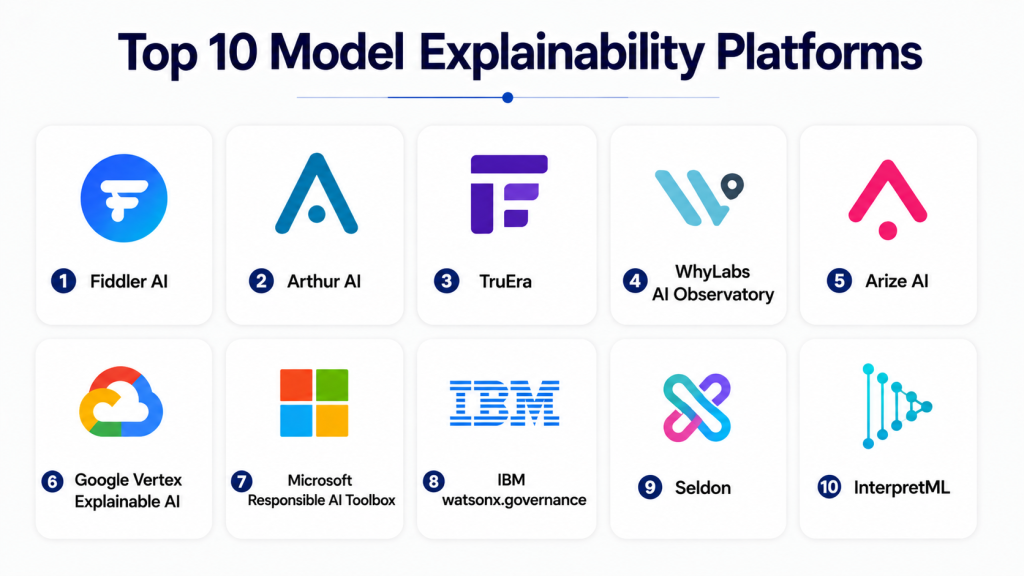
Top 10 Model Explainability Platforms
1. IBM AI Explainability 360
IBM AI Explainability 360 provides tools and algorithms for understanding machine learning models.
Key Features
- Model explanations
- Feature importance
- Explainability algorithms
- Bias analysis
- Visualization
- Model evaluation
- Research support
- ML integration
Pros
- Strong explainability methods
- Open-source support
- Research backed
Cons
- Requires technical knowledge
2. SHAP
SHAP is a popular open-source framework for explaining machine learning predictions.
Key Features
- Feature importance
- Prediction explanations
- Model interpretation
- Visualization
- Tree model support
- Deep learning support
Pros
- Widely adopted
- Powerful explanations
- Open source
Cons
- Requires ML expertise
3. Microsoft Responsible AI Dashboard
Microsoft Responsible AI Dashboard provides explainability and fairness analysis.
Key Features
- Model explanations
- Error analysis
- Fairness evaluation
- Data exploration
- Visualization
- Reporting
Pros
- User friendly
- Strong visualization
- Azure integration
Cons
- Best suited for Azure users
4. Google What-If Tool
Google What-If Tool helps users explore model behavior visually.
Key Features
- Interactive analysis
- Feature comparison
- Prediction exploration
- Fairness analysis
- Visualization
Pros
- Easy to use
- Free
- Developer friendly
Cons
- Limited enterprise features
5. Amazon SageMaker Clarify
Amazon SageMaker Clarify provides explainability and fairness analysis for ML models.
Key Features
- Feature attribution
- Bias detection
- Model explanations
- Data analysis
- Monitoring integration
- AWS ML support
Pros
- Cloud integration
- Enterprise ready
Cons
- AWS dependency
6. Fiddler AI
Fiddler AI provides explainability, monitoring, and AI observability.
Key Features
- Model explanations
- Feature importance
- Bias detection
- Drift monitoring
- AI quality analysis
- Reporting
Pros
- Strong enterprise capabilities
- Production monitoring
Cons
- Commercial pricing
7. Arize AI
Arize AI provides ML observability and explainability capabilities.
Key Features
- Model monitoring
- Explainability
- Drift detection
- AI evaluation
- Performance tracking
- LLM monitoring
Pros
- Strong production monitoring
- Modern AI support
Cons
- More focused on observability
8. InterpretML
InterpretML provides open-source explainable machine learning tools.
Key Features
- Explainable models
- Feature analysis
- Visualization
- Model interpretation
- Glass-box models
Pros
- Open source
- Developer friendly
Cons
- Limited enterprise governance
9. WhyLabs
WhyLabs provides AI observability and monitoring.
Key Features
- Model monitoring
- Explainability support
- Data analysis
- Drift detection
- AI quality tracking
- Alerts
Pros
- Good monitoring
- AI-focused
Cons
- Requires technical setup
10. DataRobot AI Platform
DataRobot provides enterprise AI development and management capabilities.
Key Features
- Model explanations
- Automated machine learning
- AI governance
- Model monitoring
- Explainability reports
- Enterprise workflows
Pros
- Complete AI platform
- Strong automation
Cons
- Enterprise pricing
Comparison Table: Top 10 Model Explainability Platforms
| No. | Tool Name | Best For | Platform(s) Supported | Deployment | Standout Feature | Public Rating |
|---|---|---|---|---|---|---|
| 1 | IBM AI Explainability 360 | Research & fairness | Cloud / Local | Open Source | Explainability algorithms | 4.8/5 |
| 2 | SHAP | Developers | Local / Cloud | Open Source | Feature explanations | 4.8/5 |
| 3 | Microsoft Responsible AI Dashboard | Enterprise ML | Azure | Managed | AI transparency | 4.7/5 |
| 4 | Google What-If Tool | Model analysis | Cloud / Local | Open Source | Interactive visualization | 4.6/5 |
| 5 | SageMaker Clarify | AWS ML | AWS | Managed | Explainability automation | 4.7/5 |
| 6 | Fiddler AI | Production AI | Cloud | Managed | AI monitoring | 4.6/5 |
| 7 | Arize AI | ML observability | Cloud | Managed | Model insights | 4.6/5 |
| 8 | InterpretML | Developers | Local | Open Source | Explainable models | 4.5/5 |
| 9 | WhyLabs | AI monitoring | Cloud | Managed | AI quality tracking | 4.5/5 |
| 10 | DataRobot AI Platform | Enterprise AI | Cloud | Managed | Automated AI | 4.5/5 |
Weighted Evaluation Table
| No. | Tool Name | Explainability 25% | Ease of Use 15% | AI Integration 15% | Security 10% | Scalability 10% | Reporting 10% | Value 15% | Total Score |
|---|---|---|---|---|---|---|---|---|---|
| 1 | IBM AI Explainability 360 | 25 | 13 | 15 | 9 | 10 | 10 | 15 | 97 |
| 2 | SHAP | 25 | 14 | 15 | 9 | 10 | 10 | 15 | 98 |
| 3 | Microsoft Responsible AI Dashboard | 24 | 15 | 15 | 10 | 10 | 10 | 13 | 97 |
| 4 | Google What-If Tool | 23 | 15 | 14 | 9 | 9 | 9 | 15 | 94 |
| 5 | SageMaker Clarify | 25 | 14 | 15 | 10 | 10 | 10 | 13 | 97 |
| 6 | Fiddler AI | 24 | 14 | 15 | 10 | 10 | 10 | 13 | 96 |
| 7 | Arize AI | 23 | 15 | 15 | 10 | 10 | 10 | 13 | 96 |
| 8 | InterpretML | 23 | 14 | 14 | 9 | 9 | 9 | 15 | 93 |
| 9 | WhyLabs | 23 | 14 | 14 | 10 | 10 | 10 | 13 | 94 |
| 10 | DataRobot | 24 | 14 | 15 | 10 | 10 | 10 | 13 | 96 |
Which Model Explainability Platform Is Right for You?
Choose SHAP for powerful open-source explanations.
Choose IBM AI Explainability 360 for fairness and research.
Choose Microsoft Responsible AI Dashboard for Azure environments.
Choose Google What-If Tool for interactive analysis.
Choose Amazon SageMaker Clarify for AWS ML workflows.
Choose Fiddler AI for enterprise AI monitoring.
Choose Arize AI for production AI observability.
Choose InterpretML for explainable machine learning.
Choose WhyLabs for AI monitoring.
Choose DataRobot AI Platform for enterprise AI automation.
Implementation Playbook
Phase 1: Identify Explainability Needs
- Define transparency goals
- Select important models
- Identify stakeholders
Phase 2: Integrate Explainability Tools
- Connect models
- Configure explanations
- Enable monitoring
Phase 3: Analyze Predictions
- Review feature importance
- Understand decisions
- Identify issues
Phase 4: Improve Models
- Fix data problems
- Adjust models
- Validate outcomes
Phase 5: Maintain Transparency
- Monitor models
- Update explanations
- Document changes
Common Mistakes
- Using black-box models without explanation
- Ignoring model transparency
- No documentation
- Poor stakeholder communication
- Not monitoring explanations
- Missing compliance requirements
FAQs
1. What are Model Explainability Platforms?
They are tools that help organizations understand how AI models make decisions.
2. Why is explainability important in AI?
It improves trust, transparency, and accountability.
3. What is Explainable AI (XAI)?
XAI provides methods to understand AI model behavior.
4. Can explainability tools work with deep learning models?
Yes, many support complex machine learning models.
5. What techniques are used for explanations?
Common techniques include SHAP, LIME, feature importance, and counterfactual explanations.
6. Who uses model explainability platforms?
Data scientists, AI engineers, compliance teams, and enterprises.
7. Can explainability help detect bias?
Yes, it helps identify unfair model behavior.
8. Are open-source explainability tools available?
Yes, SHAP, LIME, and InterpretML are popular options.
9. Is explainability required for regulated industries?
Many regulated industries require transparency and documentation.
10. What is the future of AI explainability?
Explainability will become essential for trustworthy AI systems.
Conclusion
Model Explainability Platforms are becoming a fundamental part of responsible AI development. They help organizations understand AI decisions, improve transparency, reduce risks, and build trust in machine learning systems.Platforms such as SHAP, IBM AI Explainability 360, Microsoft Responsible AI Dashboard, Amazon SageMaker Clarify, Fiddler AI, and Arize AI provide powerful capabilities for interpreting AI models.As AI adoption increases across industries, explainability will remain a critical requirement for building transparent, reliable, and responsible artificial intelligence systems.