Introduction
AI Policy Management Tools are platforms that help organizations create, manage, enforce, and monitor policies for artificial intelligence systems throughout their lifecycle.
As businesses increasingly adopt AI applications, they need clear rules to control how AI systems are developed, deployed, accessed, and used. Without proper policies, organizations may face risks related to security, compliance, privacy, fairness, and responsible AI practices.
AI Policy Management Tools help organizations define and maintain policies related to:
- AI usage standards
- Model approval processes
- Data handling requirements
- Security controls
- Risk management
- Compliance requirements
- Responsible AI practices
- AI lifecycle governance
These platforms enable organizations to establish structured AI governance frameworks that ensure AI systems operate safely and transparently.
AI Policy Management Tools are used by:
- AI governance teams
- Data scientists
- MLOps engineers
- Compliance teams
- Security professionals
- Enterprise AI leaders
- Risk management teams
Modern AI Policy Management platforms provide capabilities such as:
- Policy creation
- Policy automation
- Approval workflows
- Compliance tracking
- Risk assessment
- Access management
- Audit documentation
- Governance reporting
The goal of AI Policy Management Tools is to help organizations maintain control over AI systems while enabling responsible innovation.
What Is AI Policy Management?
AI Policy Management is the process of creating rules, standards, and controls that guide how artificial intelligence systems are designed, deployed, and operated.
AI policies define:
- Who can use AI systems
- How AI models are approved
- What data can be used
- How risks are evaluated
- How AI decisions are monitored
Example:
Without AI Policy Management:
Employee → Uses AI Tool → No Rules → Potential Risk
With AI Policy Management:
Employee → AI Policy Check → Approval → Secure AI Usage
Why AI Policy Management Matters
AI systems can introduce risks such as:
- Data privacy issues
- Unauthorized AI usage
- Model bias
- Security vulnerabilities
- Regulatory challenges
AI Policy Management helps organizations:
- Standardize AI usage
- Reduce AI risks
- Improve compliance
- Increase transparency
- Enable responsible AI adoption
How AI Policy Management Tools Work
Step 1: Define AI Policies
Organizations create rules for:
- AI usage
- Data handling
- Model deployment
Step 2: Assign Responsibilities
Teams define:
- Owners
- Approvers
- Reviewers
Step 3: Apply Governance Controls
The platform manages:
- Access
- Approvals
- Compliance checks
Step 4: Monitor AI Activities
Systems track:
- Policy violations
- AI usage
- Model behavior
Step 5: Generate Reports
Organizations create:
- Audit reports
- Compliance documentation
Key Components of AI Policy Management Platforms
Policy Creation Engine
Helps organizations create:
- AI rules
- Governance standards
- Compliance requirements
Workflow Management
Controls:
- Reviews
- Approvals
- Escalations
Risk Management Layer
Evaluates:
- AI risks
- Business impact
- Compliance concerns
Monitoring System
Tracks:
- Policy compliance
- AI activities
Audit Management
Maintains:
- Records
- Documentation
- Evidence
Integration Layer
Connects with:
- AI platforms
- MLOps tools
- Cloud environments
Types of AI Policy Management Tools
Enterprise AI Governance Platforms
Used for:
- Organization-wide AI governance
Responsible AI Platforms
Used for:
- Fairness
- Transparency
- Ethical AI
Compliance Management Platforms
Used for:
- Regulatory requirements
MLOps Governance Tools
Used for:
- Model lifecycle controls
Key Features of AI Policy Management Tools
Policy Definition
Organizations can create:
- AI guidelines
- Usage rules
- Standards
Automated Policy Enforcement
Controls:
- AI access
- Model deployment
Approval Workflows
Manages:
- Reviews
- Sign-offs
- Governance decisions
Compliance Monitoring
Tracks:
- Regulatory requirements
- Policy adherence
Documentation Management
Maintains:
- Model records
- AI documentation
Reporting and Analytics
Provides:
- Governance insights
- Compliance reports
Common Use Cases
Enterprise AI Usage
Managing:
- Internal AI applications
- Employee AI usage
Generative AI Governance
Controlling:
- Chatbots
- LLM applications
- AI assistants
Financial Services
Managing:
- AI risk
- Regulatory compliance
Healthcare AI
Governing:
- Medical AI applications
- Sensitive data usage
Government AI Programs
Supporting:
- Responsible AI frameworks
AI Agent Management
Controlling:
- Autonomous AI workflows
- Agent permissions
Benefits of AI Policy Management Tools
Better AI Control
Organizations maintain visibility over AI usage.
Reduced AI Risk
Policies prevent unsafe AI practices.
Improved Compliance
Helps meet regulatory expectations.
Increased Transparency
Creates clear AI governance processes.
Faster AI Adoption
Organizations can use AI safely.
Evaluation Criteria
Policy Management
Evaluate:
- Policy creation
- Policy enforcement
Governance Workflow
Consider:
- Approval processes
- Collaboration
Compliance Support
Evaluate:
- Regulatory alignment
- Reporting
Integration
Check support for:
- AI platforms
- MLOps tools
Security
Consider:
- Access controls
- Audit tracking
Scalability
Evaluate:
- Enterprise adoption
Key Trends
Generative AI Policy Management
Organizations are creating policies for:
- LLM usage
- AI assistants
- AI agents
Automated Governance
AI systems are helping enforce policies automatically.
AI Regulation Readiness
Companies are preparing for:
- AI laws
- Industry standards
Policy-as-Code
Organizations are moving toward automated policy enforcement.
AI Agent Governance
New policies are emerging for autonomous AI systems.
Methodology
The following AI Policy Management Tools were evaluated based on:
- Policy capabilities
- Governance workflows
- Compliance support
- Automation
- Security
- Integration
- Enterprise readiness
- Scalability
- Reporting
- Value
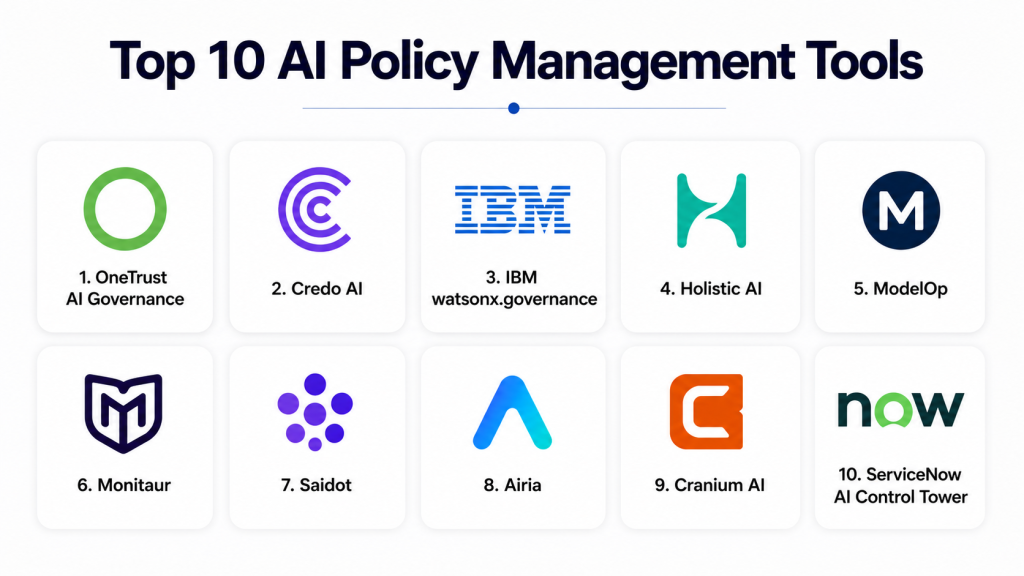
Top 10 AI Policy Management Tools
1. IBM watsonx.governance
IBM watsonx.governance provides enterprise AI governance and policy management capabilities.
Key Features
- AI policy management
- Risk assessment
- Model inventory
- Compliance workflows
- Governance automation
- Documentation
- Monitoring
- Audit support
Pros
- Enterprise-grade governance
- Strong compliance features
- AI lifecycle support
Cons
- Complex implementation
- Higher cost
2. Microsoft Purview
Microsoft Purview provides data and AI governance capabilities.
Key Features
- AI policy management
- Data governance
- Compliance tracking
- Access controls
- Risk management
- Microsoft ecosystem integration
Pros
- Strong enterprise integration
- Security focused
- Good compliance support
Cons
- Best for Microsoft environments
3. OneTrust AI Governance
OneTrust provides privacy, risk, and AI governance solutions.
Key Features
- AI policy management
- Risk assessments
- Compliance workflows
- Responsible AI controls
- Documentation
- Governance reporting
Pros
- Strong privacy capabilities
- Enterprise adoption
Cons
- Complex setup
4. Collibra AI Governance
Collibra provides data and AI governance management.
Key Features
- Policy management
- AI inventory
- Governance workflows
- Compliance tracking
- Data governance integration
- Collaboration
Pros
- Strong governance framework
- Enterprise ready
Cons
- Requires implementation effort
5. ServiceNow AI Control Tower
ServiceNow provides AI governance workflow management.
Key Features
- AI inventory
- Policy workflows
- Risk management
- Approval processes
- Compliance tracking
- Enterprise automation
Pros
- Strong workflow automation
- Enterprise IT integration
Cons
- ServiceNow ecosystem dependency
6. Google Cloud AI Governance
Google Cloud provides AI governance capabilities.
Key Features
- Responsible AI tools
- Policy controls
- Model monitoring
- Security management
- Cloud integration
Pros
- Strong AI ecosystem
- Cloud scalability
Cons
- Google Cloud dependency
7. Informatica AI Governance
Informatica provides enterprise AI and data governance.
Key Features
- Policy management
- Metadata management
- Data governance
- Compliance workflows
- AI cataloging
Pros
- Strong data governance
- Enterprise adoption
Cons
- Complex deployment
8. TrustArc AI Governance
TrustArc provides privacy and compliance management.
Key Features
- AI risk assessment
- Privacy management
- Policy workflows
- Compliance reporting
- Governance documentation
Pros
- Strong privacy focus
- Compliance capabilities
Cons
- Less focused on technical AI workflows
9. ModelOp Center
ModelOp Center manages enterprise model governance.
Key Features
- Model policies
- Approval workflows
- Lifecycle management
- Risk controls
- Compliance tracking
Pros
- Strong model governance
- Enterprise workflows
Cons
- Requires expertise
10. Holistic AI
Holistic AI focuses on responsible AI governance.
Key Features
- AI risk assessment
- Policy management
- Compliance workflows
- AI auditing
- Governance reporting
Pros
- Responsible AI focused
- Strong risk management
Cons
- Specialized platform
Comparison Table: Top 10 AI Policy Management Tools
| No. | Tool Name | Best For | Platform(s) Supported | Deployment | Standout Feature | Public Rating |
|---|---|---|---|---|---|---|
| 1 | IBM watsonx.governance | Enterprise AI policies | Cloud | Managed | Governance automation | 4.8/5 |
| 2 | Microsoft Purview | Enterprise compliance | Cloud | Managed | Policy controls | 4.7/5 |
| 3 | OneTrust AI Governance | Privacy governance | Cloud | Managed | Risk workflows | 4.7/5 |
| 4 | Collibra | Data and AI governance | Cloud | Enterprise | Policy framework | 4.6/5 |
| 5 | ServiceNow AI Control Tower | Workflow governance | Cloud | Managed | Approval workflows | 4.6/5 |
| 6 | Google AI Governance | Cloud AI governance | Cloud | Managed | Responsible AI | 4.6/5 |
| 7 | Informatica | Data governance | Cloud | Enterprise | Metadata management | 4.5/5 |
| 8 | TrustArc | Privacy compliance | Cloud | Managed | Privacy policies | 4.5/5 |
| 9 | ModelOp Center | Model governance | Cloud | Enterprise | Lifecycle policies | 4.5/5 |
| 10 | Holistic AI | Responsible AI | Cloud | Managed | AI auditing | 4.4/5 |
Weighted Evaluation Table
| No. | Tool Name | Policy Management 25% | Ease of Use 15% | AI Integration 15% | Security 10% | Scalability 10% | Compliance 10% | Value 15% | Total Score |
|---|---|---|---|---|---|---|---|---|---|
| 1 | IBM watsonx.governance | 25 | 14 | 15 | 10 | 10 | 10 | 14 | 98 |
| 2 | Microsoft Purview | 25 | 15 | 15 | 10 | 10 | 10 | 13 | 98 |
| 3 | OneTrust AI Governance | 25 | 14 | 14 | 10 | 10 | 10 | 13 | 96 |
| 4 | Collibra | 24 | 13 | 14 | 10 | 10 | 10 | 13 | 94 |
| 5 | ServiceNow AI Control Tower | 24 | 14 | 14 | 10 | 10 | 10 | 13 | 95 |
| 6 | Google AI Governance | 24 | 14 | 15 | 10 | 10 | 10 | 13 | 96 |
| 7 | Informatica | 24 | 12 | 14 | 10 | 10 | 10 | 13 | 93 |
| 8 | TrustArc | 23 | 14 | 13 | 10 | 10 | 10 | 13 | 93 |
| 9 | ModelOp Center | 24 | 13 | 14 | 10 | 10 | 10 | 13 | 94 |
| 10 | Holistic AI | 23 | 14 | 14 | 10 | 10 | 10 | 13 | 94 |
Which AI Policy Management Tool Is Right for You?
Choose IBM watsonx.governance for enterprise AI governance.
Choose Microsoft Purview for Microsoft-based organizations.
Choose OneTrust AI Governance for privacy-focused governance.
Choose Collibra for enterprise data governance.
Choose ServiceNow AI Control Tower for workflow automation.
Choose Google AI Governance for cloud AI management.
Choose Informatica for data-driven governance.
Choose TrustArc for privacy compliance.
Choose ModelOp Center for model lifecycle policies.
Choose Holistic AI for responsible AI management.
Implementation Playbook
Phase 1: Define AI Policies
- Identify AI risks
- Create usage guidelines
- Define approval rules
Phase 2: Build Governance Workflow
- Assign owners
- Create review processes
- Configure controls
Phase 3: Apply Policies
- Monitor AI usage
- Enforce standards
- Track compliance
Phase 4: Audit AI Systems
- Review models
- Document decisions
- Generate reports
Phase 5: Continuous Improvement
- Update policies
- Monitor new risks
- Improve governance
Common Mistakes
- Using AI without policies
- No ownership definition
- Poor documentation
- Ignoring compliance
- Lack of monitoring
- No approval workflow
FAQs
1. What are AI Policy Management Tools?
They are platforms used to create and manage rules for responsible AI usage.
2. Why are AI policies important?
They help organizations control risks and ensure safe AI adoption.
3. Can policy tools manage generative AI?
Yes, they help govern LLMs, AI assistants, and AI agents.
4. Who uses AI policy management platforms?
AI teams, compliance teams, security teams, and business leaders.
5. What policies can organizations create?
Usage policies, security rules, compliance requirements, and model approval rules.
6. Are AI policy tools part of AI governance?
Yes, they are a major component of AI governance frameworks.
7. Can policies be automated?
Yes, many platforms provide automated enforcement workflows.
8. How do AI policy tools support compliance?
They maintain documentation, reports, and governance records.
9. Why are AI agent policies becoming important?
Autonomous agents require rules for permissions and actions.
10. What is the future of AI policy management?
Automated, intelligent policy enforcement will become essential for enterprise AI.
Conclusion
AI Policy Management Tools are becoming a foundation for responsible artificial intelligence adoption. They help organizations establish clear rules, manage risks, maintain compliance, and ensure AI systems operate safely.Platforms such as IBM watsonx.governance, Microsoft Purview, OneTrust AI Governance, Collibra, ServiceNow AI Control Tower, and ModelOp Center provide powerful solutions for managing AI policies.As organizations continue adopting generative AI and autonomous AI systems, effective policy management will become essential for building secure, transparent, and trustworthy AI environments.