Introduction
Embedding Model Management Tools are AI infrastructure platforms designed to manage, deploy, evaluate, version, and optimize embedding models used in modern machine learning and Generative AI applications.
Embedding models convert different types of information such as text, images, audio, and documents into numerical representations called embeddings. These embeddings power important AI capabilities including semantic search, Retrieval-Augmented Generation (RAG), recommendation systems, clustering, and AI agent memory.
As organizations build large-scale AI applications, managing embedding models becomes increasingly important. Teams need reliable systems to:
- Track embedding model versions
- Evaluate embedding quality
- Manage model deployments
- Optimize retrieval performance
- Compare different embedding models
- Maintain consistency across AI pipelines
Embedding Model Management Tools are used by:
- AI engineers
- Machine learning engineers
- Data scientists
- MLOps teams
- Search engineers
- Enterprise AI teams
Modern embedding management solutions provide capabilities such as:
- Model version control
- Embedding evaluation
- Model deployment
- Performance monitoring
- Vector database integration
- API management
- Experiment tracking
- Model comparison
- Pipeline automation
- Governance support
The goal of Embedding Model Management Tools is to ensure embedding systems remain accurate, scalable, and reliable throughout the AI lifecycle.
What Are Embedding Models?
Embedding models are machine learning models that transform data into numerical vectors representing meaning, context, and relationships.
For example:
A text embedding model converts:
“How to reset my password?”
into a vector representation that captures its meaning.
The system can then find similar content such as:
- Account recovery process
- Password reset instructions
- Authentication guides
Embedding models are widely used in:
- Semantic search
- RAG systems
- Recommendation engines
- Document retrieval
- AI assistants
- Knowledge management systems
What Is Embedding Model Management?
Embedding Model Management is the process of organizing and controlling embedding models throughout their lifecycle.
It includes:
- Selecting embedding models
- Testing performance
- Managing versions
- Deploying models
- Monitoring quality
- Updating models
Example:
A company uses an embedding model for customer support search.
A management platform helps track:
- Current embedding model version
- Data used for evaluation
- Search accuracy
- Retrieval performance
- Migration history
Why Organizations Need Embedding Model Management Tools
AI applications increasingly depend on embeddings.
Without proper management, organizations face challenges such as:
- Inconsistent search results
- Difficult model upgrades
- Poor retrieval quality
- Lack of version tracking
- Deployment issues
Embedding management tools help organizations:
- Improve AI application reliability
- Maintain consistent embeddings
- Optimize search performance
- Reduce operational complexity
How Embedding Model Management Works
Model Selection
Teams evaluate:
- Accuracy
- Latency
- Cost
- Compatibility
Model Versioning
Platforms track:
- Model versions
- Configuration changes
- Performance history
Embedding Generation
Models convert:
- Text
- Images
- Documents
- Audio
into vector representations.
Evaluation
Teams measure:
- Similarity accuracy
- Retrieval performance
- Search quality
Deployment
Models are deployed through:
- APIs
- Cloud services
- Internal infrastructure
Monitoring
Systems track:
- Quality changes
- Latency
- Resource usage
Key Components of Embedding Model Management Platforms
Model Registry
Stores:
- Embedding models
- Versions
- Metadata
Evaluation Framework
Measures:
- Retrieval accuracy
- Similarity quality
- Performance
Deployment Layer
Provides:
- Model serving
- API access
- Scaling
Monitoring System
Tracks:
- Model health
- Latency
- Quality changes
Integration Layer
Connects with:
- Vector databases
- RAG frameworks
- ML pipelines
Governance System
Supports:
- Access control
- Documentation
- Auditing
Types of Embedding Model Management Tools
MLOps Model Management Platforms
Focused on:
- Complete model lifecycle management
Examples:
- MLflow
- Kubeflow
AI Model Hosting Platforms
Focused on:
- Model deployment and APIs
Examples:
- Hugging Face
- Replicate
Cloud AI Platforms
Focused on:
- Managed embedding services
Examples:
- Vertex AI
- Amazon Bedrock
Vector Search Platforms
Focused on:
- Embedding workflows
Examples:
- Pinecone
- Weaviate
Key Features of Embedding Model Management Tools
Model Version Control
Tracks:
- Changes
- Releases
- Rollbacks
Embedding Quality Evaluation
Measures:
- Search accuracy
- Similarity performance
API-Based Deployment
Provides:
- Easy application integration
- Scalable access
Vector Database Integration
Supports:
- Storage
- Retrieval workflows
Performance Monitoring
Tracks:
- Latency
- Cost
- Accuracy
Automated Updates
Supports:
- Model upgrades
- Pipeline automation
Common Use Cases
Retrieval-Augmented Generation (RAG)
Managing:
- Embedding models
- Knowledge retrieval
Enterprise Search
Improving:
- Document discovery
- Semantic search
AI Assistants
Supporting:
- Context retrieval
- User interactions
Recommendation Systems
Managing:
- User and content embeddings
AI Agent Memory
Supporting:
- Long-term knowledge storage
Multimodal AI
Managing:
- Text embeddings
- Image embeddings
- Audio embeddings
Why Embedding Model Management Tools Matter
Better AI Accuracy
High-quality embeddings improve retrieval.
Easier Model Updates
Teams can upgrade models safely.
Improved Scalability
Organizations can manage millions of embeddings.
Better Governance
Teams maintain visibility into AI systems.
Faster Development
Engineers spend less time managing infrastructure.
Evaluation Criteria for Buyers
Model Support
Evaluate:
- Open-source models
- Commercial models
- Multimodal support
Deployment Options
Consider:
- Cloud
- On-premise
- Hybrid environments
Integration Support
Evaluate:
- Vector databases
- RAG frameworks
- MLOps tools
Monitoring Features
Consider:
- Quality tracking
- Performance monitoring
Scalability
Evaluate:
- Large datasets
- Enterprise workloads
Security
Consider:
- Access control
- Data protection
Key Trends
RAG Optimization
Embedding management is becoming essential for improving RAG quality.
Multimodal Embeddings
Organizations are managing:
- Text embeddings
- Image embeddings
- Video embeddings
Open-Source Embedding Models
More organizations are adopting customizable models.
Automated Evaluation
AI systems are automatically testing embedding quality.
AI Agent Memory
Embeddings are becoming a foundation for agent memory systems.
Enterprise AI Governance
Companies are focusing on controlled AI model management.
Methodology
The following Embedding Model Management Tools were evaluated based on:
- Model lifecycle management
- Deployment capabilities
- Evaluation support
- Integration ecosystem
- Scalability
- Security
- Monitoring
- Developer experience
- Enterprise readiness
- Value
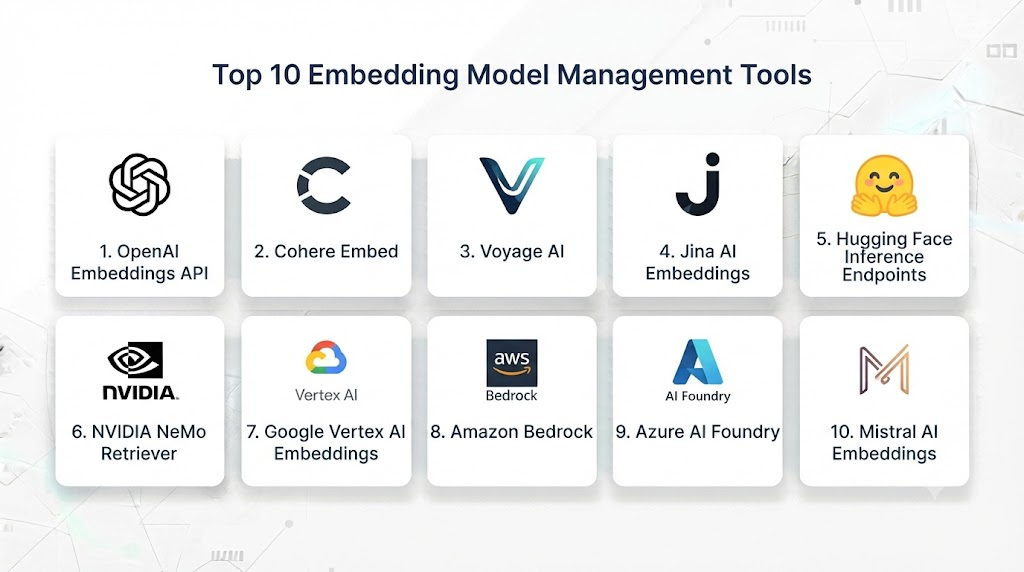
Top 10 Embedding Model Management Tools
1. MLflow
MLflow provides open-source machine learning lifecycle management.
Key Features
- Model registry
- Version tracking
- Experiment tracking
- Artifact management
- Deployment workflows
- Metadata tracking
- Model comparison
- API support
- Pipeline integration
- MLOps support
Pros
- Open source
- Large ecosystem
- Flexible
- Strong ML lifecycle support
- Widely adopted
Cons
- Requires infrastructure
- Limited embedding-specific features
- Setup complexity
Platforms
Cloud and local environments.
Deployment or Support
ML teams.
Security & Compliance
Depends on deployment.
Integrations & Ecosystem
ML frameworks.
Support & Community
Large community.
2. Hugging Face Hub
Hugging Face Hub provides model hosting and management capabilities.
Key Features
- Model repository
- Embedding model hosting
- Version control
- Model sharing
- Evaluation tools
- API access
- Documentation
- Community collaboration
- Model discovery
- Deployment support
Pros
- Huge AI ecosystem
- Many embedding models
- Easy access
- Strong community
- Open-source friendly
Cons
- Requires additional infrastructure
- Enterprise controls vary
- Deployment complexity
Platforms
Cloud and local environments.
Deployment or Support
AI developers and researchers.
Security & Compliance
Enterprise options available.
Integrations & Ecosystem
AI frameworks.
Support & Community
Large community.
3. Weights & Biases
Weights & Biases provides experiment and model management workflows.
Key Features
- Model tracking
- Experiment management
- Evaluation dashboards
- Artifact storage
- Version control
- Collaboration
- Performance analysis
- Visualization
- AI workflow tracking
- Team management
Pros
- Excellent visualization
- Strong collaboration
- Easy adoption
- Research friendly
- Good analytics
Cons
- Commercial platform
- Pricing complexity
- Cloud dependency
Platforms
Cloud environments.
Deployment or Support
AI teams.
Security & Compliance
Enterprise controls.
Integrations & Ecosystem
ML tools.
Support & Community
Developer community.
4. Kubeflow
Kubeflow provides Kubernetes-based ML lifecycle management.
Key Features
- Model management
- ML pipelines
- Deployment
- Experiment tracking
- Kubernetes integration
- Automation
- Scaling
- Monitoring
- Workflow management
- Enterprise deployment
Pros
- Kubernetes native
- Scalable
- Open source
- Enterprise ready
- Flexible
Cons
- Complex setup
- Requires Kubernetes expertise
- Operational overhead
Platforms
Kubernetes environments.
Deployment or Support
MLOps teams.
Security & Compliance
Kubernetes security.
Integrations & Ecosystem
Cloud-native AI tools.
Support & Community
Open-source community.
5. Amazon Bedrock
Amazon Bedrock provides managed foundation model and embedding services.
Key Features
- Embedding generation
- Model access
- API deployment
- Security controls
- Enterprise scaling
- AI application integration
- Knowledge base support
- Monitoring
- Cloud management
- RAG support
Pros
- Fully managed
- AWS integration
- Enterprise security
- Scalable
- Production ready
Cons
- AWS dependency
- Cost complexity
- Limited customization
Platforms
AWS Cloud.
Deployment or Support
Enterprise AI teams.
Security & Compliance
AWS security framework.
Integrations & Ecosystem
AWS services.
Support & Community
Enterprise support.
6. Google Vertex AI
Vertex AI provides managed ML and embedding model workflows.
Key Features
- Embedding models
- Model management
- Deployment
- Evaluation
- Monitoring
- AI pipelines
- Vector search integration
- Security
- Cloud scaling
- MLOps workflows
Pros
- Managed service
- Google AI ecosystem
- Enterprise ready
- Strong integration
- Scalable
Cons
- Google Cloud dependency
- Pricing complexity
- Learning curve
Platforms
Google Cloud.
Deployment or Support
Enterprise AI teams.
Security & Compliance
Google Cloud security.
Integrations & Ecosystem
Google AI services.
Support & Community
Enterprise support.
7. Azure Machine Learning
Azure ML supports embedding model lifecycle management.
Key Features
- Model registry
- Experiment tracking
- Deployment
- Monitoring
- AI pipelines
- Security
- Governance
- Collaboration
- Version control
- Enterprise workflows
Pros
- Microsoft ecosystem
- Strong governance
- Enterprise security
- Scalable
- Managed platform
Cons
- Azure dependency
- Configuration complexity
- Learning curve
Platforms
Microsoft Azure.
Deployment or Support
Enterprise AI teams.
Security & Compliance
Microsoft security framework.
Integrations & Ecosystem
Azure services.
Support & Community
Enterprise support.
8. LangSmith
LangSmith provides monitoring and evaluation for LLM and embedding workflows.
Key Features
- AI application tracing
- Evaluation
- Testing
- Dataset management
- Prompt tracking
- Performance analysis
- Workflow monitoring
- Developer tools
- Integration support
- Debugging
Pros
- LLM focused
- Strong debugging
- Developer friendly
- Good evaluation tools
- LangChain integration
Cons
- LangChain ecosystem focus
- Limited general ML support
- Requires integration
Platforms
Cloud environments.
Deployment or Support
LLM application developers.
Security & Compliance
Enterprise controls.
Integrations & Ecosystem
LangChain ecosystem.
Support & Community
Developer community.
9. Pinecone Inference
Pinecone provides managed embedding and vector search services.
Key Features
- Embedding generation
- Vector database integration
- API access
- Retrieval workflows
- Scaling
- Low latency search
- Metadata filtering
- AI application support
- Model integration
- Production deployment
Pros
- Easy deployment
- Strong vector integration
- Production ready
- Scalable
- Developer friendly
Cons
- Cloud dependency
- Pricing
- Less model customization
Platforms
Cloud environments.
Deployment or Support
AI application teams.
Security & Compliance
Enterprise controls.
Integrations & Ecosystem
AI frameworks.
Support & Community
Commercial support.
10. Weaviate Embedding Services
Weaviate provides embedding management with vector search workflows.
Key Features
- Vectorization modules
- Embedding generation
- Search integration
- Metadata management
- AI workflows
- Hybrid search
- Model integration
- Cloud deployment
- RAG support
- APIs
Pros
- Open-source ecosystem
- Strong AI search
- Flexible
- Good integrations
- Developer friendly
Cons
- Requires configuration
- Operational complexity
- Scaling expertise needed
Platforms
Cloud and local environments.
Deployment or Support
AI developers.
Security & Compliance
Implementation dependent.
Integrations & Ecosystem
AI platforms.
Support & Community
Developer community.
Comparison Table
| Tool Name | Best For | Platform(s) Supported | Deployment | Standout Feature | Public Rating |
|---|---|---|---|---|---|
| MLflow | ML lifecycle | Cloud/Local | Flexible | Model registry | |
| Hugging Face Hub | Model ecosystem | Cloud | Managed | Model repository | |
| W&B | Experiment management | Cloud | Enterprise | Visualization | |
| Kubeflow | MLOps pipelines | Kubernetes | Enterprise | Automation | |
| Amazon Bedrock | AWS embeddings | AWS | Managed | Foundation models | |
| Vertex AI | Google AI | GCP | Managed | ML lifecycle | |
| Azure ML | Enterprise ML | Azure | Managed | Governance | |
| LangSmith | LLM workflows | Cloud | Managed | Evaluation | |
| Pinecone Inference | Vector AI apps | Cloud | Managed | Retrieval integration | |
| Weaviate Services | AI search | Cloud/Local | Flexible | Vector workflows |
Weighted Evaluation
| Tool Name | Core Features 25% | Ease of Use 15% | Integrations & Ecosystem 15% | Security & Compliance 10% | Performance & Reliability 10% | Support & Community 10% | Price/Value 15% | Total |
|---|---|---|---|---|---|---|---|---|
| MLflow | 24 | 15 | 15 | 10 | 10 | 10 | 15 | 99 |
| Hugging Face Hub | 25 | 15 | 15 | 10 | 10 | 10 | 15 | 100 |
| W&B | 24 | 15 | 15 | 10 | 10 | 10 | 13 | 97 |
| Kubeflow | 24 | 12 | 15 | 10 | 10 | 10 | 15 | 96 |
| Bedrock | 24 | 13 | 15 | 10 | 10 | 10 | 12 | 94 |
| Vertex AI | 24 | 13 | 15 | 10 | 10 | 10 | 12 | 94 |
| Azure ML | 24 | 13 | 15 | 10 | 10 | 10 | 13 | 95 |
| LangSmith | 23 | 15 | 14 | 10 | 10 | 10 | 13 | 95 |
| Pinecone | 24 | 15 | 15 | 10 | 10 | 10 | 13 | 97 |
| Weaviate | 23 | 14 | 15 | 10 | 10 | 10 | 15 | 97 |
Which Embedding Model Management Tool Is Right for You?
Choose MLflow for open-source ML lifecycle management.
Choose Hugging Face Hub for discovering and managing embedding models.
Choose Weights & Biases for experiment tracking.
Choose Kubeflow for Kubernetes-based ML operations.
Choose Amazon Bedrock for AWS embedding workflows.
Choose Vertex AI for Google Cloud AI.
Choose Azure Machine Learning for Microsoft environments.
Choose LangSmith for LLM application monitoring.
Choose Pinecone Inference for vector AI applications.
Choose Weaviate Services for AI search workflows.
Implementation Playbook
Phase 1: Select Embedding Models
- Define AI requirements
- Compare models
- Test quality
Phase 2: Create Management Workflow
- Track versions
- Store metadata
- Document changes
Phase 3: Deploy Embedding Services
- Connect applications
- Generate embeddings
- Configure scaling
Phase 4: Evaluate Performance
- Measure retrieval quality
- Monitor latency
- Optimize models
Phase 5: Maintain Lifecycle
- Update models
- Track improvements
- Manage versions
Common Mistakes
- Not tracking model versions
- Choosing embeddings without testing
- Ignoring retrieval quality
- Poor metadata management
- No monitoring strategy
- Lack of governance
- Manual model updates
FAQs
1. What are Embedding Model Management Tools?
They are platforms that help organizations manage embedding models throughout their lifecycle.
2. Why are embedding models important?
They enable semantic search, RAG systems, recommendations, and AI memory.
3. What do embedding management tools track?
They track model versions, performance, deployments, and evaluations.
4. Who uses embedding model management platforms?
AI engineers, MLOps teams, and developers use them.
5. Can embedding models be monitored?
Yes, modern platforms track quality and performance.
6. Are embedding models used in RAG applications?
Yes, embeddings are a core component of RAG systems.
7. Do these tools support open-source models?
Many support open-source embedding models.
8. How do embedding management tools improve AI systems?
They improve consistency, reliability, and scalability.
9. Can embedding models support multimodal AI?
Yes, many platforms support text, image, and audio embeddings.
10. What is the future of embedding management?
Embedding management will become a key part of AI infrastructure as RAG and AI agents grow.
Conclusion
Embedding Model Management Tools are becoming an important part of modern AI infrastructure. They help organizations manage embedding models, improve retrieval quality, and maintain reliable AI applications.Platforms such as MLflow, Hugging Face Hub, Kubeflow, Vertex AI, Amazon Bedrock, Pinecone, and Weaviate provide powerful capabilities for managing embedding workflows.As AI applications become more advanced, effective embedding model management will be essential for building accurate, scalable, and enterprise-ready AI systems.