Introduction
Model Governance Workflows are AI management frameworks and platforms designed to control, monitor, document, and manage machine learning models throughout their complete lifecycle.
As organizations deploy more AI systems, maintaining transparency, security, compliance, and responsible AI practices becomes increasingly important. Model governance workflows help teams establish structured processes for model approval, risk assessment, monitoring, auditing, and operational control.
These platforms help organizations manage:
- Model approvals
- Risk assessments
- Compliance requirements
- Model documentation
- Performance monitoring
- Bias detection
- Security controls
- Audit trails
Model Governance Workflow platforms are used by:
- MLOps teams
- Data scientists
- AI governance teams
- Compliance teams
- Risk management teams
- Enterprise AI leaders
Modern model governance solutions provide capabilities such as:
- Model inventory management
- Approval workflows
- Model documentation
- Responsible AI checks
- Audit tracking
- Access control
- Compliance reporting
- Risk scoring
- Monitoring integration
- Lifecycle management
The goal of Model Governance Workflows is to ensure AI systems are trustworthy, explainable, secure, and aligned with organizational policies.
What Are Model Governance Workflows?
Model Governance Workflows are structured processes used to manage how machine learning models are developed, approved, deployed, monitored, and retired.
They create a controlled framework for every stage of the AI lifecycle.
Example:
A financial company develops a credit scoring model.
Before deployment, governance workflows ensure:
- Data sources are documented
- Model performance is tested
- Bias risks are evaluated
- Compliance teams approve usage
- Deployment decisions are recorded
Why Organizations Need Model Governance Workflows
AI systems influence important business decisions.
Organizations face challenges such as:
- Lack of model transparency
- Regulatory requirements
- Data privacy risks
- Bias concerns
- Security threats
- Poor documentation
Without governance workflows, companies may experience:
- Compliance failures
- Uncontrolled AI usage
- Poor model accountability
- Operational risks
Model governance platforms help organizations:
- Manage AI responsibly
- Improve transparency
- Reduce risks
- Maintain compliance
How Model Governance Workflows Work
Model Registration
Teams create records containing:
- Model information
- Owner details
- Training data
- Version history
Risk Assessment
The system evaluates:
- Business impact
- Compliance requirements
- Security risks
- Bias risks
Approval Process
Governance teams review:
- Model documentation
- Performance metrics
- Risk reports
Deployment Management
Approved models are:
- Released
- Monitored
- Controlled
Continuous Monitoring
Systems track:
- Model behavior
- Performance changes
- Compliance status
Retirement Process
Old models are:
- Archived
- Replaced
- Removed safely
Key Components of Model Governance Platforms
Model Inventory
Maintains:
- Model catalog
- Ownership information
- Lifecycle status
Approval Workflow Engine
Controls:
- Reviews
- Approvals
- Deployment permissions
Documentation Management
Stores:
- Model cards
- Technical details
- Risk information
Risk Management System
Evaluates:
- Bias
- Security
- Compliance
Audit Trail
Records:
- Changes
- Decisions
- User actions
Monitoring Integration
Tracks:
- Performance
- Drift
- Reliability
Types of Model Governance Platforms
Enterprise AI Governance Platforms
Designed for:
- Large organizations
- Compliance-heavy industries
Examples:
- IBM Watson Governance
- Fiddler AI
MLOps Governance Platforms
Designed for:
- Machine learning lifecycle management
Examples:
- MLflow
- Kubeflow
Cloud AI Governance Solutions
Designed for:
- Managed AI environments
Examples:
- AWS SageMaker Governance
- Google Vertex AI Model Governance
- Azure Responsible AI
Responsible AI Platforms
Focused on:
- Fairness
- Explainability
- Transparency
Key Features of Model Governance Workflow Platforms
Model Catalog Management
Tracks:
- Models
- Versions
- Owners
- Status
Responsible AI Controls
Measures:
- Fairness
- Explainability
- Transparency
Compliance Reporting
Supports:
- Audits
- Documentation
- Regulatory requirements
Approval Workflows
Manages:
- Review processes
- Human approvals
- Deployment decisions
Access Management
Controls:
- User permissions
- Model access
- Data access
Monitoring Integration
Connects with:
- Drift detection
- Performance monitoring
- AI observability tools
Common Use Cases
Banking and Finance
Managing:
- Credit models
- Fraud detection systems
- Risk models
Healthcare
Governance for:
- Medical AI systems
- Patient prediction models
Insurance
Managing:
- Pricing models
- Risk assessment systems
Government
Controlling:
- Public AI applications
- Decision systems
Enterprise AI
Managing:
- Internal AI applications
- Business automation models
Generative AI
Governance for:
- LLM applications
- AI assistants
- AI agents
Why Model Governance Workflows Matter
Improves AI Transparency
Organizations understand how models operate.
Supports Compliance
Teams maintain regulatory requirements.
Reduces AI Risks
Potential issues are identified early.
Improves Accountability
Ownership and responsibilities are clear.
Enables Responsible AI Adoption
Organizations deploy AI safely.
Evaluation Criteria for Buyers
Governance Capabilities
Evaluate:
- Model inventory
- Approval workflows
- Risk management
Compliance Support
Consider:
- Reporting
- Audit trails
- Documentation
Explainability
Evaluate:
- Model insights
- Decision explanations
Integration Support
Look for:
- MLOps platforms
- Cloud AI services
- Monitoring tools
Scalability
Consider:
- Number of models
- Enterprise requirements
Security
Evaluate:
- Access controls
- Data protection
Key Trends
AI Regulation Growth
Organizations are preparing for stronger AI governance requirements.
Responsible AI Adoption
Fairness and transparency are becoming standard practices.
Automated Governance
AI governance workflows are becoming more automated.
Generative AI Governance
Companies are creating controls for LLM applications.
AI Risk Management
Organizations are adopting structured AI risk frameworks.
Model Lifecycle Automation
Governance is becoming integrated with MLOps.
Methodology
The following Model Governance Workflow Platforms were evaluated based on:
- Governance capabilities
- Compliance support
- Model lifecycle management
- Monitoring integration
- Security
- Scalability
- Enterprise readiness
- Developer experience
- Automation
- Value
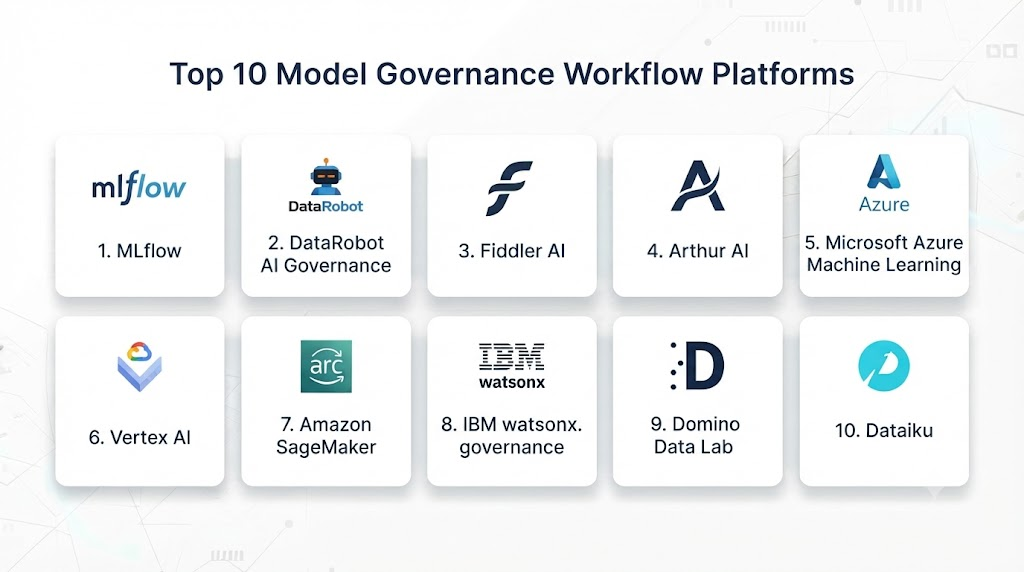
Top 10 Model Governance Workflow Platforms
1. IBM watsonx.governance
IBM watsonx.governance provides enterprise AI governance capabilities.
Key Features
- AI lifecycle governance
- Risk management
- Compliance tracking
- Model inventory
- Policy management
- Documentation
- Monitoring
- Audit workflows
- Responsible AI controls
- Enterprise reporting
Pros
- Strong enterprise governance
- Compliance-focused
- Good lifecycle management
- Responsible AI support
- Large enterprise adoption
Cons
- Enterprise pricing
- Complex implementation
- Requires expertise
Platforms
Cloud and enterprise environments.
Deployment or Support
Large organizations.
Security & Compliance
Enterprise governance controls.
Integrations & Ecosystem
Enterprise AI platforms.
Support & Community
Enterprise support.
2. Microsoft Azure Responsible AI
Azure provides responsible AI governance tools.
Key Features
- Fairness assessment
- Explainability
- Model monitoring
- Documentation
- Risk management
- Compliance support
- Responsible AI dashboard
- Model tracking
- Security controls
- Enterprise integration
Pros
- Microsoft ecosystem
- Strong responsible AI features
- Enterprise security
- Cloud integration
- Scalable
Cons
- Azure dependency
- Configuration complexity
- Requires expertise
Platforms
Microsoft Azure.
Deployment or Support
Enterprise AI teams.
Security & Compliance
Microsoft security framework.
Integrations & Ecosystem
Azure services.
Support & Community
Enterprise support.
3. Google Vertex AI Model Governance
Google Vertex AI provides governance capabilities for ML models.
Key Features
- Model management
- Metadata tracking
- Monitoring
- Explainability
- Version control
- Security
- Compliance workflows
- Model registry
- AI lifecycle management
- Cloud integration
Pros
- Managed service
- Google ecosystem
- Scalable
- Strong ML infrastructure
- Enterprise ready
Cons
- Google Cloud dependency
- Learning curve
- Pricing complexity
Platforms
Google Cloud.
Deployment or Support
Enterprise AI teams.
Security & Compliance
Google Cloud security.
Integrations & Ecosystem
Google AI services.
Support & Community
Enterprise support.
4. AWS SageMaker Governance
AWS SageMaker provides governance features for machine learning workflows.
Key Features
- Model registry
- Approval workflows
- Metadata tracking
- Monitoring
- Security controls
- Version management
- Deployment governance
- Audit support
- ML lifecycle management
- Cloud integration
Pros
- AWS integration
- Enterprise security
- Scalable
- Managed service
- Production ready
Cons
- AWS dependency
- Cost complexity
- Requires AWS knowledge
Platforms
AWS Cloud.
Deployment or Support
Enterprise AI organizations.
Security & Compliance
AWS security framework.
Integrations & Ecosystem
AWS services.
Support & Community
Enterprise support.
5. Fiddler AI
Fiddler AI provides AI monitoring and governance capabilities.
Key Features
- Explainable AI
- Model monitoring
- Bias detection
- Risk management
- LLM governance
- Performance tracking
- Alerts
- Reporting
- Compliance support
- AI insights
Pros
- Strong explainability
- AI governance focused
- Enterprise ready
- Good monitoring
- Responsible AI support
Cons
- Premium pricing
- Complex workflows
- Enterprise focused
Platforms
Cloud environments.
Deployment or Support
Enterprise AI teams.
Security & Compliance
Enterprise controls.
Integrations & Ecosystem
AI platforms.
Support & Community
Enterprise support.
6. Dataiku Govern
Dataiku provides governance workflows for enterprise data and AI projects.
Key Features
- Project governance
- Model documentation
- Workflow approvals
- Data management
- Compliance tracking
- Collaboration
- Model monitoring
- Risk management
- Reporting
- Enterprise controls
Pros
- Strong collaboration
- Enterprise features
- Data and AI governance
- User-friendly
- Good workflows
Cons
- Premium platform
- Requires setup
- Enterprise focused
Platforms
Cloud and enterprise environments.
Deployment or Support
Enterprise teams.
Security & Compliance
Enterprise controls.
Integrations & Ecosystem
Data platforms.
Support & Community
Enterprise support.
7. MLflow Model Registry
MLflow provides open-source model lifecycle management.
Key Features
- Model versioning
- Model registry
- Approval workflows
- Metadata tracking
- Deployment tracking
- Experiment integration
- Artifact management
- Collaboration
- API support
- Lifecycle management
Pros
- Open source
- Popular ecosystem
- Flexible
- Developer-friendly
- Easy integration
Cons
- Limited governance features
- Requires additional tools
- Infrastructure management needed
Platforms
Cloud and local environments.
Deployment or Support
ML teams.
Security & Compliance
Depends on deployment.
Integrations & Ecosystem
ML frameworks.
Support & Community
Large community.
8. Kubeflow
Kubeflow provides Kubernetes-based ML lifecycle management.
Key Features
- ML workflows
- Model deployment
- Pipeline management
- Version tracking
- Kubernetes integration
- Monitoring support
- Experiment management
- Resource control
- Automation
- Governance integration
Pros
- Open source
- Kubernetes native
- Flexible
- Complete ML platform
- Scalable
Cons
- Complex setup
- Requires Kubernetes expertise
- Operational overhead
Platforms
Kubernetes environments.
Deployment or Support
Enterprise MLOps teams.
Security & Compliance
Kubernetes security.
Integrations & Ecosystem
Cloud-native tools.
Support & Community
Open-source community.
9. ModelOp Center
ModelOp Center provides enterprise model lifecycle governance.
Key Features
- Model inventory
- Governance workflows
- Risk management
- Compliance reporting
- Approval automation
- Monitoring
- Documentation
- Lifecycle tracking
- Audit management
- Enterprise controls
Pros
- Governance focused
- Enterprise ready
- Strong compliance
- Good lifecycle management
- Automation
Cons
- Premium pricing
- Enterprise complexity
- Smaller ecosystem
Platforms
Enterprise environments.
Deployment or Support
Large organizations.
Security & Compliance
Enterprise controls.
Integrations & Ecosystem
Enterprise AI platforms.
Support & Community
Enterprise support.
10. Collibra AI Governance
Collibra provides data and AI governance capabilities.
Key Features
- AI governance
- Data governance
- Policy management
- Compliance tracking
- Risk management
- Documentation
- Collaboration
- Workflow automation
- Metadata management
- Enterprise reporting
Pros
- Strong governance
- Data integration
- Enterprise adoption
- Compliance support
- Collaboration
Cons
- Expensive
- Complex deployment
- Enterprise focused
Platforms
Cloud environments.
Deployment or Support
Enterprise organizations.
Security & Compliance
Enterprise controls.
Integrations & Ecosystem
Data platforms.
Support & Community
Enterprise support.
Comparison Table
| Tool Name | Best For | Platform(s) Supported | Deployment | Standout Feature | Public Rating |
|---|---|---|---|---|---|
| IBM watsonx.governance | Enterprise AI governance | Cloud/Enterprise | Enterprise | Risk management | |
| Azure Responsible AI | Microsoft AI | Azure | Enterprise | Responsible AI | |
| Vertex AI Governance | Google AI | GCP | Enterprise | Model lifecycle | |
| SageMaker Governance | AWS ML | AWS | Enterprise | Approval workflows | |
| Fiddler AI | AI monitoring | Cloud | Enterprise | Explainability | |
| Dataiku Govern | Collaboration | Cloud/Enterprise | Enterprise | AI workflows | |
| MLflow Registry | ML lifecycle | Cloud/Local | Flexible | Model versions | |
| Kubeflow | Kubernetes ML | Kubernetes | Enterprise | ML workflows | |
| ModelOp Center | Compliance | Enterprise | Enterprise | Governance automation | |
| Collibra AI Governance | Data governance | Cloud | Enterprise | Policy management |
Weighted Evaluation
| Tool Name | Core Features 25% | Ease of Use 15% | Integrations & Ecosystem 15% | Security & Compliance 10% | Performance & Reliability 10% | Support & Community 10% | Price/Value 15% | Total |
|---|---|---|---|---|---|---|---|---|
| IBM watsonx.governance | 25 | 13 | 15 | 10 | 10 | 10 | 12 | 95 |
| Azure Responsible AI | 24 | 13 | 15 | 10 | 10 | 10 | 13 | 95 |
| Vertex AI Governance | 24 | 13 | 15 | 10 | 10 | 10 | 12 | 94 |
| SageMaker Governance | 24 | 13 | 15 | 10 | 10 | 10 | 12 | 94 |
| Fiddler AI | 24 | 13 | 14 | 10 | 10 | 10 | 12 | 93 |
| Dataiku Govern | 23 | 14 | 14 | 10 | 10 | 10 | 12 | 93 |
| MLflow Registry | 23 | 15 | 15 | 10 | 10 | 10 | 15 | 98 |
| Kubeflow | 24 | 11 | 15 | 10 | 10 | 10 | 15 | 95 |
| ModelOp Center | 25 | 12 | 13 | 10 | 10 | 10 | 12 | 92 |
| Collibra AI Governance | 24 | 13 | 14 | 10 | 10 | 10 | 12 | 93 |
Which Model Governance Workflow Platform Is Right for You?
Choose IBM watsonx.governance for enterprise AI governance.
Choose Azure Responsible AI for Microsoft ecosystems.
Choose Vertex AI Governance for Google Cloud environments.
Choose AWS SageMaker Governance for AWS workloads.
Choose Fiddler AI for AI monitoring and explainability.
Choose Dataiku Govern for collaborative AI governance.
Choose MLflow Model Registry for open-source lifecycle management.
Choose Kubeflow for Kubernetes-based MLOps.
Choose ModelOp Center for regulated industries.
Choose Collibra AI Governance for enterprise data governance.
Implementation Playbook
Phase 1: Create Governance Framework
- Define AI policies
- Assign ownership
- Identify risks
Phase 2: Register Models
- Document models
- Track versions
- Store metadata
Phase 3: Establish Review Processes
- Create approval workflows
- Evaluate risks
- Validate performance
Phase 4: Monitor Production Models
- Track behavior
- Check compliance
- Review changes
Phase 5: Improve Governance
- Update policies
- Automate workflows
- Maintain transparency
Common Mistakes
- Deploying models without documentation
- No ownership tracking
- Ignoring AI risks
- Missing audit records
- Poor approval processes
- No monitoring
- Lack of compliance planning
FAQs
1. What are Model Governance Workflows?
They are structured processes used to manage, control, and monitor AI models throughout their lifecycle.
2. Why is model governance important?
It helps organizations build safe, transparent, and compliant AI systems.
3. Who uses model governance platforms?
AI teams, compliance teams, and enterprise organizations use them.
4. What does model governance include?
It includes documentation, approvals, monitoring, risk assessment, and compliance.
5. Can governance platforms support LLM applications?
Yes, modern platforms support generative AI governance.
6. How do governance workflows reduce AI risks?
They provide controls, reviews, and monitoring processes.
7. Are open-source governance tools available?
Yes, MLflow and Kubeflow provide open-source options.
8. Do governance platforms support regulations?
Many provide features for compliance reporting and audits.
9. What is responsible AI governance?
It focuses on fairness, transparency, security, and ethical AI usage.
10. What is the future of model governance?
AI governance will become a standard requirement for enterprise AI adoption.
Conclusion
Model Governance Workflows are becoming essential as organizations deploy more AI systems across business operations. They help companies manage risks, improve transparency, maintain compliance, and ensure responsible AI adoption.Platforms such as IBM watsonx.governance, Azure Responsible AI, AWS SageMaker Governance, MLflow, Fiddler AI, and Kubeflow provide powerful solutions for managing the complete AI model lifecycle.As AI regulations and enterprise adoption continue to grow, model governance workflows will play a critical role in building trustworthy, secure, and scalable artificial intelligence systems.