Introduction
Continuous Training Pipelines are machine learning automation systems designed to continuously update, retrain, validate, and deploy AI models as new data becomes available.
Traditional machine learning workflows require teams to manually collect data, retrain models, test performance, and redeploy updated versions. However, modern AI applications need faster adaptation because real-world data changes constantly.
Continuous Training Pipelines help organizations automatically manage the complete model improvement lifecycle, including:
- Data collection
- Data validation
- Model retraining
- Model evaluation
- Version management
- Deployment automation
- Performance monitoring
These platforms help organizations:
- Keep models accurate over time
- Adapt to changing data patterns
- Reduce manual ML operations
- Improve AI reliability
- Automate MLOps workflows
Continuous Training Pipelines are used by:
- MLOps engineers
- Data scientists
- Machine learning engineers
- AI platform teams
- DevOps teams
- Enterprise AI organizations
Modern continuous training platforms provide capabilities such as:
- Automated retraining
- Data pipeline integration
- Experiment tracking
- Model versioning
- Automated testing
- Model validation
- CI/CD integration
- Deployment workflows
- Monitoring feedback loops
- Governance controls
The goal of Continuous Training Pipelines is to create self-improving AI systems that remain accurate, reliable, and production-ready.
What Are Continuous Training Pipelines?
Continuous Training Pipelines are automated workflows that regularly retrain machine learning models using new data and automatically evaluate whether updated models should replace existing production models.
Example:
A fraud detection model is deployed by a bank.
Over time:
- Fraud patterns change
- Customer behavior changes
- New transaction data arrives
A continuous training pipeline automatically:
- Collects new transaction data
- Validates data quality
- Retrains the model
- Tests performance
- Compares with the current model
- Deploys only if improvements are detected
Why Organizations Need Continuous Training Pipelines
Machine learning models can become less effective over time due to:
- Data drift
- Changing customer behavior
- Market changes
- New business requirements
Without continuous training, organizations may experience:
- Reduced prediction accuracy
- Outdated AI decisions
- Manual retraining efforts
- Slow model improvements
Continuous training pipelines help organizations:
- Maintain model performance
- Automate updates
- Improve operational efficiency
- Scale AI systems
How Continuous Training Pipelines Work
Data Collection
The pipeline gathers:
- New datasets
- User feedback
- Production data
- Updated features
Data Validation
The system checks:
- Data quality
- Missing values
- Data consistency
- Distribution changes
Model Training
The pipeline automatically:
- Runs training jobs
- Uses updated datasets
- Creates new model versions
Model Evaluation
New models are tested for:
- Accuracy
- Performance
- Business metrics
- Reliability
Model Approval
The system determines:
- Whether the model improves performance
- Whether deployment conditions are met
Deployment
Approved models are automatically released into production.
Monitoring Feedback Loop
Production results are continuously analyzed for future training cycles.
Key Components of Continuous Training Platforms
Data Pipeline Management
Handles:
- Data ingestion
- Data processing
- Feature preparation
Training Automation Engine
Manages:
- Training jobs
- Compute resources
- Scheduling
Experiment Tracking
Tracks:
- Parameters
- Metrics
- Model experiments
Model Registry
Stores:
- Model versions
- Metadata
- Deployment status
Validation System
Evaluates:
- Model quality
- Performance improvements
- Deployment readiness
Deployment Automation
Supports:
- Model release
- Rollbacks
- Production updates
Types of Continuous Training Platforms
Cloud MLOps Platforms
Designed for:
- Enterprise AI workflows
Examples:
- Amazon SageMaker
- Google Vertex AI
- Azure Machine Learning
Open Source MLOps Platforms
Designed for:
- Custom AI infrastructure
Examples:
- Kubeflow
- MLflow
- Flyte
Workflow Orchestration Platforms
Designed for:
- Data and ML automation
Examples:
- Apache Airflow
- Prefect
- Dagster
Key Features of Continuous Training Pipelines
Automated Retraining
Automatically starts training when:
- New data arrives
- Performance decreases
- Scheduled updates occur
Data Drift Detection
Identifies:
- Changing data patterns
- Model performance risks
Model Version Management
Tracks:
- Previous models
- New versions
- Deployment history
Automated Testing
Checks:
- Accuracy
- Reliability
- Performance
CI/CD Integration
Connects:
- Code changes
- Training workflows
- Deployment systems
Feedback Loops
Uses:
- Production data
- User feedback
- Performance metrics
Common Use Cases
Fraud Detection
Continuously improving:
- Fraud prediction models
- Risk scoring systems
Recommendation Systems
Updating:
- User preferences
- Content ranking models
Predictive Maintenance
Improving:
- Equipment failure prediction
- Industrial AI models
Healthcare AI
Updating:
- Medical prediction systems
- Patient analytics models
Financial Forecasting
Improving:
- Market prediction models
- Risk analysis systems
Generative AI Applications
Updating:
- LLM workflows
- AI assistants
- Retrieval systems
Why Continuous Training Pipelines Matter
Maintains Model Accuracy
Models adapt to new information.
Reduces Manual Work
Teams automate repetitive ML tasks.
Improves AI Reliability
Models remain production-ready.
Supports Faster Innovation
Organizations experiment and improve quickly.
Enables Scalable MLOps
AI operations become more automated.
Evaluation Criteria for Buyers
Automation Capabilities
Evaluate:
- Retraining workflows
- Pipeline automation
Data Integration
Consider support for:
- Data platforms
- Feature stores
- Data pipelines
Model Management
Evaluate:
- Versioning
- Registry
- Deployment
Workflow Support
Consider:
- Scheduling
- Orchestration
- Automation
Scalability
Evaluate:
- Large datasets
- Multiple models
- Enterprise workloads
Security
Consider:
- Access control
- Governance
- Compliance
Key Trends
Self-Improving AI Systems
Organizations are moving toward autonomous model improvement.
Automated MLOps
Training, testing, and deployment are becoming automated.
Real-Time Model Updates
AI systems are adapting faster to changing environments.
AI Governance Integration
Continuous training is becoming part of responsible AI management.
Feature Store Integration
Training pipelines are connecting more closely with feature management.
Generative AI Model Updates
LLM applications are adopting continuous improvement workflows.
Methodology
The following Continuous Training Pipelines were evaluated based on:
- Training automation
- Workflow management
- Model lifecycle support
- Integration ecosystem
- Scalability
- Deployment capabilities
- Security
- Developer experience
- Enterprise readiness
- Value
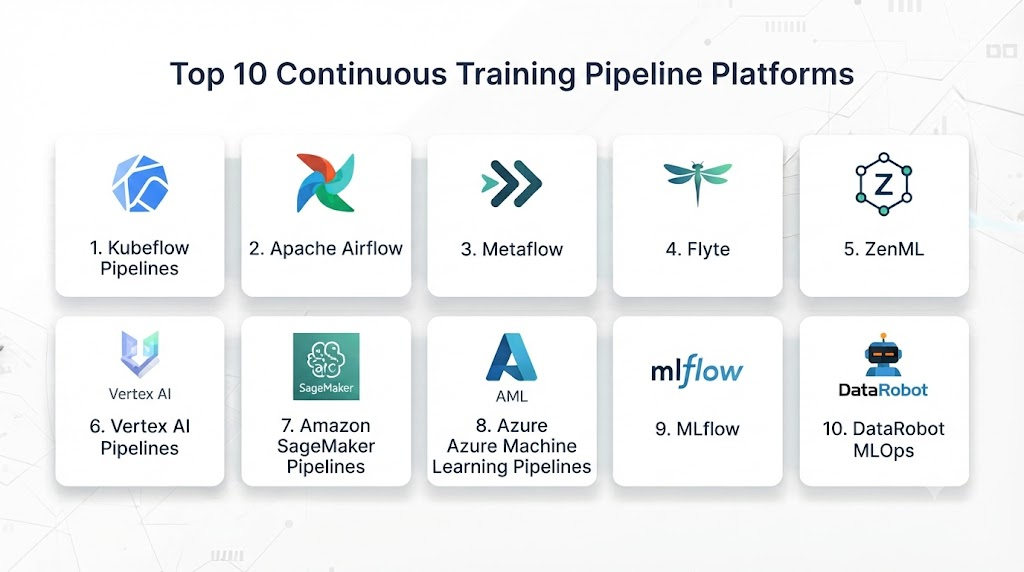
Top 10 Continuous Training Pipeline Platforms
1. Kubeflow Pipelines
Kubeflow Pipelines provides Kubernetes-based machine learning workflow automation.
Key Features
- ML workflow orchestration
- Automated training pipelines
- Experiment tracking
- Model deployment
- Kubernetes integration
- Pipeline versioning
- Component reuse
- Scalable execution
- MLOps automation
- Cloud support
Pros
- Open source
- Kubernetes native
- Complete ML workflow support
- Flexible
- Enterprise adoption
Cons
- Complex setup
- Requires Kubernetes expertise
- Operational overhead
Platforms
Kubernetes environments.
Deployment or Support
Enterprise MLOps teams.
Security & Compliance
Kubernetes security model.
Integrations & Ecosystem
Cloud-native ML tools.
Support & Community
Large open-source community.
2. Amazon SageMaker Pipelines
Amazon SageMaker Pipelines provides managed ML workflow automation.
Key Features
- Automated training
- Model evaluation
- Deployment workflows
- Pipeline management
- Experiment tracking
- Model registry
- Monitoring integration
- Cloud scaling
- CI/CD support
- Enterprise security
Pros
- Fully managed
- AWS integration
- Enterprise ready
- Scalable
- Production support
Cons
- AWS dependency
- Cost complexity
- Requires AWS knowledge
Platforms
AWS Cloud.
Deployment or Support
Enterprise AI teams.
Security & Compliance
AWS security framework.
Integrations & Ecosystem
AWS services.
Support & Community
Enterprise support.
3. Google Vertex AI Pipelines
Vertex AI Pipelines provides managed ML workflow orchestration.
Key Features
- Training automation
- Pipeline execution
- Model evaluation
- Deployment workflows
- Experiment tracking
- Metadata management
- Monitoring
- Cloud integration
- Security
- MLOps workflows
Pros
- Managed service
- Google AI ecosystem
- Scalable
- Strong infrastructure
- Enterprise support
Cons
- Google Cloud dependency
- Learning curve
- Pricing complexity
Platforms
Google Cloud.
Deployment or Support
Enterprise AI organizations.
Security & Compliance
Google Cloud security.
Integrations & Ecosystem
Google AI services.
Support & Community
Enterprise support.
4. Azure Machine Learning Pipelines
Azure ML Pipelines provide automated ML workflow management.
Key Features
- Training automation
- Pipeline workflows
- Model management
- Deployment automation
- Monitoring
- Security
- Experiment tracking
- Version control
- Governance
- Enterprise integration
Pros
- Microsoft ecosystem
- Strong governance
- Enterprise security
- Scalable
- Managed platform
Cons
- Azure dependency
- Configuration complexity
- Learning curve
Platforms
Microsoft Azure.
Deployment or Support
Enterprise AI teams.
Security & Compliance
Microsoft security framework.
Integrations & Ecosystem
Azure services.
Support & Community
Enterprise support.
5. MLflow
MLflow provides open-source ML lifecycle management.
Key Features
- Experiment tracking
- Model registry
- Pipeline integration
- Version management
- Deployment workflows
- Artifact tracking
- Model evaluation
- Collaboration
- API support
- MLOps integration
Pros
- Popular open source
- Flexible
- Easy integration
- Large ecosystem
- Developer-friendly
Cons
- Requires infrastructure setup
- Limited orchestration alone
- Additional tools needed
Platforms
Cloud and local environments.
Deployment or Support
Data science teams.
Security & Compliance
Depends on deployment.
Integrations & Ecosystem
ML frameworks.
Support & Community
Large community.
6. Apache Airflow
Apache Airflow provides workflow orchestration for data and ML pipelines.
Key Features
- Workflow scheduling
- Pipeline automation
- Task management
- Data integration
- Monitoring
- Dependency management
- Custom workflows
- Cloud support
- Plugin ecosystem
- Automation
Pros
- Widely adopted
- Flexible
- Large community
- Strong scheduling
- Many integrations
Cons
- Not ML-specific
- Requires configuration
- Complex workflows
Platforms
Cloud and local environments.
Deployment or Support
Data and ML teams.
Security & Compliance
Implementation dependent.
Integrations & Ecosystem
Data platforms.
Support & Community
Large community.
7. Flyte
Flyte provides scalable workflow automation for ML and data workloads.
Key Features
- ML pipelines
- Workflow automation
- Data versioning
- Experiment management
- Kubernetes integration
- Reproducibility
- Resource management
- Scalable execution
- Type-safe workflows
- Enterprise support
Pros
- ML focused
- Scalable
- Strong workflow management
- Reproducibility
- Cloud native
Cons
- Learning curve
- Requires expertise
- Smaller ecosystem
Platforms
Cloud and Kubernetes environments.
Deployment or Support
Enterprise MLOps teams.
Security & Compliance
Enterprise controls.
Integrations & Ecosystem
Cloud-native tools.
Support & Community
Developer community.
8. Metaflow
Metaflow provides data science workflow management.
Key Features
- ML workflows
- Experiment tracking
- Versioning
- Data management
- Cloud integration
- Pipeline automation
- Deployment support
- Collaboration
- Scalability
- Developer tools
Pros
- Data scientist friendly
- Easy workflow creation
- Flexible
- Cloud support
- Open source
Cons
- Less enterprise governance
- Smaller ecosystem
- Requires setup
Platforms
Cloud and local environments.
Deployment or Support
Data science teams.
Security & Compliance
Implementation dependent.
Integrations & Ecosystem
Cloud platforms.
Support & Community
Developer community.
9. TFX (TensorFlow Extended)
TFX provides production ML pipeline components.
Key Features
- Data validation
- Training pipelines
- Model analysis
- Deployment support
- TensorFlow integration
- Metadata management
- Model validation
- Automation
- Production workflows
- Monitoring
Pros
- Google-backed
- Production focused
- Strong ML lifecycle support
- Reliable
- Open source
Cons
- TensorFlow focused
- Complex setup
- Requires expertise
Platforms
Cloud and local environments.
Deployment or Support
Production ML systems.
Security & Compliance
Implementation dependent.
Integrations & Ecosystem
TensorFlow ecosystem.
Support & Community
Developer community.
10. Dagster
Dagster provides modern data and ML workflow orchestration.
Key Features
- Pipeline orchestration
- Data asset management
- Scheduling
- Monitoring
- Testing
- Integration support
- Workflow automation
- ML pipeline support
- Collaboration
- Developer tools
Pros
- Modern architecture
- Developer-friendly
- Strong testing
- Flexible
- Growing ecosystem
Cons
- Not ML-specific
- Requires setup
- Smaller community
Platforms
Cloud and local environments.
Deployment or Support
Data and ML teams.
Security & Compliance
Implementation dependent.
Integrations & Ecosystem
Data platforms.
Support & Community
Developer community.
Comparison Table
| Tool Name | Best For | Platform(s) Supported | Deployment | Standout Feature | Public Rating |
|---|---|---|---|---|---|
| Kubeflow Pipelines | Kubernetes MLOps | Kubernetes | Enterprise | ML workflows | |
| SageMaker Pipelines | AWS ML | AWS | Enterprise | Managed pipelines | |
| Vertex AI Pipelines | Google AI | GCP | Enterprise | Cloud ML workflows | |
| Azure ML Pipelines | Enterprise AI | Azure | Enterprise | Governance | |
| MLflow | ML lifecycle | Cloud/Local | Flexible | Model registry | |
| Airflow | Workflow automation | Cloud/Local | Flexible | Scheduling | |
| Flyte | Scalable ML workflows | Cloud/Kubernetes | Enterprise | Reproducibility | |
| Metaflow | Data science workflows | Cloud/Local | Flexible | Simplicity | |
| TFX | Production ML | Cloud/Local | Enterprise | ML validation | |
| Dagster | Data/ML orchestration | Cloud/Local | Flexible | Asset management |
Weighted Evaluation
| Tool Name | Core Features 25% | Ease of Use 15% | Integrations & Ecosystem 15% | Security & Compliance 10% | Performance & Reliability 10% | Support & Community 10% | Price/Value 15% | Total |
|---|---|---|---|---|---|---|---|---|
| Kubeflow Pipelines | 25 | 12 | 15 | 10 | 10 | 10 | 15 | 97 |
| SageMaker Pipelines | 25 | 13 | 15 | 10 | 10 | 10 | 12 | 95 |
| Vertex AI Pipelines | 25 | 13 | 15 | 10 | 10 | 10 | 12 | 95 |
| Azure ML Pipelines | 24 | 13 | 15 | 10 | 10 | 10 | 13 | 95 |
| MLflow | 23 | 15 | 15 | 10 | 10 | 10 | 15 | 98 |
| Airflow | 23 | 14 | 15 | 10 | 10 | 10 | 15 | 97 |
| Flyte | 24 | 12 | 14 | 10 | 10 | 10 | 14 | 94 |
| Metaflow | 22 | 15 | 14 | 10 | 10 | 10 | 15 | 96 |
| TFX | 24 | 11 | 14 | 10 | 10 | 10 | 14 | 93 |
| Dagster | 23 | 15 | 14 | 10 | 10 | 10 | 15 | 97 |
Which Continuous Training Pipeline Platform Is Right for You?
Choose Kubeflow Pipelines for Kubernetes-based MLOps.
Choose Amazon SageMaker Pipelines for AWS environments.
Choose Vertex AI Pipelines for Google Cloud.
Choose Azure ML Pipelines for Microsoft ecosystems.
Choose MLflow for flexible ML lifecycle management.
Choose Apache Airflow for workflow orchestration.
Choose Flyte for scalable ML workflows.
Choose Metaflow for data science teams.
Choose TFX for production TensorFlow systems.
Choose Dagster for modern data and ML pipelines.
Implementation Playbook
Phase 1: Build Data Pipeline
- Collect production data
- Validate data quality
- Prepare training datasets
Phase 2: Automate Training
- Configure training workflows
- Schedule retraining
- Track experiments
Phase 3: Evaluate Models
- Compare versions
- Validate performance
- Approve releases
Phase 4: Deploy Updates
- Release improved models
- Monitor production impact
- Enable rollback
Phase 5: Improve Continuously
- Analyze feedback
- Optimize workflows
- Maintain AI quality
Common Mistakes
- No retraining strategy
- Poor data quality checks
- Ignoring model drift
- Manual training processes
- No model validation
- Missing monitoring feedback
- Poor pipeline documentation
FAQs
1. What are Continuous Training Pipelines?
They are automated workflows that continuously retrain and update machine learning models.
2. Why are continuous training pipelines important?
They help models stay accurate as data and business conditions change.
3. How do continuous training pipelines work?
They collect new data, retrain models, evaluate performance, and deploy improvements.
4. Who uses continuous training platforms?
MLOps teams, data scientists, and AI engineers use them.
5. Can continuous training support production AI systems?
Yes, they are designed for enterprise machine learning operations.
6. What is the difference between retraining and continuous training?
Retraining updates a model manually, while continuous training automates the entire process.
7. Do these platforms support cloud deployment?
Yes, most integrate with major cloud platforms.
8. Can continuous training pipelines work with LLM applications?
Yes, many workflows support modern AI and generative AI systems.
9. How do pipelines improve AI reliability?
They automatically validate and improve models over time.
10. What is the future of continuous training?
AI systems will increasingly become self-improving through automated training loops.
Conclusion
Continuous Training Pipelines are becoming a core part of modern MLOps by enabling organizations to automatically update, validate, and improve machine learning models.Platforms such as Kubeflow Pipelines, MLflow, Amazon SageMaker Pipelines, Vertex AI Pipelines, and Azure Machine Learning Pipelines provide powerful capabilities for building automated AI improvement workflows.As organizations continue adopting AI at scale, continuous training will play a critical role in maintaining accurate, adaptive, and production-ready machine learning systems.
#MLOps, #ContinuousTraining, #MachineLearning, #AIOps, #ArtificialIntelligence