Introduction
Autoscaling Inference Orchestrators are AI infrastructure platforms designed to automatically manage, scale, and optimize machine learning model serving workloads based on demand.
As organizations deploy AI applications such as chatbots, recommendation systems, computer vision platforms, and enterprise AI assistants, inference workloads can change rapidly. A sudden increase in user requests can create performance issues, while over-provisioning resources can increase operational costs.
Autoscaling Inference Orchestrators help organizations dynamically manage AI workloads by automatically adjusting computing resources based on:
- Traffic volume
- Request patterns
- Latency requirements
- Hardware availability
- Model workload demands
These platforms help organizations:
- Maintain low response times
- Reduce infrastructure costs
- Scale AI applications automatically
- Improve resource utilization
- Support production AI workloads
Autoscaling Inference Orchestrators are used by:
- MLOps engineers
- AI platform teams
- Cloud architects
- Machine learning engineers
- DevOps teams
- Enterprise AI teams
Modern inference orchestration platforms provide capabilities such as:
- Automatic scaling
- Model deployment management
- GPU resource optimization
- Load balancing
- Request routing
- Multi-model serving
- Traffic management
- Monitoring
- High availability
- Cloud-native deployment
The goal of Autoscaling Inference Orchestrators is to provide reliable, cost-efficient, and scalable AI inference infrastructure.
What Are Autoscaling Inference Orchestrators?
Autoscaling Inference Orchestrators are systems that automatically control the deployment and scaling of AI models in production environments.
They monitor incoming requests and adjust infrastructure resources according to workload requirements.
Example:
An AI chatbot receives:
- 1,000 requests per hour during normal periods
- 50,000 requests during peak hours
An autoscaling orchestrator automatically:
- Adds more inference servers
- Allocates additional GPUs
- Distributes traffic
- Reduces resources during low usage
Why Organizations Need Autoscaling Inference Orchestrators
AI applications often experience unpredictable workloads.
Challenges include:
- Changing traffic patterns
- Expensive GPU resources
- Latency requirements
- Large model sizes
- Multiple AI services
Without autoscaling, organizations may face:
- Slow AI responses
- Higher cloud expenses
- Resource wastage
- Service interruptions
Autoscaling inference platforms help organizations:
- Improve reliability
- Optimize costs
- Handle demand spikes
- Maintain performance
How Autoscaling Inference Orchestrators Work
Traffic Monitoring
The platform monitors:
- User requests
- API traffic
- Processing requirements
Resource Analysis
The system evaluates:
- CPU usage
- GPU utilization
- Memory consumption
- Response time
Scaling Decision
The orchestrator determines whether to:
- Add resources
- Remove resources
- Move workloads
Model Deployment
New inference instances are launched automatically.
Load Distribution
Requests are distributed across:
- Servers
- GPUs
- Model replicas
Continuous Optimization
The system adjusts resources based on real-time demand.
Key Components of Inference Orchestration Platforms
Scaling Engine
Manages:
- Automatic resource adjustment
- Replica management
- Workload balancing
Model Serving Layer
Handles:
- Model deployment
- API serving
- Version management
Traffic Management
Controls:
- Request routing
- Load balancing
- Failover
Resource Scheduler
Optimizes:
- CPU allocation
- GPU usage
- Memory resources
Monitoring System
Tracks:
- Latency
- Throughput
- Errors
- Infrastructure health
Deployment Controller
Manages:
- Updates
- Rollbacks
- Model releases
Types of Autoscaling Inference Orchestrators
Kubernetes-Based Orchestrators
Designed for:
- Cloud-native AI infrastructure
- Container workloads
Examples:
- Kubernetes
- KServe
- Seldon Core
Managed Cloud AI Platforms
Designed for:
- Enterprise AI deployment
Examples:
- Amazon SageMaker
- Google Vertex AI
- Azure Machine Learning
AI-Specific Serving Platforms
Designed for:
- ML model deployment
Examples:
- Ray Serve
- BentoML
LLM Inference Platforms
Focused on:
- Generative AI workloads
Examples:
- vLLM
- NVIDIA Triton
Key Features of Autoscaling Inference Orchestrators
Automatic Scaling
Automatically adjusts:
- Model replicas
- Compute resources
- Infrastructure capacity
GPU Optimization
Improves:
- GPU utilization
- AI workload efficiency
Load Balancing
Distributes requests across:
- Multiple instances
- Multiple models
Multi-Model Serving
Supports:
- Different models
- Multiple applications
High Availability
Provides:
- Fault tolerance
- Backup instances
- Failover support
Monitoring and Analytics
Tracks:
- Performance
- Costs
- Resource usage
Common Use Cases
AI Chatbots
Managing:
- Customer conversations
- AI assistants
Generative AI Applications
Scaling:
- LLM inference
- Content generation
Recommendation Systems
Handling:
- High-volume predictions
Computer Vision Systems
Supporting:
- Real-time image analysis
Enterprise AI Platforms
Managing:
- Multiple AI applications
Edge AI Systems
Optimizing:
- Distributed inference workloads
Why Autoscaling Inference Orchestrators Matter
Better User Experience
Applications maintain fast response times.
Lower Infrastructure Costs
Resources scale based on demand.
Improved Reliability
Systems handle traffic changes automatically.
Faster AI Deployment
Teams deploy models efficiently.
Enterprise Scalability
Organizations can run AI workloads globally.
Evaluation Criteria for Buyers
Scaling Capabilities
Evaluate:
- Automatic scaling
- Response time
- Resource management
Model Support
Consider support for:
- Machine learning models
- Deep learning models
- LLMs
Deployment Flexibility
Evaluate:
- Cloud
- Kubernetes
- On-premise
Performance
Measure:
- Latency
- Throughput
- Reliability
Integration Ecosystem
Consider:
- ML frameworks
- Cloud services
- DevOps tools
Security
Evaluate:
- Access controls
- Network security
- Compliance
Key Trends
LLM Inference Scaling
Organizations are optimizing large model deployment.
GPU Resource Management
Efficient hardware usage is becoming critical.
Serverless AI Inference
Companies are adopting usage-based AI infrastructure.
Kubernetes AI Operations
Cloud-native AI deployment is increasing.
Multi-Model Infrastructure
Organizations are managing many AI services together.
Automated AI Operations
AI infrastructure management is becoming more autonomous.
Methodology
The following Autoscaling Inference Orchestrators were evaluated based on:
- Scaling capabilities
- Performance
- Model serving support
- Infrastructure management
- Integration ecosystem
- Reliability
- Security
- Developer experience
- Enterprise readiness
- Value
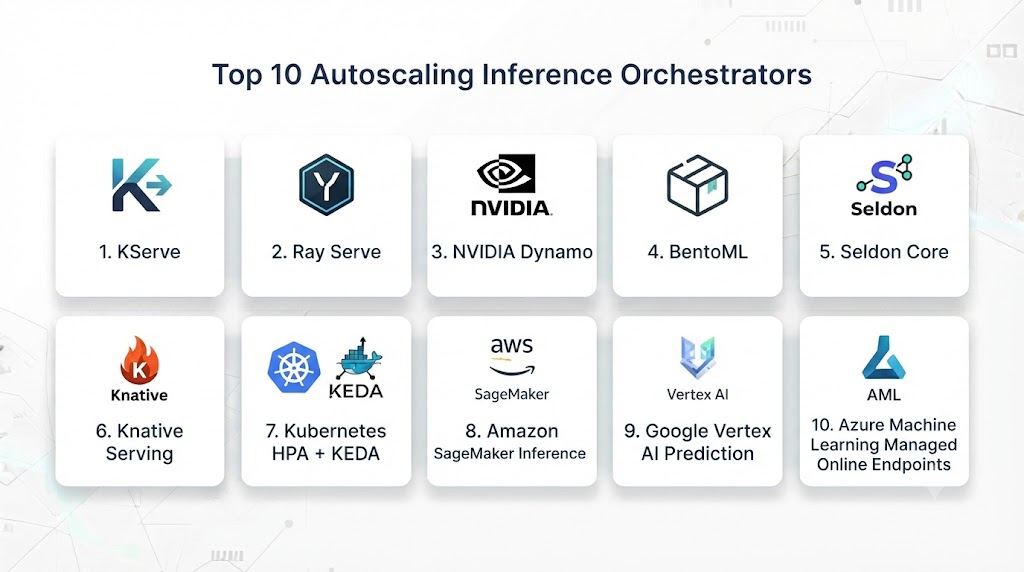
Top 10 Autoscaling Inference Orchestrators
1. Kubernetes + KServe
KServe provides Kubernetes-native model serving and autoscaling capabilities.
Key Features
- Automatic scaling
- Kubernetes integration
- Model deployment
- Serverless inference
- GPU support
- Traffic management
- Canary deployments
- Model versioning
- Monitoring
- Multi-framework support
Pros
- Cloud-native
- Highly scalable
- Open source
- Flexible deployment
- Strong Kubernetes ecosystem
Cons
- Requires Kubernetes expertise
- Complex setup
- Infrastructure management needed
Platforms
Cloud and on-premise Kubernetes environments.
Deployment or Support
Enterprise AI platforms.
Security & Compliance
Kubernetes security controls.
Integrations & Ecosystem
Cloud-native tools.
Support & Community
Large open-source community.
2. NVIDIA Triton Inference Server
NVIDIA Triton provides production-grade model serving and scaling.
Key Features
- Dynamic batching
- Multi-model serving
- GPU optimization
- Request scheduling
- Performance monitoring
- Model management
- Scaling support
- Multiple framework support
- API serving
- Hardware acceleration
Pros
- Excellent performance
- Enterprise-ready
- GPU optimized
- Multiple framework support
- Production proven
Cons
- NVIDIA dependency
- Requires expertise
- Complex configuration
Platforms
Cloud and enterprise environments.
Deployment or Support
Production AI workloads.
Security & Compliance
Enterprise controls.
Integrations & Ecosystem
NVIDIA AI ecosystem.
Support & Community
Developer community.
3. Ray Serve
Ray Serve provides scalable model serving for distributed AI workloads.
Key Features
- Autoscaling
- Distributed inference
- Model composition
- Load balancing
- Python APIs
- Multi-model serving
- Resource management
- Cloud deployment
- Monitoring
- AI workflow integration
Pros
- Flexible
- Developer-friendly
- Strong distributed support
- Scalable
- Open source
Cons
- Requires Ray knowledge
- Infrastructure complexity
- Learning curve
Platforms
Cloud and local environments.
Deployment or Support
AI engineering teams.
Security & Compliance
Implementation dependent.
Integrations & Ecosystem
Ray ecosystem.
Support & Community
Developer community.
4. Amazon SageMaker Inference
Amazon SageMaker provides managed AI inference infrastructure.
Key Features
- Automatic scaling
- Model deployment
- Endpoint management
- Monitoring
- Multi-model endpoints
- GPU support
- Cloud integration
- Security controls
- Traffic management
- Production deployment
Pros
- Fully managed
- AWS integration
- Enterprise security
- Scalable
- Production ready
Cons
- AWS dependency
- Cost complexity
- Requires AWS knowledge
Platforms
AWS Cloud.
Deployment or Support
Enterprise AI teams.
Security & Compliance
AWS security framework.
Integrations & Ecosystem
AWS services.
Support & Community
Enterprise support.
5. Google Vertex AI Prediction
Google Vertex AI provides managed model prediction and scaling.
Key Features
- Autoscaling endpoints
- Model deployment
- Monitoring
- Traffic splitting
- GPU support
- AI pipeline integration
- Security
- Version management
- Analytics
- Enterprise workflows
Pros
- Managed platform
- Google AI ecosystem
- Scalable
- Strong infrastructure
- Enterprise ready
Cons
- Google Cloud dependency
- Pricing complexity
- Learning curve
Platforms
Google Cloud.
Deployment or Support
Enterprise AI applications.
Security & Compliance
Google Cloud security.
Integrations & Ecosystem
Google AI services.
Support & Community
Enterprise support.
6. Azure Machine Learning Online Endpoints
Azure ML provides scalable inference endpoints.
Key Features
- Autoscaling
- Model deployment
- Traffic management
- Monitoring
- Security
- Kubernetes integration
- Model versions
- Enterprise governance
- API serving
- Resource management
Pros
- Microsoft ecosystem
- Enterprise security
- Strong governance
- Scalable
- Managed service
Cons
- Azure dependency
- Configuration complexity
- Learning curve
Platforms
Microsoft Azure.
Deployment or Support
Enterprise AI teams.
Security & Compliance
Microsoft security framework.
Integrations & Ecosystem
Azure services.
Support & Community
Enterprise support.
7. BentoML
BentoML provides model serving and deployment workflows.
Key Features
- Model packaging
- API serving
- Scaling support
- Container deployment
- Cloud integration
- Resource management
- Model management
- Developer tools
- Deployment automation
- Monitoring
Pros
- Easy deployment
- Developer-friendly
- Open source
- Flexible
- Good integrations
Cons
- Requires engineering knowledge
- Scaling depends on infrastructure
- Smaller ecosystem
Platforms
Cloud and local environments.
Deployment or Support
AI application teams.
Security & Compliance
Implementation dependent.
Integrations & Ecosystem
ML frameworks.
Support & Community
Developer community.
8. Seldon Core
Seldon Core provides Kubernetes-based ML deployment and scaling.
Key Features
- Model serving
- Autoscaling
- Kubernetes integration
- Monitoring
- Explainability
- A/B testing
- Traffic management
- Model graphs
- Deployment workflows
- Enterprise support
Pros
- Strong Kubernetes support
- Enterprise features
- Flexible deployment
- Good governance
- Scalable
Cons
- Requires Kubernetes expertise
- Complex setup
- Learning curve
Platforms
Kubernetes environments.
Deployment or Support
Enterprise MLOps teams.
Security & Compliance
Enterprise controls.
Integrations & Ecosystem
Cloud-native platforms.
Support & Community
Developer community.
9. vLLM Serving
vLLM provides optimized LLM inference serving.
Key Features
- High-throughput serving
- Continuous batching
- Memory optimization
- API compatibility
- GPU optimization
- LLM deployment
- Performance improvements
- Scaling support
- Efficient inference
- Developer tools
Pros
- Excellent LLM performance
- Open source
- Efficient resource usage
- Fast inference
- Growing ecosystem
Cons
- LLM focused
- Requires GPU knowledge
- Limited general ML support
Platforms
Cloud and local environments.
Deployment or Support
Generative AI applications.
Security & Compliance
Implementation dependent.
Integrations & Ecosystem
LLM ecosystem.
Support & Community
Open-source community.
10. Apache OpenWhisk
Apache OpenWhisk provides serverless workload orchestration.
Key Features
- Serverless execution
- Automatic scaling
- Event-driven workloads
- Resource management
- Cloud deployment
- API integration
- Function orchestration
- Workflow automation
- Distributed execution
- Open-source platform
Pros
- Serverless architecture
- Automatic scaling
- Flexible
- Open source
- Event-driven
Cons
- Less AI-specific
- Requires setup
- Smaller AI ecosystem
Platforms
Cloud and local environments.
Deployment or Support
Serverless AI workloads.
Security & Compliance
Implementation dependent.
Integrations & Ecosystem
Cloud platforms.
Support & Community
Open-source community.
Comparison Table
| Tool Name | Best For | Platform(s) Supported | Deployment | Standout Feature | Public Rating |
|---|---|---|---|---|---|
| Kubernetes + KServe | Cloud-native AI | Kubernetes | Enterprise | Serverless scaling | |
| NVIDIA Triton | High-performance serving | Cloud/Enterprise | Production | GPU optimization | |
| Ray Serve | Distributed AI | Cloud/Local | Flexible | Scalability | |
| SageMaker Inference | AWS AI | AWS | Enterprise | Managed endpoints | |
| Vertex AI Prediction | Google AI | GCP | Enterprise | Cloud scaling | |
| Azure ML Endpoints | Microsoft AI | Azure | Enterprise | Governance | |
| BentoML | AI deployment | Cloud/Local | Flexible | Easy packaging | |
| Seldon Core | Kubernetes ML | Kubernetes | Enterprise | Model governance | |
| vLLM Serving | LLM inference | Cloud/Local | Production | Fast LLM serving | |
| OpenWhisk | Serverless AI | Cloud/Local | Flexible | Event scaling |
Weighted Evaluation
| Tool Name | Core Features 25% | Ease of Use 15% | Integrations & Ecosystem 15% | Security & Compliance 10% | Performance & Reliability 10% | Support & Community 10% | Price/Value 15% | Total |
|---|---|---|---|---|---|---|---|---|
| Kubernetes + KServe | 25 | 12 | 15 | 10 | 10 | 10 | 15 | 97 |
| NVIDIA Triton | 25 | 13 | 15 | 10 | 10 | 10 | 13 | 96 |
| Ray Serve | 24 | 14 | 14 | 10 | 10 | 10 | 15 | 97 |
| SageMaker Inference | 25 | 13 | 15 | 10 | 10 | 10 | 12 | 95 |
| Vertex AI Prediction | 25 | 13 | 15 | 10 | 10 | 10 | 12 | 95 |
| Azure ML Endpoints | 24 | 13 | 15 | 10 | 10 | 10 | 13 | 95 |
| BentoML | 23 | 15 | 14 | 10 | 10 | 10 | 15 | 97 |
| Seldon Core | 24 | 12 | 14 | 10 | 10 | 10 | 14 | 94 |
| vLLM Serving | 24 | 14 | 14 | 10 | 10 | 10 | 15 | 97 |
| OpenWhisk | 22 | 13 | 13 | 10 | 10 | 10 | 15 | 93 |
Which Autoscaling Inference Orchestrator Is Right for You?
Choose Kubernetes + KServe for cloud-native AI platforms.
Choose NVIDIA Triton for high-performance inference.
Choose Ray Serve for distributed AI applications.
Choose Amazon SageMaker Inference for AWS environments.
Choose Google Vertex AI Prediction for Google Cloud.
Choose Azure ML Online Endpoints for Microsoft ecosystems.
Choose BentoML for simple AI deployment workflows.
Choose Seldon Core for enterprise Kubernetes ML.
Choose vLLM Serving for scalable LLM inference.
Choose Apache OpenWhisk for serverless AI workloads.
Implementation Playbook
Phase 1: Analyze Workload Requirements
- Measure traffic patterns
- Identify latency targets
- Understand resource needs
Phase 2: Select Infrastructure
- Choose cloud or Kubernetes
- Configure compute resources
- Plan scaling policies
Phase 3: Deploy Models
- Package models
- Configure endpoints
- Enable monitoring
Phase 4: Enable Autoscaling
- Define scaling rules
- Monitor performance
- Optimize resources
Phase 5: Maintain Operations
- Review costs
- Improve latency
- Update models
Common Mistakes
- No scaling strategy
- Over-provisioning resources
- Ignoring GPU costs
- Poor traffic management
- No monitoring
- Manual scaling only
- Ignoring latency requirements
FAQs
1. What are Autoscaling Inference Orchestrators?
They are platforms that automatically manage AI model serving resources based on workload demand.
2. Why is autoscaling important for AI applications?
It helps maintain performance while reducing infrastructure costs.
3. Can autoscaling platforms support LLMs?
Yes, many support large language model inference workloads.
4. What is inference scaling?
It is the process of increasing or reducing model-serving resources based on traffic.
5. Who uses inference orchestration platforms?
MLOps engineers, AI developers, and enterprise teams use them.
6. Do these platforms support GPU workloads?
Yes, many provide GPU scheduling and optimization.
7. Can autoscaling reduce AI costs?
Yes, resources are adjusted based on actual demand.
8. Are Kubernetes-based AI orchestrators popular?
Yes, Kubernetes is widely used for scalable AI infrastructure.
9. Can multiple models run together?
Yes, many platforms support multi-model serving.
10. What is the future of inference orchestration?
AI infrastructure will become more automated, efficient, and intelligent.
Conclusion
Autoscaling Inference Orchestrators are becoming essential for organizations running AI applications at production scale. They help businesses maintain performance, reduce infrastructure costs, and efficiently manage growing AI workloads.Platforms such as Kubernetes with KServe, NVIDIA Triton, Ray Serve, BentoML, and cloud-based inference services provide powerful solutions for scalable AI deployment.As generative AI and machine learning adoption continues to grow, automated inference orchestration will play a critical role in building reliable, cost-efficient, and high-performance AI systems.