Introduction
Model Monitoring & Drift Detection Tools are AI operations platforms designed to track, analyze, and maintain the performance of machine learning models after deployment.
Once machine learning models move into production, their performance can change because of new data patterns, changing user behavior, business conditions, or external factors. Model monitoring tools help organizations identify these issues before they impact business operations.
These platforms continuously monitor:
- Model accuracy
- Data quality
- Prediction performance
- Data drift
- Concept drift
- Feature changes
- Model reliability
- Production behavior
Model Monitoring & Drift Detection Tools help organizations:
- Detect model degradation
- Maintain AI performance
- Identify data quality issues
- Improve model reliability
- Support AI governance
- Automate model health checks
These tools are used by:
- Machine learning engineers
- Data scientists
- MLOps teams
- AI platform teams
- Data engineers
- Enterprise AI teams
Modern model monitoring platforms provide capabilities such as:
- Data drift detection
- Model performance monitoring
- Feature monitoring
- Prediction analysis
- Explainability
- Alerting
- Bias detection
- Model observability
- Dashboard reporting
- Integration with ML pipelines
The goal of Model Monitoring & Drift Detection Tools is to ensure that AI systems remain accurate, reliable, and trustworthy throughout their production lifecycle.
What Is Model Monitoring?
Model monitoring is the process of continuously tracking machine learning models after deployment to ensure they perform correctly.
A deployed model can experience issues such as:
- Lower accuracy
- Changing input patterns
- Incorrect predictions
- Increasing latency
- Data quality problems
Model monitoring helps teams detect and fix these issues.
What Is Model Drift?
Model drift occurs when the relationship between model inputs, outputs, and real-world conditions changes over time.
There are different types of drift:
Data Drift
Changes in input data distribution.
Example:
Customer purchasing behavior changes after a market shift.
Concept Drift
Changes in the relationship between inputs and outcomes.
Example:
A fraud detection model becomes less effective because fraud patterns evolve.
Prediction Drift
Changes in model output patterns.
Example:
A recommendation system starts producing different recommendations.
Why Organizations Need Model Monitoring Tools
Machine learning models are not static systems.
After deployment, models face:
- Changing data
- New customer behavior
- Market changes
- Infrastructure issues
Without monitoring, organizations may experience:
- Poor predictions
- Business losses
- Compliance risks
- AI reliability problems
Model monitoring tools help organizations:
- Maintain model quality
- Detect problems early
- Improve AI systems continuously
How Model Monitoring & Drift Detection Works
Data Collection
The platform collects:
- Input data
- Predictions
- Model outputs
- Performance metrics
Data Analysis
The system analyzes:
- Data distributions
- Feature changes
- Prediction patterns
Drift Detection
Algorithms identify:
- Data drift
- Concept drift
- Performance changes
Alert Generation
Teams receive alerts about:
- Model degradation
- Data issues
- Quality problems
Model Improvement
Teams respond through:
- Retraining
- Feature updates
- Model replacement
Key Components of Model Monitoring Platforms
Data Monitoring
Tracks:
- Missing values
- Data changes
- Data quality
Performance Monitoring
Measures:
- Accuracy
- Precision
- Recall
- Business metrics
Drift Detection Engine
Identifies:
- Statistical changes
- Feature drift
- Prediction drift
Explainability Layer
Provides:
- Feature importance
- Prediction explanations
- Model insights
Alerting System
Supports:
- Notifications
- Incident management
- Automated responses
Reporting Dashboard
Displays:
- Model health
- Performance trends
- Risk indicators
Types of Model Monitoring Tools
Enterprise AI Monitoring Platforms
Designed for:
- Large organizations
- Governance
- Compliance
Examples:
- Arize AI
- Fiddler AI
Open Source Monitoring Tools
Designed for:
- Custom deployments
- Developer workflows
Examples:
- Evidently AI
- WhyLabs
Cloud-Based Monitoring Solutions
Integrated with:
- Cloud ML platforms
- Managed AI services
Examples:
- Amazon SageMaker Model Monitor
- Vertex AI Model Monitoring
MLOps Monitoring Platforms
Provide:
- End-to-end lifecycle management
- Monitoring
- Deployment support
Key Features of Model Monitoring Tools
Drift Detection
Identifies:
- Data distribution changes
- Model behavior changes
Performance Tracking
Monitors:
- Accuracy
- Prediction quality
- Business impact
Feature Monitoring
Tracks:
- Feature importance
- Feature changes
- Data quality
Automated Alerts
Provides:
- Notifications
- Incident management
Explainable AI
Helps teams understand:
- Why predictions happen
- Which features matter
Dashboard Analytics
Provides:
- Model health reports
- Performance visualization
Common Use Cases
Financial Services
Monitoring:
- Fraud detection models
- Credit risk models
- Trading systems
Healthcare
Tracking:
- Medical prediction models
- Patient analytics systems
Retail
Monitoring:
- Recommendation systems
- Demand forecasting models
Manufacturing
Tracking:
- Predictive maintenance models
- Quality prediction systems
Cybersecurity
Monitoring:
- Threat detection models
- Security analytics
Enterprise AI Applications
Maintaining:
- Business AI workflows
- Automated decision systems
Why Model Monitoring Tools Matter
Better AI Reliability
Models remain accurate after deployment.
Faster Issue Detection
Teams identify problems early.
Improved Governance
Organizations maintain AI control.
Reduced Business Risk
Poor predictions are detected quickly.
Continuous AI Improvement
Models can be improved regularly.
Evaluation Criteria for Buyers
Monitoring Capabilities
Evaluate:
- Drift detection
- Performance tracking
- Data monitoring
Alerting Features
Consider:
- Notification systems
- Incident workflows
Explainability
Evaluate:
- Feature importance
- Model insights
Integration Support
Look for:
- ML platforms
- Cloud services
- Data systems
Scalability
Consider:
- Number of models
- Data volume
- Enterprise workloads
Security
Evaluate:
- Access controls
- Compliance features
Key Trends
AI Observability Growth
Organizations are investing in better AI visibility.
Automated Drift Detection
AI systems are becoming self-monitoring.
Responsible AI Management
Companies are focusing on fairness and transparency.
Generative AI Monitoring
Monitoring tools are expanding to LLM applications.
Real-Time Model Health
Businesses need instant model performance insights.
AI Governance Platforms
Monitoring is becoming part of enterprise AI control systems.
Methodology
The following Model Monitoring & Drift Detection Tools were evaluated based on:
- Drift detection capabilities
- Monitoring features
- Explainability
- Integration ecosystem
- Alerting
- Scalability
- Security
- Developer experience
- Enterprise readiness
- Value
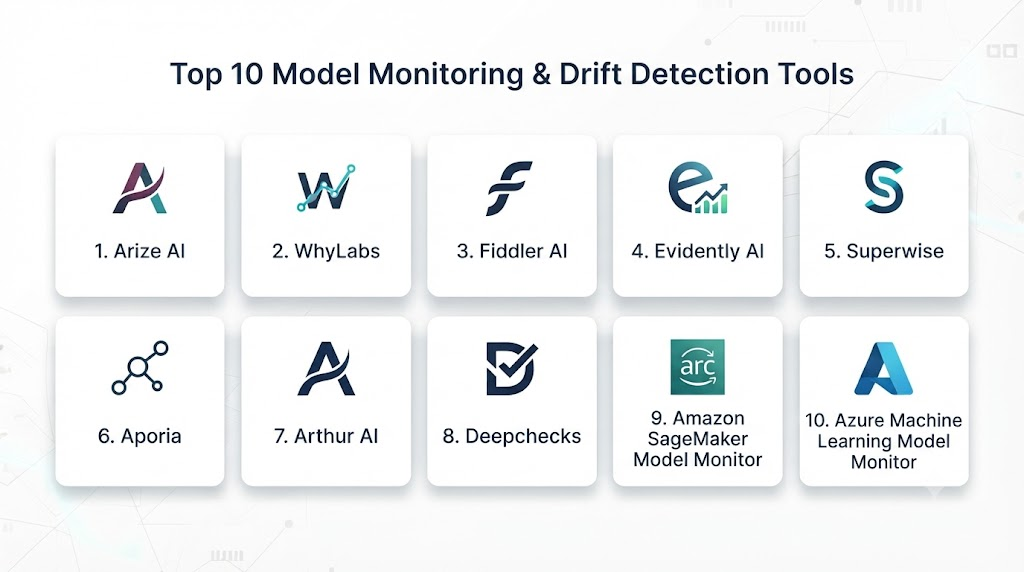
Top 10 Model Monitoring & Drift Detection Tools
1. Arize AI
Arize AI provides enterprise AI observability and model monitoring capabilities.
Key Features
- Model performance monitoring
- Drift detection
- Data quality monitoring
- Explainability
- Embedding monitoring
- LLM monitoring
- Alerting
- Dashboards
- Model diagnostics
- Production analytics
Pros
- Strong AI observability
- Excellent drift detection
- Enterprise-ready
- Good explainability
- Supports modern AI systems
Cons
- Enterprise pricing
- Requires setup
- Advanced features need expertise
Platforms
Cloud environments.
Deployment or Support
Enterprise AI monitoring.
Security & Compliance
Enterprise controls.
Integrations & Ecosystem
ML platforms and AI systems.
Support & Community
Enterprise support.
2. Evidently AI
Evidently AI provides open-source tools for ML monitoring and evaluation.
Key Features
- Data drift detection
- Model performance checks
- Data quality analysis
- Reports
- Metrics tracking
- Testing workflows
- Dashboard support
- Open-source deployment
- ML integration
- AI evaluation
Pros
- Open source
- Easy adoption
- Flexible
- Developer-friendly
- Strong community
Cons
- Requires implementation
- Limited enterprise features
- Manual configuration
Platforms
Cloud and local environments.
Deployment or Support
ML engineering teams.
Security & Compliance
Depends on deployment.
Integrations & Ecosystem
ML frameworks.
Support & Community
Open-source community.
3. WhyLabs
WhyLabs provides AI observability and monitoring solutions.
Key Features
- Data monitoring
- Drift detection
- ML observability
- Data quality checks
- Alerts
- Model monitoring
- Analytics
- Reporting
- AI governance
- Production insights
Pros
- Strong monitoring
- Good data quality tools
- Enterprise-focused
- Scalable
- AI governance support
Cons
- Enterprise pricing
- Requires configuration
- Learning curve
Platforms
Cloud environments.
Deployment or Support
Enterprise AI teams.
Security & Compliance
Enterprise controls.
Integrations & Ecosystem
Data and ML platforms.
Support & Community
Enterprise support.
4. Fiddler AI
Fiddler AI provides model monitoring, explainability, and AI governance.
Key Features
- Model monitoring
- Explainable AI
- Drift detection
- Bias detection
- Performance tracking
- Alerts
- AI governance
- LLM monitoring
- Analytics
- Reporting
Pros
- Strong explainability
- Governance features
- Enterprise-ready
- Good monitoring
- Responsible AI support
Cons
- Premium pricing
- Requires setup
- Complex enterprise workflows
Platforms
Cloud environments.
Deployment or Support
Enterprise AI governance.
Security & Compliance
Enterprise controls.
Integrations & Ecosystem
AI platforms.
Support & Community
Enterprise support.
5. Amazon SageMaker Model Monitor
Amazon SageMaker Model Monitor provides monitoring capabilities for deployed ML models.
Key Features
- Data quality monitoring
- Model quality monitoring
- Drift detection
- Bias monitoring
- Alerts
- Cloud integration
- Model dashboards
- Automated monitoring
- Security controls
- MLOps integration
Pros
- AWS integration
- Managed service
- Enterprise security
- Scalable
- Production-ready
Cons
- AWS dependency
- Cost complexity
- Requires AWS expertise
Platforms
AWS Cloud.
Deployment or Support
Enterprise AI systems.
Security & Compliance
AWS security framework.
Integrations & Ecosystem
AWS services.
Support & Community
Enterprise support.
6. Google Vertex AI Model Monitoring
Google Vertex AI provides monitoring capabilities for deployed models.
Key Features
- Feature drift detection
- Prediction monitoring
- Model quality tracking
- Alerts
- AI workflows
- Cloud integration
- Explainability
- Security
- Analytics
- Enterprise management
Pros
- Google Cloud integration
- Managed infrastructure
- Scalable
- Enterprise-ready
- AI ecosystem
Cons
- Google Cloud dependency
- Pricing complexity
- Requires expertise
Platforms
Google Cloud.
Deployment or Support
Enterprise AI applications.
Security & Compliance
Google Cloud security.
Integrations & Ecosystem
Google AI services.
Support & Community
Enterprise support.
7. Azure Machine Learning Model Monitor
Azure ML provides model monitoring capabilities for enterprise AI systems.
Key Features
- Data drift detection
- Model performance monitoring
- Alerts
- Explainability
- Model management
- Security
- Governance
- ML pipeline integration
- Reporting
- Enterprise workflows
Pros
- Microsoft ecosystem
- Strong governance
- Enterprise security
- Scalable
- Managed service
Cons
- Azure dependency
- Configuration complexity
- Learning curve
Platforms
Microsoft Azure.
Deployment or Support
Enterprise AI teams.
Security & Compliance
Microsoft security framework.
Integrations & Ecosystem
Azure services.
Support & Community
Enterprise support.
8. Datadog ML Monitoring
Datadog provides infrastructure and application monitoring capabilities for ML systems.
Key Features
- Metrics monitoring
- Logging
- Performance tracking
- Dashboards
- Alerts
- Infrastructure monitoring
- AI application visibility
- Integration support
- Analytics
- Incident management
Pros
- Strong monitoring ecosystem
- Good dashboards
- Enterprise support
- Infrastructure integration
- Scalable
Cons
- Not ML-specific
- Requires customization
- Additional configuration
Platforms
Cloud environments.
Deployment or Support
Enterprise operations teams.
Security & Compliance
Enterprise controls.
Integrations & Ecosystem
DevOps tools.
Support & Community
Enterprise support.
9. Monte Carlo ML Observability
Monte Carlo provides data and ML observability capabilities.
Key Features
- Data monitoring
- Pipeline monitoring
- Data quality checks
- Incident detection
- Analytics
- Governance
- Reliability monitoring
- Alerts
- Reporting
- Enterprise workflows
Pros
- Strong data observability
- Enterprise-focused
- Good monitoring
- Governance support
- Scalable
Cons
- Premium pricing
- Requires setup
- Broad data focus
Platforms
Cloud environments.
Deployment or Support
Enterprise data teams.
Security & Compliance
Enterprise controls.
Integrations & Ecosystem
Data platforms.
Support & Community
Enterprise support.
10. NannyML
NannyML provides open-source ML model performance monitoring.
Key Features
- Drift detection
- Performance estimation
- Data quality monitoring
- Model analysis
- Reports
- Metrics tracking
- Explainability
- Testing
- Analytics
- Open-source tools
Pros
- ML-focused
- Open-source options
- Good drift detection
- Developer-friendly
- Flexible
Cons
- Requires setup
- Smaller ecosystem
- Enterprise features vary
Platforms
Cloud and local environments.
Deployment or Support
ML teams.
Security & Compliance
Depends on deployment.
Integrations & Ecosystem
ML workflows.
Support & Community
Developer community.
Comparison Table
| Tool Name | Best For | Platform(s) Supported | Deployment | Standout Feature | Public Rating |
|---|---|---|---|---|---|
| Arize AI | AI observability | Cloud | Enterprise | Drift detection | |
| Evidently AI | Open-source monitoring | Cloud/Local | Flexible | ML testing | |
| WhyLabs | AI monitoring | Cloud | Enterprise | Data observability | |
| Fiddler AI | Governance | Cloud | Enterprise | Explainability | |
| SageMaker Monitor | AWS ML | AWS | Enterprise | Managed monitoring | |
| Vertex AI Monitor | Google AI | GCP | Enterprise | Cloud monitoring | |
| Azure ML Monitor | Microsoft AI | Azure | Enterprise | Governance | |
| Datadog ML Monitoring | Operations | Cloud | Enterprise | Dashboards | |
| Monte Carlo | Data observability | Cloud | Enterprise | Data reliability | |
| NannyML | ML monitoring | Cloud/Local | Flexible | Drift analysis |
Weighted Evaluation
| Tool Name | Core Features 25% | Ease of Use 15% | Integrations & Ecosystem 15% | Security & Compliance 10% | Performance & Reliability 10% | Support & Community 10% | Price/Value 15% | Total |
|---|---|---|---|---|---|---|---|---|
| Arize AI | 25 | 14 | 15 | 10 | 10 | 10 | 12 | 96 |
| Evidently AI | 24 | 15 | 14 | 10 | 10 | 10 | 15 | 98 |
| WhyLabs | 24 | 13 | 15 | 10 | 10 | 10 | 13 | 95 |
| Fiddler AI | 24 | 13 | 14 | 10 | 10 | 10 | 12 | 93 |
| SageMaker Monitor | 25 | 13 | 15 | 10 | 10 | 10 | 12 | 95 |
| Vertex AI Monitor | 25 | 13 | 15 | 10 | 10 | 10 | 12 | 95 |
| Azure ML Monitor | 24 | 13 | 15 | 10 | 10 | 10 | 13 | 95 |
| Datadog ML | 22 | 14 | 15 | 10 | 10 | 10 | 13 | 94 |
| Monte Carlo | 23 | 13 | 14 | 10 | 10 | 10 | 12 | 92 |
| NannyML | 23 | 14 | 13 | 10 | 10 | 10 | 15 | 95 |
Which Model Monitoring & Drift Detection Tool Is Right for You?
Choose Arize AI for enterprise AI observability.
Choose Evidently AI for open-source monitoring.
Choose WhyLabs for data and ML monitoring.
Choose Fiddler AI for explainable AI governance.
Choose Amazon SageMaker Model Monitor for AWS environments.
Choose Google Vertex AI Model Monitoring for Google Cloud.
Choose Azure ML Model Monitor for Microsoft ecosystems.
Choose Datadog ML Monitoring for infrastructure visibility.
Choose Monte Carlo for data observability.
Choose NannyML for flexible ML monitoring.
Implementation Playbook
Phase 1: Define Monitoring Goals
- Identify important models
- Select performance metrics
- Define alert conditions
Phase 2: Connect Production Models
- Collect prediction data
- Monitor inputs
- Track outputs
Phase 3: Configure Drift Detection
- Set thresholds
- Analyze feature changes
- Create alerts
Phase 4: Respond to Issues
- Retrain models
- Update features
- Improve workflows
Phase 5: Maintain AI Quality
- Review performance
- Improve monitoring
- Optimize models
Common Mistakes
- Deploying models without monitoring
- Ignoring data drift
- No alert strategy
- Poor metric selection
- Manual model reviews only
- Ignoring explainability
- No retraining process
FAQs
1. What are Model Monitoring & Drift Detection Tools?
They are platforms that track machine learning models after deployment and identify performance issues.
2. Why is model drift detection important?
It helps identify when models become less accurate due to changing data patterns.
3. What types of drift can tools detect?
They can detect data drift, concept drift, and prediction drift.
4. Who uses model monitoring tools?
MLOps teams, data scientists, and AI engineers use them.
5. Can monitoring tools support production AI systems?
Yes, they are designed for deployed machine learning applications.
6. Do monitoring tools support LLM applications?
Many modern tools now support generative AI monitoring.
7. How do these tools improve AI reliability?
They identify problems early and help teams maintain model quality.
8. Are open-source monitoring tools available?
Yes, tools like Evidently AI and NannyML provide open-source solutions.
9. Can monitoring tools integrate with cloud platforms?
Yes, many integrate with AWS, Google Cloud, and Azure.
10. What is the future of model monitoring?
Model monitoring will become a core part of AI governance and autonomous AI operations.
Conclusion
Model Monitoring & Drift Detection Tools are essential for maintaining reliable AI systems after deployment. They help organizations identify data changes, performance issues, and model degradation before they impact business operations.Platforms such as Arize AI, Evidently AI, WhyLabs, Fiddler AI, Amazon SageMaker Model Monitor, and Google Vertex AI Model Monitoring provide powerful capabilities for AI observability.As machine learning and generative AI adoption continues to grow, continuous monitoring and drift detection will become critical for building trustworthy, scalable, and production-ready AI systems.