Introduction
Batch Feature Store Platforms are data infrastructure systems designed to store, manage, transform, and provide large-scale machine learning features for model training, analytics, and offline processing workflows.
In machine learning projects, high-quality features are essential for building accurate models. Batch feature stores help data scientists and ML engineers organize historical feature data, maintain consistency between training datasets, and improve collaboration across teams.
Unlike online feature stores that focus on real-time inference, batch feature stores are optimized for:
- Large-scale data processing
- Historical feature computation
- Model training workflows
- Feature discovery
- Data analysis
- Machine learning experimentation
These platforms help organizations:
- Create reusable ML features
- Manage historical feature data
- Improve training consistency
- Reduce duplicate feature engineering
- Track feature lineage
- Support large AI workloads
Batch Feature Store Platforms are used by:
- Data scientists
- Machine learning engineers
- Data engineers
- MLOps teams
- AI researchers
- Enterprise analytics teams
Modern batch feature store platforms provide capabilities such as:
- Feature computation pipelines
- Historical feature storage
- Feature versioning
- Data lineage
- Feature discovery
- Offline retrieval
- ML framework integration
- Governance
- Data quality monitoring
- Collaboration tools
The goal of Batch Feature Store Platforms is to provide reliable and scalable feature infrastructure for developing and training machine learning models.
What Are Batch Feature Store Platforms?
Batch Feature Store Platforms are systems that store and manage historical machine learning features used during model development and training.
Features are transformed data points that help machine learning models make predictions.
Examples:
For a customer churn prediction model:
Features:
- Customer purchase history
- Login frequency
- Support interactions
- Subscription duration
A batch feature store stores historical versions of these features for training machine learning models.
Why Organizations Need Batch Feature Store Platforms
Machine learning teams often face challenges:
- Recreating features repeatedly
- Managing large datasets
- Maintaining training consistency
- Tracking feature changes
Without batch feature stores, organizations experience:
- Duplicate engineering work
- Poor collaboration
- Difficult model reproduction
- Data quality problems
Batch feature stores help organizations:
- Standardize feature engineering
- Improve ML development speed
- Maintain historical data
- Build better models
How Batch Feature Store Platforms Work
Data Collection
Features are created from:
- Data warehouses
- Data lakes
- Databases
- Business systems
Feature Engineering
Raw data is transformed into:
- ML-ready features
- Aggregated datasets
- Training inputs
Feature Storage
Features are stored in:
- Data warehouses
- Data lakes
- Distributed storage systems
Feature Retrieval
Data scientists retrieve features for:
- Model training
- Testing
- Analysis
Feature Management
Teams manage:
- Versions
- Metadata
- Ownership
- Dependencies
Monitoring
Platforms track:
- Data quality
- Feature changes
- Pipeline performance
Key Components of Batch Feature Store Platforms
Feature Registry
Manages:
- Feature definitions
- Metadata
- Documentation
- Ownership
Offline Storage Layer
Stores:
- Historical features
- Training datasets
- Feature snapshots
Feature Computation Engine
Handles:
- Transformations
- Aggregations
- Data processing
Data Pipeline Integration
Connects with:
- ETL systems
- Data warehouses
- Data lakes
Feature Discovery System
Allows teams to:
- Search features
- Reuse existing features
- Understand dependencies
Governance Layer
Provides:
- Access control
- Data lineage
- Compliance tracking
Types of Batch Feature Store Platforms
Open Source Feature Stores
Designed for:
- Flexible deployment
- Custom ML workflows
Examples:
- Feast
- Featureform
Cloud Data Platform Feature Stores
Integrated with:
- Cloud warehouses
- Managed ML platforms
Examples:
- Databricks Feature Store
- Vertex AI Feature Store
Enterprise Feature Management Platforms
Designed for:
- Large-scale AI organizations
- Governance
- Collaboration
Data Warehouse-Based Feature Stores
Built using:
- SQL systems
- Data lake technologies
- Analytics platforms
Key Features of Batch Feature Store Platforms
Historical Feature Management
Stores:
- Feature snapshots
- Historical values
- Training datasets
Feature Version Control
Tracks:
- Feature updates
- Changes
- Previous versions
Feature Discovery
Helps teams:
- Find existing features
- Avoid duplication
- Share knowledge
Data Lineage Tracking
Shows:
- Feature sources
- Transformations
- Dependencies
Training Dataset Generation
Supports:
- Model experiments
- ML pipelines
- Research workflows
Data Quality Monitoring
Detects:
- Missing data
- Incorrect values
- Feature inconsistencies
Common Use Cases
Fraud Detection Models
Batch features support:
- Historical transaction analysis
- Risk modeling
- Pattern discovery
Recommendation Systems
Used for:
- Customer behavior analysis
- Product preferences
- User segmentation
Financial Risk Modeling
Supports:
- Credit scoring
- Market analysis
- Risk prediction
Healthcare Analytics
Manages:
- Patient history
- Medical data features
- Research datasets
Marketing Analytics
Supports:
- Customer segmentation
- Campaign prediction
- Churn analysis
Business Intelligence
Provides:
- Historical insights
- Predictive analytics
- Data-driven decisions
Why Batch Feature Store Platforms Matter
Better ML Training
Models receive consistent historical features.
Feature Reusability
Teams can share existing feature definitions.
Faster AI Development
Data scientists spend less time rebuilding features.
Improved Collaboration
Teams work from a common feature repository.
Better Governance
Organizations maintain feature ownership and lineage.
Evaluation Criteria for Buyers
Feature Management
Evaluate:
- Registry capabilities
- Versioning
- Metadata management
Data Integration
Consider:
- Data warehouses
- Data lakes
- ML platforms
Scalability
Evaluate:
- Data volume
- Processing capability
- Enterprise workloads
Governance
Look for:
- Lineage
- Security
- Access controls
ML Integration
Consider support for:
- ML frameworks
- Training pipelines
- Experiment workflows
Monitoring
Evaluate:
- Data quality
- Pipeline health
- Feature changes
Key Trends
Feature Engineering Automation
AI is helping automate feature creation.
Lakehouse-Based Feature Stores
Organizations are combining data lakes and warehouses.
Feature Reuse Across Teams
Companies are building shared feature libraries.
AI Governance Growth
Feature management is becoming more controlled.
Generative AI Feature Management
Feature stores are expanding toward AI applications.
Unified Online and Offline Features
Platforms are combining training and serving workflows.
Methodology
The following Batch Feature Store Platforms were evaluated based on:
- Feature management capabilities
- Offline storage support
- Data integration
- Scalability
- Governance
- ML workflow support
- Developer experience
- Monitoring
- Enterprise readiness
- Value
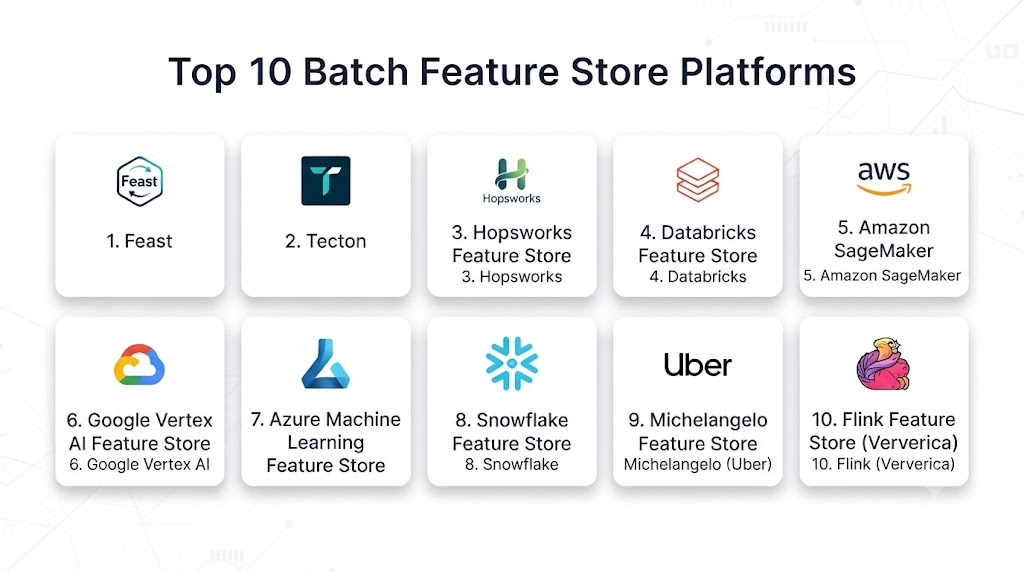
Top 10 Batch Feature Store Platforms
1. Feast Offline Store
Feast provides offline feature storage capabilities for machine learning workflows.
Key Features
- Historical feature storage
- Feature registry
- Data source integration
- Feature retrieval
- Metadata management
- Training dataset generation
- Version tracking
- ML framework support
- Data pipeline integration
- Open-source architecture
Pros
- Open source
- Flexible deployment
- Strong community
- Framework support
- Cloud compatible
Cons
- Requires configuration
- Infrastructure management needed
- Limited enterprise tooling
Platforms
Cloud and local environments.
Deployment or Support
ML development teams.
Security & Compliance
Depends on deployment.
Integrations & Ecosystem
Data systems and ML frameworks.
Support & Community
Open-source community.
2. Databricks Feature Store
Databricks provides feature management capabilities integrated with its lakehouse platform.
Key Features
- Feature engineering
- Offline feature storage
- Feature sharing
- Data lineage
- ML workflow integration
- Governance
- Collaboration
- Analytics
- Model training support
- Enterprise management
Pros
- Strong data platform
- Enterprise-ready
- Unified analytics
- Good governance
- Scalable
Cons
- Expensive
- Platform dependency
- Requires expertise
Platforms
Cloud environments.
Deployment or Support
Enterprise AI teams.
Security & Compliance
Enterprise controls.
Integrations & Ecosystem
Databricks ecosystem.
Support & Community
Enterprise support.
3. Hopsworks Feature Store
Hopsworks provides a complete feature management system.
Key Features
- Offline feature storage
- Feature registry
- Data lineage
- Feature discovery
- ML integration
- Security
- Feature versioning
- Training datasets
- Collaboration
- Governance
Pros
- Complete feature platform
- Strong governance
- Open-source options
- Good collaboration
- Enterprise support
Cons
- Complex setup
- Learning curve
- Requires expertise
Platforms
Cloud and enterprise environments.
Deployment or Support
Enterprise ML teams.
Security & Compliance
Enterprise controls.
Integrations & Ecosystem
Data platforms.
Support & Community
Developer community.
4. Tecton Batch Features
Tecton provides enterprise feature engineering and management capabilities.
Key Features
- Batch feature pipelines
- Feature computation
- Data transformation
- Feature catalog
- Monitoring
- Governance
- ML integration
- Feature reuse
- Data management
- Enterprise workflows
Pros
- Enterprise-grade
- Strong automation
- Scalable
- Production-focused
- Good monitoring
Cons
- Premium pricing
- Requires implementation
- Closed platform
Platforms
Cloud environments.
Deployment or Support
Enterprise ML operations.
Security & Compliance
Enterprise controls.
Integrations & Ecosystem
Cloud data platforms.
Support & Community
Enterprise support.
5. Google Vertex AI Feature Store
Google Vertex AI Feature Store supports feature management for machine learning workflows.
Key Features
- Offline feature management
- Data integration
- Feature discovery
- ML pipelines
- Model integration
- Monitoring
- Governance
- Cloud scalability
- AI workflows
- Security
Pros
- Google Cloud integration
- Managed infrastructure
- Scalable
- Enterprise support
- AI ecosystem
Cons
- Google dependency
- Pricing complexity
- Requires cloud expertise
Platforms
Google Cloud.
Deployment or Support
Enterprise AI teams.
Security & Compliance
Google Cloud security.
Integrations & Ecosystem
Google AI services.
Support & Community
Enterprise support.
6. AWS SageMaker Feature Store
AWS SageMaker Feature Store supports offline feature management for ML workloads.
Key Features
- Offline feature storage
- Feature groups
- Data integration
- Training workflows
- Governance
- Security
- ML pipeline support
- Metadata management
- AWS integration
- Feature monitoring
Pros
- Managed service
- AWS ecosystem
- Enterprise security
- Scalable
- Reliable
Cons
- AWS dependency
- Cost complexity
- Requires AWS knowledge
Platforms
AWS Cloud.
Deployment or Support
Enterprise machine learning.
Security & Compliance
AWS security framework.
Integrations & Ecosystem
AWS services.
Support & Community
Enterprise support.
7. Azure Machine Learning Feature Store
Azure provides feature management capabilities for enterprise ML workflows.
Key Features
- Feature definitions
- Offline storage
- Data pipelines
- Model training support
- Governance
- Security
- Monitoring
- ML integration
- Enterprise workflows
- Collaboration
Pros
- Microsoft ecosystem
- Strong governance
- Enterprise-ready
- Managed platform
- Secure
Cons
- Azure dependency
- Configuration complexity
- Pricing considerations
Platforms
Microsoft Azure.
Deployment or Support
Enterprise AI teams.
Security & Compliance
Microsoft security framework.
Integrations & Ecosystem
Azure services.
Support & Community
Enterprise support.
8. Featureform
Featureform provides an open-source feature store solution.
Key Features
- Feature definitions
- Feature transformations
- Offline storage
- Metadata management
- Feature discovery
- ML integration
- Data pipelines
- Version control
- Developer APIs
- Collaboration
Pros
- Open source
- Flexible
- Developer-friendly
- Cost-effective
- Easy customization
Cons
- Smaller ecosystem
- Requires setup
- Limited enterprise features
Platforms
Cloud and local environments.
Deployment or Support
ML engineering teams.
Security & Compliance
Depends on deployment.
Integrations & Ecosystem
Data systems.
Support & Community
Developer community.
9. Snowflake Feature Store
Snowflake-based feature management supports machine learning workflows using cloud data infrastructure.
Key Features
- Feature storage
- SQL-based processing
- Data sharing
- Historical analysis
- ML integration
- Data governance
- Analytics workflows
- Data pipelines
- Security controls
- Cloud scalability
Pros
- Strong data warehouse integration
- Good analytics
- Enterprise governance
- Scalable
- Familiar SQL workflows
Cons
- Requires Snowflake ecosystem
- Not a dedicated feature store
- Additional configuration needed
Platforms
Cloud environments.
Deployment or Support
Enterprise data teams.
Security & Compliance
Enterprise controls.
Integrations & Ecosystem
Snowflake ecosystem.
Support & Community
Enterprise support.
10. BigQuery ML Feature Store
Google BigQuery provides feature management capabilities through its analytics ecosystem.
Key Features
- Historical feature storage
- SQL-based feature engineering
- Data processing
- ML integration
- Analytics
- Data governance
- Cloud scalability
- Feature datasets
- Pipeline support
- Enterprise security
Pros
- Powerful analytics
- Google Cloud integration
- Scalable storage
- Easy SQL workflows
- Enterprise support
Cons
- Requires Google Cloud
- Limited dedicated feature store capabilities
- Cost management needed
Platforms
Google Cloud.
Deployment or Support
Enterprise analytics teams.
Security & Compliance
Google Cloud security.
Integrations & Ecosystem
Google Cloud services.
Support & Community
Enterprise support.
Comparison Table
| Tool Name | Best For | Platform(s) Supported | Deployment | Standout Feature | Public Rating |
|---|---|---|---|---|---|
| Feast Offline Store | Open-source ML | Cloud/Local | Flexible | Feature management | |
| Databricks Feature Store | Data teams | Cloud | Enterprise | Lakehouse integration | |
| Hopsworks | Enterprise features | Cloud | Enterprise | Feature governance | |
| Tecton Batch | Large ML teams | Cloud | Enterprise | Feature pipelines | |
| Vertex AI Feature Store | Google users | GCP | Enterprise | AI integration | |
| SageMaker Feature Store | AWS users | AWS | Enterprise | Managed features | |
| Azure ML Feature Store | Microsoft users | Azure | Enterprise | Governance | |
| Featureform | Developers | Cloud/Local | Flexible | Open-source | |
| Snowflake Feature Store | Data warehouses | Cloud | Enterprise | SQL analytics | |
| BigQuery Feature Store | Google analytics | GCP | Enterprise | Data processing |
Weighted Evaluation
| Tool Name | Core Features 25% | Ease of Use 15% | Integrations & Ecosystem 15% | Security & Compliance 10% | Performance & Reliability 10% | Support & Community 10% | Price/Value 15% | Total |
|---|---|---|---|---|---|---|---|---|
| Feast | 24 | 14 | 15 | 10 | 10 | 10 | 15 | 98 |
| Databricks Feature Store | 25 | 12 | 15 | 10 | 10 | 10 | 12 | 94 |
| Hopsworks | 24 | 12 | 14 | 10 | 10 | 10 | 13 | 93 |
| Tecton | 25 | 13 | 15 | 10 | 10 | 10 | 12 | 95 |
| Vertex AI Feature Store | 24 | 13 | 15 | 10 | 10 | 10 | 12 | 94 |
| SageMaker Feature Store | 25 | 13 | 15 | 10 | 10 | 10 | 12 | 95 |
| Azure Feature Store | 24 | 13 | 15 | 10 | 10 | 10 | 13 | 95 |
| Featureform | 22 | 15 | 13 | 10 | 10 | 10 | 15 | 95 |
| Snowflake Feature Store | 23 | 14 | 14 | 10 | 10 | 10 | 13 | 94 |
| BigQuery Feature Store | 23 | 14 | 15 | 10 | 10 | 10 | 13 | 95 |
Which Batch Feature Store Platform Is Right for You?
Choose Feast for open-source feature workflows.
Choose Databricks Feature Store for lakehouse-based AI.
Choose Hopsworks for feature governance.
Choose Tecton for enterprise ML pipelines.
Choose Google Vertex AI Feature Store for Google Cloud.
Choose AWS SageMaker Feature Store for AWS environments.
Choose Azure ML Feature Store for Microsoft ecosystems.
Choose Featureform for flexible open-source development.
Choose Snowflake Feature Store for warehouse-based ML.
Choose BigQuery Feature Store for Google analytics workflows.
Implementation Playbook
Phase 1: Identify Feature Requirements
- Define ML objectives
- Select data sources
- Plan feature ownership
Phase 2: Build Feature Pipelines
- Create transformations
- Store historical features
- Validate datasets
Phase 3: Connect ML Workflows
- Integrate training pipelines
- Generate datasets
- Track features
Phase 4: Monitor Quality
- Check freshness
- Validate consistency
- Track lineage
Phase 5: Improve Feature Operations
- Reuse features
- Optimize pipelines
- Expand ML capabilities
Common Mistakes
- Poor feature documentation
- Ignoring data quality
- Duplicate feature creation
- No feature ownership
- Lack of monitoring
- Weak governance
- Poor pipeline management
FAQs
1. What are Batch Feature Store Platforms?
They are platforms that manage historical machine learning features for training and analytics.
2. How are batch and online feature stores different?
Batch stores support training workflows, while online stores support real-time predictions.
3. Why are batch feature stores important?
They improve feature consistency, reuse, and machine learning development speed.
4. Who uses batch feature stores?
Data scientists, ML engineers, and MLOps teams use them.
5. Can batch feature stores improve model accuracy?
Yes, by providing consistent and reliable training features.
6. Do feature stores support data warehouses?
Yes, many integrate with cloud data warehouses and lakes.
7. Are open-source batch feature stores available?
Yes, Feast and Featureform provide open-source options.
8. How do feature stores manage historical data?
They store feature versions and historical snapshots.
9. Can batch feature stores support enterprise AI?
Yes, many provide governance and security capabilities.
10. What is the future of batch feature stores?
They will become important infrastructure for scalable AI and machine learning systems.
Conclusion
Batch Feature Store Platforms provide the foundation for reliable machine learning development by managing historical features, improving collaboration, and supporting scalable AI workflows.Platforms such as Feast, Databricks Feature Store, Hopsworks, Tecton, AWS SageMaker Feature Store, and Google Vertex AI Feature Store help organizations build better machine learning models with consistent and reusable feature pipelines.As AI systems become more complex, batch feature stores will continue to play an important role in MLOps, enterprise AI, and large-scale machine learning operations.
#FeatureStore, #MLOps, #MachineLearning, #AIInfrastructure, #ArtificialIntelligence