Introduction
Agent-to-Agent Communication Protocol Tooling refers to frameworks, platforms, and technologies that enable AI agents to communicate, coordinate, exchange information, negotiate tasks, and collaborate with each other in autonomous AI environments.
As AI systems evolve from single agents into multi-agent ecosystems, reliable communication between agents becomes essential. Agent-to-Agent communication tools provide standardized methods for agents to share context, exchange messages, delegate tasks, and coordinate workflows.
Unlike traditional software communication methods, agent-to-agent protocols are designed for intelligent systems where agents need to understand goals, collaborate dynamically, and make decisions together.
These platforms help organizations build:
- Multi-agent AI systems
- Autonomous workflows
- Collaborative AI teams
- Enterprise agent ecosystems
- Distributed AI applications
Agent-to-Agent Communication Protocol Tooling supports:
- Agent discovery
- Message exchange
- Task delegation
- Context sharing
- Workflow coordination
- Identity management
- Security controls
- Agent interoperability
These tools are used by:
- AI engineers
- Machine learning teams
- Enterprise architects
- Automation developers
- Research organizations
- Software developers
The goal of Agent-to-Agent Communication Protocol Tooling is to create reliable communication standards that allow AI agents from different systems to work together efficiently.
What Is Agent-to-Agent Communication?
Agent-to-Agent Communication is the process where autonomous AI agents exchange information and coordinate activities without continuous human control.
Example:
A business automation system may have:
Sales Agent → finds customer opportunities
Research Agent → gathers market information
Finance Agent → evaluates pricing
Decision Agent → recommends action
These agents need communication protocols to share information and complete tasks together.
Why Agent Communication Protocols Matter
Modern AI applications are moving toward:
- Multiple specialized agents
- Autonomous workflows
- Distributed AI systems
Without communication standards, agents face challenges:
- Poor coordination
- Data exchange problems
- Limited interoperability
- Duplicate work
- Security risks
Agent communication protocols solve these problems by providing structured communication methods.
How Agent-to-Agent Communication Works
Agent Discovery
Agents identify:
- Available agents
- Capabilities
- Services
Message Exchange
Agents communicate through:
- Messages
- Events
- Requests
- Responses
Context Sharing
Agents exchange:
- Task information
- Knowledge
- Previous actions
Task Delegation
Agents assign:
- Subtasks
- Responsibilities
- Objectives
Result Coordination
Agents combine outputs to achieve goals.
Key Components of Agent Communication Tooling
Communication Protocol Layer
Defines:
- Message formats
- Communication rules
- Interaction methods
Agent Identity Management
Handles:
- Agent authentication
- Identity verification
- Permissions
Message Broker System
Manages:
- Agent messages
- Queues
- Events
Context Management
Maintains:
- Shared information
- Conversation history
- Task state
Security Layer
Provides:
- Encryption
- Access control
- Trust management
Monitoring System
Tracks:
- Agent interactions
- Performance
- Errors
Types of Agent Communication Models
Direct Agent Communication
One agent communicates directly with another.
Example:
Research agent → Analysis agent
Broker-Based Communication
Agents communicate through a central messaging system.
Benefits:
- Scalability
- Better management
Event-Based Communication
Agents respond to events.
Example:
New customer request → Sales agent activated
Shared Memory Communication
Agents access shared information.
Key Features of Agent-to-Agent Communication Protocol Tooling
Agent Discovery
Allows agents to find available capabilities.
Benefits:
- Better collaboration
- Dynamic workflows
Standardized Messaging
Provides:
- Structured communication
- Reliable information exchange
Task Coordination
Supports:
- Delegation
- Scheduling
- Collaboration
Context Transfer
Allows agents to share:
- Knowledge
- History
- State information
Security Management
Controls:
- Authentication
- Permissions
- Data access
Multi-Agent Workflow Support
Enables:
- Complex automation
- Agent collaboration
Common Use Cases
Enterprise AI Workflows
Multiple agents collaborate on:
- Business processes
- Data analysis
- Operations
Customer Service Systems
Agents coordinate:
- Customer requests
- Escalations
- Solutions
Software Development Agents
Agents collaborate on:
- Coding
- Testing
- Deployment
Research Systems
Agents perform:
- Information gathering
- Analysis
- Report generation
Autonomous Business Operations
Agents manage:
- Procurement
- Sales
- Finance workflows
Robotics and IoT
Agents communicate for:
- Decision-making
- Coordination
Why Agent Communication Tooling Matters
Better AI Collaboration
Agents can work together efficiently.
Increased Automation
Complex tasks can be completed autonomously.
Improved Scalability
Organizations can deploy many specialized agents.
Greater Interoperability
Different AI systems can communicate.
Enterprise AI Growth
Businesses can build larger AI ecosystems.
Evaluation Criteria for Buyers
Protocol Support
Evaluate:
- Communication standards
- Compatibility
Scalability
Consider:
- Number of agents
- Message volume
- Enterprise workloads
Security
Look for:
- Authentication
- Encryption
- Access controls
Developer Experience
Evaluate:
- SDK availability
- Documentation
- Integration simplicity
Workflow Support
Consider:
- Task coordination
- Multi-agent orchestration
Monitoring
Look for:
- Logs
- Tracing
- Analytics
Key Trends
Open Agent Communication Standards
Organizations are developing common protocols.
Multi-Agent AI Systems
AI applications are moving toward collaborative agents.
Agent Interoperability
Different AI platforms will communicate seamlessly.
Enterprise Agent Networks
Companies will build internal AI ecosystems.
Autonomous Digital Organizations
AI agents will manage complex business workflows.
Secure Agent Communication
Security will become critical for agent ecosystems.
Methodology
The following Agent-to-Agent Communication Protocol Tooling was evaluated based on:
- Communication capabilities
- Interoperability
- Security
- Scalability
- Developer support
- Agent framework compatibility
- Enterprise readiness
- Performance
- Community adoption
- Value
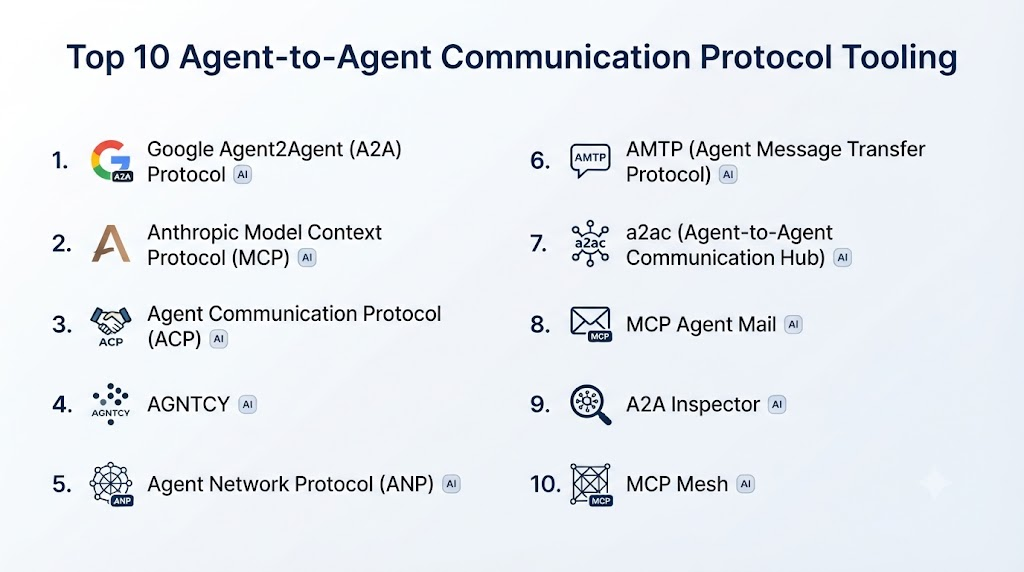
Top 10 Agent-to-Agent Communication Protocol Tooling
1. Google Agent2Agent (A2A) Protocol
Google A2A Protocol is designed to enable communication and collaboration between AI agents.
Key Features
- Agent discovery
- Standard communication
- Agent capability sharing
- Task delegation
- Interoperability
- Multi-agent workflows
- Enterprise agent collaboration
- Secure messaging
- Agent coordination
- Protocol standardization
Pros
- Designed specifically for agent communication
- Supports interoperability
- Future-focused architecture
- Enterprise potential
- Open ecosystem approach
Cons
- Emerging technology
- Ecosystem still developing
- Adoption is growing
Platforms
Cloud and AI environments.
Deployment or Support
Multi-agent AI systems.
Security & Compliance
Depends on implementation.
Integrations & Ecosystem
AI agent frameworks.
Support & Community
Growing developer community.
2. Model Context Protocol (MCP)
MCP provides a standardized way for AI systems to connect with external tools and data sources.
Key Features
- Context exchange
- Tool integration
- Data access
- Standard communication
- AI application connectivity
- Resource sharing
- Developer SDKs
- Secure connections
- Extensible architecture
- Agent workflows
Pros
- Open standard
- Strong ecosystem growth
- Easy integrations
- Developer-friendly
- Flexible
Cons
- Primarily context-focused
- Agent communication capabilities evolving
- Requires implementation
Platforms
Cloud and local environments.
Deployment or Support
AI applications and agents.
Security & Compliance
Implementation dependent.
Integrations & Ecosystem
AI tools and applications.
Support & Community
Developer community.
3. Microsoft AutoGen
Microsoft AutoGen enables developers to build applications where multiple AI agents communicate and collaborate.
Key Features
- Multi-agent conversations
- Agent coordination
- Task delegation
- Human-agent interaction
- Workflow management
- LLM integration
- Agent customization
- Developer tools
- Automation workflows
- Research support
Pros
- Strong multi-agent support
- Developer-friendly
- Flexible architecture
- Good documentation
- Research adoption
Cons
- Requires coding skills
- Framework dependency
- Production setup needed
Platforms
Cloud and local environments.
Deployment or Support
AI development.
Security & Compliance
Depends on implementation.
Integrations & Ecosystem
LLMs and AI frameworks.
Support & Community
Developer community.
4. LangGraph
LangGraph enables developers to build stateful multi-agent workflows.
Key Features
- Agent workflows
- State management
- Agent communication
- Task coordination
- Graph-based execution
- Memory handling
- Human approval flows
- LLM integration
- Workflow control
- Debugging tools
Pros
- Strong workflow control
- Good agent coordination
- Developer-focused
- Flexible architecture
- Production capabilities
Cons
- Requires technical knowledge
- Learning curve
- Framework dependency
Platforms
Cloud and local environments.
Deployment or Support
Agent applications.
Security & Compliance
Depends on deployment.
Integrations & Ecosystem
LangChain ecosystem.
Support & Community
Developer community.
5. CrewAI
CrewAI provides frameworks for building collaborative AI agent teams.
Key Features
- Multi-agent collaboration
- Agent roles
- Task assignment
- Workflow management
- Tool integration
- Agent communication
- Memory support
- Automation
- Developer APIs
- Templates
Pros
- Easy multi-agent development
- Clear agent roles
- Flexible workflows
- Growing ecosystem
- Developer-friendly
Cons
- New ecosystem
- Requires customization
- Enterprise features developing
Platforms
Cloud and local environments.
Deployment or Support
AI agent development.
Security & Compliance
Depends on implementation.
Integrations & Ecosystem
AI frameworks.
Support & Community
Developer community.
6. Semantic Kernel Agent Framework
Microsoft Semantic Kernel supports AI agent development and orchestration.
Key Features
- Agent orchestration
- Plugin system
- Workflow management
- Memory integration
- Multi-agent support
- Enterprise integrations
- LLM connectivity
- Developer SDKs
- Planning
- Automation
Pros
- Enterprise-ready
- Microsoft support
- Strong architecture
- Flexible
- Good integrations
Cons
- Requires development knowledge
- Complex for beginners
- Microsoft ecosystem focus
Platforms
Cloud and local environments.
Deployment or Support
Enterprise AI applications.
Security & Compliance
Enterprise controls.
Integrations & Ecosystem
Microsoft ecosystem.
Support & Community
Developer community.
7. JADE Agent Framework
JADE is a classic framework for developing distributed intelligent agents.
Key Features
- Agent communication
- Distributed systems
- Message passing
- Agent management
- FIPA standards
- Multi-agent applications
- Java support
- Agent lifecycle management
- Collaboration
- Research support
Pros
- Mature framework
- Standard communication
- Research adoption
- Reliable architecture
- Long history
Cons
- Older technology
- Less modern AI integration
- Requires Java knowledge
Platforms
Java environments.
Deployment or Support
Research and distributed systems.
Security & Compliance
Implementation dependent.
Integrations & Ecosystem
Java applications.
Support & Community
Research community.
8. OpenAI Swarm
OpenAI Swarm provides lightweight multi-agent experimentation capabilities.
Key Features
- Agent handoffs
- Task routing
- Agent collaboration
- Tool usage
- Lightweight framework
- Workflow experiments
- Developer APIs
- Agent coordination
- Simple architecture
- Rapid prototyping
Pros
- Simple design
- Easy experimentation
- Good for prototypes
- Developer-friendly
- Lightweight
Cons
- Not full enterprise platform
- Requires customization
- Production requirements vary
Platforms
Cloud and local environments.
Deployment or Support
AI experimentation.
Security & Compliance
Depends on implementation.
Integrations & Ecosystem
OpenAI ecosystem.
Support & Community
Developer community.
9. Apache Kafka Agent Messaging
Apache Kafka provides distributed messaging infrastructure useful for agent communication systems.
Key Features
- Event streaming
- Message handling
- High scalability
- Distributed communication
- Data pipelines
- Real-time processing
- Fault tolerance
- Enterprise deployment
- Monitoring
- Integration support
Pros
- Highly scalable
- Enterprise proven
- Reliable messaging
- Strong ecosystem
- Real-time communication
Cons
- Not AI-specific
- Requires engineering expertise
- Complex setup
Platforms
Cloud and enterprise environments.
Deployment or Support
Large-scale systems.
Security & Compliance
Enterprise controls.
Integrations & Ecosystem
Enterprise applications.
Support & Community
Large community.
10. RabbitMQ Agent Messaging
RabbitMQ provides message-based communication infrastructure for distributed applications.
Key Features
- Message queues
- Agent communication
- Routing
- Reliable delivery
- Event handling
- Distributed systems
- Security controls
- Integration support
- Workflow messaging
- Developer tools
Pros
- Reliable messaging
- Easy integration
- Flexible routing
- Mature platform
- Good community
Cons
- Not AI-specific
- Requires architecture design
- Scaling requires planning
Platforms
Cloud and local environments.
Deployment or Support
Distributed applications.
Security & Compliance
Enterprise controls.
Integrations & Ecosystem
Software systems.
Support & Community
Developer community.
Comparison Table
| Tool Name | Best For | Platform(s) Supported | Deployment | Standout Feature | Public Rating |
|---|---|---|---|---|---|
| Google A2A Protocol | Agent interoperability | Cloud | Enterprise | Agent communication standard | |
| MCP | AI integrations | Cloud/Local | Flexible | Context exchange | |
| AutoGen | Multi-agent apps | Cloud/Local | Development | Agent conversations | |
| LangGraph | Agent workflows | Cloud/Local | Production | State management | |
| CrewAI | Agent teams | Cloud/Local | Development | Agent collaboration | |
| Semantic Kernel | Enterprise agents | Cloud/Local | Enterprise | Agent orchestration | |
| JADE | Distributed agents | Java | Research | FIPA communication | |
| OpenAI Swarm | Prototypes | Cloud/Local | Development | Agent handoffs | |
| Kafka | Messaging systems | Cloud/Enterprise | Enterprise | Event streaming | |
| RabbitMQ | Message queues | Cloud/Local | Flexible | Reliable messaging |
Weighted Evaluation
| Tool Name | Core Features 25% | Ease of Use 15% | Integrations & Ecosystem 15% | Security & Compliance 10% | Performance & Reliability 10% | Support & Community 10% | Price/Value 15% | Total |
|---|---|---|---|---|---|---|---|---|
| Google A2A | 25 | 13 | 15 | 10 | 10 | 10 | 14 | 97 |
| MCP | 24 | 15 | 15 | 10 | 10 | 10 | 15 | 99 |
| AutoGen | 24 | 14 | 14 | 10 | 10 | 10 | 15 | 97 |
| LangGraph | 24 | 13 | 15 | 10 | 10 | 10 | 14 | 96 |
| CrewAI | 23 | 15 | 14 | 10 | 10 | 10 | 15 | 97 |
| Semantic Kernel | 24 | 13 | 15 | 10 | 10 | 10 | 13 | 95 |
| JADE | 22 | 12 | 13 | 10 | 10 | 10 | 15 | 92 |
| OpenAI Swarm | 22 | 15 | 14 | 10 | 10 | 10 | 15 | 96 |
| Kafka | 24 | 12 | 15 | 10 | 10 | 10 | 13 | 94 |
| RabbitMQ | 23 | 13 | 14 | 10 | 10 | 10 | 14 | 94 |
Which Agent-to-Agent Communication Tool Is Right for You?
Choose Google A2A Protocol for future agent interoperability standards.
Choose MCP for connecting AI agents with tools and data.
Choose Microsoft AutoGen for multi-agent applications.
Choose LangGraph for controlled agent workflows.
Choose CrewAI for collaborative AI teams.
Choose Semantic Kernel for enterprise agent development.
Choose JADE for traditional multi-agent systems.
Choose OpenAI Swarm for lightweight agent experiments.
Choose Apache Kafka for large-scale messaging.
Choose RabbitMQ for reliable message-based systems.
Implementation Playbook
Phase 1: Define Agent Architecture
- Identify agent roles
- Define communication requirements
- Select protocols
Phase 2: Design Communication Flow
- Create message formats
- Define workflows
- Configure permissions
Phase 3: Build Agent Network
- Connect agents
- Implement tools
- Test communication
Phase 4: Secure and Monitor
- Add authentication
- Track interactions
- Review performance
Phase 5: Scale Operations
- Add new agents
- Improve workflows
- Optimize communication
Common Mistakes
- No clear communication design
- Poor agent identity management
- Ignoring security
- Using incompatible protocols
- Lack of monitoring
- Poor message structure
- No failure handling
FAQs
1. What is Agent-to-Agent Communication Protocol Tooling?
It provides frameworks and standards that allow AI agents to communicate and collaborate.
2. Why do AI agents need communication protocols?
Protocols help agents exchange information and complete complex tasks together.
3. What is multi-agent AI?
Multi-agent AI uses multiple specialized agents working together.
4. Can different AI agents communicate with each other?
Yes, with proper protocols and integration layers.
5. Is MCP an agent communication protocol?
MCP mainly focuses on connecting AI systems with tools and context sources.
6. What is the role of Google A2A Protocol?
It focuses on enabling communication between AI agents.
7. Are agent communication tools secure?
Security depends on authentication, permissions, and implementation.
8. Do enterprises use multi-agent systems?
Yes, enterprises are increasingly adopting collaborative AI workflows.
9. Can communication protocols support thousands of agents?
Scalable messaging systems can support large agent networks.
10. What is the future of agent communication?
Standardized protocols will enable global AI agent ecosystems.
Conclusion
Agent-to-Agent Communication Protocol Tooling is becoming a critical foundation for the next generation of AI systems. As organizations move from single AI assistants toward collaborative agent ecosystems, reliable communication standards will become essential.Technologies such as Google A2A Protocol, MCP, Microsoft AutoGen, LangGraph, CrewAI, and Semantic Kernel are helping developers build intelligent multi-agent applications.The future of AI will depend on agents that can securely communicate, coordinate, and collaborate to solve increasingly complex problems.