Introduction
Multi-Agent Coordination Platforms are artificial intelligence frameworks and platforms designed to help multiple AI agents communicate, collaborate, coordinate tasks, and complete complex workflows together.
Unlike traditional AI applications that rely on a single model responding to requests, multi-agent systems use multiple specialized agents that can work together. Each agent can have its own role, knowledge, tools, and responsibilities while coordinating with other agents to achieve a shared goal.
As organizations adopt autonomous AI systems, managing communication between multiple agents has become increasingly important. Multi-Agent Coordination Platforms provide the infrastructure needed to design, execute, monitor, and optimize collaborative AI workflows.
These platforms help organizations:
- Build teams of AI agents
- Coordinate agent communication
- Assign tasks between agents
- Manage complex workflows
- Connect agents with external tools
- Improve AI automation
- Create scalable agent-based applications
Multi-Agent Coordination Platforms are used by:
- AI engineers
- Software developers
- Enterprise automation teams
- Research organizations
- Data scientists
- Product development teams
- Business process automation teams
Modern multi-agent platforms support:
- Agent collaboration
- Task delegation
- Communication protocols
- Shared memory
- Tool usage
- Workflow orchestration
- Human approval workflows
- Agent monitoring
- Enterprise AI deployment
The goal of Multi-Agent Coordination Platforms is to create intelligent systems where multiple AI agents can work together efficiently, reliably, and securely.
What Are Multi-Agent Systems?
A multi-agent system is an AI architecture where multiple autonomous agents work together to solve problems.
Each agent may have:
- A specific role
- Different capabilities
- Separate objectives
- Access to different tools
- Individual reasoning abilities
Examples:
- Research agent
- Data analysis agent
- Coding agent
- Planning agent
- Customer support agent
What Is Multi-Agent Coordination?
Multi-Agent Coordination is the process of managing how AI agents:
- Communicate
- Share information
- Assign tasks
- Make decisions
- Collaborate toward goals
Coordination ensures that agents do not work independently without alignment.
How Multi-Agent Coordination Platforms Work
Goal Definition
A user provides a high-level objective.
Example:
“Create a complete market research report.”
Task Breakdown
The platform divides the goal into smaller tasks.
Example:
- Collect market data
- Analyze competitors
- Generate insights
- Prepare report
Agent Assignment
Different agents receive specific responsibilities.
Example:
- Research agent → gathers information
- Analyst agent → evaluates data
- Writer agent → prepares report
Agent Communication
Agents exchange:
- Results
- Instructions
- Context
- Feedback
Tool Usage
Agents connect with:
- APIs
- Databases
- Search systems
- Enterprise software
Final Execution
The coordinated agents produce the final outcome.
Key Capabilities of Multi-Agent Coordination Platforms
Agent Communication Management
Enables agents to exchange information.
Benefits:
- Better collaboration
- Reduced duplication
- Improved decision-making
Task Delegation
Automatically assigns tasks based on agent capabilities.
Benefits:
- Efficient workflows
- Better specialization
Shared Memory
Allows agents to access:
- Previous conversations
- Knowledge
- Task history
Workflow Orchestration
Controls:
- Execution order
- Dependencies
- Decision points
Tool Integration
Connects agents with:
- APIs
- Databases
- Applications
Monitoring and Analytics
Tracks:
- Agent actions
- Performance
- Errors
- Results
Common Use Cases
Enterprise Automation
Organizations automate:
- Business workflows
- Document processing
- Internal operations
Software Development
Multiple agents collaborate on:
- Coding
- Testing
- Debugging
- Documentation
Research Automation
Agents perform:
- Data gathering
- Analysis
- Report generation
Customer Service
Agents handle:
- Customer questions
- Ticket management
- Knowledge retrieval
Business Intelligence
AI agents support:
- Data analysis
- Decision-making
- Reporting
Content Creation
Multiple agents manage:
- Research
- Writing
- Editing
- Optimization
Why Multi-Agent Coordination Platforms Matter
Complex Problem Solving
Multiple specialized agents can handle larger tasks.
Improved Efficiency
Agents divide work and complete tasks faster.
Better AI Applications
Organizations can build more advanced automation systems.
Scalability
Businesses can manage many AI agents together.
Human-AI Collaboration
Platforms allow humans to supervise agent activities.
Evaluation Criteria for Buyers
Agent Collaboration Features
Platforms should support:
- Multiple agents
- Communication systems
- Task coordination
Workflow Management
Important features include:
- Workflow design
- Execution control
- Automation
Integration Support
Platforms should connect with:
- APIs
- Databases
- Business systems
Memory Management
Important capabilities include:
- Shared context
- Knowledge storage
- History management
Security Controls
Organizations should evaluate:
- Access management
- Data protection
- Monitoring
Developer Experience
Important features include:
- SDKs
- Documentation
- Community support
Key Trends
Growth of Autonomous AI Teams
Organizations are moving toward AI systems where multiple agents collaborate.
Enterprise Agent Adoption
Businesses are using multi-agent systems for automation.
AI Workflow Automation
Agent platforms are becoming enterprise workflow engines.
Human-Agent Collaboration
Future systems will combine human decisions with AI execution.
Agent Governance
Organizations are focusing on:
- Monitoring
- Safety
- Control
Specialized AI Agents
More systems are using dedicated agents for specific tasks.
Methodology
The following Multi-Agent Coordination Platforms were evaluated based on:
- Agent collaboration capabilities
- Workflow orchestration
- Integration support
- Scalability
- Developer experience
- Enterprise readiness
- Security features
- Community adoption
- Flexibility
- Value
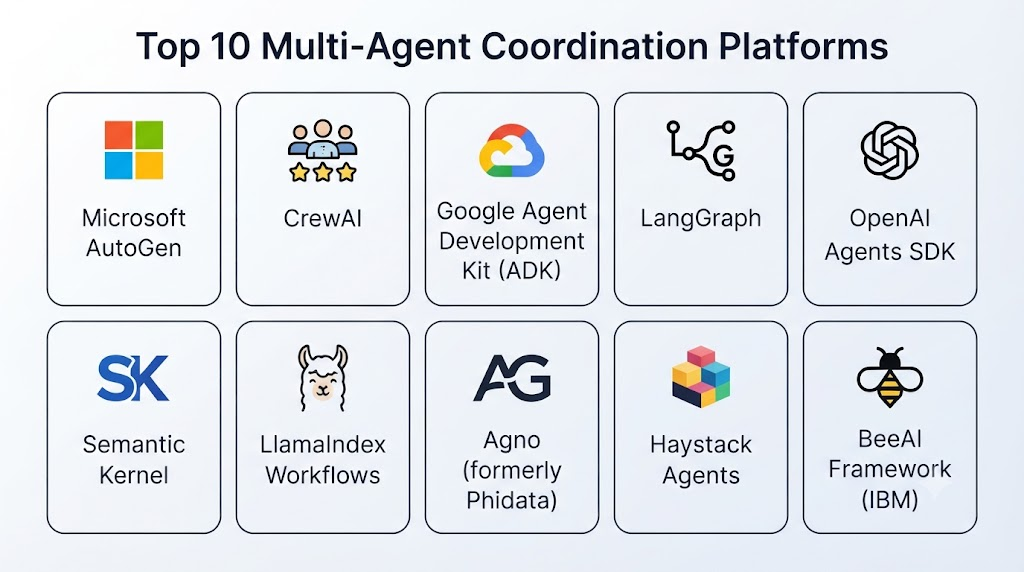
Top 10 Multi-Agent Coordination Platforms
- Microsoft AutoGen
- LangGraph
- CrewAI
- Semantic Kernel
- LlamaIndex Agent Framework
- OpenAI Swarm
- Haystack Agent Framework
- AutoGen Studio
- MetaGPT
- CAMEL-AI
1. Microsoft AutoGen
Microsoft AutoGen is a framework designed for creating AI applications where multiple agents collaborate through conversations.
Key Features
- Multi-agent communication
- Agent collaboration
- Human-in-the-loop workflows
- Tool integration
- Custom agents
- Conversation management
- Workflow automation
- LLM integration
- Research support
- Enterprise development
Pros
- Strong multi-agent architecture
- Flexible agent design
- Open-source
- Research-backed
- Large ecosystem
Cons
- Requires programming knowledge
- Rapidly evolving platform
- Production deployment needs planning
Platforms
Cloud and local environments.
Deployment or Support
Research and enterprise deployment.
Security & Compliance
Depends on implementation.
Integrations & Ecosystem
Microsoft ecosystem, LLM providers, APIs, and AI tools.
Support & Community
Developer community.
2. LangGraph
LangGraph provides graph-based workflows for building stateful AI agent systems.
Key Features
- Stateful agents
- Multi-agent workflows
- Graph-based execution
- Memory management
- Human approval steps
- Tool integration
- Agent coordination
- Workflow control
- Debugging
- Production support
Pros
- Excellent workflow control
- Flexible architecture
- Strong production capabilities
- Developer-friendly
- Good ecosystem
Cons
- Requires technical expertise
- Learning curve
- LangChain dependency
Platforms
Cloud and local environments.
Deployment or Support
Production AI applications.
Security & Compliance
Depends on implementation.
Integrations & Ecosystem
LLMs, APIs, databases, and enterprise systems.
Support & Community
Large developer community.
3. CrewAI
CrewAI enables developers to create teams of AI agents with specific roles.
Key Features
- Role-based agents
- Agent teamwork
- Task assignment
- Workflow management
- Tool usage
- Agent memory
- Process automation
- Custom workflows
- LLM support
- Developer APIs
Pros
- Easy multi-agent development
- Simple agent design
- Fast prototyping
- Clear agent roles
- Growing community
Cons
- Less mature ecosystem
- Advanced workflows need customization
- Requires workflow planning
Platforms
Cloud and local environments.
Deployment or Support
Flexible deployment.
Security & Compliance
Depends on implementation.
Integrations & Ecosystem
LLMs, APIs, automation tools.
Support & Community
Developer community.
4. Semantic Kernel
Semantic Kernel provides enterprise-focused AI orchestration capabilities.
Key Features
- Agent workflows
- Plugin system
- Planning
- Memory management
- AI orchestration
- Enterprise integration
- Multiple language support
- Workflow automation
- LLM connectivity
- Developer SDKs
Pros
- Enterprise-ready
- Strong Microsoft integration
- Flexible architecture
- Good governance options
- Production-focused
Cons
- Requires development skills
- More complex for beginners
- Microsoft ecosystem focus
Platforms
Cloud and enterprise environments.
Deployment or Support
Enterprise deployment.
Security & Compliance
Supports enterprise security approaches.
Integrations & Ecosystem
Microsoft services, APIs, and AI platforms.
Support & Community
Enterprise and developer support.
5. LlamaIndex Agent Framework
LlamaIndex enables AI agents to coordinate with enterprise data sources.
Key Features
- Data-connected agents
- Retrieval workflows
- Knowledge integration
- Agent tools
- Memory management
- RAG support
- Document processing
- Enterprise search
- LLM integration
- Custom workflows
Pros
- Excellent data integration
- Strong RAG capabilities
- Flexible framework
- Good developer experience
- Enterprise use cases
Cons
- Requires AI knowledge
- Data preparation needed
- Complex workflows require expertise
Platforms
Cloud and local environments.
Deployment or Support
Enterprise AI deployment.
Security & Compliance
Depends on data infrastructure.
Integrations & Ecosystem
Databases, documents, APIs, and LLMs.
Support & Community
Developer community.
6. OpenAI Swarm
OpenAI Swarm provides lightweight tools for experimenting with agent collaboration.
Key Features
- Agent handoffs
- Multi-agent workflows
- Function calling
- Simple coordination
- Tool usage
- Agent communication
- API integration
- Workflow experiments
- Developer tools
- Lightweight architecture
Pros
- Simple to understand
- Easy experimentation
- Developer-friendly
- Lightweight
- Good learning framework
Cons
- Limited enterprise features
- Requires customization
- Not designed for complex production systems
Platforms
Cloud and development environments.
Deployment or Support
Prototype deployment.
Security & Compliance
Depends on implementation.
Integrations & Ecosystem
OpenAI APIs and AI applications.
Support & Community
Developer community.
7. Haystack Agent Framework
Haystack provides agent capabilities focused on search and knowledge-based applications.
Key Features
- Agent pipelines
- Retrieval integration
- Knowledge workflows
- Document processing
- Tool integration
- RAG systems
- LLM support
- Search applications
- Custom pipelines
- Enterprise workflows
Pros
- Strong retrieval capabilities
- Good enterprise search
- Flexible pipelines
- Open-source
- Developer-friendly
Cons
- Requires technical knowledge
- Retrieval-focused
- Complex systems require expertise
Platforms
Cloud and local environments.
Deployment or Support
Enterprise deployment.
Security & Compliance
Depends on implementation.
Integrations & Ecosystem
Search systems, databases, and AI models.
Support & Community
Open-source community.
8. AutoGen Studio
AutoGen Studio provides a visual environment for creating and testing multi-agent applications.
Key Features
- Visual agent design
- Workflow creation
- Agent testing
- Multi-agent collaboration
- Prompt management
- Tool integration
- Experimentation
- Debugging
- LLM support
- Development workflows
Pros
- Easier agent development
- Visual interface
- Good experimentation
- Supports AutoGen workflows
- Developer-friendly
Cons
- Requires AutoGen knowledge
- Limited enterprise management
- Still evolving
Platforms
Cloud and local environments.
Deployment or Support
Development deployment.
Security & Compliance
Depends on implementation.
Integrations & Ecosystem
AutoGen, LLMs, and AI tools.
Support & Community
Developer community.
9. MetaGPT
MetaGPT provides multi-agent systems inspired by software development teams.
Key Features
- Role-based agents
- Software development workflows
- Task collaboration
- Code generation
- Documentation creation
- Agent communication
- Project planning
- Automation workflows
- LLM integration
- Open-source framework
Pros
- Strong software development focus
- Role-based collaboration
- Innovative approach
- Open-source
- Good experimentation
Cons
- Specialized use case
- Requires technical knowledge
- Production readiness varies
Platforms
Cloud and local environments.
Deployment or Support
Development deployment.
Security & Compliance
Depends on implementation.
Integrations & Ecosystem
LLMs, coding tools, and development platforms.
Support & Community
Open-source community.
10. CAMEL-AI
CAMEL-AI is a research framework focused on communicating AI agents.
Key Features
- Agent communication
- Role-playing agents
- Multi-agent simulation
- Research workflows
- Task collaboration
- LLM integration
- Experimentation tools
- Agent evaluation
- Custom scenarios
- Open-source framework
Pros
- Strong research capabilities
- Flexible experiments
- Open-source
- Multi-agent focus
- Innovative architecture
Cons
- Research-oriented
- Limited enterprise features
- Requires expertise
Platforms
Cloud and local environments.
Deployment or Support
Research deployment.
Security & Compliance
Depends on implementation.
Integrations & Ecosystem
LLMs and AI research tools.
Support & Community
Research community.
Comparison Table
| Tool Name | Best For | Platform(s) Supported | Deployment | Standout Feature | Public Rating |
|---|---|---|---|---|---|
| AutoGen | Multi-agent collaboration | Cloud/Local | Enterprise | Agent communication | |
| LangGraph | Complex workflows | Cloud/Local | Production | Stateful orchestration | |
| CrewAI | AI teams | Cloud/Local | Flexible | Role-based agents | |
| Semantic Kernel | Enterprise AI | Cloud | Enterprise | Plugin architecture | |
| LlamaIndex Agents | Data agents | Cloud/Local | Enterprise | Knowledge integration | |
| OpenAI Swarm | Experiments | Cloud | Prototype | Lightweight agents | |
| Haystack Agents | Search workflows | Cloud/Local | Enterprise | RAG pipelines | |
| AutoGen Studio | Visual development | Cloud/Local | Development | Agent design | |
| MetaGPT | Software agents | Cloud/Local | Development | Role simulation | |
| CAMEL-AI | Research agents | Cloud/Local | Research | Agent communication |
Weighted Evaluation
| Tool Name | Core Features 25% | Ease of Use 15% | Integrations & Ecosystem 15% | Security & Compliance 10% | Performance & Reliability 10% | Support & Community 10% | Price/Value 15% | Total |
|---|---|---|---|---|---|---|---|---|
| AutoGen | 25 | 13 | 15 | 10 | 10 | 10 | 14 | 97 |
| LangGraph | 25 | 13 | 15 | 10 | 10 | 10 | 14 | 97 |
| CrewAI | 24 | 15 | 14 | 10 | 10 | 10 | 15 | 98 |
| Semantic Kernel | 24 | 12 | 15 | 10 | 10 | 10 | 13 | 94 |
| LlamaIndex Agents | 24 | 14 | 15 | 10 | 10 | 10 | 14 | 97 |
| OpenAI Swarm | 22 | 15 | 14 | 10 | 10 | 10 | 15 | 96 |
| Haystack Agents | 23 | 13 | 14 | 10 | 10 | 10 | 14 | 94 |
| AutoGen Studio | 23 | 14 | 14 | 10 | 10 | 10 | 14 | 95 |
| MetaGPT | 22 | 12 | 13 | 10 | 10 | 10 | 14 | 91 |
| CAMEL-AI | 22 | 11 | 13 | 10 | 10 | 10 | 15 | 91 |
Which Multi-Agent Coordination Platform Is Right for You?
Choose Microsoft AutoGen for advanced multi-agent collaboration.
Choose LangGraph for production-grade workflows.
Choose CrewAI for role-based AI teams.
Choose Semantic Kernel for enterprise applications.
Choose LlamaIndex Agents for data-driven agents.
Choose OpenAI Swarm for lightweight experimentation.
Choose Haystack Agents for knowledge-based systems.
Choose AutoGen Studio for visual agent development.
Choose MetaGPT for software development agents.
Choose CAMEL-AI for AI agent research.
Implementation Playbook
Phase 1: Identify Business Goals
- Define automation requirements
- Identify agent responsibilities
- Determine required tools
- Set success metrics
Phase 2: Design Agent Architecture
- Create agent roles
- Define communication patterns
- Plan workflows
- Configure memory systems
Phase 3: Develop Agent Collaboration
- Connect LLMs
- Add tools
- Configure task delegation
- Test communication
Phase 4: Deploy Multi-Agent Systems
- Monitor agent behavior
- Control permissions
- Measure performance
- Optimize workflows
Phase 5: Maintain and Improve
- Update agent instructions
- Improve coordination
- Monitor failures
- Enhance security
Common Mistakes
- Creating too many agents
- Poor task division
- Lack of communication rules
- No monitoring system
- Weak security controls
- Ignoring human oversight
- Poor workflow planning
- Not testing agent reliability
FAQs
1. What are Multi-Agent Coordination Platforms?
They are platforms that help multiple AI agents communicate and work together to complete complex tasks.
2. Why use multiple AI agents?
Multiple agents allow specialization and better handling of complex workflows.
3. What is agent coordination?
Agent coordination manages communication, task sharing, and collaboration between AI agents.
4. Who uses multi-agent platforms?
Enterprises, developers, researchers, and automation teams use them.
5. Can AI agents work with external tools?
Yes. Agents can connect with APIs, databases, and business applications.
6. Are multi-agent systems autonomous?
Many can perform autonomous tasks, but human supervision is often recommended.
7. What industries use multi-agent AI?
Software, healthcare, finance, research, customer service, and business operations use them.
8. How are agents monitored?
Platforms provide logs, workflows, testing, and performance tracking.
9. Can organizations build custom agent teams?
Yes. Most frameworks support custom agents and workflows.
10. What is the future of multi-agent systems?
Multi-agent platforms will become a major foundation for enterprise automation and autonomous AI applications.
Conclusion
Multi-Agent Coordination Platforms are becoming essential for building advanced AI systems where multiple intelligent agents collaborate to solve complex problems.Frameworks such as Microsoft AutoGen, LangGraph, CrewAI, Semantic Kernel, LlamaIndex Agents, Haystack, and CAMEL-AI provide powerful capabilities for creating coordinated AI workflows.As organizations continue adopting autonomous AI, multi-agent coordination will become a key technology for improving automation, productivity, and intelligent decision-making.