Introduction
Sovereign AI Cloud Platforms are specialized cloud infrastructure solutions designed to help governments, enterprises, and regulated organizations build, deploy, and manage artificial intelligence systems while maintaining control over data, models, infrastructure, and compliance requirements.
As AI adoption increases worldwide, organizations are becoming more concerned about data sovereignty, regulatory compliance, cybersecurity, and dependence on foreign technology providers. Sovereign AI cloud platforms address these challenges by providing AI capabilities within controlled geographic, legal, and operational boundaries.
These platforms enable organizations to maintain control over:
- Data location
- AI workloads
- Model deployment
- Security policies
- Infrastructure ownership
- Regulatory compliance
Sovereign AI Cloud Platforms help organizations:
- Deploy AI within national or regional boundaries
- Protect sensitive information
- Meet government regulations
- Build trusted AI systems
- Reduce dependency on external AI providers
- Maintain operational independence
- Support mission-critical AI applications
These platforms are used by:
- Government agencies
- Defense organizations
- Financial institutions
- Healthcare providers
- Research organizations
- Large enterprises
- Regulated industries
Modern Sovereign AI Cloud Platforms provide capabilities such as:
- AI infrastructure management
- Secure cloud environments
- Private AI deployment
- Data residency controls
- AI governance
- Model management
- Compliance monitoring
- High-performance computing
- GPU-based AI acceleration
The goal of Sovereign AI Cloud Platforms is to provide secure, compliant, and independent AI infrastructure while enabling organizations to benefit from advanced artificial intelligence technologies.
What Is Sovereign AI?
Sovereign AI refers to the ability of a country, organization, or region to develop and operate artificial intelligence systems while maintaining control over:
- Data
- Computing infrastructure
- AI models
- Technology stack
- Governance policies
Unlike traditional cloud AI services, sovereign AI focuses on independence, security, and regulatory control.
What Are Sovereign AI Cloud Platforms?
Sovereign AI Cloud Platforms combine cloud computing infrastructure with AI capabilities while ensuring:
- Data remains within approved locations
- Local regulations are followed
- AI workloads are protected
- Organizations maintain control
These platforms can be deployed through:
- Government clouds
- Private clouds
- Regional cloud environments
- Dedicated AI infrastructure
- Hybrid cloud systems
How Sovereign AI Cloud Platforms Work
Secure Infrastructure Layer
The platform provides controlled computing resources including:
- GPUs
- Storage
- Networking
- AI accelerators
AI Model Deployment
Organizations deploy:
- Foundation models
- Large language models
- Custom AI models
- Industry-specific models
Data Governance
Platforms manage:
- Data residency
- Access controls
- Encryption
- Compliance policies
AI Operations Management
Organizations manage:
- Model lifecycle
- AI applications
- Monitoring
- Performance optimization
Regulatory Compliance
Platforms support:
- Government standards
- Industry regulations
- Security frameworks
Key Capabilities of Sovereign AI Cloud Platforms
Data Sovereignty
Ensures data remains within approved geographic and legal boundaries.
Benefits:
- Regulatory compliance
- Better privacy protection
- Greater control
Secure AI Infrastructure
Provides:
- Isolated environments
- Encryption
- Identity management
- Security monitoring
AI Model Control
Organizations can manage:
- Model deployment
- Fine-tuning
- Updates
- Access policies
High-Performance Computing
Supports:
- GPU clusters
- AI training
- Large-scale inference
Governance and Compliance
Enables:
- Audit trails
- Policy enforcement
- Risk management
Common Use Cases
Government AI Systems
Used for:
- Public services
- National security
- Policy analysis
Defense and Intelligence
Supports:
- Secure AI operations
- Data analysis
- Mission applications
Healthcare AI
Used for:
- Medical research
- Patient data analysis
- Healthcare automation
Financial Services
Supports:
- Risk management
- Fraud detection
- Regulatory compliance
Enterprise AI
Used for:
- Internal AI assistants
- Business automation
- Data intelligence
Research Institutions
Supports:
- AI research
- Scientific computing
- Innovation projects
Why Sovereign AI Cloud Platforms Matter
Data Protection
Sensitive information remains under organizational control.
Regulatory Compliance
Organizations can meet local and industry regulations.
Technology Independence
Reduces dependency on external AI infrastructure providers.
Secure AI Adoption
Enables safer deployment of advanced AI systems.
Strategic AI Control
Organizations maintain ownership of AI capabilities.
Evaluation Criteria for Buyers
Data Residency Support
Platforms should provide:
- Regional infrastructure
- Data location controls
- Compliance options
Security Features
Important capabilities include:
- Encryption
- Identity management
- Zero-trust security
- Monitoring
AI Infrastructure
Organizations should evaluate:
- GPU availability
- Computing capacity
- AI acceleration
Compliance Support
Important standards include:
- Government regulations
- Industry certifications
- Security frameworks
AI Platform Capabilities
Platforms should support:
- Model deployment
- AI development
- Inference management
- Monitoring
Scalability
Important factors include:
- Enterprise workloads
- Large AI models
- Growing demand
Key Trends
Growth of National AI Infrastructure
Countries are investing in independent AI capabilities.
AI Sovereignty Regulations
Governments are creating policies around AI control and data protection.
Regional Cloud Expansion
Cloud providers are building localized AI infrastructure.
Secure Generative AI Adoption
Organizations require controlled environments for LLM deployment.
Hybrid Sovereign AI
Businesses are combining:
- Private infrastructure
- Public cloud
- Regional AI services
Open AI Infrastructure
Organizations are adopting open models for greater control.
Methodology
The following Sovereign AI Cloud Platforms were evaluated based on:
- Sovereignty capabilities
- AI infrastructure
- Security features
- Compliance support
- Enterprise readiness
- Scalability
- Model support
- Deployment flexibility
- Performance
- Value
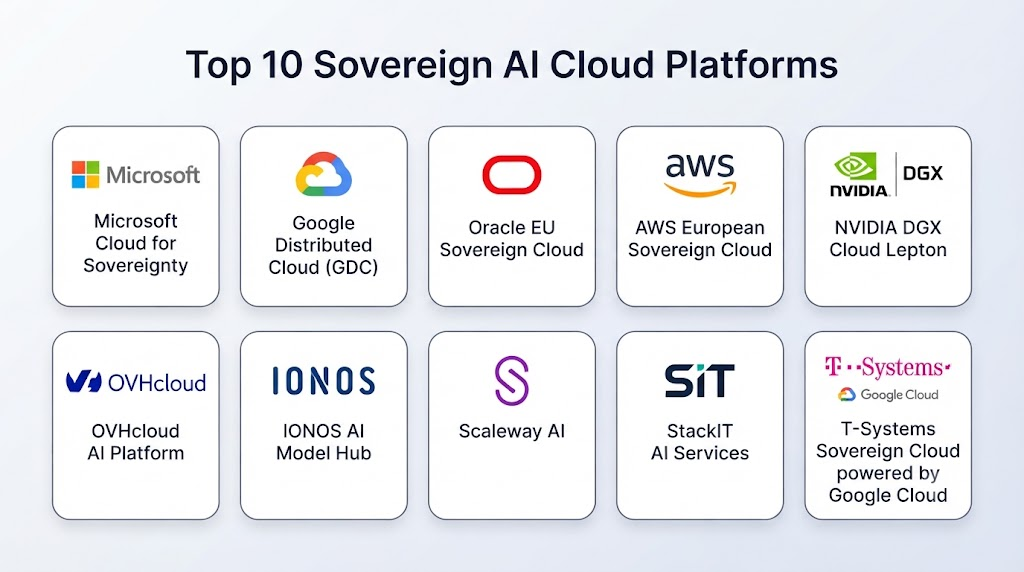
Top 10 Sovereign AI Cloud Platforms
1. NVIDIA Sovereign AI Cloud
NVIDIA Sovereign AI Cloud provides AI infrastructure solutions designed to help organizations build secure and controlled AI capabilities.
Key Features
- Sovereign AI infrastructure
- GPU-powered computing
- AI model deployment
- Enterprise AI workloads
- Secure environments
- AI acceleration
- Data control
- AI factory capabilities
- Model optimization
- Partner ecosystem
Pros
- Powerful AI hardware
- High-performance computing
- Enterprise-ready
- Strong AI ecosystem
- Supports large AI workloads
Cons
- NVIDIA ecosystem dependency
- Infrastructure investment required
- Requires AI expertise
Platforms
Private cloud and sovereign cloud environments.
Deployment or Support
Enterprise deployment.
Security & Compliance
Supports secure AI infrastructure.
Integrations & Ecosystem
NVIDIA GPUs, cloud providers, and enterprise systems.
Support & Community
Enterprise support.
2. AWS European Sovereign Cloud
AWS European Sovereign Cloud is designed to provide cloud infrastructure aligned with European sovereignty requirements.
Key Features
- Regional cloud infrastructure
- Data residency controls
- Security management
- AI service integration
- Compliance support
- Enterprise workloads
- Cloud governance
- Identity controls
- Monitoring
- AI deployment support
Pros
- Strong cloud capabilities
- Enterprise security
- Large ecosystem
- Scalable infrastructure
- Compliance-focused
Cons
- AWS dependency
- Regional availability limitations
- Cloud complexity
Platforms
AWS sovereign cloud environments.
Deployment or Support
Enterprise cloud deployment.
Security & Compliance
Strong security framework.
Integrations & Ecosystem
AWS services and enterprise applications.
Support & Community
Enterprise support.
3. Google Cloud Sovereign Solutions
Google Cloud Sovereign Solutions provide controlled cloud environments for regulated organizations.
Key Features
- Data sovereignty
- AI infrastructure
- Security controls
- Regional cloud options
- Compliance support
- AI services
- Governance tools
- Encryption
- Monitoring
- Enterprise deployment
Pros
- Strong AI capabilities
- Advanced cloud infrastructure
- Security features
- Global expertise
- AI innovation
Cons
- Google Cloud dependency
- Complex implementation
- Requires cloud skills
Platforms
Google Cloud environments.
Deployment or Support
Enterprise deployment.
Security & Compliance
Enterprise security support.
Integrations & Ecosystem
Google Cloud AI services.
Support & Community
Enterprise support.
4. Microsoft Cloud for Sovereignty
Microsoft Cloud for Sovereignty helps governments and regulated organizations deploy secure cloud workloads.
Key Features
- Sovereign cloud controls
- Data protection
- Compliance tools
- AI integration
- Identity management
- Security monitoring
- Policy controls
- Hybrid cloud support
- Governance
- Enterprise deployment
Pros
- Strong government support
- Enterprise security
- Hybrid capabilities
- Microsoft ecosystem
- Compliance features
Cons
- Microsoft dependency
- Complex configuration
- Enterprise-focused
Platforms
Azure cloud environments.
Deployment or Support
Enterprise deployment.
Security & Compliance
Strong compliance support.
Integrations & Ecosystem
Microsoft services and enterprise applications.
Support & Community
Enterprise support.
5. IBM Sovereign Cloud
IBM provides sovereign cloud capabilities focused on security, compliance, and regulated workloads.
Key Features
- Secure cloud infrastructure
- AI governance
- Data control
- Compliance management
- Hybrid cloud support
- Enterprise AI
- Privacy controls
- Model management
- Monitoring
- Automation
Pros
- Strong governance
- Enterprise security
- Hybrid cloud expertise
- Compliance focus
- AI capabilities
Cons
- Complex platform
- Enterprise pricing
- Requires expertise
Platforms
Private and hybrid cloud.
Deployment or Support
Enterprise deployment.
Security & Compliance
Strong governance features.
Integrations & Ecosystem
IBM Cloud, AI systems, and enterprise tools.
Support & Community
Enterprise support.
6. Oracle EU Sovereign Cloud
Oracle provides sovereign cloud services designed for regulated European workloads.
Key Features
- Regional cloud infrastructure
- Data residency
- Enterprise security
- AI workloads
- Database integration
- Compliance support
- Cloud management
- Enterprise applications
- Monitoring
- Governance
Pros
- Strong enterprise infrastructure
- Database ecosystem
- Compliance support
- Regional deployment
- Security features
Cons
- Oracle ecosystem dependency
- Enterprise complexity
- Specialized skills required
Platforms
Oracle Cloud environments.
Deployment or Support
Enterprise deployment.
Security & Compliance
Enterprise security support.
Integrations & Ecosystem
Oracle applications and enterprise systems.
Support & Community
Enterprise support.
7. OVHcloud Trusted Cloud
OVHcloud provides trusted cloud infrastructure with strong European data sovereignty focus.
Key Features
- European cloud infrastructure
- Data protection
- Trusted environments
- AI workloads
- Private cloud
- Compliance support
- Infrastructure management
- Security controls
- Enterprise services
- Cloud deployment
Pros
- European sovereignty focus
- Competitive infrastructure
- Data control
- Private cloud support
- Security-focused
Cons
- Smaller ecosystem
- Limited global reach
- Fewer AI services
Platforms
Private and public cloud.
Deployment or Support
Enterprise deployment.
Security & Compliance
Trusted cloud certifications.
Integrations & Ecosystem
Cloud infrastructure and enterprise systems.
Support & Community
Enterprise support.
8. Scaleway Sovereign Cloud
Scaleway provides European cloud infrastructure focused on privacy and sovereignty.
Key Features
- European infrastructure
- AI computing
- Data residency
- Cloud services
- Security controls
- GPU resources
- Developer tools
- Private environments
- Monitoring
- Enterprise support
Pros
- European-based infrastructure
- Developer-friendly
- AI hardware support
- Privacy focus
- Flexible services
Cons
- Smaller enterprise ecosystem
- Limited global availability
- Fewer AI tools
Platforms
European cloud environments.
Deployment or Support
Cloud deployment.
Security & Compliance
Privacy-focused infrastructure.
Integrations & Ecosystem
Cloud services and AI tools.
Support & Community
Developer support.
9. HPE GreenLake Sovereign Cloud
HPE GreenLake provides private cloud and sovereign infrastructure solutions.
Key Features
- Private cloud
- AI infrastructure
- Data control
- Hybrid cloud management
- Enterprise hardware
- Security controls
- AI workloads
- Resource management
- Compliance support
- Automation
Pros
- Strong enterprise infrastructure
- Private deployment
- Flexible consumption model
- AI support
- Security capabilities
Cons
- Hardware-focused
- Requires expertise
- Enterprise cost
Platforms
Private cloud and data centers.
Deployment or Support
Enterprise deployment.
Security & Compliance
Enterprise security support.
Integrations & Ecosystem
HPE infrastructure and AI systems.
Support & Community
Enterprise support.
10. Dell Sovereign AI Infrastructure
Dell provides infrastructure solutions for organizations building sovereign AI environments.
Key Features
- AI servers
- GPU infrastructure
- Private deployment
- Secure systems
- Data control
- AI workload management
- Enterprise integration
- Storage solutions
- Infrastructure optimization
- Deployment support
Pros
- Strong hardware ecosystem
- Enterprise-ready
- Secure infrastructure
- Scalable systems
- AI optimization
Cons
- Infrastructure investment
- Requires expertise
- Hardware dependency
Platforms
On-premise and private cloud.
Deployment or Support
Enterprise deployment.
Security & Compliance
Supports secure infrastructure.
Integrations & Ecosystem
Dell hardware and AI platforms.
Support & Community
Enterprise support.
Comparison Table
| Tool Name | Best For | Platform(s) Supported | Deployment | Standout Feature | Public Rating |
|---|---|---|---|---|---|
| NVIDIA Sovereign AI Cloud | AI infrastructure | Private Cloud | Enterprise | GPU AI acceleration | |
| AWS Sovereign Cloud | Regulated cloud | AWS | Enterprise | Cloud compliance | |
| Google Sovereign Solutions | AI cloud workloads | Google Cloud | Enterprise | AI ecosystem | |
| Microsoft Cloud Sovereignty | Government AI | Azure | Enterprise | Governance | |
| IBM Sovereign Cloud | Enterprise AI | Hybrid Cloud | Enterprise | AI governance | |
| Oracle Sovereign Cloud | Enterprise systems | Oracle Cloud | Enterprise | Database integration | |
| OVHcloud Trusted Cloud | European sovereignty | Cloud | Enterprise | Data control | |
| Scaleway Sovereign Cloud | European cloud | Cloud | Flexible | Privacy focus | |
| HPE GreenLake | Private AI infrastructure | Private Cloud | Enterprise | Hybrid cloud | |
| Dell Sovereign AI | AI hardware | On-premise | Enterprise | Infrastructure |
Weighted Evaluation
| Tool Name | Core Features 25% | Ease of Use 15% | Integrations & Ecosystem 15% | Security & Compliance 10% | Performance & Reliability 10% | Support & Community 10% | Price/Value 15% | Total |
|---|---|---|---|---|---|---|---|---|
| NVIDIA Sovereign AI | 25 | 12 | 15 | 10 | 10 | 10 | 12 | 94 |
| AWS Sovereign Cloud | 24 | 13 | 15 | 10 | 10 | 10 | 12 | 94 |
| Google Sovereign Solutions | 24 | 13 | 15 | 10 | 10 | 10 | 12 | 94 |
| Microsoft Sovereignty | 24 | 13 | 15 | 10 | 10 | 10 | 12 | 94 |
| IBM Sovereign Cloud | 24 | 12 | 14 | 10 | 10 | 10 | 12 | 92 |
| Oracle Sovereign Cloud | 23 | 12 | 14 | 10 | 10 | 10 | 12 | 91 |
| OVHcloud Trusted Cloud | 22 | 14 | 13 | 10 | 10 | 10 | 14 | 93 |
| Scaleway Sovereign Cloud | 22 | 15 | 13 | 10 | 10 | 10 | 14 | 94 |
| HPE GreenLake | 23 | 12 | 14 | 10 | 10 | 10 | 12 | 91 |
| Dell Sovereign AI | 23 | 12 | 14 | 10 | 10 | 10 | 12 | 91 |
Which Sovereign AI Cloud Platform Is Right for You?
Choose NVIDIA Sovereign AI Cloud for high-performance AI infrastructure.
Choose AWS Sovereign Cloud for regulated enterprise cloud workloads.
Choose Google Sovereign Solutions for AI-focused cloud environments.
Choose Microsoft Cloud for Sovereignty for government and enterprise workloads.
Choose IBM Sovereign Cloud for governance-focused AI.
Choose Oracle Sovereign Cloud for enterprise database environments.
Choose OVHcloud Trusted Cloud for European data sovereignty.
Choose Scaleway Sovereign Cloud for privacy-focused cloud services.
Choose HPE GreenLake for private AI infrastructure.
Choose Dell Sovereign AI Infrastructure for enterprise hardware deployment.
Implementation Playbook
Phase 1: Define Sovereignty Requirements
- Identify regulations
- Determine data residency needs
- Define security requirements
- Select deployment model
Phase 2: Build Infrastructure
- Configure computing resources
- Deploy AI platforms
- Establish security controls
- Configure networking
Phase 3: Deploy AI Systems
- Select AI models
- Configure workloads
- Test performance
- Validate compliance
Phase 4: Manage AI Operations
- Monitor workloads
- Manage models
- Track security events
- Optimize resources
Phase 5: Continuous Governance
- Review policies
- Update security controls
- Monitor compliance
- Improve AI operations
Common Mistakes
- Ignoring data residency requirements
- Selecting unsuitable infrastructure
- Poor governance planning
- Weak security controls
- Lack of compliance monitoring
- Ignoring AI workload requirements
- Underestimating infrastructure costs
- Poor model management
FAQs
1. What are Sovereign AI Cloud Platforms?
Sovereign AI Cloud Platforms provide controlled AI infrastructure that keeps data, models, and workloads within defined sovereignty requirements.
2. Why is AI sovereignty important?
It helps organizations maintain control over sensitive data and AI operations.
3. Who uses sovereign AI platforms?
Governments, enterprises, healthcare organizations, defense groups, and regulated industries use them.
4. How are sovereign clouds different from normal clouds?
Sovereign clouds provide stronger control over data location, governance, and compliance.
5. Can sovereign AI platforms run large language models?
Yes. Many support enterprise LLM deployment.
6. Are sovereign AI platforms more secure?
They provide additional control and security measures for sensitive workloads.
7. What industries need sovereign AI?
Government, defense, finance, healthcare, and research sectors commonly require sovereign AI.
8. Can organizations customize sovereign AI systems?
Yes. They can customize models, infrastructure, and policies.
9. What challenges exist with sovereign AI?
Challenges include cost, infrastructure complexity, and technical expertise requirements.
10. What is the future of sovereign AI?
Sovereign AI will continue growing as organizations prioritize secure, independent, and compliant AI infrastructure.
Conclusion
Sovereign AI Cloud Platforms are becoming a critical foundation for organizations that require secure, controlled, and compliant artificial intelligence infrastructure.Platforms such as NVIDIA Sovereign AI Cloud, AWS Sovereign Cloud, Google Sovereign Solutions, Microsoft Cloud for Sovereignty, IBM Sovereign Cloud, HPE GreenLake, and Dell AI Infrastructure enable organizations to build AI systems while maintaining control over data, models, and operations.As AI becomes strategically important across governments and enterprises, sovereign AI infrastructure will play a major role in creating secure, independent, and trusted artificial intelligence ecosystems.