Introduction
Open-Source Model Hub Platforms are centralized platforms that allow developers, researchers, businesses, and AI communities to discover, share, download, customize, and deploy machine learning and artificial intelligence models.
As artificial intelligence adoption continues to grow, organizations are increasingly using open-source models to build customized AI applications without depending only on proprietary solutions. Open-source model hubs provide access to thousands of pre-trained models for natural language processing, computer vision, speech recognition, generative AI, robotics, and other AI workloads.
These platforms act as marketplaces and collaboration environments where developers can access:
- Large language models
- Computer vision models
- Speech models
- Embedding models
- Multimodal models
- Generative AI models
- Machine learning datasets
- AI development resources
Open-source model hubs help organizations:
- Reduce AI development time
- Experiment with different models
- Customize AI solutions
- Improve transparency
- Build private AI applications
- Collaborate with global AI communities
These platforms are used by:
- AI researchers
- Machine learning engineers
- Software developers
- Startups
- Enterprises
- Universities
- Data scientists
- AI communities
Modern open-source model hub platforms provide capabilities such as:
- Model repositories
- Version management
- Model documentation
- Dataset sharing
- Model evaluation
- Deployment tools
- Fine-tuning support
- Community collaboration
The goal of these platforms is to make AI development more accessible, flexible, and collaborative.
How Open-Source Model Hub Platforms Work
Model Discovery
Users search and discover models based on:
- AI tasks
- Model architecture
- Performance
- Framework compatibility
- Industry requirements
Model Sharing
Developers and researchers upload:
- Trained models
- Model versions
- Documentation
- Configuration files
- Usage examples
Model Customization
Organizations customize models using:
- Fine-tuning
- Transfer learning
- Prompt engineering
- Additional datasets
Model Deployment
Models can be deployed through:
- APIs
- Cloud platforms
- Edge devices
- Enterprise systems
- Local infrastructure
Community Collaboration
Developers contribute:
- Improvements
- Documentation
- Evaluations
- New model versions
Common Use Cases
Generative AI Development
Organizations use open models for:
- Text generation
- Image generation
- Code generation
- AI assistants
Machine Learning Research
Researchers use model hubs for:
- Experimentation
- Benchmarking
- Model comparison
Enterprise AI Applications
Companies build:
- Internal AI assistants
- Search systems
- Automation workflows
Computer Vision
Organizations deploy models for:
- Object detection
- Image classification
- Video analysis
Natural Language Processing
Models support:
- Translation
- Summarization
- Sentiment analysis
- Text classification
Education and Learning
Students and developers use open models to learn AI development.
Why Open-Source Model Hub Platforms Matter
Faster AI Development
Developers can start projects using existing models instead of building everything from scratch.
Cost Reduction
Organizations reduce AI development costs by using available models.
Greater Flexibility
Open models allow customization and modification.
Community Innovation
Global collaboration improves model quality and accessibility.
Research Advancement
Researchers can compare, improve, and experiment with AI models.
Evaluation Criteria for Buyers
Model Availability
Platforms should provide:
- Large model collections
- Different AI categories
- Updated repositories
Model Quality
Important factors include:
- Accuracy
- Performance
- Documentation
- Evaluation results
Developer Experience
Platforms should provide:
- APIs
- SDKs
- Documentation
- Easy downloads
Customization Support
Important capabilities include:
- Fine-tuning
- Training tools
- Model modification
Security
Organizations should evaluate:
- Model verification
- Access control
- License information
- Data safety
Deployment Options
Platforms should support:
- Cloud deployment
- Local deployment
- Edge deployment
- Enterprise environments
Key Trends
Growth of Open AI Models
Organizations are increasingly adopting open-source alternatives.
Enterprise AI Customization
Companies are adapting models for business-specific requirements.
Model Evaluation Improvements
Platforms are adding better benchmarking and testing systems.
AI Community Collaboration
Developers worldwide are contributing improvements.
Private AI Adoption
Organizations are using open models for greater control.
Multimodal Model Expansion
Model hubs are expanding beyond text into:
- Images
- Audio
- Video
- Robotics
Methodology
The following platforms were evaluated based on:
- Model ecosystem size
- Developer experience
- Model quality
- Deployment capabilities
- Community support
- Security features
- Integration options
- Customization support
- Reliability
- Value
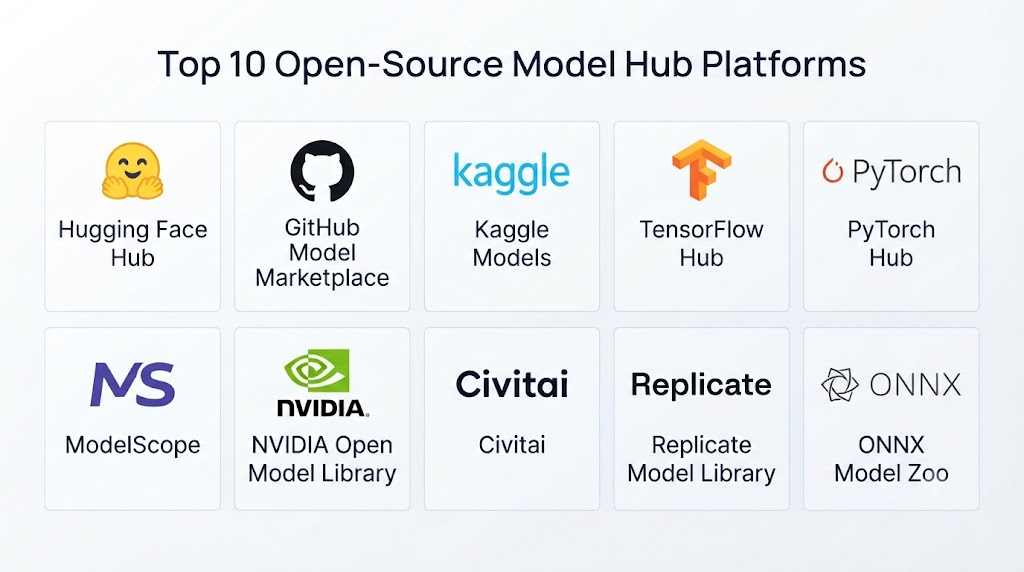
Top 10 Open-Source Model Hub Platforms
1. Hugging Face Hub
Hugging Face Hub is one of the largest open-source AI model platforms, providing access to thousands of machine learning models, datasets, and AI development resources.
Key Features
- Large model repository
- Language models
- Vision models
- Audio models
- Dataset hosting
- Model documentation
- Model evaluation
- Deployment tools
- Community collaboration
- AI application support
Pros
- Largest open-source AI ecosystem
- Wide model variety
- Strong developer community
- Excellent documentation
- Supports many frameworks
Cons
- Model quality varies
- Requires technical knowledge
- License management needed
Platforms
Cloud platform and local development environments.
Deployment or Support
Cloud, local, and enterprise deployment.
Security & Compliance
Provides model information, licensing details, and community evaluation.
Integrations & Ecosystem
Supports PyTorch, TensorFlow, machine learning frameworks, cloud platforms, and AI applications.
Support & Community
Large global AI developer community.
2. GitHub Model Marketplace
GitHub provides a collaborative environment for sharing and managing AI models and development resources.
Key Features
- Open-source repositories
- Model code sharing
- Version control
- Developer collaboration
- Documentation
- AI project management
- Integration support
- Community contributions
- Development workflows
- Open-source tools
Pros
- Strong developer ecosystem
- Excellent version control
- Collaboration features
- Large technology community
- Integration with development workflows
Cons
- Model discovery can be challenging
- Quality varies
- Requires technical skills
Platforms
Cloud-based developer platform.
Deployment or Support
Cloud and local development.
Security & Compliance
Repository security and access controls.
Integrations & Ecosystem
Software development tools, AI frameworks, and cloud platforms.
Support & Community
Large developer community.
3. Kaggle Models
Kaggle provides a platform for AI developers and researchers to share models, datasets, and machine learning experiments.
Key Features
- Model sharing
- Dataset integration
- AI competitions
- Notebook environment
- Machine learning resources
- Community collaboration
- Model experiments
- Research workflows
- Learning resources
- Performance comparison
Pros
- Strong data science community
- Educational resources
- Easy experimentation
- Dataset availability
- Research support
Cons
- Less enterprise-focused
- Limited deployment features
- Requires data science knowledge
Platforms
Cloud platform.
Deployment or Support
Cloud-based experimentation.
Security & Compliance
Community-based model sharing.
Integrations & Ecosystem
Data science tools, notebooks, AI frameworks, and datasets.
Support & Community
Large data science community.
4. TensorFlow Hub
TensorFlow Hub provides reusable machine learning models for TensorFlow applications.
Key Features
- Pre-trained models
- Computer vision models
- NLP models
- Transfer learning
- Model reuse
- TensorFlow integration
- Documentation
- Developer tools
- Model sharing
- Research support
Pros
- Strong TensorFlow ecosystem
- Reliable models
- Good documentation
- Easy model reuse
- Google support
Cons
- TensorFlow-focused
- Limited framework flexibility
- Smaller ecosystem compared with larger hubs
Platforms
Cloud and local development environments.
Deployment or Support
Local and cloud deployment.
Security & Compliance
Model documentation and verification support.
Integrations & Ecosystem
TensorFlow ecosystem, AI applications, and development tools.
Support & Community
TensorFlow developer community.
5. PyTorch Hub
PyTorch Hub provides access to reusable models designed for PyTorch applications.
Key Features
- Pre-trained models
- Deep learning models
- Computer vision support
- Research models
- Model loading tools
- Documentation
- Developer resources
- Community contributions
- AI experimentation
- Framework integration
Pros
- Strong research adoption
- Excellent PyTorch support
- Easy experimentation
- Large developer community
- Flexible customization
Cons
- Requires PyTorch knowledge
- Model availability varies
- Deployment requires additional tools
Platforms
Cloud and local environments.
Deployment or Support
Local and cloud deployment.
Security & Compliance
Repository-based model sharing.
Integrations & Ecosystem
PyTorch framework, research tools, and AI applications.
Support & Community
Large research community.
6. ModelScope
ModelScope is an AI model community platform providing access to machine learning models and AI resources.
Key Features
- AI model repository
- NLP models
- Vision models
- Multimodal models
- Dataset resources
- Model testing
- Deployment tools
- Community collaboration
- AI applications
- Research support
Pros
- Large model collection
- Multimodal support
- Research-friendly
- Community-driven
- Growing ecosystem
Cons
- Smaller global adoption
- Documentation varies
- Requires technical knowledge
Platforms
Cloud platform.
Deployment or Support
Cloud and local deployment.
Security & Compliance
Model documentation and community evaluation.
Integrations & Ecosystem
AI frameworks, datasets, and development tools.
Support & Community
Developer community.
7. NVIDIA Open Model Library
NVIDIA provides access to optimized AI models designed for accelerated deployment.
Key Features
- Optimized AI models
- GPU acceleration
- Enterprise deployment
- Model optimization
- AI frameworks
- Performance tools
- Deployment resources
- Developer support
- Edge AI support
- Generative AI models
Pros
- High-performance models
- GPU optimization
- Enterprise readiness
- Production-focused
- Strong hardware ecosystem
Cons
- NVIDIA-focused
- Requires specialized hardware
- Enterprise-oriented
Platforms
Cloud, enterprise, and edge environments.
Deployment or Support
Enterprise and edge deployment.
Security & Compliance
Enterprise deployment controls.
Integrations & Ecosystem
NVIDIA hardware, AI frameworks, and cloud platforms.
Support & Community
Enterprise developer support.
8. Civitai
Civitai is a community platform focused on sharing generative AI models.
Key Features
- Generative AI models
- Image models
- Model sharing
- Community feedback
- Model discovery
- Version management
- Creative AI workflows
- User ratings
- Model examples
- Community collaboration
Pros
- Strong creative AI community
- Easy model discovery
- Large image model collection
- Community-driven
- Beginner-friendly
Cons
- Mostly focused on image models
- Quality varies
- Enterprise features limited
Platforms
Cloud platform.
Deployment or Support
Cloud and local AI workflows.
Security & Compliance
Community-based moderation and licensing considerations.
Integrations & Ecosystem
Generative AI tools and creative applications.
Support & Community
Large creative AI community.
9. Replicate Model Library
Replicate provides access to AI models through simple APIs and deployment workflows.
Key Features
- Model hosting
- API access
- Open-source models
- AI experimentation
- Model deployment
- Developer tools
- Image and language models
- Model execution
- Application integration
- Community models
Pros
- Easy API access
- Fast experimentation
- Developer-friendly
- Wide model availability
- Simple deployment
Cons
- Less focused on enterprise governance
- Usage costs vary
- Requires API-based workflows
Platforms
Cloud platform.
Deployment or Support
Cloud deployment.
Security & Compliance
Security depends on application implementation.
Integrations & Ecosystem
AI applications, APIs, and developer tools.
Support & Community
Developer community.
10. ONNX Model Zoo
ONNX Model Zoo provides optimized machine learning models using the ONNX format.
Key Features
- Pre-trained models
- Cross-platform compatibility
- Model optimization
- Computer vision models
- AI deployment support
- Runtime integration
- Performance tools
- Developer resources
- Model conversion
- Edge support
Pros
- Broad hardware compatibility
- Enterprise-friendly
- Easy model reuse
- Strong optimization
- Flexible deployment
Cons
- Requires ONNX knowledge
- Limited general AI model variety
- Technical setup needed
Platforms
Cloud, edge, and enterprise environments.
Deployment or Support
Local and enterprise deployment.
Security & Compliance
Supports controlled model deployment.
Integrations & Ecosystem
AI frameworks, hardware platforms, and deployment systems.
Support & Community
Open-source community.
Comparison Table
| Tool Name | Best For | Platform(s) Supported | Deployment | Standout Feature | Public Rating |
|---|---|---|---|---|---|
| Hugging Face Hub | AI model ecosystem | Cloud/Local | Flexible | Largest model library | N/A |
| GitHub Model Marketplace | Developer collaboration | Cloud | Flexible | Version control | N/A |
| Kaggle Models | Data science research | Cloud | Cloud | Community learning | N/A |
| TensorFlow Hub | TensorFlow models | Cloud/Local | Flexible | TensorFlow integration | N/A |
| PyTorch Hub | Research models | Cloud/Local | Flexible | PyTorch support | N/A |
| ModelScope | AI model sharing | Cloud | Flexible | Multimodal models | N/A |
| NVIDIA Open Model Library | Optimized AI | Cloud/Edge | Enterprise | GPU acceleration | N/A |
| Civitai | Creative AI models | Cloud | Local/Cloud | Generative models | N/A |
| Replicate Library | API deployment | Cloud | Cloud | Simple execution | N/A |
| ONNX Model Zoo | Enterprise models | Multi-platform | Flexible | Cross-platform support | N/A |
Weighted Evaluation
| Tool Name | Core Features 25% | Ease of Use 15% | Integrations & Ecosystem 15% | Security & Compliance 10% | Performance & Reliability 10% | Support & Community 10% | Price/Value 15% | Total |
|---|---|---|---|---|---|---|---|---|
| Hugging Face Hub | 25 | 14 | 15 | 10 | 10 | 10 | 14 | 98 |
| GitHub Model Marketplace | 23 | 14 | 15 | 10 | 10 | 10 | 14 | 96 |
| Kaggle Models | 22 | 15 | 13 | 10 | 10 | 10 | 14 | 94 |
| TensorFlow Hub | 23 | 13 | 14 | 10 | 10 | 10 | 13 | 93 |
| PyTorch Hub | 23 | 13 | 14 | 10 | 10 | 10 | 13 | 93 |
| ModelScope | 22 | 13 | 13 | 10 | 10 | 10 | 13 | 91 |
| NVIDIA Open Model Library | 24 | 12 | 14 | 10 | 10 | 10 | 11 | 91 |
| Civitai | 22 | 15 | 12 | 10 | 10 | 10 | 14 | 93 |
| Replicate Library | 22 | 15 | 13 | 10 | 10 | 10 | 12 | 92 |
| ONNX Model Zoo | 23 | 12 | 14 | 10 | 10 | 10 | 13 | 92 |
Which Open-Source Model Hub Platform Is Right for You?
Choose Hugging Face Hub when you need the largest AI model ecosystem.
Choose GitHub Model Marketplace when developer collaboration is important.
Choose Kaggle Models for research, experimentation, and learning.
Choose TensorFlow Hub when working with TensorFlow models.
Choose PyTorch Hub when developing research-focused AI applications.
Choose ModelScope when exploring diverse AI models.
Choose NVIDIA Open Model Library when optimized AI deployment is required.
Choose Civitai for creative generative AI models.
Choose Replicate Model Library for simple API-based model execution.
Choose ONNX Model Zoo for enterprise cross-platform deployment.
Implementation Playbook
Phase 1: Identify AI Requirements
- Define project goals
- Select AI tasks
- Choose required model types
- Evaluate deployment needs
Phase 2: Select Models
- Compare available models
- Review performance
- Check licenses
- Test compatibility
Phase 3: Customize Models
- Fine-tune models
- Add domain data
- Optimize performance
- Configure workflows
Phase 4: Deploy AI Solutions
- Integrate models
- Configure infrastructure
- Monitor performance
- Secure applications
Phase 5: Maintain Models
- Update versions
- Track improvements
- Monitor usage
- Improve accuracy
Common Mistakes
- Selecting models without evaluation
- Ignoring licensing requirements
- Poor documentation review
- Not testing performance
- Ignoring security concerns
- Choosing models without deployment planning
- Lack of monitoring
- Poor customization strategy
FAQs
1. What are Open-Source Model Hub Platforms?
Open-Source Model Hub Platforms are online repositories where developers can discover, share, customize, and deploy AI models.
2. Why use open-source AI models?
They provide flexibility, customization options, and lower development costs.
3. Who uses model hub platforms?
Researchers, developers, startups, and enterprises use these platforms.
4. Can open-source models be customized?
Yes. Many models can be fine-tuned for specific tasks.
5. Are open-source models free to use?
Many are free, but users should review individual licenses.
6. What types of models are available?
Platforms provide language, vision, audio, multimodal, and generative AI models.
7. Are open-source models secure?
Organizations should evaluate model sources, licenses, and security practices.
8. Can businesses use open-source models commercially?
Yes, depending on model licensing terms.
9. How do companies choose a model hub?
They should evaluate model quality, ecosystem, security, and deployment options.
10. What is the future of open-source model hubs?
Model hubs will continue expanding as AI communities create more specialized and powerful models.
Conclusion
Open-Source Model Hub Platforms are becoming a foundation for modern AI development by enabling developers andorganizations to access, customize, and deploy powerful AI models.Platforms such as Hugging Face Hub, GitHub, Kaggle, TensorFlow Hub, PyTorch Hub, NVIDIA model resources, and ONNX Model Zoo provide flexible solutions for AI experimentation and production development.The future of AI innovation will depend heavily on open collaboration, reusable models, community contributions, and accessible AI development ecosystems.