Introduction
Model Distillation Toolkits are specialized frameworks that help organizations compress and optimize large AI models into smaller, faster, and more efficient versions while retaining high accuracy. By transferring knowledge from a large “teacher” model to a smaller “student” model, these toolkits reduce computation costs, enable deployment on edge devices, and maintain performance in production applications.
With AI models growing in size and complexity, model distillation has become essential for teams seeking to balance performance, efficiency, and scalability. Distillation toolkits simplify this process, providing pipelines for training, evaluation, and deployment.
Real-world use cases include:
- Deploying large NLP models on mobile and edge devices.
- Compressing vision models for real-time inference in robotics and IoT devices.
- Reducing cloud inference costs for conversational AI systems.
- Maintaining high accuracy in student models for recommendation engines.
- Accelerating inference for large language models in chatbots.
- Supporting multi-modal AI pipelines with compressed models.
Evaluation criteria for buyers:
- Support for different model architectures (transformers, CNNs, RNNs)
- Multi-framework compatibility (PyTorch, TensorFlow, JAX)
- Evaluation pipelines for student model accuracy
- Knowledge transfer methods (logits, attention, features)
- GPU/TPU optimization and hardware acceleration
- Edge and on-device deployment support
- Integration with training, fine-tuning, or hyperparameter tuning pipelines
- Observability and performance tracking
- Cost and energy efficiency
- Multi-modal distillation support
- Admin and security controls
- Community, documentation, and support ecosystem
Best for: AI engineers, data scientists, and enterprises needing smaller, faster models for deployment on edge devices, mobile, or production pipelines.
Not ideal for: Teams that do not need model compression or have ample computational resources for full-scale models.
What’s Changed in Model Distillation Toolkits
- Native support for transformer, CNN, and multi-modal model distillation.
- Multi-framework pipelines compatible with PyTorch, TensorFlow, and JAX.
- Advanced knowledge transfer: attention, features, and logits distillation.
- Support for hardware acceleration on GPU, TPU, and edge devices.
- Observability dashboards for inference speed, memory usage, and accuracy.
- Integration with fine-tuning, hyperparameter search, and automated pipelines.
- Energy-efficient and cost-aware training options.
- Support for federated and distributed distillation workflows.
- Compatibility with RAG pipelines and multi-model ensembles.
- Built-in evaluation pipelines to validate student model fidelity.
- Simplified deployment pipelines for on-device AI.
- Enhanced community support and documentation for faster adoption.
Quick Buyer Checklist
- ✅ Multi-architecture support (transformers, CNNs, RNNs)
- ✅ Framework compatibility (PyTorch, TensorFlow, JAX)
- ✅ Knowledge transfer methods (logits, attention, features)
- ✅ Evaluation pipelines for student accuracy
- ✅ Edge and on-device deployment support
- ✅ GPU/TPU acceleration
- ✅ Observability and performance dashboards
- ✅ Energy and cost efficiency
- ✅ Multi-modal distillation support
- ✅ Integration with hyperparameter tuning
- ✅ Community and support
- ✅ Ease of deployment
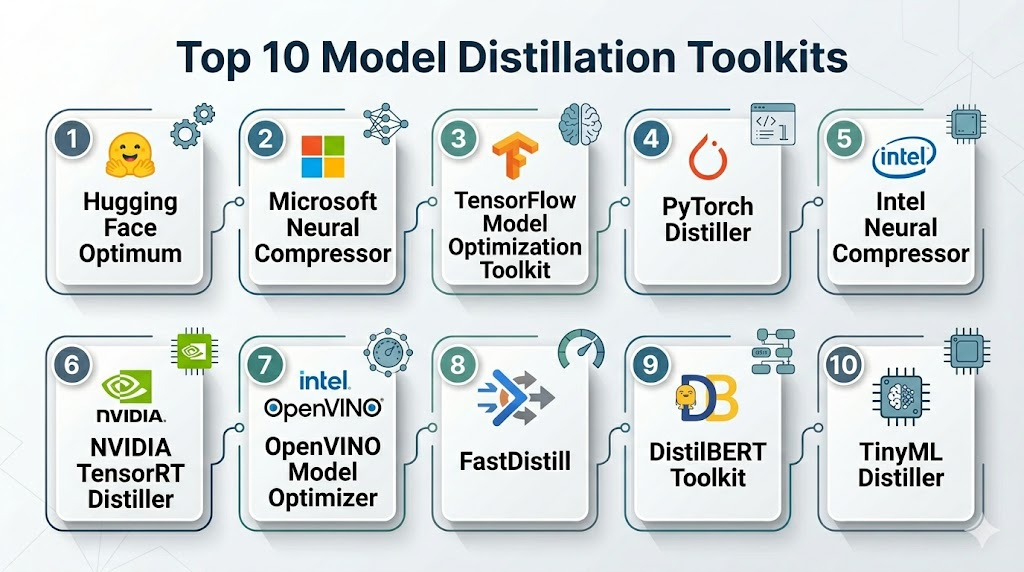
Top 10 Model Distillation Toolkits
1- Hugging Face Optimum
One-line verdict: Best for developers needing a streamlined framework for transformer model distillation with hardware acceleration.
Short description: Provides tools for PyTorch and ONNX-based distillation of transformer models, with optimization for GPU and edge deployment.
Standout Capabilities
- Supports transformer and multi-modal models
- ONNX export for optimized deployment
- GPU and CPU acceleration
- Evaluation metrics for student fidelity
- Pipeline integration for fine-tuning and hyperparameter tuning
- Documentation and examples for popular NLP models
AI-Specific Depth
- Model support: Transformers, PyTorch, ONNX
- RAG / knowledge integration: Varies / N/A
- Evaluation: Accuracy tests, benchmark datasets
- Guardrails: Varies / N/A
- Observability: Speed, memory usage, accuracy
Pros
- Hardware acceleration
- Easy integration with Hugging Face models
- Well-documented and community-supported
Cons
- Focused on transformers
- Limited CNN support
- Edge device tuning requires manual adjustments
Security & Compliance
- Varies / N/A
Deployment & Platforms
- Linux, macOS, Windows
- Cloud and edge deployment
Integrations & Ecosystem
- Python API, ONNX export
- Integrates with Hugging Face Datasets
- Supports PyTorch and TorchScript
- Hyperparameter tuning pipelines
Pricing Model
- Open-source free, enterprise support optional
Best-Fit Scenarios
- NLP model compression
- Edge deployment of transformer models
- Fine-tuning optimized student models
2- Microsoft Neural Compressor
One-line verdict: Ideal for enterprises needing quantization and distillation tools across PyTorch and TensorFlow models.
Short description: Optimizes model size and inference speed using quantization, pruning, and knowledge distillation for multiple model types.
Standout Capabilities
- Model quantization and pruning
- Distillation with logits, features, attention
- Multi-framework support (PyTorch, TensorFlow)
- Hardware-aware optimization for CPU, GPU, FPGA
- Performance benchmarking and evaluation pipelines
AI-Specific Depth
- Model support: Transformers, CNNs, PyTorch, TensorFlow
- RAG / knowledge integration: Varies / N/A
- Evaluation: Regression and accuracy testing
- Guardrails: Varies / N/A
- Observability: Latency, memory, throughput
Pros
- Supports diverse architectures
- Hardware-aware optimization
- Enterprise-ready evaluation pipelines
Cons
- Setup complexity for beginners
- Requires tuning for edge devices
- Limited multi-modal examples
Security & Compliance
- Varies / N/A
Deployment & Platforms
- Linux, Windows
- Cloud, on-prem, edge
Integrations & Ecosystem
- Python API
- ONNX, TorchScript export
- Hardware backend tuning
- Benchmarking integration
Pricing Model
- Open-source, enterprise support optional
Best-Fit Scenarios
- Enterprise deployment
- CPU/GPU optimization
- Multi-architecture distillation
3- TensorFlow Model Optimization Toolkit
One-line verdict: Developer-friendly framework for TensorFlow models with quantization and distillation features.
Short description: Provides TensorFlow-native APIs for pruning, quantization, and distillation to create smaller and faster models for inference.
Standout Capabilities
- Post-training quantization
- Pruning and clustering for compression
- Distillation support for teacher-student models
- TensorFlow Lite export for mobile/edge deployment
- Evaluation metrics for student fidelity
AI-Specific Depth
- Model support: TensorFlow, Keras, CNNs, Transformers
- RAG / knowledge integration: Varies / N/A
- Evaluation: Accuracy and regression tests
- Guardrails: Varies / N/A
- Observability: Latency and memory profiling
Pros
- Native TensorFlow integration
- Edge deployment ready
- Supports multiple model compression strategies
Cons
- Limited PyTorch support
- May require manual tuning for large transformers
- Multi-modal distillation requires custom pipelines
Security & Compliance
- Varies / N/A
Deployment & Platforms
- Linux, macOS, Windows
- Cloud, mobile, edge
Integrations & Ecosystem
- TensorFlow Lite, TensorFlow Hub
- Python API
- Evaluation and profiling tools
- Hyperparameter tuning
Pricing Model
- Open-source free
Best-Fit Scenarios
- TensorFlow model optimization
- Mobile/edge deployment
- Student model generation
4- PyTorch Distiller
One-line verdict: Best for PyTorch developers seeking pruning, quantization, and distillation frameworks with fine-grained control.
Short description: Python toolkit for PyTorch that supports model compression, structured pruning, and knowledge distillation.
Standout Capabilities
- Structured and unstructured pruning
- Quantization-aware training
- Knowledge distillation pipelines
- Integration with PyTorch Lightning
- Evaluation and metric tracking
AI-Specific Depth
- Model support: PyTorch, CNNs, Transformers
- RAG / knowledge integration: Varies / N/A
- Evaluation: Regression and accuracy testing
- Guardrails: Varies / N/A
- Observability: Memory and speed profiling
Pros
- Fine-grained control over compression
- Easy PyTorch integration
- Supports student-teacher pipelines
Cons
- Limited TensorFlow support
- Requires ML expertise
- Hardware optimization manual
Security & Compliance
- Varies / N/A
Deployment & Platforms
- Linux, macOS, Windows
- Cloud and edge
Integrations & Ecosystem
- Python API
- PyTorch Lightning
- ONNX export
- Evaluation pipelines
Pricing Model
- Open-source free
Best-Fit Scenarios
- PyTorch model compression
- Custom distillation pipelines
- Edge deployment optimization
5- Intel Neural Compressor
One-line verdict: Enterprise-ready toolkit for quantization and distillation targeting CPU and GPU acceleration.
Short description: Focused on performance optimization for deep learning models with hardware-aware compression and knowledge transfer.
Standout Capabilities
- CPU/GPU optimization
- Quantization and distillation
- Multi-framework support (PyTorch, TensorFlow)
- Benchmarking and evaluation pipelines
- Edge and on-device deployment
AI-Specific Depth
- Model support: CNNs, Transformers, PyTorch, TensorFlow
- RAG / knowledge integration: Varies / N/A
- Evaluation: Regression, accuracy tests
- Guardrails: Varies / N/A
- Observability: Latency and memory metrics
Pros
- Hardware-aware optimization
- Multi-framework support
- Enterprise-friendly pipelines
Cons
- Requires tuning for edge devices
- Setup complexity
- Multi-modal distillation limited
Security & Compliance
- Varies / N/A
Deployment & Platforms
- Linux, Windows
- Cloud, on-prem, edge
Integrations & Ecosystem
- ONNX, PyTorch, TensorFlow
- Python API
- Benchmarking tools
Pricing Model
- Open-source free, enterprise optional
Best-Fit Scenarios
- CPU/GPU model optimization
- Enterprise model deployment
- On-device AI acceleration
6- NVIDIA TensorRT Distiller
One-line verdict: GPU-optimized toolkit for deep learning model compression and inference acceleration.
Short description: Provides distillation, pruning, and optimization pipelines for NVIDIA GPU deployment, supporting PyTorch and TensorRT.
Standout Capabilities
- GPU-accelerated distillation
- Quantization and pruning
- TensorRT integration
- Student-teacher pipelines
- Performance benchmarking
AI-Specific Depth
- Model support: Transformers, CNNs, PyTorch
- RAG / knowledge integration: Varies / N/A
- Evaluation: Regression and accuracy testing
- Guardrails: Varies / N/A
- Observability: GPU utilization, memory, latency
Pros
- GPU-optimized
- Supports PyTorch models
- High-performance inference
Cons
- NVIDIA hardware only
- Limited multi-framework support
- Edge deployment requires conversion
Security & Compliance
- Varies / N/A
Deployment & Platforms
- Linux, Windows
- GPU/cloud
Integrations & Ecosystem
- Python SDK
- PyTorch, TensorRT
- Benchmarking tools
Pricing Model
- Open-source free
Best-Fit Scenarios
- GPU model compression
- High-performance inference
- PyTorch student-teacher pipelines
7- OpenVINO Model Optimizer
One-line verdict: Ideal for edge and IoT deployment with compressed deep learning models.
Short description: Intel toolkit for model optimization, distillation, and deployment across CPUs, VPUs, and GPUs.
Standout Capabilities
- Edge deployment support
- Model quantization and compression
- Student-teacher knowledge transfer
- Multi-framework support
- Benchmarking and evaluation
AI-Specific Depth
- Model support: CNNs, Transformers, PyTorch, TensorFlow
- RAG / knowledge integration: Varies / N/A
- Evaluation: Accuracy benchmarking
- Guardrails: Varies / N/A
- Observability: Performance metrics
Pros
- Edge-focused
- Multi-framework support
- Optimized for Intel hardware
Cons
- Requires hardware alignment
- Limited multi-modal support
- Learning curve for distillation
Security & Compliance
- Varies / N/A
Deployment & Platforms
- Linux, Windows
- Edge, CPU/GPU
Integrations & Ecosystem
- Python API
- ONNX support
- Edge pipelines
Pricing Model
- Open-source free
Best-Fit Scenarios
- IoT deployment
- Edge AI optimization
- Compressed CNN inference
8- FastDistill
One-line verdict: Developer-friendly Python toolkit for fast knowledge distillation across PyTorch models.
Short description: Offers lightweight student-teacher distillation, focusing on speed and simplicity for NLP and vision models.
Standout Capabilities
- Lightweight Python integration
- Multi-architecture support (CNNs, Transformers)
- Knowledge distillation pipelines
- Simple evaluation scripts
- GPU/CPU acceleration
AI-Specific Depth
- Model support: PyTorch, Transformers, CNNs
- RAG / knowledge integration: Varies / N/A
- Evaluation: Regression and accuracy testing
- Guardrails: Varies / N/A
- Observability: Latency, memory usage
Pros
- Fast and lightweight
- Easy setup for developers
- Flexible for multiple architectures
Cons
- Limited enterprise features
- Edge deployment manual
- Multi-modal pipelines limited
Security & Compliance
- Varies / N/A
Deployment & Platforms
- Linux, Windows
- Cloud or on-prem
Integrations & Ecosystem
- Python API
- PyTorch pipelines
- Evaluation tools
Pricing Model
- Open-source free
Best-Fit Scenarios
- Developer experimentation
- Fast NLP/vision distillation
- Student model benchmarking
9- DistilBERT Toolkit
One-line verdict: Optimized for NLP transformer distillation with student-teacher pipelines.
Short description: Focused on reducing transformer model size while preserving performance for NLP tasks.
Standout Capabilities
- Transformer-specific distillation
- Student-teacher pipeline
- Evaluation and regression tests
- ONNX export
- Edge and server deployment
AI-Specific Depth
- Model support: Transformers (BERT family)
- RAG / knowledge integration: Varies / N/A
- Evaluation: Accuracy tests, benchmark datasets
- Guardrails: Varies / N/A
- Observability: Latency, memory, token usage
Pros
- NLP-optimized
- Lightweight student models
- Prebuilt evaluation scripts
Cons
- Limited vision support
- Cloud-specific optimizations manual
- Transformer-only focus
Security & Compliance
- Varies / N/A
Deployment & Platforms
- Linux, macOS, Windows
- Cloud or edge
Integrations & Ecosystem
- Python API, ONNX export
- Hugging Face integration
Pricing Model
- Open-source free
Best-Fit Scenarios
- NLP model compression
- Chatbot inference
- Student transformer deployment
10- TinyML Distiller
One-line verdict: Best for edge-focused, low-power model deployment with compression and distillation.
Short description: Lightweight framework for distilling models for IoT, mobile, and constrained hardware devices.
Standout Capabilities
- Edge and IoT deployment
- Compression and distillation pipelines
- Quantization support
- Lightweight inference
- Student-teacher knowledge transfer
AI-Specific Depth
- Model support: CNNs, Transformers, PyTorch
- RAG / knowledge integration: Varies / N/A
- Evaluation: Accuracy testing on edge hardware
- Guardrails: Varies / N/A
- Observability: Latency and memory
Pros
- Optimized for low-power devices
- Lightweight deployment
- Supports multiple model types
Cons
- Limited multi-framework support
- Manual tuning for student models
- Minimal enterprise features
Security & Compliance
- Varies / N/A
Deployment & Platforms
- Linux, Windows, ARM devices
- Edge, embedded hardware
Integrations & Ecosystem
- Python API
- Edge inference libraries
- Benchmarking scripts
Pricing Model
- Open-source free
Best-Fit Scenarios
- IoT device AI
- Mobile deployment
- Low-power edge inference
Comparison Table
| Tool Name | Best For | Deployment | Model Flexibility | Strength | Watch-Out | Public Rating |
|---|---|---|---|---|---|---|
| Hugging Face Optimum | Transformer Devs | Cloud/Edge | Transformers, PyTorch, ONNX | Multi-platform acceleration | CNN limited | N/A |
| Microsoft Neural Compressor | Enterprise | Cloud/Edge | PyTorch, TF, CNNs, Transformers | Hardware-aware optimization | Setup complexity | N/A |
| TensorFlow Model Optimization Toolkit | TF Developers | Cloud/Edge | TF, CNNs, Transformers | Native TensorFlow support | Limited PyTorch | N/A |
| PyTorch Distiller | PyTorch Devs | Cloud/Self-hosted | CNNs, Transformers | Fine-grained control | Enterprise features limited | N/A |
| Intel Neural Compressor | Enterprise | Cloud/Edge | CNNs, Transformers | CPU/GPU optimization | Multi-modal limited | N/A |
| NVIDIA TensorRT Distiller | GPU AI | Cloud | PyTorch, Transformers | GPU-optimized | NVIDIA hardware only | N/A |
| OpenVINO Model Optimizer | Edge AI | Cloud/Edge | CNNs, Transformers | Optimized for Intel hardware | Hardware alignment | N/A |
| FastDistill | Developers | Cloud/Self-hosted | CNNs, Transformers | Lightweight & fast | Enterprise features limited | N/A |
| DistilBERT Toolkit | NLP Devs | Cloud/Edge | Transformers | Optimized NLP distillation | Transformer-only | N/A |
| TinyML Distiller | Edge/IoT | Edge/Embedded | CNNs, Transformers | Low-power deployment | Enterprise features limited | N/A |
Scoring & Evaluation
| Tool | Core | Reliability/Eval | Guardrails | Integrations | Ease | Perf/Cost | Security/Admin | Support | Weighted Total |
|---|---|---|---|---|---|---|---|---|---|
| Hugging Face Optimum | 9 | 8 | 7 | 8 | 9 | 8 | 7 | 8 | 8.1 |
| Microsoft Neural Compressor | 8 | 8 | 7 | 8 | 7 | 9 | 7 | 7 | 7.8 |
| TensorFlow Model Optimization Toolkit | 8 | 7 | 7 | 8 | 8 | 8 | 7 | 7 | 7.6 |
| PyTorch Distiller | 8 | 7 | 6 | 7 | 8 | 7 | 6 | 7 | 7.1 |
| Intel Neural Compressor | 7 | 7 | 6 | 7 | 7 | 8 | 7 | 7 | 7.1 |
| NVIDIA TensorRT Distiller | 8 | 8 | 7 | 7 | 7 | 9 | 6 | 7 | 7.5 |
| OpenVINO Model Optimizer | 7 | 7 | 6 | 7 | 7 | 8 | 6 | 7 | 7.0 |
| FastDistill | 7 | 6 | 6 | 6 | 8 | 7 | 6 | 6 | 6.7 |
| DistilBERT Toolkit | 8 | 7 | 6 | 7 | 8 | 7 | 6 | 7 | 7.1 |
| TinyML Distiller | 7 | 6 | 6 | 6 | 7 | 8 | 6 | 6 | 6.7 |
Top 3 for Enterprise: Hugging Face Optimum, Microsoft Neural Compressor, NVIDIA TensorRT Distiller
Top 3 for SMB: TensorFlow Model Optimization Toolkit, Intel Neural Compressor, PyTorch Distiller
Top 3 for Developers: FastDistill, DistilBERT Toolkit, TinyML Distiller
Which Model Distillation Toolkit Is Right for You?
Solo / Freelancer
Open-source toolkits like FastDistill or Hugging Face Optimum are ideal for experimentation, small-scale projects, or NLP-focused distillation.
SMB
TensorFlow Model Optimization Toolkit, Intel Neural Compressor, and PyTorch Distiller provide reliable performance while keeping costs manageable.
Mid-Market
Hugging Face Optimum or NVIDIA TensorRT Distiller support larger pipelines, multi-modal models, and distributed training.
Enterprise
Microsoft Neural Compressor, NVIDIA TensorRT, or OpenVINO Model Optimizer provide hardware-aware optimization, monitoring, and scalable deployment pipelines.
Regulated industries
Toolkits with observability dashboards, evaluation pipelines, and validated student-teacher workflows reduce compliance and audit risk.
Budget vs premium
Open-source frameworks reduce costs but require internal expertise. Enterprise-optimized toolkits add evaluation pipelines, monitoring, and hardware integration.
Build vs buy
DIY with open-source is suitable for research or small deployments. Enterprise-managed toolkits offer operational efficiency, support, and compliance assurances.
Implementation Playbook
- 30 Days: Select pilot model, configure distillation pipeline, measure baseline accuracy and speed, test student-teacher setup.
- 60 Days: Optimize student model using quantization/pruning, integrate evaluation and benchmark tests, validate edge and cloud deployment.
- 90 Days: Scale pipelines to multiple models or multi-modal data, monitor latency, memory, and throughput, and finalize deployment for production or edge devices.
Common Mistakes & How to Avoid Them
- Ignoring accuracy trade-offs between teacher and student models.
- Skipping evaluation pipelines after distillation.
- Deploying compressed models without testing edge latency or memory.
- Overlooking GPU/TPU optimization during training.
- Using default hyperparameters without tuning.
- Deploying multi-modal models without proper input alignment.
- Ignoring observability of inference speed and memory footprint.
- Assuming smaller student models automatically perform well in all tasks.
- Neglecting reproducibility in distillation experiments.
- Over-quantization causing accuracy degradation.
- Poor versioning of student models.
- Lack of documentation for reproducibility.
- Not validating RAG or knowledge integration with distilled models.
- Ignoring community or ecosystem best practices.
FAQs
1- What is model distillation?
Model distillation is the process of transferring knowledge from a large “teacher” model to a smaller “student” model to improve inference efficiency while retaining accuracy.
2- Can distillation reduce inference costs?
Yes, student models are smaller and faster, reducing compute requirements, energy consumption, and latency.
3- Which architectures are supported?
Most toolkits support transformers, CNNs, and sometimes RNNs; multi-modal support varies per toolkit.
4- Are these toolkits open-source?
Many, like Hugging Face Optimum, PyTorch Distiller, and TensorFlow Model Optimization Toolkit, are open-source; some enterprise toolkits have paid versions.
5- Can I deploy models on edge devices?
Yes, toolkits like TinyML Distiller, OpenVINO, and TensorFlow Lite export models optimized for edge deployment.
6- How do I evaluate distilled models?
Evaluation uses accuracy benchmarks, regression testing, and comparison against the teacher model using student metrics.
7- Are multi-modal models supported?
Some toolkits, like Hugging Face Optimum and NVIDIA TensorRT, support multi-modal inputs; others focus on NLP or vision only.
8- Can I combine quantization and distillation?
Yes, many toolkits allow quantization-aware distillation to further reduce model size and improve speed.
9- How do I monitor performance after deployment?
Observability dashboards track latency, throughput, memory usage, and accuracy metrics in production or edge devices.
10- Are hardware accelerators required?
Not always, but GPU/TPU acceleration improves training and distillation efficiency significantly.
11- Can these toolkits integrate with RAG pipelines?
Yes, most Python-based toolkits allow vector DB or knowledge base integration, though some require custom wrappers.
12- How do I ensure compliance with enterprise standards?
Select enterprise-ready toolkits that include evaluation pipelines, reproducibility, logging, and monitoring features.
Conclusion
Model Distillation Toolkits help AI teams compress and optimize large models while maintaining high performance. Choosing the right toolkit depends on deployment needs, model architecture, and infrastructure requirements. Open-source solutions are ideal for experimentation, whereas enterprise-optimized toolkits offer performance tuning, monitoring, and hardware-aware optimization.
Beyond model size reduction, teams should also consider the maintenance burden of distillation pipelines. Managing teacher models, training datasets, and periodic re-distillation cycles can become a significant long-term engineering commitment.