Introduction
Multimodal Model Platforms are AI solutions that allow organizations to process, analyze, and generate content across multiple data types—such as text, images, audio, and video—within a unified environment. Unlike single-modality models, these platforms integrate diverse inputs, enabling richer AI applications, more accurate outputs, and complex workflow automation.
Why it matters now: In 2026+, enterprises increasingly rely on AI that can handle multimodal data for research, content creation, analytics, and immersive experiences. Platforms that combine multiple modalities streamline development, reduce operational complexity, and provide advanced insights across business processes.
Real World Use Cases
- AI-powered content creation combining text, images, and video.
- Cross-modal search engines integrating text, images, and audio.
- Customer support systems interpreting voice, text, and visual inputs.
- Multimodal RAG workflows combining document analysis with image/video retrieval.
- Marketing and social media analytics using audio, visual, and text signals.
- Autonomous AI agents performing decision-making across multiple data streams.
Evaluation Criteria for Buyers
- Supported modalities: text, images, audio, video
- Model flexibility: hosted, BYO, hybrid or open-source
- Latency and throughput across modalities
- Guardrails and security across multiple inputs
- Data privacy, residency, and retention policies
- Observability, tracing, and logging
- RAG / knowledge integration for multimodal workflows
- Scalability across enterprise use cases
- Integration with existing pipelines and APIs
- Cost and resource efficiency
- Developer tooling and SDK support
- Vendor lock-in and flexibility
Best for: AI engineers, product teams, CTOs, and enterprises needing multimodal intelligence for marketing, analytics, research, or AI agents.
Not ideal for: Teams with minimal multimodal use cases or those only processing single-modality data where simpler AI APIs are sufficient.
What’s Changed in Multimodal Model Platforms in
- Unified architectures handling text, image, audio, and video inputs.
- Agentic workflows performing multi-step, multimodal tasks.
- Evaluation frameworks measuring hallucinations, reliability, and cross-modal accuracy.
- Guardrails across multiple modalities to prevent unsafe outputs.
- Enterprise privacy, data residency, and retention controls.
- Cost and latency optimization via dynamic model routing for each modality.
- Observability dashboards covering tokens, embeddings, and multimodal metrics.
- Integration with RAG workflows and vector databases.
- BYO model hosting and fine-tuning for each modality.
- Hybrid cloud and edge deployment for latency-sensitive multimodal inference.
- Expanded SDKs, APIs, and workflow plug-ins for developers.
Quick Buyer Checklist
- ✅ Multi-modality support: text, image, audio, video
- ✅ Hosted, BYO, or open-source model flexibility
- ✅ Guardrails and content moderation across modalities
- ✅ Evaluation frameworks for hallucinations and cross-modal reliability
- ✅ RAG/knowledge integration for multimodal retrieval
- ✅ Observability: latency, token, embedding, cost metrics
- ✅ Data privacy and retention policies
- ✅ Deployment flexibility: cloud, hybrid, on-prem
- ✅ Cost and performance monitoring
- ✅ Developer tooling: APIs, SDKs, CLI
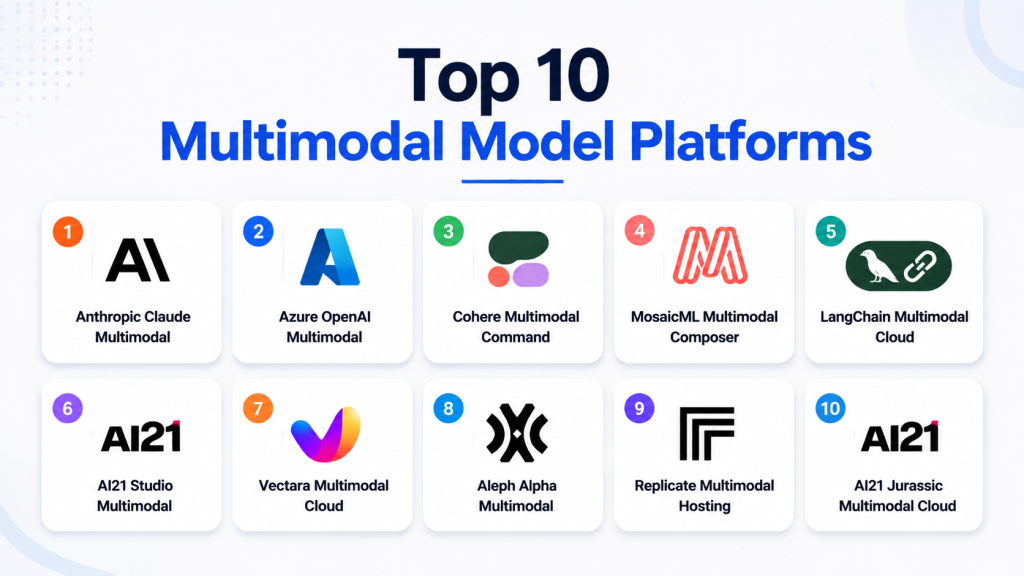
Top 10 Multimodal Model Platforms
1- Anthropic Claude Multimodal
One-line verdict: Enterprise-grade platform for secure, multimodal AI applications across text, image, and audio.
Short description: Provides hosting for Claude multimodal models with strong safety, guardrails, and cross-modal integration.
Key Features
- Multi-turn multimodal conversation support
- Text, image, and audio inputs
- Agentic workflow orchestration
- Enterprise SLA and uptime guarantees
- Built-in evaluation for hallucinations
- Prompt injection defenses
- Observability dashboards
Pros
- Strong enterprise safety focus
- Built-in multimodal guardrails
- Reliable SLA and uptime
Cons
- Multimodal features still experimental
- Limited open-source support
- Pricing not publicly stated
Platforms / Deployment
- Cloud, Web
Security & Compliance
- SSO/SAML, RBAC, encryption, audit logs; Certifications: Not publicly stated
Integrations & Ecosystem
- Python/Node SDKs, workflow connectors, vector DBs
Support & Community
- Enterprise support and documentation
2- Azure OpenAI Multimodal
One-line verdict: Developers and SMBs benefit from hosted multimodal GPT models with Azure integration.
Short description: Supports text, images, and audio via GPT-4 Turbo and integrates into enterprise workflows on Azure.
Key Features
- Multimodal GPT hosting
- Fine-tuning for multimodal data
- Enterprise authentication and audit logs
- RAG integration for multimodal content
- Cost and usage dashboards
Pros
- Azure integration
- Auto-scaling for enterprise workloads
- Strong compliance features
Cons
- Dependent on Azure ecosystem
- Fine-tuning may incur latency
- Costs can escalate
Platforms / Deployment
- Cloud, Web/API
Security & Compliance
- SOC 2, ISO 27001, HIPAA; RBAC, encryption, audit logs
Integrations & Ecosystem
- Azure SDKs, vector DBs, workflow connectors
Support & Community
- Microsoft enterprise support
3- Cohere Multimodal Command
One-line verdict: Developer-focused platform for multimodal NLP, embeddings, and RAG applications.
Short description: Hosts proprietary LLMs optimized for text, image, and audio generation with vector integration.
Key Features
- Embeddings for multimodal data
- Fine-tuning across modalities
- API-first development
- RAG workflow support
- Observability dashboards
Pros
- Developer-friendly
- Efficient for multimodal RAG
- Flexible scaling
Cons
- Enterprise compliance limited
- GUI limited
- Multimodal experimental
Platforms / Deployment
- Cloud, Web/API
Security & Compliance
- SSO/RBAC, Not publicly stated
Integrations & Ecosystem
- Python/Node SDKs, vector DBs, workflow automation
Support & Community
- Documentation and API support
4- MosaicML Multimodal Composer
One-line verdict: Research and enterprise hosting for fine-tuned multimodal models on GPU clusters.
Short description: Enables orchestration and deployment of open-source multimodal LLMs with cost and latency optimization.
Key Features
- GPU-optimized multimodal training
- Text, image, audio support
- Open-source model hosting
- Observability dashboards
- Guardrails for safety
Pros
- Flexible open-source hosting
- GPU efficiency
- Strong observability
Cons
- Requires ML expertise
- Limited enterprise SaaS integrations
- Complex deployment
Platforms / Deployment
- Cloud/on-prem GPU clusters, Linux/Windows
Security & Compliance
- Varies / N/A
Integrations & Ecosystem
- Python SDK, ML pipelines, data connectors
Support & Community
- Enterprise-level support
5- LangChain Multimodal Cloud
One-line verdict: Developer-friendly RAG platform with multimodal input orchestration.
Short description: Supports pipelines integrating text, images, and audio with retrieval workflows.
Key Features
- Multimodal RAG pipelines
- Agentic workflow orchestration
- Multi-model routing
- Observability dashboards
- Guardrails for prompts
Pros
- Developer-focused
- Excellent for multimodal RAG
- Cloud simplicity
Cons
- Limited enterprise features
- Dependent on LangChain framework
- Multimodal still maturing
Platforms / Deployment
- Cloud, Web/API
Security & Compliance
- Not publicly stated
Integrations & Ecosystem
- Python SDK, vector DBs, workflow connectors
Support & Community
- Active developer forums
6- AI21 Studio Multimodal
One-line verdict: NLP and multimodal platform for text, image, and audio applications.
Short description: Hosts AI21 LLMs with multimodal embeddings, RAG, and semantic search support.
Key Features
- Text, image, audio generation
- Fine-tuning across modalities
- RAG-ready
- Observability dashboards
- Multi-language support
Pros
- Multi-language capabilities
- Developer-friendly
- Embeddings & RAG-ready
Cons
- Enterprise compliance limited
- Multimodal still experimental
- Pricing varies
Platforms / Deployment
- Cloud, Web/API
Security & Compliance
- SSO/RBAC, Not publicly stated
Integrations & Ecosystem
- SDKs, APIs, vector DB connectors
Support & Community
- Developer support
7- Vectara Multimodal Cloud
One-line verdict: Optimized for multimodal RAG and semantic search applications.
Short description: Hosts LLMs for text, image, audio retrieval and vector-based RAG pipelines.
Key Features
- Vector-based multimodal retrieval
- Multi-model routing
- Observability dashboards
- API-first for developers
- Cost/latency monitoring
Pros
- Optimized for RAG
- Strong search capabilities
- Scalable APIs
Cons
- Limited general NLP
- Enterprise features limited
- Pricing not publicly stated
Platforms / Deployment
- Cloud, API
Security & Compliance
- Not publicly stated
Integrations & Ecosystem
- Python SDK, REST API, vector DBs
Support & Community
- Developer channels
8- Aleph Alpha Multimodal
One-line verdict: European platform with privacy-focused multimodal support.
Short description: Hosts text, image, and audio models with enterprise governance and multilingual capabilities.
Key Features
- Multilingual multimodal generation
- Privacy-focused hosting
- Fine-tuning options
- RAG integration
- Observability dashboards
Pros
- Privacy & compliance focus
- Multilingual support
- Enterprise-ready
Cons
- Cloud-only
- Multimodal still experimental
- Pricing varies
Platforms / Deployment
- Cloud, Web/API
Security & Compliance
- SSO/RBAC, encryption; Not publicly stated
Integrations & Ecosystem
- SDKs, APIs, vector DB connectors
Support & Community
- Enterprise support
9- Replicate Multimodal Hosting
One-line verdict: Developer-focused platform for open-source multimodal experimentation.
Short description: Provides hosting for text, image, and audio models without managing infrastructure.
Key Features
- One-click hosting
- Open-source model support
- Observability dashboards
- API-first design
- Guardrails minimal
Pros
- Developer-friendly
- Open-source hosting
- Quick setup
Cons
- Enterprise features limited
- Guardrails minimal
- Scaling requires planning
Platforms / Deployment
- Cloud, Web/API
Security & Compliance
- Not publicly stated
Integrations & Ecosystem
- APIs, Python SDKs, open-source connectors
Support & Community
- Developer support
10- AI21 Jurassic Multimodal Cloud
One-line verdict: High-quality multimodal NLP platform for text, image, and audio workflows.
Short description: Hosts Jurassic models for multimodal text generation, embeddings, and RAG pipelines.
Key Features
- Text, image, audio generation
- Semantic embeddings
- Multi-language support
- Fine-tuning options
- Observability dashboards
Pros
- High-quality outputs
- Embeddings & RAG-ready
- Multi-language support
Cons
- Enterprise integration limited
- Multimodal still maturing
- Pricing not publicly stated
Platforms / Deployment
- Cloud, Web/API
Security & Compliance
- Not publicly stated
Integrations & Ecosystem
- Python SDK, REST API, vector DB connectors
Support & Community
- Developer support
Comparison Table
| Tool Name | Best For | Deployment | Model Flexibility | Strength | Watch-Out | Public Rating |
|---|---|---|---|---|---|---|
| Claude Multimodal | Enterprise safety | Cloud | Proprietary | Safety & guardrails | Experimental multimodal | N/A |
| Azure OpenAI Multimodal | Developers & SMB | Cloud | Hosted GPT | Azure integration | Azure dependency | N/A |
| Cohere Multimodal | NLP devs | Cloud | Proprietary/BYO | RAG & embeddings | GUI limited | N/A |
| MosaicML Multimodal | Research teams | Cloud/on-prem | Open-source/BYO | Fine-tuning | Requires expertise | N/A |
| LangChain Multimodal | Developers | Cloud | Hosted/BYO | RAG orchestration | Limited enterprise features | N/A |
| AI21 Studio Multimodal | NLP devs | Cloud | Proprietary | Text generation | Compliance limited | N/A |
| Vectara Multimodal | Semantic search | Cloud | Hosted | RAG optimization | General NLP limited | N/A |
| Aleph Alpha Multimodal | Privacy-focused | Cloud | Proprietary | Multilingual & privacy | Cloud-only | N/A |
| Replicate Multimodal | Dev experimentation | Cloud | Open-source | Open-source hosting | Minimal guardrails | N/A |
| Jurassic Multimodal | NLP apps | Cloud | Proprietary | High-quality outputs | Enterprise integration limited | N/A |
Weighted Scoring Table
| Tool | Core | Reliability/Eval | Guardrails | Integrations | Ease | Perf/Cost | Security/Admin | Support | Weighted Total |
|---|---|---|---|---|---|---|---|---|---|
| Claude | 9 | 9 | 9 | 8 | 7 | 8 | 8 | 7 | 8.5 |
| Azure OpenAI | 8 | 8 | 8 | 9 | 9 | 8 | 9 | 8 | 8.5 |
| Cohere | 8 | 8 | 7 | 8 | 8 | 7 | 7 | 7 | 7.7 |
| MosaicML | 7 | 7 | 7 | 7 | 6 | 8 | 6 | 6 | 6.9 |
| LangChain | 8 | 7 | 7 | 8 | 8 | 7 | 6 | 7 | 7.4 |
| AI21 Studio | 7 | 7 | 7 | 7 | 7 | 7 | 6 | 6 | 6.9 |
| Vectara | 7 | 6 | 6 | 7 | 7 | 7 | 6 | 6 | 6.6 |
| Aleph Alpha | 7 | 6 | 7 | 6 | 7 | 6 | 6 | 6 | 6.5 |
| Replicate | 6 | 6 | 5 | 6 | 8 | 6 | 5 | 6 | 6.0 |
| Jurassic | 7 | 6 | 6 | 6 | 7 | 6 | 6 | 6 | 6.5 |
Top 3 for Enterprise: Claude, Azure OpenAI, MosaicML
Top 3 for SMB: Azure OpenAI, LangChain, Cohere
Top 3 for Developers: Cohere, LangChain, Replicate
Which Multimodal Platform Is Right for You?
Solo / Freelancer: Cloud APIs like Azure OpenAI, Cohere, Replicate for experimentation.
SMB: Cost-efficient platforms with RAG support: LangChain, Azure OpenAI, Cohere.
Mid-Market: Governance and integration: Claude, MosaicML, LangChain.
Enterprise: Security, hybrid deployment, compliance: Claude, MosaicML, Aleph Alpha.
Regulated industries: Privacy, guardrails, observability: Claude, Aleph Alpha, Azure OpenAI.
Budget vs Premium: Budget: Replicate, Cohere; Premium: Claude, MosaicML.
Build vs Buy: DIY for open-source experimentation; Buy for enterprise-ready platforms.
Implementation Playbook (30/60/90 Days)
- 30 days: Pilot platform, evaluate guardrails, measure latency, define success metrics
- 60 days: Harden security, integrate RAG pipelines, set observability dashboards
- 90 days: Optimize cost, multi-model routing, governance policies, scale across teams
Common Mistakes & How to Avoid Them
- Prompt injection exposure
- No evaluation or reliability testing
- Unmanaged data retention
- Observability gaps
- Cost surprises
- Over-automation without human review
- Vendor lock-in without abstraction
- Ignoring latency optimization
- Missing hybrid deployment planning
- Using single-modality models only
- Insufficient guardrails for regulated data
FAQs
1- Do these platforms support text, image, and audio?
Yes, most support text, images, and audio; some also support video in experimental modes.
2- Can I use my own multimodal models?
BYO hosting is available on MosaicML, Cohere, and some cloud APIs; others remain proprietary.
3- Are RAG workflows supported?
Yes, LangChain, Vectara, and AI21 Studio support RAG pipelines across modalities.
4- How do guardrails work for multimodal inputs?
Guardrails validate inputs and prevent unsafe outputs across text, image, and audio.
5- How is latency managed across modalities?
Platforms optimize routing dynamically and provide observability dashboards for token, embedding, and modality metrics.
6- Are these platforms enterprise-ready?
Claude, MosaicML, Aleph Alpha, and Azure OpenAI provide enterprise-grade compliance, SLA, and hybrid options.
7- How is cost managed?
Token-based, usage-based, or tiered pricing; dashboards help control expenditure.
8- Do platforms provide SDKs and APIs?
Yes, Python/Node SDKs, REST APIs, and CLI tools are standard.
9- Can multiple models run concurrently?
Multi-model routing is supported on LangChain, Vectara, and Azure OpenAI.
10- Is fine-tuning possible?
Supported on Cohere, MosaicML, Azure OpenAI; Claude and some proprietary platforms do not allow fine-tuning.
Conclusion
Multimodal Model Platforms empower organizations to integrate text, image, audio, and video AI in a unified environment. Selecting the right platform depends on team size, workflow complexity, regulatory needs, and budget. Pilot the platform, evaluate guardrails, observability, and latency, and scale gradually. Enterprises prioritize compliance and hybrid deployment, SMBs leverage cloud APIs, and developers benefit from open-source experimentation.
The article provides a well-rounded overview of multimodal AI platforms, making it easier to understand how different solutions handle text, image, audio, and video workflows.