Introduction
In the current era of distributed systems, data has become the most critical asset for any enterprise, necessitating a specialized management approach. The CDOM – Certified DataOps Manager program is designed for engineers and leaders who want to move beyond traditional database management into high-velocity, automated data lifecycles. This guide provides a comprehensive roadmap for professionals looking to master the intersection of data engineering, cloud-native infrastructure, and operational excellence. By focusing on the principles of DataOps, individuals can drive better business outcomes and improve the reliability of their data platforms. To begin this journey, professionals can explore the official DataOps Certification provided by Dataopsschool, which serves as the primary technical host for these industry-recognized credentials.
What is the CDOM – Certified DataOps Manager?
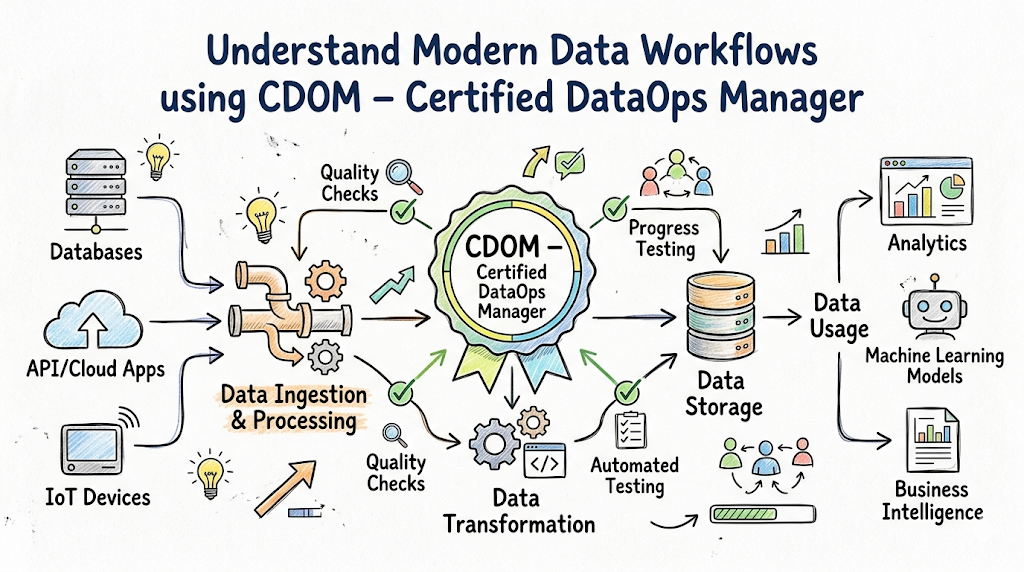
The CDOM – Certified DataOps Manager represents a shift in how organizations handle data pipelines, moving from manual, siloed processes to automated, collaborative workflows. It is a professional framework that emphasizes the use of agile methodologies and DevOps practices specifically tailored for the data domain. This certification exists to validate that a professional can manage the complexities of data quality, integration, and delivery at scale. It focuses on production-ready skills rather than just theoretical knowledge of data science or basic storage techniques.
By aligning with modern engineering workflows, the program ensures that data is treated with the same level of rigor as application code. It incorporates continuous integration and continuous delivery for data, ensuring that every change in the pipeline is tested and validated before it reaches production. For the modern enterprise, this means fewer data outages and a faster time-to-market for data-driven features. Professionals who hold this designation are equipped to lead teams that prioritize observability, reproducibility, and reliability in every stage of the data lifecycle.
Who Should Pursue CDOM – Certified DataOps Manager?
This program is specifically built for working professionals such as Data Engineers, DevOps Engineers, and Site Reliability Engineers who are responsible for the health of data platforms. It is also an excellent path for Cloud Architects and Platform Engineers who want to specialize in the operational side of data management. Beyond technical roles, Engineering Managers and technical leaders will find immense value in the strategic frameworks provided by the certification. It bridges the gap between those who build the data and those who ensure it stays available and accurate.
Whether you are an experienced engineer looking to formalize your expertise or a beginner aiming for a structured learning path, this certification offers a clear progression. It is globally relevant as companies across the world struggle with data debt and pipeline inefficiencies, and it holds significant weight in the Indian tech sector where large-scale data migration projects are common. Professionals focused on security and finance will also benefit from the specialized tracks that integrate compliance and cost-optimization into the core DataOps methodology.
Why CDOM – Certified DataOps Manager is Valuable and Beyond
The demand for DataOps expertise is growing rapidly as organizations realize that traditional data management cannot keep up with the volume of modern cloud-native environments. This certification offers long-term career longevity because it focuses on core principles and human-centric processes that do not become obsolete with the next tool update. It provides a standard language and framework that allows professionals to communicate effectively across different departments, from development to operations to business leadership.
Enterprise adoption of DataOps is no longer optional for companies that rely on real-time analytics and machine learning. Holding this certification demonstrates a commitment to operational excellence and a proactive approach to solving complex data problems. The return on investment is clear: professionals gain the skills to reduce operational costs, minimize downtime, and lead high-performing teams. In a competitive job market, this credential serves as a powerful signal that you possess the advanced management skills necessary to navigate the future of data infrastructure.
CDOM – Certified DataOps Manager Certification Overview
The certification program is primarily delivered through the training modules available at the official curriculum site and is hosted by the institution mentioned in the introduction. The program is structured into clear levels of progression, starting from foundational concepts and moving toward advanced strategic management. Each level involves a comprehensive assessment process that combines technical exams with scenario-based questions to test real-world problem-solving abilities. Ownership of the certification resides with a body of industry experts who ensure the material remains at the cutting edge of modern engineering.
Practicality is a hallmark of this program, with a strong focus on how DataOps integrates with existing cloud providers and containerization technologies. Candidates are expected to demonstrate proficiency in managing automated pipelines and implementing proactive monitoring. The certification levels are designed to align with various career milestones, ensuring that the skills learned are immediately applicable to current roles. By providing a clear hierarchy of certifications, the program allows for continuous professional development over many years.
CDOM – Certified DataOps Manager Certification Tracks & Levels
The CDOM path is organized into three main levels: Foundation, Professional, and Advanced, alongside several specialized tracks. The Foundation level is designed to provide a broad understanding of the DataOps manifesto and basic automation principles. This level is perfect for those moving into the field or for non-technical stakeholders who need to understand how data operations impact the business. It sets the stage for more technical deep dives by establishing a common vocabulary and a shared set of operational goals.
The Professional level targets senior engineers and lead roles, focusing on the technical execution of automated testing, CI/CD for data, and environment management. This level is where candidates learn to build the actual infrastructure that supports a DataOps culture. The Advanced level, or the Manager track, focuses on the leadership and strategic aspects, such as team topology, governance, and financial accountability. This tiered approach ensures that every professional can find a entry point and a clear path forward regardless of their current level of seniority.
Complete CDOM – Certified DataOps Manager Certification Table
| Track | Level | Who it’s for | Prerequisites | Skills Covered | Recommended Order |
| Core DataOps | Foundation | Junior Engineers / PMs | Basic IT Knowledge | Agile, CI/CD, Data Flows | 1 |
| Infrastructure | Professional | Senior Data Engineers | Foundation Cert | Orchestration, Containers | 2 |
| Strategy | Advanced | Engineering Managers | Professional Cert | Governance, KPIs, Budgets | 3 |
| Security | Specialist | DevSecOps Engineers | Foundation Cert | Data Privacy, Compliance | 4 |
| Cost Control | Specialist | FinOps Practitioners | Foundation Cert | Cloud Cost, Optimization | 5 |
Detailed Guide for Each CDOM – Certified DataOps Manager Certification
CDOM – Foundation
What it is
The Foundation level validates a professional’s comprehension of the core tenets of the DataOps movement. It ensures a baseline understanding of how to reduce cycle times and improve data quality through collaboration and automation.
Who should take it
This is ideal for individuals new to data operations, including junior engineers, project managers, and business analysts who want to understand the modern data delivery lifecycle.
Skills you’ll gain
- Understanding the 19 principles of the DataOps Manifesto.
- Basic concepts of version control for data and configuration.
- Awareness of the different roles within a DataOps team.
Real-world projects you should be able to do
- Documentation of an existing data pipeline and identification of manual bottlenecks.
- Assisting in the implementation of basic automated quality checks.
Preparation plan
- 7 Days: Thoroughly read the DataOps Manifesto and core terminology.
- 30 Days: Participate in introductory workshops and online modules.
- 60 Days: Review case studies and take practice exams to solidify concepts.
Common mistakes
- Assuming DataOps is just a set of tools rather than a cultural change.
- Underestimating the importance of the collaborative aspect between teams.
Best next certification after this
- Same-track option: CDOM Professional
- Cross-track option: Cloud Practitioner
- Leadership option: Certified Scrum Master
CDOM – Professional
What it is
The Professional level is a technical certification that focuses on the practical implementation of DataOps workflows. It validates the ability to build, automate, and monitor complex data pipelines in a production environment.
Who should take it
This is designed for senior engineers, SREs, and architects who are responsible for the technical health and scalability of data platforms.
Skills you’ll gain
- Implementation of CI/CD pipelines for data using modern orchestration tools.
- Advanced automated testing for data quality and schema validation.
- Configuring observability and proactive alerting systems.
Real-world projects you should be able to do
- Building a self-healing pipeline that can handle data source interruptions.
- Automating the deployment of data environments using Infrastructure as Code.
Preparation plan
- 7 Days: Deep dive into specific orchestration tool syntax and logic.
- 30 Days: Build and document a multi-stage automated pipeline in a lab.
- 60 Days: Practice performance tuning and security hardening for pipelines.
Common mistakes
- Failing to account for data privacy requirements during automation.
- Building overly complex systems that are difficult for the rest of the team to maintain.
Best next certification after this
- Same-track option: CDOM Advanced
- Cross-track option: Kubernetes Administrator
- Leadership option: Technical Lead Certification
CDOM – Advanced (Manager)
What it is
The Advanced level validates the leadership and strategic skills required to manage a full-scale DataOps organization. It covers governance, financial management, and the human side of technical operations.
Who should take it
Current and aspiring managers, directors of data, and principal engineers who need to drive organizational-level changes and manage large budgets.
Skills you’ll gain
- Strategic planning for data infrastructure and team scaling.
- Implementing governance frameworks that align with compliance laws.
- Financial management and cloud cost optimization for data platforms.
Real-world projects you should be able to do
- Creating a multi-year DataOps roadmap for a medium to large enterprise.
- Leading a cross-functional team through a complex data platform migration.
Preparation plan
- 7 Days: Study organizational leadership theories and DataOps case studies.
- 30 Days: Develop a mock strategic plan including budgeting and KPI tracking.
- 60 Days: Engage in peer-to-peer mentoring and mock interviews for leadership roles.
Common mistakes
- Ignoring the technical debt when planning for new strategic initiatives.
- Failing to clearly communicate the business value of DataOps to executives.
Best next certification after this
- Same-track option: Data Ethics and Privacy Expert
- Cross-track option: Certified FinOps Professional
- Leadership option: Executive Leadership Program
Choose Your Learning Path
DevOps Path
This path focuses on merging the traditional software development lifecycle with data engineering practices. Professionals here work on ensuring that data changes are treated with the same rigor as code deployments. The primary goal is to build a seamless flow between the application and the data storage layers. It involves a heavy focus on version control, automated testing, and deployment strategies.
DevSecOps Path
The focus in this path is on the security and compliance of the data pipeline. It ensures that sensitive data is protected at every stage of the lifecycle without sacrificing the speed of delivery. Professionals learn to implement automated security checks and encryption standards within the automation framework. This path is essential for industries with high regulatory requirements like finance and healthcare.
SRE Path
Site Reliability Engineers in the DataOps world focus on the availability, latency, and performance of data platforms. They apply SRE concepts like Error Budgets and SLOs specifically to data pipelines to ensure consistent service. This path emphasizes observability, incident response, and performance tuning for large-scale data systems. It is about building resilient systems that can withstand production failures.
AIOps Path
In the AIOps path, professionals use machine learning and artificial intelligence to manage and optimize operational tasks. This includes using AI to detect anomalies in data pipelines or to predict capacity needs before they become an issue. It is a forward-looking path that focuses on reducing manual toil through intelligent automation. It requires a blend of operational knowledge and basic data science principles.
MLOps Path
This path is tailored for those who manage the lifecycle of machine learning models. It covers everything from managing training datasets to deploying and monitoring models in production environments. It bridges the gap between data science and production engineering, ensuring that models are reliable and reproducible. Professionals learn to version models and data together for better traceability.
DataOps Path
The core DataOps path is dedicated to the holistic management of the data delivery lifecycle. It focuses on the speed and quality of data delivery across the entire organization, from the source to the final consumer. Professionals learn to build a culture of collaboration and automation that eliminates silos. This is the primary path for anyone seeking to master the CDOM framework and principles.
FinOps Path
The FinOps path focuses on the financial accountability and cost-optimization of data operations in the cloud. As data storage and compute costs can spiral out of control, this path provides the tools to manage budgets effectively. Professionals learn to analyze cloud usage and implement cost-saving measures without impacting performance. It is a critical skill for managers overseeing large-scale cloud data platforms.
Role → Recommended CDOM – Certified DataOps Manager Certifications
| Role | Recommended Certifications |
| DevOps Engineer | CDOM Foundation, Professional |
| SRE | CDOM Professional, SRE Specialization |
| Platform Engineer | CDOM Professional, Advanced |
| Cloud Engineer | CDOM Foundation, Cloud Specialist |
| Security Engineer | CDOM Foundation, DevSecOps Specialist |
| Data Engineer | CDOM Foundation, Professional |
| FinOps Practitioner | CDOM Foundation, FinOps Specialist |
| Engineering Manager | CDOM Foundation, Professional, Advanced |
Next Certifications to Take After CDOM – Certified DataOps Manager
Same Track Progression
Once you have completed the Advanced level, the focus shifts to deep specialization within the DataOps domain. This could involve pursuing advanced certifications in specific data architectures like Data Mesh or mastering specialized tools used for data observability. Staying current with the latest updates to the DataOps Manifesto and participating in global conferences are also vital for continued growth. Continuous learning ensures that your expertise remains relevant as the industry evolves.
Cross-Track Expansion
Broadening your skills into related fields like FinOps or DevSecOps is a logical next step for any DataOps professional. Understanding how security impacts the data lifecycle or how to optimize the costs of cloud storage adds significant value to your profile. You might also consider gaining expert-level certifications in specific cloud platforms like AWS or Azure to complement your operational knowledge. This cross-training makes you a more versatile leader and a better problem solver.
Leadership & Management Track
For those aiming for executive roles such as CTO or VP of Data, the transition involves moving from technical management to strategic leadership. Pursuing certifications in project management or executive leadership can provide the necessary skills for high-level stakeholder management. These programs focus on organizational behavior, strategic finance, and long-term business planning. This track prepares you to lead large-scale digital transformations at the highest levels of the enterprise.
Training & Certification Support Providers for CDOM – Certified DataOps Manager
DevOpsSchool has established itself as a leading authority in technical training, offering a robust curriculum that spans the entire DevOps and DataOps spectrum. Their approach to the CDOM certification is deeply practical, focusing on hands-on labs and real-world scenarios that prepare students for actual production challenges. With a global community of alumni and expert instructors, they provide a support network that extends far beyond the classroom. The institution is known for its ability to break down complex technical concepts into digestible modules, making it a preferred choice for working professionals. Their commitment to staying updated with industry trends ensures that their training remains relevant in a fast-paced market.
Cotocus is recognized for its high-end corporate training solutions and specialized technical workshops. They focus on delivering intensive, deep-dive sessions that are designed to upskill senior engineers and technical leaders quickly. Their CDOM training program emphasizes the integration of data operations with modern cloud-native infrastructures, providing students with a holistic view of the engineering lifecycle. Cotocus is particularly valued for its project-based learning approach, where students work on simulated enterprise problems. Their instructors are seasoned professionals who bring years of industry experience into every session, offering insights that are not found in standard textbooks. This makes them an ideal partner for organizations looking to modernize their data teams.
Scmgalaxy serves as a vital resource hub and community for software configuration and operations professionals. They provide a wealth of documentation, tutorials, and specialized training tracks for the CDOM certification, making them a cornerstone of the technical learning community. Their strength lies in their community-driven approach, where professionals can share best practices and learn from each other’s experiences. Scmgalaxy’s training programs are designed to be flexible and accessible, catering to individuals at various stages of their careers. By fostering a culture of continuous learning and knowledge sharing, they help engineers stay at the top of their game in an ever-changing technical landscape.
BestDevOps provides focused and results-oriented training programs that are designed to help professionals achieve their certification goals efficiently. Their CDOM curriculum is streamlined to focus on the most critical skills and knowledge areas required for success in the field. They utilize a blend of self-paced learning and instructor-led sessions to provide a balanced and effective educational experience. BestDevOps is known for its clear instruction and practical approach, ensuring that students can apply what they learn immediately to their jobs. Their focus on the core competencies of DataOps makes them a reliable choice for those looking to advance their careers without unnecessary complexity.
Devsecopsschool is the premier destination for professionals who want to master the intersection of security and operations. Their contribution to the CDOM path involves a heavy emphasis on data privacy, secure automation, and compliance within the data lifecycle. They provide specialized modules that teach engineers how to build “security-by-design” into their data pipelines. As security becomes an integral part of all technical operations, the training provided by Devsecopsschool is increasingly essential for modern data managers. Their curriculum is rigorous and updated regularly to reflect the latest security threats and regulatory changes, ensuring their graduates are well-prepared to protect enterprise data.
Sreschool focuses on the principles of reliability and scalability, making it a critical partner for anyone pursuing the CDOM certification. Their training programs apply the rigorous standards of Site Reliability Engineering to the world of data, teaching students how to manage complex systems with minimal downtime. They emphasize the importance of observability, error budgeting, and proactive incident management in the data domain. Sreschool’s approach is centered on reducing manual toil and building automated systems that can self-heal. This focus on operational excellence makes their graduates highly valuable to any organization that relies on high-availability data platforms.
Aiopsschool is at the forefront of the next wave of technical operations, focusing on the use of artificial intelligence to improve engineering workflows. Their training for the CDOM path includes specialized sections on using AI for predictive maintenance and automated anomaly detection within data pipelines. They help students understand how to leverage data to manage the data platform itself more effectively. By bridging the gap between AI and operations, Aiopsschool prepares professionals for the future of highly automated, “intelligent” infrastructure. Their forward-thinking curriculum is ideal for engineers who want to stay ahead of the curve in a rapidly evolving technological landscape.
Dataopsschool is the primary institution responsible for the hosting and development of the CDOM certification, making it the most authoritative source for this training. They provide the most comprehensive and direct path to becoming a Certified DataOps Manager, with a curriculum that is built directly on the principles of the DataOps Manifesto. Their focus is entirely on the discipline of data operations, ensuring that students receive the most specialized and in-depth education possible. As the owner of the certification standards, they offer insights and resources that are unmatched by other providers. For those who want the most direct and thorough training experience, this is the definitive starting point.
Finopsschool addresses the critical need for financial management in the cloud, providing essential skills for any data manager. Their training for the CDOM track focuses on managing the costs associated with large-scale data storage and compute resources. They teach students how to implement a culture of financial accountability within their engineering teams, ensuring that technical decisions are aligned with business goals. As cloud costs continue to rise, the ability to optimize resources is a vital skill for any technical leader. Finopsschool provides the frameworks and tools needed to ensure that data platforms remain cost-effective and sustainable in the long term.
Frequently Asked Questions (General)
- How difficult is the CDOM certification exam?The difficulty level is moderate to high, as it requires a deep understanding of both technical automation and organizational management principles.
- How much time is required to prepare for the Foundation level?A professional with basic IT knowledge can typically prepare for the Foundation level in about 30 to 45 days of consistent study.
- Are there any specific coding languages I need to know?A working knowledge of SQL and a scripting language like Python or Bash is highly beneficial for the Professional and Advanced levels.
- Is the CDOM certification recognized globally?Yes, the principles of DataOps are universal, and the certification is recognized by major enterprises across the globe as a standard for operational excellence.
- Does the certification expire?Most certifications in this track are valid for two or three years, after which you may need to recertify or provide proof of continued education.
- Can I skip the Foundation level if I have experience?While it is possible, it is highly recommended to start with the Foundation level to ensure you are aligned with the specific terminology used in the program.
- How does DataOps differ from standard DevOps?DataOps specifically addresses the challenges of data quality, data integrity, and the lifecycle of data, which are not the primary focus of standard DevOps.
- Is this certification valuable for project managers?Yes, specifically the Foundation and Advanced levels provide project managers with the framework needed to lead data-centric projects successfully.
- What are the career benefits of becoming a Certified DataOps Manager?Benefits include access to senior leadership roles, higher salary potential, and the ability to lead high-impact digital transformation projects.
- Are there hands-on labs in the training?Yes, the Professional level in particular relies heavily on hands-on labs where you build and manage real automated pipelines.
- How is the exam conducted?The exam is typically conducted online through a proctored platform, ensuring it is accessible to professionals worldwide.
- Can I apply these skills to any cloud provider?Yes, the CDOM framework is cloud-agnostic and can be applied to AWS, Azure, Google Cloud, or even on-premises environments.
FAQs on CDOM – Certified DataOps Manager
- What is the core focus of the CDOM Manager certification?The core focus is on managing the human, process, and technical elements required to deliver high-quality data at high speeds across an organization.
- How does the program handle data privacy laws like GDPR?The curriculum includes sections on automated compliance and governance, teaching managers how to build privacy checks directly into the data pipelines.
- Why is the CDOM certification important for India-based professionals?As India remains a global hub for data engineering and IT operations, this certification provides a competitive edge in the local and international job markets.
- Does the certification cover machine learning operations (MLOps)?Yes, there are specialized sections and tracks that specifically address the unique requirements of managing and deploying machine learning models.
- How does DataOps help in reducing technical debt?By implementing automated testing and version control, DataOps ensures that data systems are maintainable and that “quick fixes” do not lead to long-term failures.
- What role does observability play in the CDOM curriculum?Observability is a key pillar, teaching professionals how to monitor the health of data flows and detect issues before they impact the final user.
- Is there a focus on team culture in the Manager track?Yes, a significant portion of the Advanced track is dedicated to building collaborative cultures and breaking down the silos between data and operations teams.
- Can I use this certification to transition from a developer role to a management role?Absolutely, as it provides the strategic and leadership framework needed to oversee complex technical teams and large-scale infrastructure projects.
Final Thoughts: Is CDOM – Certified DataOps Manager Worth It?
From the perspective of a mentor who has seen many technical trends come and go, I can say that DataOps is not a passing fad; it is the necessary evolution of data management. The CDOM – Certified DataOps Manager is worth it for any professional who wants to move beyond the “firefighting” stage of their career and into a position of strategic leadership. It provides the structured knowledge needed to build resilient systems and the leadership skills to manage the people who run them.
Choosing this path means committing to a higher standard of operational excellence. It isn’t just about the tools you use; it’s about how you think about data as a product and a service. For those willing to put in the effort, this certification offers a clear path to becoming a highly sought-after expert in one of the most critical areas of modern enterprise technology. Focus on the principles, master the automation, and you will find that the opportunities follow naturally.
Great explanation of how modern DataOps workflows help organizations improve data quality, automation, and collaboration. The concepts were presented in a very practical and engaging way.
Really enjoyed this insightful overview of modern data workflows using the CDOM certification approach. The article clearly highlights how DataOps improves efficiency and collaboration.
Really insightful article on understanding DataOps workflows. The explanation of data pipelines, orchestration, and operational excellence makes this topic very easy to grasp for professionals.